




- Nutraceuticals & Functional Foods
- Costus Root Oil Market
Costus Root Oil Market Size, Share, and Growth Forecast, 2026 - 2033
Costus Root Oil Market by Grade Type (Food-Grade, Industrial-Grade, Cosmetic-Grade), Processing Method (Steam Distillation, Others), Application (Food & Beverages, Cosmetics and Personal Care, Oriental Perfumes, Scented Candles, Others), and Regional Analysis for 2026 - 2033

Costus Root Oil Market Size and Trends Analysis
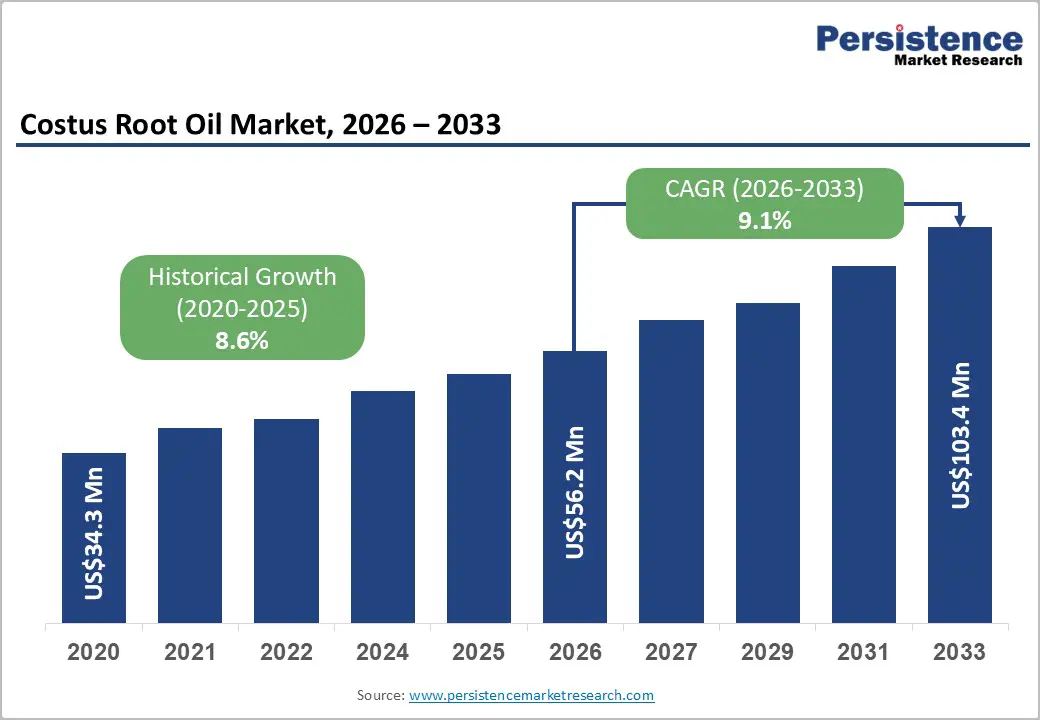
The global costus root oil market size is likely to be valued at US$56.2 million in 2026 and is estimated to reach US$103.4 million by 2033, growing at a CAGR of 9.1% during the forecast period from 2026 to 2033, driven by increasing integration across aromatherapy systems, expansion of botanical extraction infrastructure, rising preference for plant-derived therapeutic oils, and regulatory alignment supporting standardized essential oil usage in wellness and cosmetic formulations.
Growth momentum is shaped by demographic shifts toward preventive wellness consumption, particularly among urban populations adopting natural wellness routines. Regulatory frameworks in herbal medicine and fragrance safety standards strengthen product acceptance across cosmetic and food applications. Technology adoption in CO2 extraction and vacuum distillation improves yield efficiency and purity consistency.
Key Industry Highlights:
- Leading Grade Type: Cosmetic-grade is set to hold around 47% revenue share in 2026, driven by premium fragrance and clean-label personal care formulator demand for verified botanical purity.
- Fastest-growing Grade Type: Food-grade is projected as the fastest-growing segment, supported by expansion in natural flavor applications within artisanal confectionery and specialty beverage formulations.
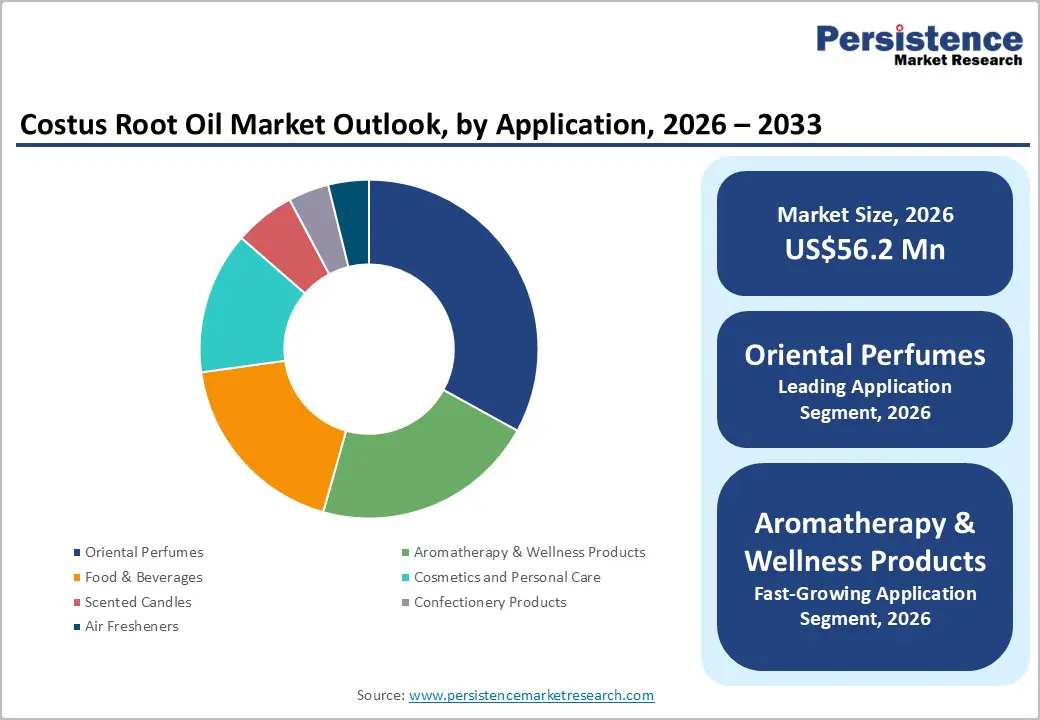
- Leading Application: Oriental perfumes are estimated to hold roughly 34% revenue share in 2026, due to deep-rooted demand for costus root oil as a fixative and depth contributor in luxury fragrance composition across GCC and Asian markets.
- Fastest-growing Application: Aromatherapy & wellness products are forecast to record the fastest growth, driven by global wellness economy expansion and rising demand for therapeutic botanical aromatic formulations.
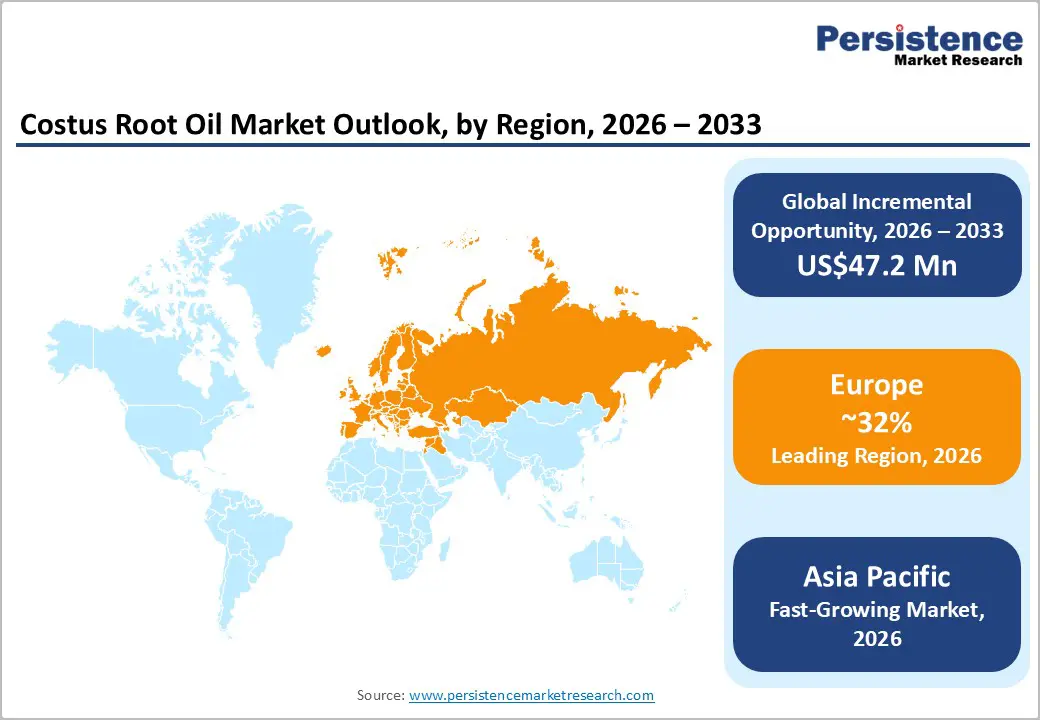
- Regional Leadership: Europe is projected to capture around 32% market share by 2026, while Asia Pacific is forecast to record the fastest growth due to production expansion.
- Competitive Environment: The market reflects a moderately fragmented structure, with key players such as Givaudan and Symrise leveraging supply chain integration, extraction technology, and certified natural sourcing networks to sustain competitive positioning.
DRO Analysis
Driver - Escalating Global Demand for Botanical Ingredients in Luxury Perfumery
Modern consumers increasingly seek authentic, premium olfactory profiles, prompting major fragrance formulation entities to pivot toward rare natural fixatives. The unique animalic, woody notes characteristic of the root derivative provide irreplaceable base-note permanence that synthetic substitutes fail to replicate effectively. This structural preference within high-end personal care formulation drives substantial volume procurement across specialized supply chains.
According to data published by the International Fragrance Association (IFRA), strict safe-use thresholds dictate chemical composition boundaries, forcing cosmetic chemists to optimize natural botanical inputs. Industrial demand for persistent fixatives accelerates processing facility expansions in primary growing regions. The systematic alignment of luxury consumer demand with authentic ingredient profiles ensures consistent capital allocation toward raw feedstock extraction.
Restraint - Severe International Trade Restrictions and Environmental Protection Mandates
The primary biological source plant, Saussurea lappa, faces critical survival threats in wild habitats, leading to rigid international regulatory oversight. The species is listed explicitly under Appendix I of the Convention on International Trade in Endangered Species of Wild Fauna and Flora (CITES). This regulatory classification effectively bans the cross-border commercial movement of wild-harvested plant matter, imposing complex certification pathways for cultivated variants.
Compliance with national enforcement mechanisms, such as the Kuth Act in specific regional jurisdictions, lengthens supply chains and inflates administrative outlays. Export documentation delays cause systemic unpredictability for global formulation entities, discouraging long-term procurement contracts. The resulting compliance pressures restrict raw material flow to processing facilities, severely compromising processing capacity scalability.
Opportunity - Integration into Certified Organic and Clean Beauty Product Formulations
The certified organic personal care and cosmetics segment presents a high-value growth pathway for costus root oil as a botanical active and fragrance component. Global organic cosmetic sales have been growing in double digits, and Ecocert- and COSMOS-certified raw materials command significant price premiums over conventional equivalents.
Brands across Europe and North America are proactively reformulating product lines to meet the European Commission's evolving restrictions under the EU Cosmetics Regulation, which is progressively tightening permitted concentration limits for synthetic musks. This regulatory direction is creating a structural substitution opportunity for naturally sourced woody base notes.
Category-wise Analysis
Grade Type Insights
Cosmetic-grade is anticipated to secure around 47% of the costus root oil market share in 2026, reflecting strong demand from premium perfumery and personal care formulators seeking botanical ingredients with verified purity and low contaminant profiles. Brands such as L'Occitane en Provence utilize cosmetic-grade botanical extracts to substantiate clean-label claims, increasing procurement of certified natural oils.
Food-grade is expected to be the fastest-growing segment, propelled by increasing utilization of costus root oil as a natural flavoring and aroma compound in confectionery, baked goods, and specialty beverage applications. The U.S. FDA GRAS (Generally Recognized as Safe) designation eligibility for botanical extractives is accelerating their adoption in clean-label food formulation, particularly in artisanal and premium confectionery lines seeking differentiated aromatic complexity.
Processing Method Insights
Steam distillation processes are poised to dominate with a forecast market share of over 52% in 2026, powered by established infrastructure, cost-effective operation, and broad compatibility with existing botanical oil production facilities across South and Southeast Asia. Processors such as Aromaaz International and SVA Organics have deployed large-scale steam distillation units specifically configured for costus root processing, yielding commercially consistent aromatic profiles that meet international fragrance grade standards.
CO2 extraction is estimated to be the fastest-growing segment, fueled by demand for superior purity and preservation of delicate compounds preferred in premium wellness and cosmetic products. Advanced systems minimize thermal degradation compared to conventional techniques. A specialized extractor in India commissioned new capacity in early 2026 to serve European clients seeking traceable, high-aroma profiles. Policy alignment with green chemistry principles accelerates investment in this technology.
Application Insights
Oriental perfumes are likely to be the leading segment with a projected 34% in 2026 due to the deep-rooted cultural tradition of woody, resinous, and animalic fragrance composition across the Middle Eastern, South Asian, and East Asian luxury perfumery markets. Houses such as Amouage and Arabian Oud specify costus root oil as a structural fixative and depth contributor in signature compositions.
Aromatherapy & wellness products are anticipated to be the fastest-growing segment, fueled by increasing consumer spending on natural stress-relief and holistic mental wellness products. Specialized wellness centers utilize custom botanical oil blends within targeted inhalation therapies to leverage natural grounding characteristics.
Regional Insights
North America Costus Root Oil Market Trends
North America is expected to account for an estimated 21% global market share in 2026, supported by rising demand for botanical aromatics in wellness and premium personal care formulations. Regulatory preference for clean-label cosmetic ingredients strengthens substitution away from synthetic fragrance compounds.
U.S. Costus Root Oil Market Insights
The U.S. is projected to dominate, holding around 82% of the regional market share in 2026, driven by strong penetration of natural personal care products and aromatherapy applications. Cosmetic manufacturers increasingly integrate plant-derived oils into fragrance systems.
Canada Costus Root Oil Market Insights
Canada is expected to account for approximately 18% of the regional market share in 2026, supported by rising demand for natural health products and herbal wellness formulations. Regulatory frameworks under natural health product classification strengthen compliance-driven adoption. Expansion of wellness retail infrastructure enhances product accessibility across urban centers.
Europe Costus Root Oil Market Trends
Europe is expected to lead with an estimated 32% regional market share in 2026, supported by strict chemical safety regulations and a high substitution rate toward botanical fragrance ingredients. Registration, Evaluation, Authorisation, and Restriction of Chemicals (REACH) compliance requirements accelerate the adoption of plant-derived oils in cosmetics and perfumery sectors. Advanced fragrance manufacturing infrastructure reinforces consistent industrial demand.
France Costus Root Oil Market Insights
France is expected to account for approximately 23% of the regional market share in 2026, supported by dominance in luxury perfumery and fragrance innovation. Demand for natural aromatic compounds increases the integration of botanical oils in premium product lines. Regulatory alignment with clean fragrance standards further supports adoption.
Germany Costus Root Oil Market Insights
Germany is projected to hold around 11% of the regional market share in 2026, driven by strong cosmetic manufacturing capabilities and high adoption of certified natural ingredients. Pharmaceutical and personal care sectors integrate botanical oils into formulation systems. Export-oriented production strengthens the procurement of high-quality essential oils.
Asia Pacific Costus Root Oil Market Trends
Asia Pacific is forecast to be the fastest-growing market, stimulated by the presence of native cultivation zones and expanding processing infrastructure. Increasing disposable incomes across developing nations expand the regional consumer base for premium traditional personal care items.
India Costus Root Oil Market Insights
India is projected to account for approximately 22% of the regional market share in 2026, supported by Ayurveda industry expansion and structured herbal cultivation initiatives. Processing clusters and export-oriented essential oil manufacturing strengthen production scalability. Rising domestic wellness consumption further supports demand expansion.
China Costus Root Oil Market Insights
China is expected to hold around 14% of the regional market share in 2026, driven by the integration of traditional medicine systems and large-scale cosmetic manufacturing. Advanced extraction infrastructure supports industrial efficiency and export competitiveness. Increasing demand for natural fragrance ingredients reinforces steady growth.
Competitive Landscape
The global costus root oil market is moderately fragmented, characterized by a combination of large multinational flavor and fragrance conglomerates and specialized independent essential oil producers. Companies including Givaudan, Symrise, Biolandes, Albert Vieille, and Rocky Mountain Oils maintain competitive positioning through supply chain integration, proprietary extraction technology, and established trade relationships with certified cultivation networks in key sourcing regions.
Raw material supply concentration in geographically restricted cultivation zones creates structural supply chain dependencies that limit the ability of new entrants to scale rapidly. Established market participants benefit from long-term cultivation partnership agreements and CITES-compliant procurement documentation systems, creating meaningful barriers to entry that reinforce the incumbency advantage of existing players with verified supply access and regulatory compliance infrastructure.
Companies Covered in Costus Root Oil Market
- Givaudan SA
- Symrise AG
- International Flavors & Fragrances Inc. (IFF)
- Biolandes
- Albert Vieille SAS
- Rocky Mountain Oils
- Plant Therapy
- AOS Products Pvt. Ltd.
- Essentially Natural
- SVA Organics
- Aromaaz International
- Eden Botanicals
- Hermitage Oils
- Quinessence Aromatherapy
- The Good Scents Company
Frequently Asked Questions
The global costus root oil market is projected to reach US$56.2 million in 2026.
The rising demand for natural aromatic ingredients in cosmetics and wellness products, regulatory restrictions on synthetic fragrances, and expansion of aromatherapy applications drive the costus root oil market.
The costus root oil market is poised to witness a CAGR of 9.1% from 2026 to 2033.
Expansion of certified organic essential oil production, adoption of advanced extraction technologies, and growing integration in premium cosmetic and aromatherapy formulations create key market opportunities for costus root oil.
Some of the key market players include Givaudan, Symrise, Biolandes, Albert Vieille, and Rocky Mountain Oils.


