




- Pharmaceuticals
- Brain Disease Market
Brain Disease Market Size, Share, and Growth Forecast, 2026 – 2033
Brain Disease Market by Disease Type (Alzheimer's Disease, Parkinson's Disease, Huntington's Disease, Others), Treatment Type (Medications/Drug Therapy, Others, End-user (Hospitals, Clinics, Research Institutes, Others), and Regional Analysis for 2026 - 2033

Brain Disease Market Size and Trends Analysis
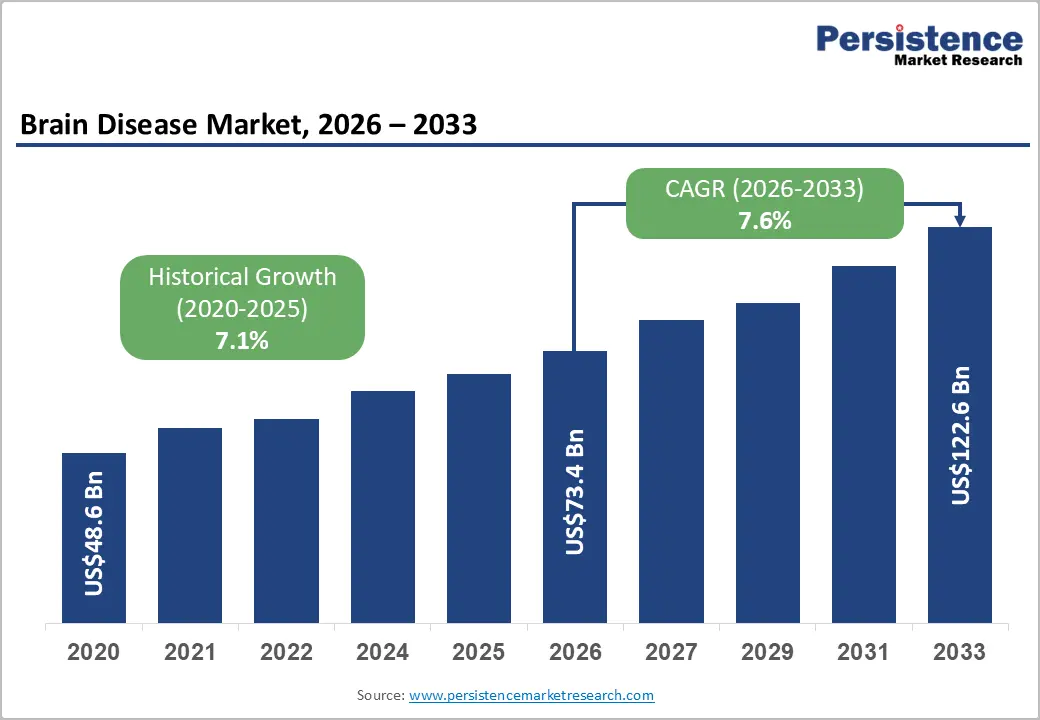
The global brain disease market size is likely to be valued at US$73.4 billion in 2026 and is estimated to reach US$122.6 billion by 2033, growing at a CAGR of 7.6% during the forecast period from 2026 to 2033, driven by increasing neurological disorder prevalence, expanding treatment accessibility, and accelerating innovation in diagnostics and therapeutics. Market growth is supported by aging populations that increase the incidence of neurodegenerative conditions and chronic neurological disorders. Regulatory agencies continue to encourage the development of innovative therapies through accelerated review pathways and orphan drug incentives. Adoption of artificial intelligence-assisted diagnostics, precision medicine, neurological devices, and advanced imaging technologies is improving disease identification and treatment outcomes.
Key Industry Highlights:
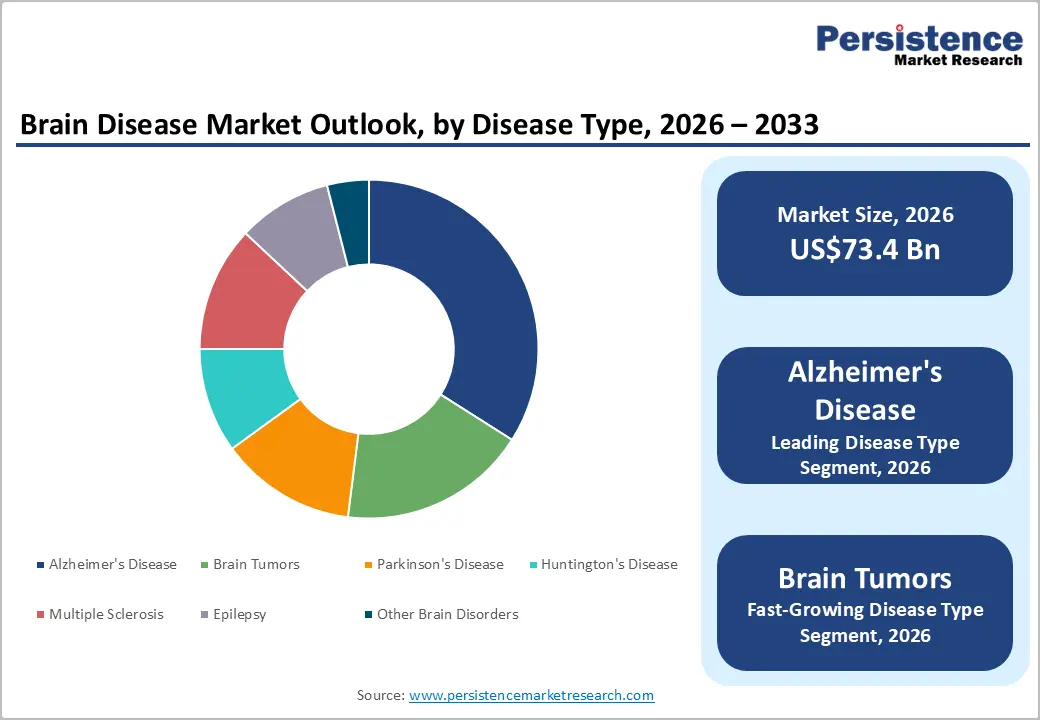
- Leading Disease Type: Alzheimer's disease is set to hold around 34% revenue share in 2026, driven by FDA-approved disease-modifying therapies and expanding Medicare reimbursement coverage.
- Fastest-growing Disease Type: Brain tumors are projected as the fastest-growing segment, supported by accelerating immunotherapy and tumor-treating field’s adoption across neuro-oncology centers.
- Leading Treatment Type: Medications and drug therapy are estimated to hold roughly 42% revenue share in 2026, due to the broad commercial portfolio of approved CNS pharmaceutical agents across neurodegenerative and inflammatory brain disease indications.
- Fastest-growing Treatment Type: Gene therapy is forecast to record the fastest growth, driven by advancing clinical programs in Huntington's disease and rare pediatric neurological disorders with orphan drug designation support.
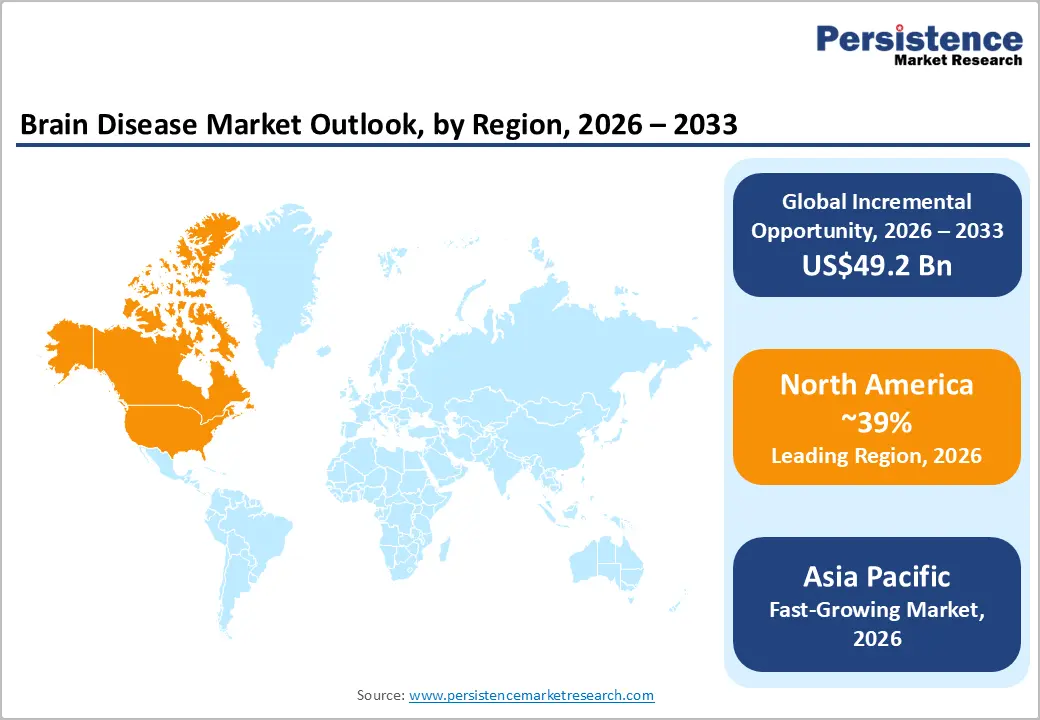
- Regional Leadership: North America is projected to capture approximately 39% of the brain disease market share in 2026, while Asia Pacific is forecast to record the fastest regional growth due to aging demographics and expanding public health insurance coverage for neurological conditions.
- Competitive Environment: The market reflects a moderately fragmented structure, with key players such as Biogen, Eli Lilly, and Roche leveraging deep CNS pipelines, established regulatory relationships, and global commercial infrastructure to maintain competitive positioning.
DRO Analysis
Driver - Rising Burden of Neurological Disorders and Aging Populations
The increasing prevalence of neurological disorders is creating sustained demand for diagnostic, therapeutic, and rehabilitation solutions. Population aging contributes directly to higher incidence rates of Alzheimer's disease, Parkinson's disease, and other neurodegenerative conditions. Longer life expectancy increases the duration of care requirements, resulting in greater utilization of hospitals, clinics, neurological devices, and long-term treatment programs. Healthcare systems are expanding specialized neurological services to accommodate growing patient volumes.
According to the National Institute on Aging, nearly 7.1 million people in the U.S. were living with Alzheimer's disease in 2025. Growing patient populations are encouraging pharmaceutical companies, device manufacturers, and healthcare providers to expand neurological treatment portfolios. Investment in disease-modifying therapies, cognitive assessment technologies, and neuroimaging platforms is increasing as healthcare providers seek earlier intervention strategies and improved disease management outcomes.
Restraint - High Treatment Costs and Reimbursement Challenges
Advanced neurological therapies, gene-based treatments, and specialized surgical interventions involve substantial development and delivery costs. Healthcare providers frequently face reimbursement limitations that restrict patient access to innovative treatments. Financial pressure can reduce adoption rates, particularly in resource-constrained healthcare systems where budget allocation remains focused on broader public health priorities.
Long treatment durations and extensive monitoring requirements increase operational expenditures for healthcare institutions. Cost-intensive care pathways may reduce scalability for emerging treatment platforms. Manufacturers face margin pressure when attempting to balance affordability, reimbursement requirements, and continued investment in research and development activities.
Opportunity - Expansion of Precision Medicine and Biomarker-Based Therapies
Precision medicine is creating opportunities to improve treatment outcomes through patient-specific therapeutic approaches. Biomarker-driven diagnosis enables the identification of disease subtypes and supports targeted intervention strategies. Pharmaceutical developers can leverage biomarker insights to enhance clinical trial efficiency, improve treatment effectiveness, and expand commercialization opportunities across multiple neurological disease categories.
Regulatory support for innovative therapies is accelerating development pathways for personalized neurological treatments. Companies investing in genomic analysis, digital biomarkers, and companion diagnostics can establish differentiated treatment ecosystems. Integration of precision medicine approaches with advanced diagnostic technologies creates opportunities for broader healthcare adoption and long-term value creation.
Category-wise Analysis
Disease Type Insights
Alzheimer's disease is anticipated to secure around 34% of the brain disease market share in 2026, reflecting its position as the most prevalent and costly neurodegenerative condition globally. Biogen's lecanemab (Leqembi), approved by the FDA and reimbursed under Medicare, has catalyzed renewed commercial activity. Demand is reinforced by large patient populations in aging economies and sustained pipeline investment from major pharmaceutical companies.
Brain tumors are expected to be the fastest-growing segment, propelled by advances in surgical neuro-oncology, immunotherapy combinations, and radiotherapy precision. Novocure's tumor treating fields (TTFields) therapy for glioblastoma, now deployed across major oncology centers, illustrates clinical uptake. Increasing incidence rates and expanding clinical trial activity in glioma subtype targeting are compounding growth velocity in this disease area.
Treatment Type Insights
The medications/drug therapy segment is poised to dominate with a forecast market share of over 42% of the brain disease market in 2026, powered by high patient compliance rates, standardized clinical guidelines, and widespread oral and intravenous product availability. Pharmaceutical interventions form the baseline of primary care management across acute and chronic neurological conditions.
Gene therapy is estimated to be the fastest-growing segment, fueled by accelerating clinical-stage progress in Huntington's disease and spinocerebellar ataxia. Spark Therapeutics and Neurogene have advanced CNS-targeted gene therapy programs that are drawing substantial investment. Regulatory incentives, including FDA Rare Pediatric Disease designations for certain childhood neurological conditions, are improving the commercial pathway for gene-based interventions.
End-user Insights
Hospitals are likely to be the leading segment with a projected 47% of the market share in 2026 due to their capacity to deliver multidisciplinary neurological care, including neurosurgery, advanced imaging, and inpatient rehabilitation. Mayo Clinic's dedicated neuroscience programs and comparable centers at Johns Hopkins Medicine represent the scale of hospital-based neurological care delivery that anchors this segment.
Home care settings are anticipated to be the fastest-growing segment, fueled by the expansion of remote patient monitoring technologies, wearable neurological devices, and Centers for Medicare & Medicaid Services (CMS) reimbursement support for home-based neurological care. Adoption of biosensor-enabled wearables for Parkinson's tremor monitoring in outpatient settings illustrates the shift of care delivery from institutional to home environments.
Regional Insights
North America Brain Disease Market Trends
North America is expected to lead with an estimated 39% of the global market share in 2026, supported by advanced neurological care infrastructure, strong neuroscience research funding, and widespread adoption of innovative therapeutics. High diagnosis rates and established reimbursement systems support treatment accessibility. Expansion of biomarker-based diagnostics and disease-modifying therapies continues to strengthen clinical adoption.
U.S. Brain Disease Market Insights
The U.S. is projected to account for approximately 82% of the North America market in 2026, supported by extensive neuroscience research activity, advanced healthcare infrastructure, and strong commercialization of neurological therapies. National research funding programs continue to accelerate innovation in Alzheimer's disease, Parkinson's disease, and other neurological disorders.
Canada Brain Disease Market Insights
Canada is expected to represent nearly 18% of the North America market in 2026, driven by healthcare modernization initiatives and expanding neurological care services. Public healthcare programs continue to improve access to diagnostics, rehabilitation, and long-term neurological care. Increasing adoption of tele-neurology solutions is enhancing patient access across geographically dispersed populations.
Europe Brain Disease Market Trends
Europe is expected to account for approximately 28% of the brain disease market share in 2026, supported by aging demographics, increasing neurological disease awareness, and sustained healthcare investment. Government-backed neuroscience programs are encouraging therapeutic innovation and clinical research. Expansion of specialized neurology centers is improving treatment accessibility.
Germany Brain Disease Market Insights
Germany is projected to contribute around 24% of the Europe market in 2026, supported by advanced healthcare infrastructure and strong adoption of neurological diagnostic technologies. Research institutions and pharmaceutical companies continue to collaborate on neurodegenerative disease programs. Investment in digital health platforms is improving patient monitoring and disease management.
U.K. Brain Disease Market Insights
The U.K. is forecast to hold approximately 19% of the Europe market in 2026, driven by the increasing prevalence of neurological disorders and strong healthcare support programs. Early diagnosis initiatives are encouraging timely treatment intervention. Adoption of artificial intelligence-assisted diagnostic tools is improving clinical efficiency.
Asia Pacific Brain Disease Market Trends
Asia Pacific is forecast to be the fastest-growing market for brain disease, stimulated by expanding healthcare infrastructure, rising healthcare expenditure, and increasing awareness of neurological disorders. Large patient populations continue to generate substantial demand for diagnosis and treatment services. Government investments in advanced medical facilities and neuroscience research are strengthening healthcare capabilities.
China Brain Disease Market Insights
China is expected to account for approximately 36% of the Asia Pacific market in 2026, supported by rapid healthcare infrastructure development and increasing biotechnology investments. Government initiatives focused on neurological disease management are improving healthcare accessibility. Expansion of neuroscience research centers is strengthening clinical development activities.
Japan Brain Disease Market Insights
Japan is projected to represent nearly 21% of the Asia Pacific market in 2026, driven by a large aging population and a strong focus on neurodegenerative disease management. Healthcare providers continue to adopt advanced neurological diagnostics and precision medicine approaches. Pharmaceutical companies are increasing investment in innovative therapies targeting Alzheimer's disease and Parkinson's disease.
Competitive Landscape
The global brain disease market is moderately fragmented, with a mix of large multinational biopharmaceutical corporations and specialized CNS-focused companies competing across therapeutic indication, geography, and treatment modality. Biogen, Eli Lilly, Roche, AbbVie, and Johnson and Johnson hold leading positions through diversified neurological portfolios, established payer relationships, and global distribution networks. No single company commands a dominant market share across all brain disease indications, creating sustained competitive pressure and ongoing pipeline differentiation activity.
Competitive intensity is shaped by the high regulatory bar for CNS drug approval, the complexity of clinical trial design in neurodegenerative disease, and the strategic value of securing Breakthrough Therapy or Orphan Drug designations. Mid-tier specialty companies are capturing share in specific indication areas, particularly gene therapy and rare neurological disorders, where pipeline differentiation yields commercial pricing power and market exclusivity advantages.
Key Industry Developments:
- In May 2026, Eli Lilly and Company launched Lormalzi (donanemab) in India as the first approved amyloid-targeting therapy for early-stage Alzheimer's disease, reinforcing advancement in disease-modifying treatment options for neurodegenerative brain disorders.
- In August 2025, Biogen Inc. and Eisai Co., Ltd. received U.S. FDA approval for LEQEMBI IQLIK subcutaneous maintenance dosing for early Alzheimer's disease, reinforcing expanded access to at-home treatment options for neurodegenerative brain disorders.
Companies Covered in Brain Disease Market
- Biogen Inc.
- Eli Lilly and Company
- Roche Holding AG
- AbbVie Inc.
- Johnson and Johnson
- Novartis AG
- Takeda Pharmaceutical Company Limited
- UCB S.A.
- Eisai Co., Ltd.
- Pfizer Inc.
- AstraZeneca PLC
- Bristol Myers Squibb Company
- Sanofi S.A.
- Alexion Pharmaceuticals (AstraZeneca)
- Neurocrine Biosciences Inc.
Frequently Asked Questions
The global brain disease market is projected to reach US$73.4 billion in 2026.
The brain disease market is driven by rising prevalence of neurological disorders, aging populations, advancements in neurodiagnostics and therapeutics, and increasing investment in neuroscience research.
The brain disease market is poised to witness a CAGR of 7.6% from 2026 to 2033.
Key market opportunities include expansion of precision medicine, gene therapies, biomarker-based diagnostics, digital neurology platforms, and home-based neurological care solutions.
Some of the key market players include Biogen, Eli Lilly, Roche, AbbVie, and Johnson and Johnson.


