




- Industrial Goods & Service
- ABS Filament 3D Printing Material Market
ABS Filament 3D Printing Material Market Size, Share, and Growth Forecast, 2026 - 2033
ABS Filament 3D Printing Material Market by Product Type (Standard ABS Filament, High-performance ABS Variants, Others), Application (Prototyping, Functional Parts, Others), End-use Industry, and Regional Analysis for 2026 - 2033

ABS Filament 3D Printing Material Market Size and Trends Analysis
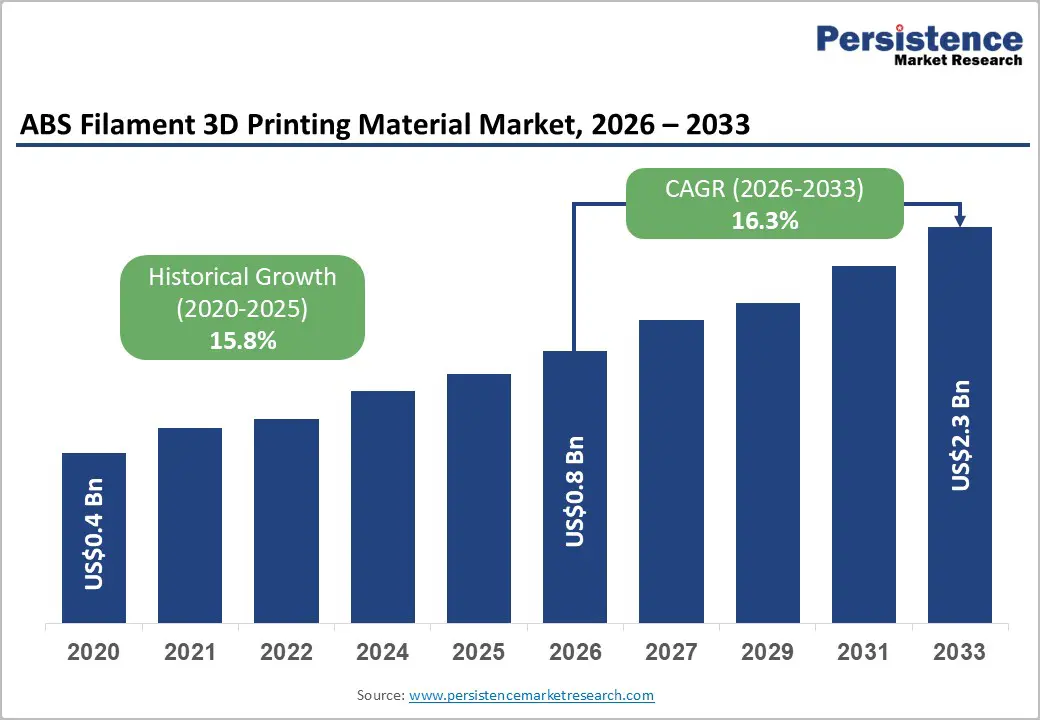
The global ABS filament 3D printing material market size is likely to be valued at US$0.8 billion in 2026 and is expected to reach US$2.3 billion by 2033, growing at a CAGR of 16.3% between 2026 and 2033, driven by increasing adoption of additive manufacturing across automotive, consumer electronics, industrial manufacturing, and education sectors.
ABS filament remains one of the most widely used thermoplastics in fused deposition modeling (FDM) printing owing to its durability, thermal resistance, machinability, and cost-efficiency. Growth is supported by rising investments in rapid prototyping, localized manufacturing, and industrial-grade 3D printing systems.
Key Industry Highlights:
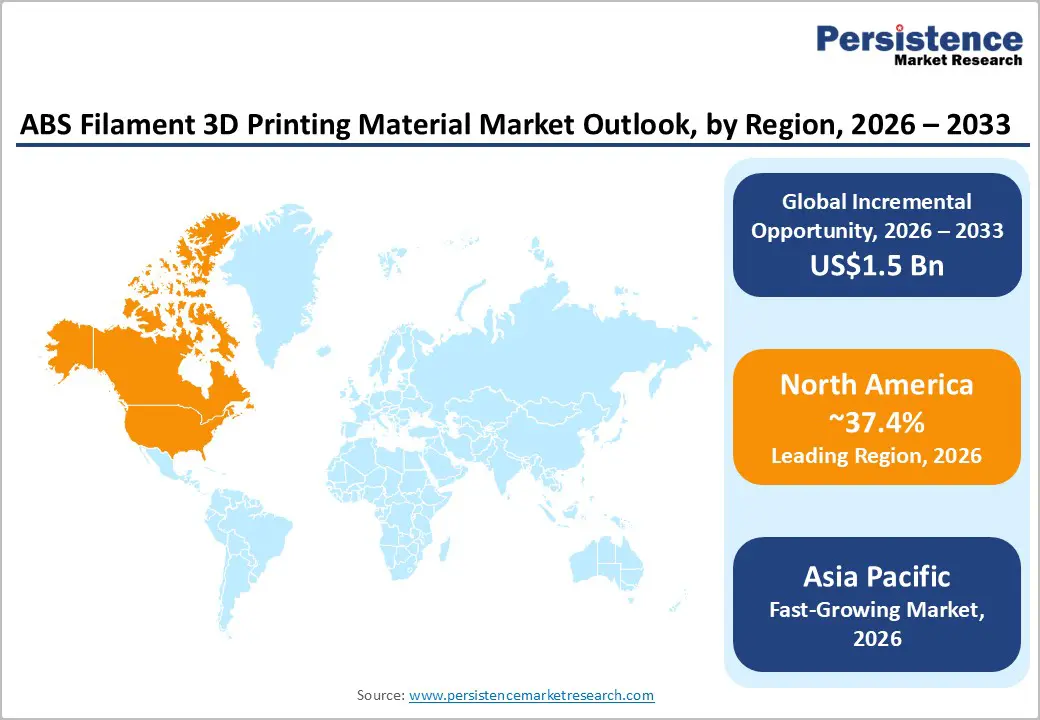
- Leading Region: North America is projected to lead the market with an anticipated 37.4% market share in 2026, supported by advanced additive manufacturing infrastructure, aerospace innovation, and strong industrial adoption across the U.S. and Canada.
- Fastest-growing Region: Asia Pacific is projected to be the fastest-growing regional market during the forecast period, driven by expanding electronics manufacturing, industrial automation investments, and cost-competitive filament production across China, India, Japan, and ASEAN countries.
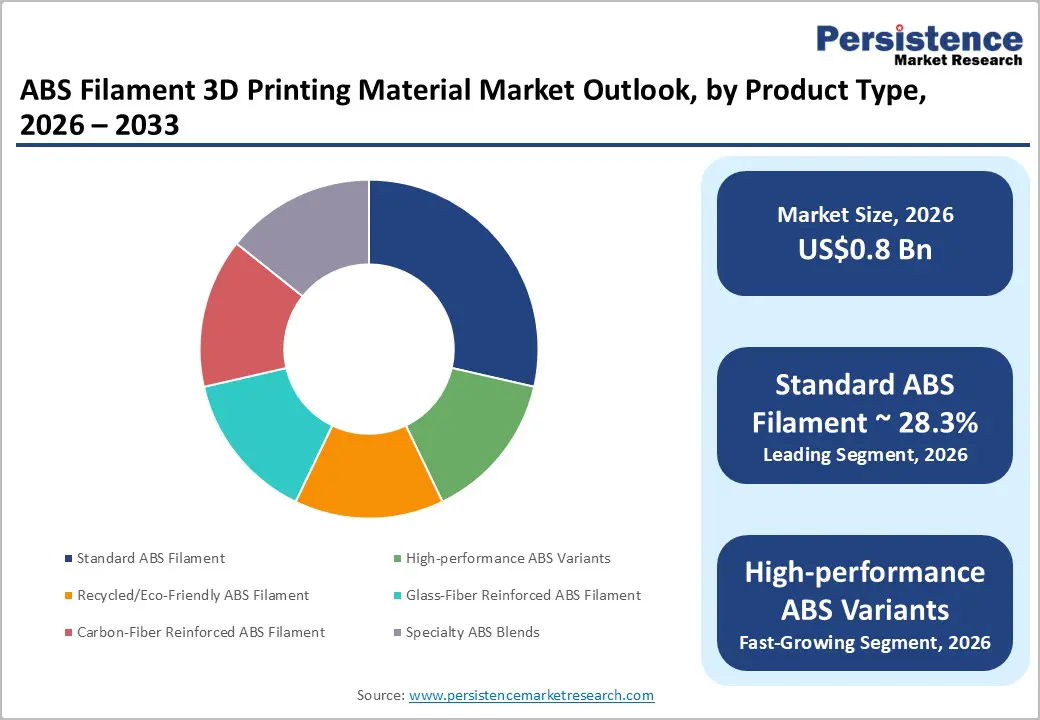
- Dominant Product Type: Standard ABS filament is anticipated to dominate with approximately 28.3% market share in 2026, supported by broad usage in prototyping, tooling, and educational 3D printing applications.
- Leading Application: Prototyping is expected to lead nearly 29.1% of market share in 2026, driven by rising adoption of rapid product development workflows across automotive, electronics, and industrial manufacturing sectors.
DRO Analysis
Driver - Rising Industrial Adoption of Additive Manufacturing across Automotive and Manufacturing Sectors
The increasing deployment of additive manufacturing technologies in industrial production environments is a major driver for the ABS filament 3D printing material market. According to data from the International Organization for Standardization and manufacturing assessments published by World Economic Forum, industries are accelerating the use of additive manufacturing to reduce prototyping cycles, improve supply chain flexibility, and lower tooling expenses. ABS filament is particularly preferred for functional prototyping because of its impact resistance, dimensional stability, and post-processing compatibility.
Automotive manufacturers increasingly use ABS-based filaments for dashboard prototypes, housing components, brackets, and assembly fixtures. The ability to reduce prototype lead times from several weeks to a few days significantly improves product development efficiency. Industrial manufacturers are also integrating FDM systems into decentralized production operations to support low-volume customized manufacturing.
Expansion of Consumer Electronics and Desktop 3D Printing Ecosystems
The rapid expansion of desktop 3D printing infrastructure and consumer electronics manufacturing is creating sustained demand for ABS filament materials. According to assessments from International Data Corporation and OECD, growing accessibility of low-cost FDM printers has accelerated adoption among educational institutions, startups, hobbyists, and small-scale manufacturing facilities.
ABS filament is widely utilized in consumer electronics because of its heat resistance and mechanical durability, particularly for casings, enclosures, and structural components. Educational institutions increasingly integrate 3D printing into engineering and STEM programs, creating recurring demand for economical and durable filament materials. Simultaneously, the maker movement and personalized product manufacturing trend continue to support retail filament consumption.
Restraint - Emission Concerns, Warping Challenges, and Material Processing Limitations
Despite strong commercial adoption, ABS filament faces operational and environmental limitations that restrain broader market penetration. During the printing process, ABS emits volatile organic compounds (VOCs) and ultrafine particles, prompting regulatory scrutiny from occupational safety agencies and environmental authorities, including U.S. Environmental Protection Agency and the European Chemicals Agency. These concerns increase compliance costs for industrial users operating enclosed printing facilities.
ABS filament also presents technical challenges, including shrinkage, warping, and cracking during printing, particularly in open-frame printer systems without heated chambers. These processing constraints increase material wastage and reduce print reliability for inexperienced users. Competition from alternative materials such as PLA, PETG, and nylon composites also affects market growth in entry-level applications. Manufacturers must therefore invest in advanced formulations, improved print stability, and low-emission variants to maintain competitiveness in regulated industrial environments.
Opportunity - Development of High-Performance and Reinforced ABS Composite Filaments
The emergence of reinforced and engineering-grade ABS materials represents a major growth opportunity for filament manufacturers. Carbon-fiber reinforced ABS and glass-fiber reinforced ABS are increasingly utilized in aerospace, automotive, and industrial tooling applications requiring superior mechanical strength and thermal performance. According to engineering material studies published by American Society for Testing and Materials, reinforced thermoplastic composites improve structural rigidity while maintaining lightweight characteristics.
Industrial customers increasingly demand materials capable of replacing conventionally manufactured components in low-volume production runs. This trend is encouraging manufacturers to expand advanced ABS product portfolios optimized for functional parts and end-use applications. Enhanced flame resistance, dimensional stability, and chemical resistance are becoming critical product differentiators. The opportunity is particularly significant because industrial-grade composite filaments command higher profit margins and strengthen long-term supplier relationships with manufacturing enterprises.
Growing Demand for Sustainable and Recycled Filament Materials
Sustainability initiatives across manufacturing industries are creating strong opportunities for recycled and eco-friendly ABS filament products. Environmental policies encouraging circular economy adoption are influencing purchasing decisions among industrial buyers and educational institutions. Organizations such as United Nations Environment Programme and European Commission continue promoting waste reduction frameworks and sustainable plastics management.
Manufacturers are responding by introducing recycled ABS formulations produced from industrial plastic waste streams and reclaimed printing materials. Closed-loop recycling systems for failed prints and discarded filament spools are also gaining commercial traction. Sustainable filament branding provides competitive advantages in Europe and North America, where procurement decisions increasingly incorporate environmental compliance criteria. The integration of recycled content into engineering-grade filaments enables producers to balance sustainability targets with material performance requirements, supporting long-term market differentiation and regulatory alignment.
Category-wise Analysis
Product Type Insights
Standard ABS filament is anticipated to account for approximately 28.3% of the market share in 2026, supported by its widespread use in general-purpose prototyping and functional printing applications. The material remains highly preferred because of its affordability, impact resistance, machinability, and compatibility with most FDM printers. Automotive and industrial manufacturers frequently use standard ABS for dashboard prototypes, assembly fixtures, and concept models, while educational institutions rely on it for engineering training and product design projects.
Its dominance is further strengthened by established supply chains and broad availability across industrial and retail channels. Manufacturers continue improving print consistency, spool quality, and color customization to support broader adoption. For example, desktop printing brands such as Ultimaker and Prusa Research widely support standard ABS materials for professional and educational applications.
High-performance ABS variants are projected to be the fastest-growing product segment, driven by rising demand for heat-resistant and reinforced components in industrial manufacturing. These advanced filaments integrate carbon fiber, glass fiber, and specialty additives to improve thermal stability, strength, and dimensional accuracy. Aerospace and automotive companies increasingly use these materials for lightweight tooling, durable housings, and engineering-grade prototypes.
The transition from prototyping toward low-volume production is accelerating segment growth. Carbon-fiber reinforced ABS is increasingly adopted in industrial FDM systems for applications requiring higher structural performance and reduced material warping. For instance, BASF and Polymaker have expanded their engineering-grade filament portfolios to address growing industrial demand for stronger and more reliable additive manufacturing materials.
Application Analysis
Prototyping is anticipated to hold nearly 29.1% of the market share in 2026, driven by strong demand for rapid product development across automotive, electronics, and industrial manufacturing sectors. ABS filament is extensively used for fit, form, and functional prototypes because of its durability, heat resistance, and post-processing flexibility.
Automotive manufacturers commonly produce dashboard models, mounting brackets, and ergonomic validation parts using ABS-based FDM printing systems. The segment benefits from increasing adoption of in-house additive manufacturing to reduce outsourcing costs and accelerate design iterations. Engineering institutions and startups also contribute significantly to demand through desktop 3D printing adoption.
Functional parts are expected to witness the fastest growth during the forecast period as industries increasingly adopt additive manufacturing for end-use production. ABS filament is being used to manufacture customized housings, jigs, fixtures, replacement components, and lightweight brackets capable of operating under industrial conditions. The trend is particularly strong in automotive maintenance, factory tooling, and low-volume manufacturing environments.
Improved filament formulations with enhanced mechanical strength and thermal resistance are expanding commercial adoption. Manufacturers are integrating 3D printing into distributed production models to reduce inventory costs and improve operational flexibility. For example, electronics manufacturers increasingly use ABS-based printed enclosures and fit-check components for rapid assembly testing and short production runs.
Regional Insights
North America ABS Filament 3D Printing Material Market Trends
North America is anticipated to account for approximately 37.4% of the market share in 2026, supported by advanced additive manufacturing infrastructure, strong industrial automation adoption, and significant R&D investments. The region benefits from widespread deployment of FDM-based printing systems across aerospace, automotive, healthcare, and industrial manufacturing sectors.
U.S. ABS Filament 3D Printing Material Market Trends
The U.S. leads the North America market due to the strong presence of aerospace, automotive, and industrial manufacturing companies integrating additive manufacturing into digital production ecosystems. Organizations such as the National Institute of Standards and Technology support manufacturing modernization initiatives that encourage industrial 3D printing adoption.
Automotive and aerospace manufacturers increasingly utilize ABS-based materials for dashboard prototypes, testing fixtures, lightweight tooling, and customized engineering components. Environmental regulations established by the Occupational Safety and Health Administration and the U.S. Environmental Protection Agency are encouraging the development of low-emission and recyclable ABS filament products.
Canada ABS Filament 3D Printing Material Market Trends
Canada demonstrates stable market growth through investments in advanced manufacturing research, engineering education, and industrial automation technologies. Universities and technical institutions increasingly integrate additive manufacturing into STEM and engineering curricula, creating consistent demand for ABS filament materials. Canadian industrial manufacturers are also expanding the use of 3D printing for tooling, prototyping, and customized component production.
Government-supported innovation programs and collaborations between research institutions and manufacturing companies continue supporting the adoption of engineering-grade filament materials.
Europe ABS Filament 3D Printing Material Market Trends
Europe represents a technologically advanced and regulation-driven market for ABS filament 3D printing materials, supported by strong automotive manufacturing, industrial automation, and sustainability initiatives. The region benefits from widespread Industry 4.0 adoption and increasing demand for engineering-grade thermoplastics across aerospace, healthcare, and electronics industries.
Germany ABS Filament 3D Printing Material Market Trends
Germany leads the European market due to its strong automotive and industrial manufacturing base. German manufacturers increasingly integrate additive manufacturing into product development, tooling, and smart factory operations. Automotive companies widely use ABS filament for prototype validation, lightweight tooling, and assembly fixtures.
The country’s emphasis on Industry 4.0 and precision engineering continues driving demand for reinforced ABS composites and high-performance filament materials. German industrial firms are also investing in automated additive manufacturing workflows integrated with digital production systems.
U.K. ABS Filament 3D Printing Material Market Trends
The U.K. demonstrates growing adoption of ABS filament materials across aerospace engineering, defense manufacturing, and university research environments. Aerospace companies increasingly utilize reinforced ABS materials for lightweight tooling and prototype applications, while educational institutions continue expanding additive manufacturing laboratories.
The U.K. market also benefits from increasing startup activity and investments in advanced manufacturing technologies supporting rapid prototyping and small-scale production.
Asia Pacific ABS Filament 3D Printing Material Market Trends
Asia Pacific is anticipated to be the fastest-growing regional market for ABS filament 3D printing materials, driven by large-scale manufacturing activity, expanding electronics production, and rising industrial automation investments. The region benefits from strong supply chain integration, lower manufacturing costs, and increasing adoption of desktop and industrial 3D printing systems across automotive, electronics, and educational sectors.
China ABS Filament 3D Printing Material Market Trends
China dominates the Asia Pacific market due to its extensive electronics manufacturing industry and strong government support for industrial modernization. Chinese manufacturers increasingly integrate additive manufacturing into automotive, aerospace, and consumer electronics production workflows. Domestic filament producers are also expanding export capabilities through cost-efficient manufacturing and large-scale production capacity.
The country’s strong presence in electronics and smart device manufacturing significantly supports demand for ABS filament materials used in enclosures, prototypes, and fit-check components.
Japan ABS Filament 3D Printing Material Market Trends
Japan remains a key innovation hub for robotics, precision manufacturing, and industrial automation. Japanese companies increasingly use ABS filament for tooling, engineering prototypes, and customized industrial components. The country’s advanced manufacturing infrastructure and focus on high-performance materials continue supporting demand for reinforced ABS composites and specialty filament solutions.
Competitive Landscape
The global ABS filament 3D printing material market remains moderately fragmented, with global and regional manufacturers competing across industrial, educational, and consumer segments. Leading companies collectively account for a significant portion of market revenue through diversified product portfolios and established distribution networks. Major participants focus on material innovation, reinforced composites, and sustainable filament solutions to strengthen competitive positioning.
Leading companies prioritize material innovation, reinforced composite development, and sustainability-focused product differentiation. Strategic themes include expansion into industrial-grade applications, partnerships with printer manufacturers, and regional manufacturing investments. Companies increasingly focus on recyclable filament ecosystems, application-specific engineering materials, and certified production workflows to strengthen long-term customer retention.
Key Industry Developments:
- In March 2025, Stratasys Ltd. announced the launch of AIS™ Antero® 800NA and AIS™ Antero 840CN03 validated materials for its F900® platform, developed in collaboration with aerospace and defense companies including Boeing and Northrop Grumman, aiming to accelerate adoption of high-performance additive manufacturing materials in regulated industries.
- In July 2025, Stratasys Ltd. partnered with Shin-Etsu to commercially launch P3™ Silicone 25A, a high-performance 3D printing material designed for automotive, healthcare, consumer goods, and industrial applications, strengthening its industrial additive manufacturing materials portfolio.
Companies Covered in ABS Filament 3D Printing Material Market
- Stratasys Ltd.
- 3D Systems Corporation
- BASF
- Arkema
- SABIC
- Evonik Industries
- Covestro AG
- Materialise NV
- Ultimaker
- Prusa Research
- ColorFabb
- eSUN Industrial Co., Ltd.
- Polymaker
- Hatchbox
- Raise3D
- MatterHackers
Frequently Asked Questions
The global ABS filament 3D printing material market is anticipated to be valued at US$0.8 billion in 2026.
The ABS filament 3D printing material market is projected to reach approximately US$2.3 billion by 2033.
Key market trends include growing adoption of high-performance ABS composites, rising demand for recyclable and eco-friendly filament materials, expansion of functional end-use part production, and increasing integration of additive manufacturing into smart factory and Industry 4.0 environments.
Standard ABS filament is expected to remain the leading product type segment, accounting for nearly 28.3% of the market share in 2026, due to its affordability, durability, and broad compatibility with FDM 3D printing systems.
The ABS filament 3D printing material market is projected to grow at a CAGR of 16.3% between 2026 and 2033.
Major companies operating in the market include Stratasys Ltd., 3D Systems Corporation, BASF, SABIC, and Arkema.


