Yogurt and Probiotic Drink Market Size, Share, and Growth Forecast for 2025 - 2032

Market Study on Yogurt and Probiotic Drink: PMR Anticipates Multiple Opportunities for Yogurt and Probiotic Drink Manufacturers, Analysing the Rising Awareness of Digestive Health Benefits, and Growing Demand for Functional Foods

ID: PMRREP33775
Calendar

February 2025

158 Pages

Author : Amol Patil

Yogurt and Probiotic Drink Market

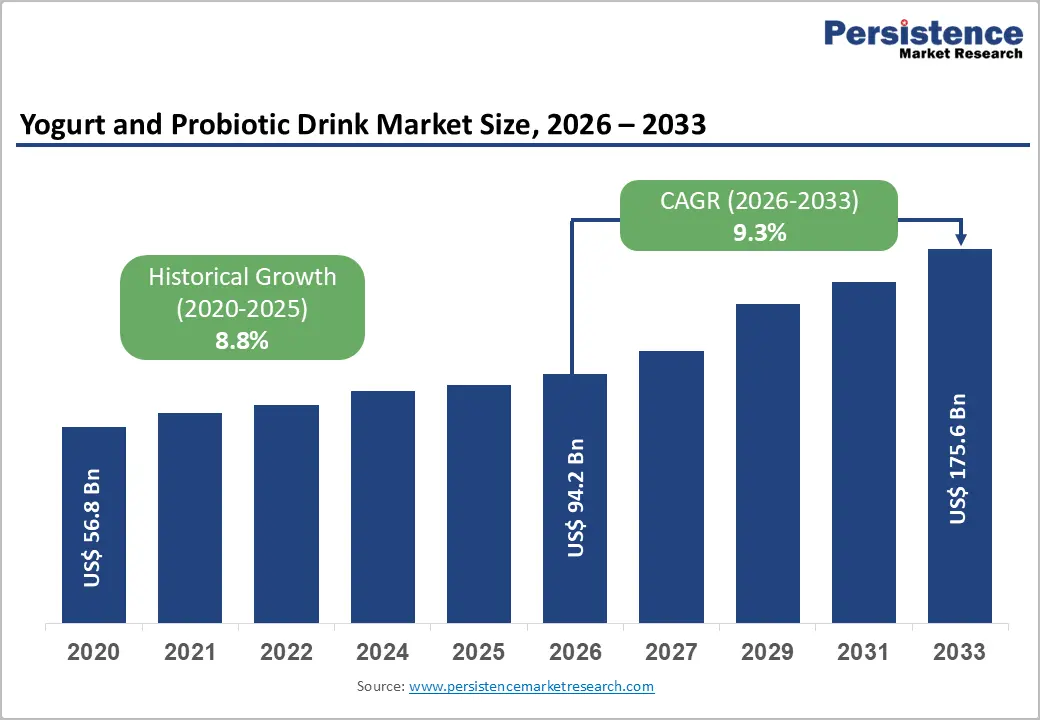
The global yogurt and probiotic drink market is forecast to expand at a CAGR of 7.5% and thereby increase from a value of US$ 180.7 Bn in 2025, to US$ 299.8 Bn by the end of 2032.

Attributes

Key Insights

Yogurt And Probiotic Drink Market Size (2025E)

US$ 180.7 Bn

Projected Market Value (2032F)

US$ 299.8 Bn

Global Market Growth Rate (CAGR 2025 to 2032)

7.5%

Historical Market Growth Rate (CAGR 2019 to 2024)

7.1%

Market Introduction and Definition

The market for yogurt and probiotic beverages is an ever-evolving segment of the food and beverage industry as a whole. Probiotic beverages, which comprise live beneficial bacteria, and yogurt, which is a fermented dairy product, have become immensely popular on account of the perception that they provide health benefits. Because of the fermentation of milk by lactic acid bacteria, yogurt is distinguished by its creamy consistency and acidic flavour. Conversely, probiotic beverages are intended to provide a concentrated dose of these advantageous microorganisms to promote digestive health. They constitute a market segment that is dedicated to the advancement of digestive health and general well-being.

Numerous factors contribute to the expansion of the worldwide yogurt and probiotic beverage market. Consumers' heightened understanding of the correlation between digestive health and general wellness has contributed to the surge in demand for these products. The market is propelled forward by the demand for functional foods that provide digestive benefits among health-conscious consumers. Moreover, the increasing incidence of digestive disorders has provided additional evidence of the criticality of probiotics, thereby creating a conducive atmosphere for the growth of the market.

Additionally, advancements in product formulations, including the incorporation of lactose-free alternatives and a variety of flavour profiles, have expanded the range of consumers. Furthermore, the implementation of strategic marketing campaigns that highlight the nutritional benefits of yogurt and probiotic beverages plays a significant role in maintaining the momentum of market expansion. With the ongoing inclination toward adopting healthier lifestyles, it is anticipated that the market will experience consistent growth for the foreseeable future.

Market Growth Drivers

Rising Emphasis on Preventive Healthcare

An increasingly significant factor propelling the worldwide yogurt and probiotic drink market to unprecedented levels of growth is the growing focus on preventive healthcare. In recent times, a paradigm shift has occurred in consumer perspectives regarding health and wellness, as an increasing number of individuals recognize the significant influence that diet has on one's overall well-being. As a consequence of this transition, individuals are now actively seeking out food and beverages that provide discernible health advantages; thus, yogurt and probiotic drinks are regarded as premier options for those concerned with preventive healthcare.

An important determinant in the proliferation of these products is the acknowledgment of the vital significance that gastrointestinal health imparts to the preservation of a resilient immune system and general well-being. An abundance of scientific studies have identified a robust correlation between the gut microbiome—an assortment of microorganisms inhabiting the gastrointestinal tract—and a multitude of health parameters, such as metabolism, immune function, and psychological state. This understanding is perfectly aligned with probiotic drinks, which are designed to deliver a concentrated dosage of these microorganisms, and yogurt, which contains a diverse array of live beneficial bacteria. There is a growing trend among consumers to utilize these products to improve and maintain their digestive health. They are perceived not only as appetizing treats but also as functional foods that possess the capacity to strengthen the body against diseases.

Market Restraints

Regulatory Hurdles and Inconsistent Quality Standards by Region

Despite the substantial expansion of the worldwide yogurt and probiotic drink industry, regulatory obstacles and regionally inconsistent quality standards represent a constraining factor that merits careful examination. Strict regulations govern the food and beverage sector about probiotic usage, health claims, and product labelling. The regulations can exhibit substantial variation across different countries, thereby presenting manufacturers with a convoluted environment and impeding the smooth expansion of their markets. The necessity for transparent and uniform regulatory frameworks becomes indisputable as organizations endeavour to introduce novel products and communicate health-related information to public. The process of bringing yogurt and probiotic beverages to market is extended in duration and expense due to the need to comply with numerous regulatory requirements.

Escalating Competition and Saturation

The escalating competition and saturation that characterize the global yogurt and probiotic drink market constitute a substantial obstacle. The increasing recognition among consumers of the health advantages linked to these products has resulted in a substantial influx of new participants into the market, which in turn has intensified the rivalry among manufacturers. Established and emerging actors alike encounter difficulties in achieving market share, product differentiation, and overall profitability due to this fierce competition. The market is further saturated due to the widespread availability of comparable products, which poses a growing challenge for brands to differentiate themselves. Numerous enterprises provide an extensive selection of probiotic beverages and yogurt, resulting in a highly competitive market where differentiating one's brand becomes an arduous undertaking.

Opportunities

Growing Demand for Personalized Nutrition and Functional Foods

The worldwide market for probiotic drinks and yogurt is anticipated to be driven by an advantageous factor; the increasing desire of consumers for customized nutrition and functional foods. Consumer preferences are shifting away from generic products and toward those that cater to specific health requirements and preferences, as evidenced by this upward trend. Yogurt and probiotic beverages, by their intrinsic health advantages, are ideally suited to exploit this opportunity through the provision of customized products that cater to particular dietary restrictions and health objectives.

The emergence of personalized nutrition is intricately connected to technological progress and the expanding accessibility of health-related information. Contemporary consumers are endowed with an abundance of data about their health profiles using ubiquitous technologies, health applications, and genetic screening. This increased consciousness enables people to make well-informed decisions regarding their dietary habits and way of life. Manufacturers of probiotic and yogurt beverages can capitalize on this trend by creating products that target particular health issues, such as weight management, immune support, or digestive health. The utilization of functional ingredients and customized formulations that are enriched with specific probiotic strains empowers consumers to synchronize their dietary selections with their individual health goals.

Analyst’s Viewpoint

The yogurt and probiotic drink market on a global scale is anticipated to experience substantial expansion due to a convergence of elements that influence consumer inclinations, industry reactions, and emerging patterns. An important factor driving the expansion of the market is the increasing consciousness among consumers concerning the significance of probiotics in promoting digestive health and overall wellness. With the progression of scientific inquiry revealing the correlation between a balanced gut microbiome and a multitude of health advantages, there is a growing trend among consumers to utilize yogurt and probiotic beverages as convenient and pleasurable methods of bolstering their digestive systems.

Manufacturers occupy a critical position within this ecosystem as they are responsible for both satisfying the demand for these products and fostering innovation to meet the changing demands of consumers. In contemporary society, manufacturers and consumers have established a mutually beneficial relationship, whereby consumers desire products that not only provide palatable and convenient choices but also correspond to their specific health objectives. As a result, manufacturers have allocated resources towards research and development, investigating innovative formulations, a wide range of probiotic strains, and personalized nutrition products to cater to the specific needs and desires of health-conscious consumers. In addition, an increasing proportion of consumers who adhere to vegetarian, vegan, or flexitarian diets are propelling a surge in the demand for plant-based alternatives on a global scale.

Probiotic beverages and plant-based yogurt are increasingly being recognized as viable substitutes for conventional dairy-based products. This trend caters to the tastes of consumers who prioritize alternatives that are free from cruelty, environmentally harmful, and lactose. The range of products offered by manufacturers is indicative of their ability to respond to shifting market conditions and consumer preferences.  With manufacturers persistently adjusting to emergent trends and capitalizing on technological advancements, it is anticipated that the market will experience continuous growth. This presents promising prospects for industry participants and health-conscious consumers.

Supply-side Dynamics

The global market for probiotic beverages and yogurt is comprised of industry leaders including Danone, Nestle, and Yakult Honsha. These behemoths of the industry have solidified their positions with extensive product lines and worldwide distribution systems. These products are primarily adopted by the US, China, and several European countries. In the US, for instance, the yogurt market is prospering due to increased probiotic awareness and consumer preferences for Greek yogurt. A rising health-conscious middle class in China has contributed to market expansion by increasing demand for probiotic beverages. In the same way, European nations such as Germany and France exhibit a developed market characterized by a substantial intake of probiotic beverages and yogurt as essential components of their daily dietary regimens.

Constraints such as the market dominance of Danone, Nestle, and Yakult, as well as their strategic initiatives and ongoing innovation, are reshaping the industry. These corporations are allocating substantial resources towards research and development to introduce novel product formulations, flavors, and packaging that satisfy the varied preferences of consumers. Moreover, their heightened focus on marketing and promotional endeavours serves to augment consumer consciousness and foster brand allegiance. Using collaborations and partnerships with retailers and e-commerce platforms, these entities are capable of broadening their global footprint and guaranteeing a robust market presence. The market is not only shaped by the dominant players' ongoing investments in sustainable practices, product diversification, and strategic alliances; they also establish standards for quality, innovation, and consumer engagement, thereby impacting the trajectory of the yogurt and probiotic drink industry as a whole.

Top Regional Markets

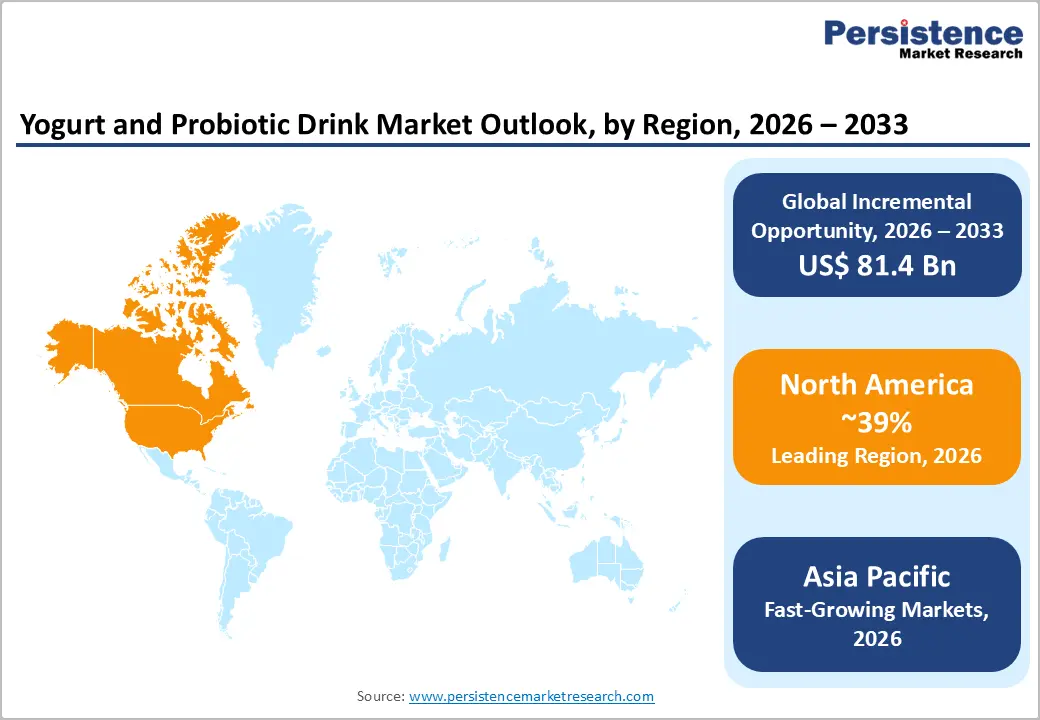
Asia Pacific's Ascendancy Stems from Widespread Recognition and Cultural Approval

It is projected that the Asia Pacific region will hold the largest market share in the worldwide yogurt and probiotic drink sector. Numerous elements contribute to this state of dominance. To begin with, it is important to note that the region has a significant cultural predilection for fermented dairy products, including yogurt, which is an integral part of the traditional diets of nations such as Japan, China, and India. Due to the widespread recognition and cultural approval of these products, the Asia Pacific region represents a substantial market for probiotic beverages, and yogurt.

Furthermore, the Asia Pacific market is witnessing a surge in demand for these products due to the growing awareness of the advantages probiotics have in preserving digestive health and the escalating health consciousness among individuals. The consumption of health-oriented products is additionally stimulated by the expanding middle class with disposable income and the region's sizable and diverse population. The ongoing process of urbanization is causing a transformation in lifestyles, resulting in an increased desire for convenient and nourishing food and beverages. In this regard, probiotic drinks and yogurt are well-suited.

Manufacturers Find Ample Opportunity in the Middle East and Africa as Dietary Preferences Shift

The Middle East and Africa are anticipated to witness the most rapid expansion of the worldwide yogurt and probiotic drink market. Numerous elements contribute to the expansion of this market, which is why it has experienced such rapid development. To commence, there is a progressive transformation in dietary inclinations within the region, which is propelled by a growing recognition of the correlation between proper nutrition and overall health.

With increasing urbanization and disposable incomes in specific regions of the Middle East, consumer preferences have shifted to favour health-conscious and functional foods. There is a growing consumer trend in the Middle East and Africa towards products that provide health benefits in addition to pleasant flavour. This trend renders yogurt and probiotic drinks appealing options for consumers. Moreover, the region is witnessing an increasing incidence of digestive health issues, which has motivated consumers to proactively pursue products that promote gastrointestinal health.

Competitive Intelligence and Business Strategy

Prominent industry participants allocate substantial resources towards research and development endeavours to introduce ground-breaking products that align with the ever-changing tastes of consumers. This encompasses the creation of novel flavours, formulations, and packaging to accommodate a wide range of preferences and health-conscious consumers. Through the consistent introduction of innovative products, these corporations maintain a competitive edge in the market, appealing to consumers who value versatility and practicality when it comes to probiotic and yogurt options. These competitors prioritize global expansion to maximize their market share, utilizing their well-established brands to enter new markets. By its substantial market share in Europe, North America, and Asia, Danone, for instance, enjoys extensive geographical coverage.

Through the implementation of streamlined distribution networks, market leaders can promptly address regional needs and seize emerging opportunities in numerous areas. Establishing robust brand identities via efficient marketing is a critical tactic employed by market leaders. Consumer awareness and trust are enhanced through the implementation of advertising campaigns that highlight the health benefits of probiotics, endorsements from health professionals, and collaborations with influencers. By associating their brands with attributes such as health, dependability, and quality, they hope to sway consumer purchasing decisions and cultivate a sense of allegiance to the brand.

In light of the significance attributed to consumer education, industry leaders proactively participate in health promotion initiatives. These campaigns frequently highlight the correlation between probiotics, gastrointestinal health, and general wellness. Through the provision of informative materials and clear data regarding the nutritional benefits of their merchandise, these businesses not only appeal to fresh clientele but also cultivate a base of health-conscious consumers. As a consequence of the increasing focus on sustainability, industry leaders incorporate ecologically conscious procedures into their business activities. This includes packaging that is friendly to the environment, sustainable ingredient procurement, and carbon footprint reduction. These initiatives appeal to a socially conscious consumer base, thereby bolstering the desirability of their products and fostering a favourable brand perception.

Key Recent Developments

New Product

In June 2022, Danone introduced Activa+, a novel beverageable yogurt. Activa+ is a multipurpose beverage yogurt formulated with zinc, probiotic vitamins A and D, and active probiotics. There are several flavour options for the product, including raspberry, peach, and strawberry.

Market Impact: The potential impact of Danone's June 2022 introduction of Activa+, an innovative beverageable yogurt fortified with active probiotics, probiotic vitamins A and D, and zinc, on the worldwide yogurt and probiotic drink market is favourable. The implementation of this versatile yogurt beverage, which is available in an assortment of flavours, demonstrates a dedication to innovating products and catering to the varied preferences of consumers. This advancement is anticipated to facilitate the expansion of the market by providing consumers with novel and enticing choices, thereby stimulating additional interest and consumption within the yogurt and probiotic drink industry.

Yogurt and Probiotic Drink Market Research Segmentation

By Product Type:

  • Yogurt Drink
  • Juice
  • Water
  • Kefir
  • Others

By Source Type:

  • Dairy-based
  • Plant-based
  • Water-based

By Region:

  • North America
  • Europe
  • East Asia
  • South Asia & Oceania
  • Latin America
  • Middle East & Africa

Companies Covered in Yogurt and Probiotic Drink Market

  • Danone
  • Yakult Honsha Co. Ltd
  • Grupo Lala
  • Chobani, LLC
  • Califia Farms
  • Harmless
  • Lifeway Foods, Inc
  • KeVita
  • Bio-K+
Frequently Asked Questions

The market is anticipated to grow at a CAGR of 7.5% during the projected period.

The yogurt and probiotic drink market will be valued at US$ 180.7 billion in 2025.

The US will held the largest market share in 2025.

The prominent players in the market include Danone, Yakult Honsha Co. Ltd, Grupo Lala, Chobani, LLC, and Califia Farms.

The plant-based segment is expected to grow at the fastest CAGR during the forecast period.

Market Segmentation

Which Product Type Dominates Global Market?

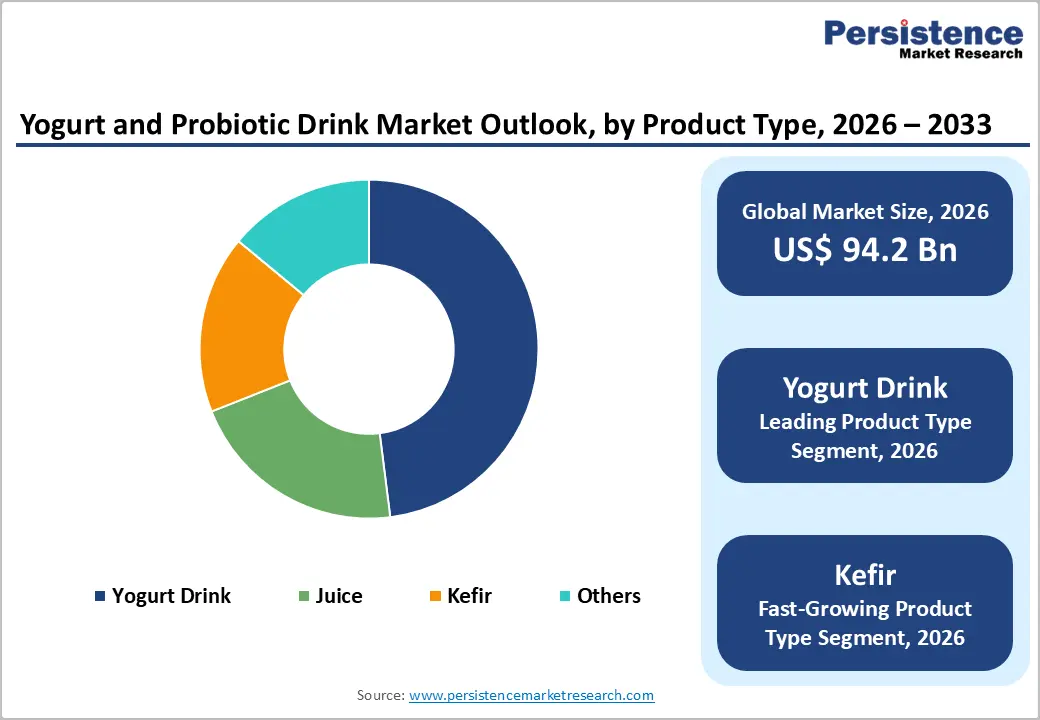
Yogurt Drink Sales Continue to Top with their Invigorating Flavour

Based on the present market conditions, it is anticipated that the yogurt drink segment will hold the most significant market share in the industry of probiotics and yogurt drinks. The allure of yogurt beverages arises from their harmonious amalgamation of invigorating flavour and the advantageous properties linked to probiotics, rendering them a coveted option among consumers in pursuit of a harmonious equilibrium between flavour and functionality. In the foreseeable future, the kefir sector is anticipated to witness the most rapid expansion rate among all market segments.

Kefir, an exceptionally flavourful and probiotic-rich fermented milk product, has garnered increasing attention owing to its perceived health benefits. Kefir is positioned as a segment that is anticipated to experience substantial growth in the coming years, owing to consumer inclinations towards functional beverages and the increasing fascination with unique and unusual probiotic alternatives. This development presents market participants with promising prospects and appeals to health-conscious consumers.

Which is the Most Widely Preferred Source Type?

The Dairy-based Category Leads by Source Type

It is anticipated that the dairy-based segment will maintain its dominant market position in the yogurt and probiotic drink sector. Notwithstanding the emergence of substitute alternatives, the enduring appeal of conventional dairy-based products, including kefir, and yogurt, contributes to their dominance in this market segment. Dairy-based products are well-liked by a wide range of consumers and frequently contain an abundance of probiotics, which establishes them as market fundamentals. On the contrary, it is expected that the plant-based sector will experience the most rapid expansion in the forthcoming years. The expansion of plant-based yogurt and probiotic beverages is being driven by the rising demand for dairy alternatives among lactose-intolerant and vegan consumers and the increasing prevalence of plant-based diets. Advancements in plant-based formulations, which include probiotic-rich alternatives such as almond, soy, and coconut, are meeting the demands of an expanding market of health-conscious consumers who prefer non-dairy alternatives. The aforementioned development establishes the plant-based sector as a dynamic and swiftly progressing division within the wider yogurt and probiotic beverage industry.

Yogurt and Probiotic Drink Market Report Scope

Attribute

Details

Forecast Period

2025 to 2032

Historical Data Available for

2019 to 2024

Market Analysis Units  Value: US$ Bn/Mn, Volume: As applicable

Key Regions Covered

  • North America
  • Latin America
  • Europe
  • South Asia & Pacific
  • East Asia
  • The Middle East & Africa  

Key Countries Covered

  • United States
  • Canada
  • Germany
  • United Kingdom
  • France
  • Italy
  • Spain
  • Russia
  • China
  • Japan
  • South Korea
  • India
  • Thailand
  • Malaysia
  • Indonesia
  • Australia
  • New Zealand
  • GCC Countries
  • South Africa  

Key Market Segments Covered

  • Product Type
  • Source Type
  • Region

Key Companies Profiled

  • Danone
  • Yakult Honsha Co. Ltd
  • Grupo Lala
  • Chobani, LLC
  • Califia Farms
  • Harmless
  • Lifeway Foods, Inc
  • KeVita
  • Bio-K+
Report Highlights 
  • Market Forecast and Trends 
  • Competitive Intelligence & Share Analysis 
  • Growth Factors and Challenges 
  • Strategic Growth Initiatives 
  • Pricing Analysis & Technology Roadmap 
  • Future Opportunities and Revenue Pockets 
  • Industry Market Analysis Tools 

Customization & Pricing

Available upon request

Related Reports

1. Executive Summary

    1.1. Global Yogurt And Probiotic Drink Market Snapshot, 2025 and 2032

    1.2. Market Opportunity Assessment, 2025 - 2032, US$ Mn

    1.3. Key Market Trends

    1.4. Future Market Projections

    1.5. Premium Market Insights

    1.6. Industry Developments and Key Market Events   

    1.7. PMR Analysis and Recommendations

2. Market Overview

    2.1. Market Scope and Definition

    2.2. Market Dynamics

        2.2.1. Drivers

        2.2.2. Restraints

        2.2.3. Opportunity

        2.2.4. Challenges

        2.2.5. Key Trends

    2.3. Product Type Lifecycle Analysis

    2.4. Yogurt And Probiotic Drink Market: Value Chain

        2.4.1. List of Raw Material Supplier

        2.4.2. List of Manufacturers

        2.4.3. List of Distributors

        2.4.4. List of Applications

        2.4.5. Profitability Analysis

    2.5. Porter Five Force's Analysis

    2.6. Geopolitical Tensions: Market Impact   

    2.7. Macro-Economic Factors

        2.7.1. Global Sectorial Outlook

        2.7.2. Global GDP Growth Outlook

        2.7.3. Global Parent Market Overview

    2.8. Forecast Factors - Relevance and Impact

    2.9. Regulatory and Technology Landscape

3. Global Yogurt And Probiotic Drink Outlook, 2019 - 2032

    3.1. Key Highlights

        3.1.1. Market Volume (Units) Projections

        3.1.2. Market Size and Y-o-Y Growth

        3.1.3. Absolute $ Opportunity

    3.2. Market Size (US$ Mn) Analysis and Forecast

        3.2.1. Historical Market Size Analysis, 2019-2023

        3.2.2. Current Market Size Forecast, 2024-2032

    3.3. Global Yogurt And Probiotic Drink Market Outlook: Product Type

        3.3.1. Introduction / Key Findings

        3.3.2. Historical Market Size (US$ Mn) and Volume (Units) Analysis By Product Type, 2019 - 2023

    3.3.3. Current Market Size (US$ Mn) and Volume (Units) Forecast By Product Type, 2024 - 2032

            3.3.3.1. Yogurt Drink

            3.3.3.2. Juice

            3.3.3.3. Water

            3.3.3.4. Kefir

            3.3.3.5. Others

    3.4. Market Attractiveness Analysis: Product Type

    3.5. Global Yogurt And Probiotic Drink Market Outlook: Source Type

        3.5.1. Introduction / Key Findings

        3.5.2. Historical Market Size (US$ Mn) and Volume (Units) Analysis By Source Type, 2019 - 2023

        3.5.3. Current Market Size (US$ Mn) and Volume (Units) Forecast By Source Type, 2024 - 2032

            3.5.3.1. Dairy-based

            3.5.3.2. Plant-based

            3.5.3.3. Water-based

    3.6. Market Attractiveness Analysis: Source Type

4. Global Yogurt And Probiotic Drink Market Outlook: Region

    4.1. Key Highlights

    4.2. Historical Market Size (US$ Mn) and Volume (Units) Analysis By Region, 2019 - 2023

    4.3. Current Market Size (US$ Mn) and Volume (Units) Forecast By Region, 2024 - 2032

        4.3.1. North America

        4.3.2. Europe

        4.3.3. East Asia

        4.3.4. South Asia and Oceania

        4.3.5. Latin America

        4.3.6. Middle East & Africa (MEA)

    4.4. Market Attractiveness Analysis: Region

5. North America Yogurt And Probiotic Drink Outlook, 2019 - 2032 

    5.1. Key Highlights

    5.2. Pricing Analysis

    5.3. Historical Market Size (US$ Mn) and Volume (Units) Analysis By Market, 2019 - 2023

        5.3.1. By Country

        5.3.2. By Product Type

        5.3.3. By Source Type

    5.4. Current Market Size (US$ Mn) and Volume (Units) Forecast By Country, 2024 - 2032

        5.4.1. U.S.

        5.4.2. Canada

    5.5. Current Market Size (US$ Mn) and Volume (Units) Forecast By Product Type, 2024 - 2032

        5.5.1. Yogurt Drink

        5.5.2. Juice

        5.5.3. Water

        5.5.4. Kefir

        5.5.5. Others

    5.6. Current Market Size (US$ Mn) and Volume (Units) Forecast By Source Type, 2024 - 2032

        5.6.1. Dairy-based

        5.6.2. Plant-based

        5.6.3. Water-based

    5.7. Market Attractiveness Analysis

6. Europe Yogurt And Probiotic Drink Outlook, 2019 - 2032

    6.1. Key Highlights

    6.2. Pricing Analysis

    6.3. Historical Market Size (US$ Mn) and Volume (Units) Analysis By Market, 2019 - 2023

        6.3.1. By Country

        6.3.2. By Product Type

        6.3.3. By Source Type

    6.4. Current Market Size (US$ Mn) and Volume (Units) Forecast By Country, 2024 - 2032

        6.4.1. Germany

        6.4.2. France

        6.4.3. U.K.

        6.4.4. Italy

        6.4.5. Spain

        6.4.6. Russia

        6.4.7. Türkiye

        6.4.8. Rest of Europe

    6.5. Current Market Size (US$ Mn) and Volume (Units) Forecast By Product Type, 2024 - 2032

        6.5.1. Yogurt Drink

        6.5.2. Juice

        6.5.3. Water

        6.5.4. Kefir

        6.5.5. Others

    6.6. Current Market Size (US$ Mn) and Volume (Units) Forecast By Source Type, 2024 - 2032

        6.6.1. Dairy-based

        6.6.2. Plant-based

        6.6.3. Water-based

    6.7. Market Attractiveness Analysis

7. East Asia Yogurt And Probiotic Drink Outlook, 2019 - 2032

    7.1. Key Highlights

    7.2. Pricing Analysis

    7.3. Historical Market Size (US$ Mn) and Volume (Units) Analysis By Market, 2019 - 2023

        7.3.1. By Country

        7.3.2. By Product Type

        7.3.3. By Source Type

    7.4. Current Market Size (US$ Mn) and Volume (Units) Forecast By Country, 2024 - 2032

        7.4.1. China

        7.4.2. Japan

        7.4.3. South Korea

    7.5. Current Market Size (US$ Mn) and Volume (Units) Forecast By Product Type, 2024 - 2032

        7.5.1. Yogurt Drink

        7.5.2. Juice

        7.5.3. Water

        7.5.4. Kefir

        7.5.5. Others

    7.6. Current Market Size (US$ Mn) and Volume (Units) Forecast By Source Type, 2024 - 2032

        7.6.1. Dairy-based

        7.6.2. Plant-based

        7.6.3. Water-based

    7.7. Market Attractiveness Analysis

8. South Asia & Oceania Yogurt And Probiotic Drink Outlook, 2019 - 2032

    8.1. Key Highlights

    8.2. Pricing Analysis

    8.3. Historical Market Size (US$ Mn) and Volume (Units) Analysis By Market, 2019 - 2023

        8.3.1. By Country

        8.3.2. By Product Type

        8.3.3. By Source Type

    8.4. Current Market Size (US$ Mn) and Volume (Units) Forecast By Country, 2024 - 2032

        8.4.1. India

        8.4.2. Southeast Asia

        8.4.3. ANZ

        8.4.4. Rest of South Asia & Oceania

    8.5. Current Market Size (US$ Mn) and Volume (Units) Forecast By Product Type, 2024 - 2032

        8.5.1. Yogurt Drink

        8.5.2. Juice

        8.5.3. Water

        8.5.4. Kefir

        8.5.5. Others

    8.6. Current Market Size (US$ Mn) and Volume (Units) Forecast By Source Type, 2024 - 2032

        8.6.1. Dairy-based

        8.6.2. Plant-based

        8.6.3. Water-based

    8.7. Market Attractiveness Analysis

9. Latin America Yogurt And Probiotic Drink Outlook, 2019 - 2032

    9.1. Key Highlights

    9.2. Pricing Analysis

    9.3. Historical Market Size (US$ Mn) and Volume (Units) Analysis By Market, 2019 - 2023

        9.3.1. By Country

        9.3.2. By Product Type

        9.3.3. By Source Type

    9.4. Current Market Size (US$ Mn) and Volume (Units) Forecast By Country, 2024 - 2032

        9.4.1. Brazil

        9.4.2. Mexico

        9.4.3. Rest of Latin America

    9.5. Current Market Size (US$ Mn) and Volume (Units) Forecast By Product Type, 2024 - 2032

        9.5.1. Yogurt Drink

        9.5.2. Juice

        9.5.3. Water

        9.5.4. Kefir

        9.5.5. Others

    9.6. Current Market Size (US$ Mn) and Volume (Units) Forecast By Source Type, 2024 - 2032

        9.6.1. Dairy-based

        9.6.2. Plant-based

        9.6.3. Water-based

    9.7. Market Attractiveness Analysis

10. Middle East & Africa Yogurt And Probiotic Drink Outlook, 2019 - 2032

    10.1. Key Highlights

    10.2. Pricing Analysis

    10.3. Historical Market Size (US$ Mn) and Volume (Units) Analysis By Market, 2019 - 2023

        10.3.1. By Country

        10.3.2. By Product Type

        10.3.3. By Source Type

    10.4. Current Market Size (US$ Mn) and Volume (Units) Forecast By Country, 2024 - 2032

        10.4.1. GCC

        10.4.2. Egypt

        10.4.3. South Africa

        10.4.4. Northern Africa

        10.4.5. Rest of Middle East & Africa

    10.5. Current Market Size (US$ Mn) and Volume (Units) Forecast By Product Type, 2024 - 2032

        10.5.1. Yogurt Drink

        10.5.2. Juice

        10.5.3. Water

        10.5.4. Kefir

        10.5.5. Others

    10.6. Current Market Size (US$ Mn) and Volume (Units) Forecast By Source Type, 2024 - 2032

        10.6.1. Dairy-based

        10.6.2. Plant-based

        10.6.3. Water-based

    10.7. Market Attractiveness Analysis

11. Competition Landscape

    11.1. Market Share Analysis, 2024

    11.2. Market Structure

        11.2.1. Competition Intensity Mapping By Market  

        11.2.2. Competition Analog IC

        11.2.3. Apparent Product Type Capacity

    11.3. Company Profiles (Details - Overview, Financials, Strategy, Recent Developments)

        11.3.1. Danone

            11.3.1.1. Overview

            11.3.1.2. Segments and Product Type

            11.3.1.3. Key Financials

            11.3.1.4. Market Developments

            11.3.1.5. Market Strategy

    11.3.2. Yakult Honsha Co. Ltd

            11.3.2.1. Overview

            11.3.2.2. Segments and Product Type

            11.3.2.3. Key Financials

            11.3.2.4. Market Developments

            11.3.2.5. Market Strategy

        11.3.3. Grupo Lala

            11.3.3.1. Overview

            11.3.3.2. Segments and Product Type

            11.3.3.3. Key Financials

            11.3.3.4. Market Developments

            11.3.3.5. Market Strategy

        11.3.4. Chobani, LLC

            11.3.4.1. Overview

            11.3.4.2. Segments and Product Type

            11.3.4.3. Key Financials

            11.3.4.4. Market Developments

            11.3.4.5. Market Strategy

        11.3.5. Califia Farms

            11.3.5.1. Overview

            11.3.5.2. Segments and Product Type

            11.3.5.3. Key Financials

            11.3.5.4. Market Developments

            11.3.5.5. Market Strategy

        11.3.6. Harmless

            11.3.6.1. Overview

            11.3.6.2. Segments and Product Type

            11.3.6.3. Key Financials

            11.3.6.4. Market Developments

            11.3.6.5. Market Strategy

        11.3.7. Lifeway Foods, Inc

            11.3.7.1. Overview

            11.3.7.2. Segments and Product Type

            11.3.7.3. Key Financials

            11.3.7.4. Market Developments

            11.3.7.5. Market Strategy

        11.3.8. KeVita

            11.3.8.1. Overview

            11.3.8.2. Segments and Product Type

            11.3.8.3. Key Financials

            11.3.8.4. Market Developments

            11.3.8.5. Market Strategy

        11.3.9. Bio-K+

            11.3.9.1. Overview

            11.3.9.2. Segments and Product Type

            11.3.9.3. Key Financials

            11.3.9.4. Market Developments

            11.3.9.5. Market Strategy

12. Appendix

    12.1. Research Methodology

    12.2. Research Assumptions

    12.3. Acronyms and Abbreviations


Research Methodology Framework for Market Research Excellence

At Persistence Market Research, we implement a comprehensive, validated, and multi-dimensional approachto market analysis that delivers actionable insights across complex market landscapes. Our methodology combines the analytical rigor of leading consulting firms with innovative research techniques, ensuring robust market assessments that guide strategic decision-making with confidence.

Core Research Philosophy

Our methodology is built on four foundational pillars:

Research Philosophy Image

At Persistence Market Research, our methodology is designed to transcend conventional market studies by combining analytical rigor, multi-source validation, and future-focused insights.

We integrate advanced research frameworks, robust data collection strategies, cutting-edge analytics, and innovative technologies to deliver a 360-degree view of complex markets.

We integrate advanced research frameworks, robust data collection strategies, cutting-edge analytics, and innovative technologies to deliver a 360-degree view of complex markets.

Each stage spanning from strategic scoping and hypothesis-building to competitive intelligence, quality validation, and actionable recommendations is engineered to provide clients with unmatched clarity, precision, and confidence in decision-making.

By embedding innovation and technology at the core, our approach ensures that insights are not only comprehensive but also predictive, empowering businesses to seize opportunities, mitigate risks, and achieve sustainable growth

Research Philosophy Image

Capturing Key Information and Events

During this phase, key research objectives focus on essential information and data points for assessing the market, including:

Research Philosophy Image

TAM-SAM-SOM Framework Implementation

We employ both top-down and bottom-up approaches to ensure accurate market sizing.

Top-Down Market SizingBottom-Up Market Sizing
Universe Definition: Total global/regional market identificationUnit Economics: Average transaction values, purchase frequencies, customer lifecycle
Segmentation Filters: Geographic, demographic, and behavioral constraintsCustomer Segmentation: Detailed buyer persona development and sizing
Market Share Analysis: Competitive landscape assessment and share allocationPenetration Analysis: Market penetration rates by segment and geography
Growth Rate Application: Historical trends and forward-looking growth assumptionsScaling Methodology: Extrapolation techniques with confidence intervals

Validation & Cross-Verification

  • Triangulation: Comparing top-down and bottom-up results for consistency
  • Sensitivity Analysis: Testing key assumptions and parameter variations
  • Peer Benchmarking: Comparison with analogous markets and industry benchmarks
  • Expert Review: External validation through industry specialist consultation

Research Philosophy Image

Forecasting & Projection Modeling

Our proprietary forecasting models incorporate multiple variables and scenarios.

Forecasting Components

  • Historical Trend Analysis: 10-year historical growth patterns and cyclical variations
  • Driver-Based Modeling: Economic indicators, demographic shifts, technology adoption
  • Scenario Planning: Base case, optimistic, and conservative projections
  • Monte Carlo Simulations: Probability-weighted outcomes and risk assessments

Model Validation

  • Back-Testing: Historical accuracy assessment over 3–5-year periods
  • Cross-Validation: Multiple modeling approaches for result comparison
  • External Benchmarking: Comparison with established market forecasts
  • Continuous Calibration: Quarterly model updates based on new data

Comprehensive Data Collection Strategy

Our secondary research phase establishes a robust knowledge base utilizing diverse, credible sources.

Secondary Data Sourcess

  • Industry Publications & Reports
  • Government & Regulatory Data
  • Financial Intelligence (filings & reports)
  • Academic Research & Digital Intelligence

Quality Assurance Protocol

  • Source credibility assessment and publication date validation
  • Data consistency checks across multiple sources
  • Bias identification and neutralization techniques
  • Information gap tracking for primary research prioritization

Research Philosophy Image

Primary Research Excellence

Our primary research methodology employs best-in-class techniques to capture unique market insights.

Quantitative Research Methods

  • Large-Scale Surveys: Statistically representative samples with 95% confidence intervals
  • Survey Methodology: Multi-channel deployment (online, telephone, in-person)
  • Question Architecture and Response Optimization

Qualitative Research Methods

  • Executive Interviews
  • Focus Groups
  • Expert Consultations

Quality Assurance & Validation Framework

Multi-Stage Validation Process

  • Source Verification and Consistency Testing
  • Outlier Detection and Bias Assessment
  • Peer Review Process and External Validation
  • Sensitivity Analysis and Confidence Intervals

Research Philosophy Image

Methodology Validation & Credibility

Our research methodology has been extensively validated through:

  • Academic Partnerships: Collaborations with top-tier business schools and research institutions
  • Client Success Stories: Documented case studies demonstrating research impact and ROI
  • Continuous Benchmarking: Performance comparison with leading global research firms

This comprehensive methodology framework positions Persistence Market Research at the forefront of market intelligence, combining the analytical sophistication of top-tier consulting firms with innovative research techniques. Our approach ensures that every market assessment delivers precise, actionable, and strategically valuable insights that drive business success in competitive market environments.

Ready to unlock your market potential? Contact our research experts to discuss how our validated methodology can transform your strategic decision-making with data-driven market intelligence.

Copyright © 2026 Persistence Market Research. All Rights Reserved

Connect With Us -
Yogurt and Probiotic Drink Market Size & Share Report, 2032