




- Pharmaceuticals
- Tremfya Market
Tremfya Market Size, Share, and Growth Forecast 2026 - 2033
Tremfya Market by Application (Plaque Psoriasis, Psoriatic Arthritis), Distribution Channel (Hospital Pharmacies, Retail Pharmacies, Online Pharmacies), and Regional Analysis, 2026 - 2033

Tremfya Market Size and Trends Analysis
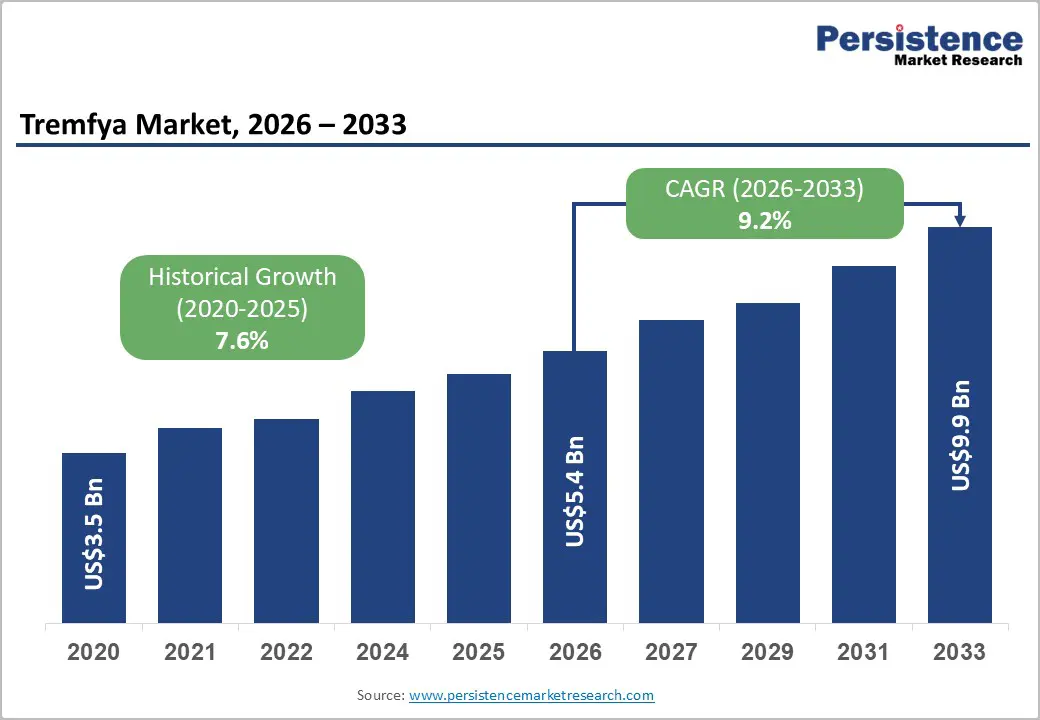
The global tremfya market size is likely to be valued at US$5.4 billion in 2026 and is expected to reach US$9.9 billion by 2033, growing at a CAGR of 9.2% during the forecast period from 2026 to 2033, driven by increasing prevalence and early diagnosis of chronic inflammatory diseases such as plaque psoriasis and psoriatic arthritis. Rising physician preference for IL-23 inhibitors due to their superior long-term efficacy and favorable safety profile is also pushing growth.
Key Industry Highlights:
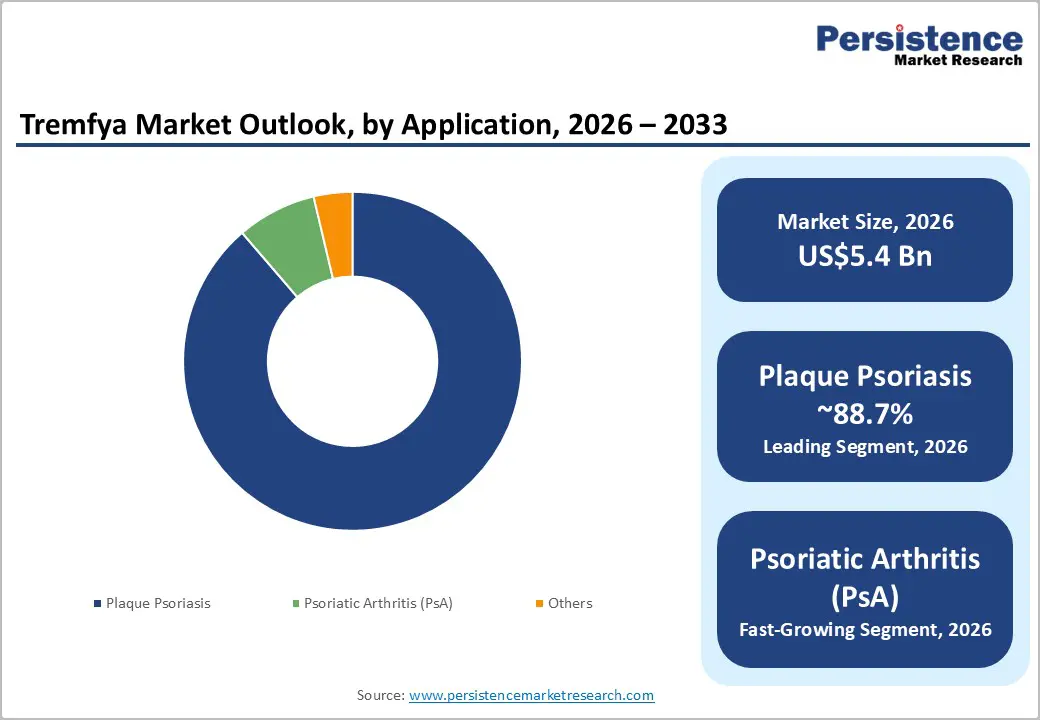
- Leading Application: Plaque psoriasis, approximately 88.7% share in 2026, as it is the primary entry point for prescribing high-efficacy biologics such as Tremfya with proven long-term skin clearance.
- Dominant Distribution Channel: Hospital pharmacies, nearly 53.6% in 2026, as biologics require specialist-led initiation and controlled storage.
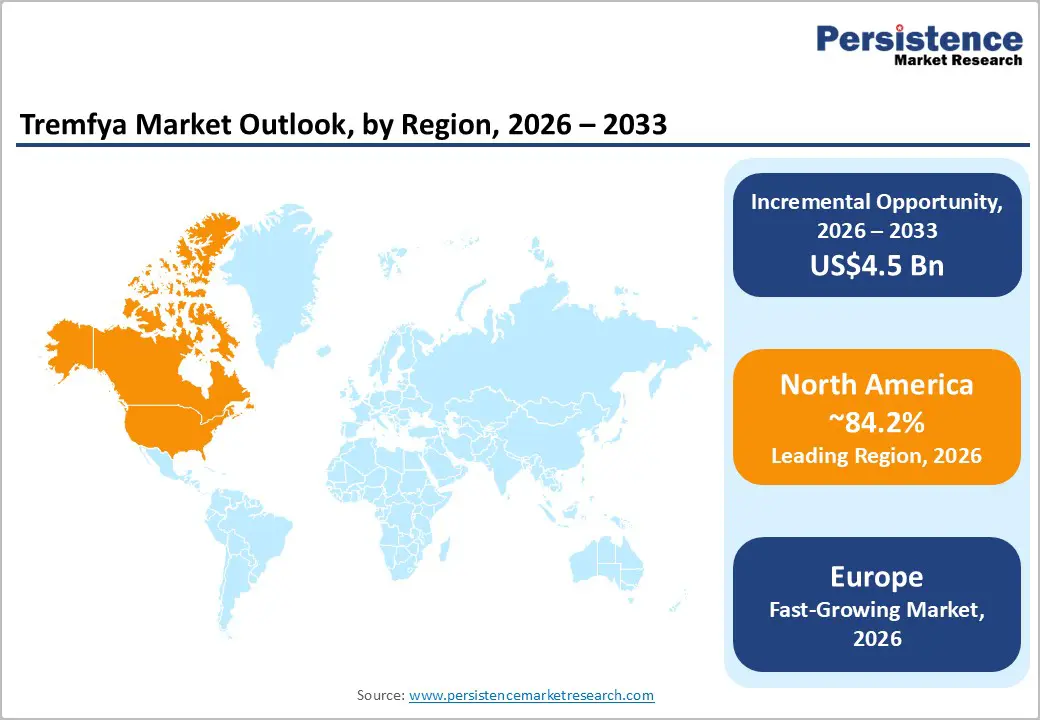
- Leading Region: North America, with about 84.2% share in 2026, owing to early adoption of advanced biologics, superior insurance coverage, and quick switching from old therapies to IL-23 inhibitors.
- Fast-growing Region: Europe, as treatment guidelines increasingly favor targeted biologics with better safety and long-term outcomes.
- Fast Track Approval: In May 2025, the European Commission granted a Marketing Authorization for Tremfya (guselkumab) for the treatment of adults with moderately to severely active Crohn's disease. The approval covered both intravenous and subcutaneous induction options, making Tremfya the first dual-acting IL-23 inhibitor to deliver both routes of administration for the indication in the European Union.

DRO Analysis
Driver - Proven Long-Term Outcomes Strengthen Tremfya's Clinical Case
Tremfya has built a strong reputation on the back of evidence that goes well beyond short-term efficacy. Phase 3 VOYAGE 1 and 2 data showed that approximately 80% of patients maintained skin clearance, measured by IGA 0/1 or PASI 90, consistently across subgroups through five years, regardless of baseline disease severity or prior treatment history. This kind of durability is rare among biologics. Real-world data adds further weight.
A post-hoc analysis of the VOYAGE 2 trial found that Tremfya showed greater treatment persistence compared to IL-17 inhibitors such as ixekizumab and secukinumab in both bio-naïve and bio-experienced patients. For Inflammatory Bowel Disease (IBD), three-year data from the QUASAR long-term extension study, presented at ECCO 2026, showed that 80.8% of UC patients remained in clinical remission at Week 140, with nearly all who achieved remission being corticosteroid-free. These outcomes justify long-term prescribing and help retain patients on therapy.
Flexible Dosing in IBD Sets Tremfya Apart from Other Inhibitors
A key differentiator for Tremfya in the IBD space is its dosing flexibility, something no other IL-23 inhibitor currently delivers. Following the September 2025 Food and Drug Administration (FDA) approval of subcutaneous induction for UC, Tremfya became the first and only IL-23 inhibitor to provide inflammatory bowel disease patients superior clinical and endoscopic results with a fully subcutaneous regimen across both ulcerative colitis and Crohn's disease.
For patients who prefer to avoid hospital-based IV infusions, this is a meaningful shift. The Phase 3 ASTRO study confirmed that Tremfya delivered meaningful improvements across all clinical and endoscopic measures in both biologic-naïve and biologic-refractory patients through 48 weeks with the fully SC regimen. This flexibility directly addresses a practical unmet need, making it easier for patients to self-administer from day one of treatment.
Restraint - Infection Risk from Immune Suppression
As Tremfya works by blocking IL-23, it carries an inherent risk of lowering the body's ability to fight infections. In clinical trials for plaque psoriasis, infections occurred in 23% of patients in the Tremfya group versus 21% in the placebo group through 16 weeks. Upper respiratory tract infections, gastroenteritis, and tinea infections were among the most commonly reported.
A broad pharmacovigilance study published in a peer-reviewed journal, using data from the FDA Adverse Event Reporting System (FAERS), found that among IL-23 inhibitors analyzed, infections and infestations were the system organ class with the highest signal incidence for guselkumab. Around 5 out of 20 identified signals fell in this category. This adds caution around prescribing for patients with pre-existing chronic infections or a history of recurring illness. Clinicians must screen patients before starting therapy, which can delay or restrict access for a subset of eligible patients.
Opportunity - Increasing IBD Patient Base Opens an Untapped Revenue Channel
Tremfya's entry into gastroenterology is still early, and the prescribing momentum is building fast. Research shows that Tremfya is quickly emerging as a standout among U.S. gastroenterologists despite being the most recently launched IL-23 inhibitor in Crohn's disease, outpacing Omvoh (mirikizumab) in physician preference metrics. What gives it an edge is the SC induction option.
Gastroenterologists have shown significant interest in Tremfya due to pre-approval familiarity and its unique subcutaneous induction dosing, which delivers a more convenient alternative to intravenous infusions. This factor is projected to fuel prescription shifts from other IL-23 inhibitors.
Pediatric Approvals Create a New Patient Segment with Limited Competition
Tremfya's pediatric label has opened a space where it faces no direct IL-23 competition. The September 2025 FDA approval for children aged six and older with moderate to severe plaque psoriasis or active psoriatic arthritis made Tremfya the first and only IL-23 inhibitor approved for these pediatric indications. The EU followed in December 2025 for pediatric plaque psoriasis.
Johnson & Johnson is currently running Phase 3 trials of guselkumab in pediatric patients with Crohn's disease and ulcerative colitis across multiple countries. No IL-23 inhibitor currently holds a pediatric IBD approval. If those trials succeed, Tremfya would enter a completely uncontested segment of the IBD market, one where parents and physicians are actively seeking alternatives to long-standing TNF inhibitors that carry heavier safety profiles.
Category-wise Analysis
Application Insights
The plaque psoriasis segment is predicted to lead with a share of approximately 88.7% in 2026. It represents the largest diagnosed patient pool and is the primary indication for which biologics such as Tremfya are prescribed first-line after topical or systemic failure. Clinically, over 80 to 90% of psoriasis patients have the plaque subtype, making it the default entry point for biologic therapy. What strengthens its dominance is the shift toward high-efficacy endpoints such as PASI 90 and PASI 100, where IL-23 inhibitors, including Tremfya, consistently show durable skin clearance beyond 1 year.
Recent real-world registries in the U.S. and Europe show that dermatologists are increasingly initiating IL-23 therapies earlier in moderate cases, not just severe ones, expanding the treated population.
The Psoriatic Arthritis (PsA) segment is estimated to be the fastest growing in the forecast period, as diagnosis rates are rising steadily due to improved screening in dermatology clinics. Nearly 30% of psoriasis patients are now estimated to develop PsA, and early detection is pushing biologics into rheumatology sooner than before. Tremfya’s growth here is propelled by its dual benefit on skin and joint symptoms, which reduces the requirement for combination therapies. Recent clinical discussions show that IL-23 inhibitors are gaining traction in biologic-naïve PsA patients who want fewer injections and better safety compared to Tumor Necrosis Factor (TNF) inhibitors, accelerating adoption.
Distribution Channel Insights
Hospital pharmacies are anticipated to dominate with a share of nearly 53.6% in 2026, as biologics such as Tremfya require controlled storage, physician supervision, and often initial dosing within clinical settings. In several countries, reimbursement frameworks are associated with hospital-based dispensing, especially for high-cost injectable therapies. First prescriptions are also usually initiated by specialists such as dermatologists or rheumatologists in hospital networks, making hospital pharmacies the primary point of access. This is evident in Europe, where biologic initiation is heavily centralized.
Online pharmacies are expected to remain in the second position in 2026, spurred by the shift toward self-administered biologics and patient preference for convenience. Tremfya’s dosing schedule, which is every 8 weeks after induction, supports home delivery models. Digital pharmacy platforms are integrating cold-chain logistics to handle biologics safely. In the U.S., specialty pharmacy networks linked with insurers are extending direct-to-patient delivery, while in India and Southeast Asia, e-pharmacies are gaining traction among urban patients managing chronic diseases. This shift is strengthened by post-COVID behavioral changes toward remote care.
Regional Insights
North America Tremfya Market Trends
In 2026, North America will likely dominate with a share of around 84.2%, owing to early adoption of advanced biologics and superior payer support for high-cost therapies. The region has a high diagnosed prevalence of autoimmune diseases and a well-established biologics network. The U.S., in particular, propels leadership due to constant switching from old TNF inhibitors to IL-23 drugs. Prescription data trends show that IL-23 therapies are increasingly preferred for long-term disease control due to low dosing frequency and sustained remission rates, strengthening Tremfya’s position.
U.S. Tremfya Market Trends
The U.S. is expected to surge at a fast pace, boosted by label expansions into inflammatory bowel diseases and increasing use in early lines of therapy. Physicians are becoming more comfortable switching stable patients from prominent biologics to IL-23 inhibitors based on long-term safety data. Another driver is payer acceptance. Insurance providers are gradually easing step-therapy restrictions for new biologics, which historically slowed adoption. The rise of specialty pharmacies and patient support programs is also improving treatment adherence.
Europe Tremfya Market Trends
Europe is estimated to be the fastest-growing market in the forecast period, as treatment guidelines are evolving to favor targeted biologics with better safety profiles. Countries such as the U.K. and France are constantly emphasizing real-world evidence and long-term remission rather than just short-term clearance. The expansion of biosimilars in the TNF inhibitor space is indirectly pushing physicians toward new mechanisms such as IL-23. This is because they differentiate on efficacy rather than price alone. This has created a favorable environment for Tremfya’s uptake.
Germany Tremfya Market Trends
Germany is the fastest-growing market in Europe due to its early adoption of innovative biologics and a well-established reimbursement infrastructure. Local dermatologists are known for quickly integrating new clinical evidence into practice, and IL-23 inhibitors have been widely accepted for both psoriasis and PsA. Germany’s sickness fund system also supports access to novel therapies without prolonged delays, allowing faster patient onboarding compared to other countries in Europe.
France Tremfya Market Trends
France is a lucrative market because of its centralized healthcare system and increasing focus on chronic disease management. The country has been actively expanding access to biologics through hospital-based programs, and dermatology networks play a key role in early diagnosis and treatment initiation. France also emphasizes patient quality of life metrics, where long-acting biologics such as Tremfya perform well due to reduced dosing frequency and sustained symptom control.
Asia Pacific Tremfya Market Trends
Asia Pacific is seeing steady growth as awareness and diagnosis of autoimmune diseases improve, especially in urban populations. Historically underdiagnosed, psoriasis and PsA cases are now being identified early due to better access to dermatologists and diagnostic tools. Governments in countries such as China and India are expanding insurance coverage for biologics, although access remains uneven. The region’s growth is also supported by increasing local manufacturing capabilities for biologics.
China Tremfya Market Trends
China exhibits decent growth, propelled by ongoing healthcare infrastructure expansion and policy reforms that include biologics in national reimbursement drug lists. Domestic pharmaceutical companies are investing heavily in biologics manufacturing, improving affordability and access. International players are also partnering with local firms to extend reach. The rising middle-class population and surging awareness of chronic inflammatory diseases are further boosting demand.
Japan Tremfya Market Trends
Japan is a significantly growing market due to its aging population and high healthcare standards. Local physicians are highly guideline-driven and have increasingly adopted IL-23 inhibitors based on robust clinical data. The country also benefits from fast regulatory approvals for novel therapies and superior patient adherence to prescribed biologics. Japan’s focus on precision medicine and long-term disease control also complies well with Tremfya’s clinical profile, supporting sustained growth.
Competitive Landscape
The global Tremfya market is moderately consolidated, with competition concentrated among a small group of biologic drug makers. Johnson & Johnson has positioned Tremfya beyond psoriasis into psoriatic arthritis, ulcerative colitis, and Crohn’s disease, allowing it to compete across dermatology, rheumatology, and gastroenterology simultaneously. Its recent expansion into inflammatory bowel disease has intensified direct competition with Skyrizi. It is currently considered Tremfya’s strongest rival as both drugs selectively inhibit IL-23 and deliver superior skin-clearance outcomes with durable remission data.
The competitive landscape is now shifting toward IL-23 therapies as physicians are gradually moving away from old TNF inhibitors in patients seeking high efficacy and low systemic immune suppression. This has pressured prominent biologics such as Humira and Stelara. IL-17 inhibitors, including Cosentyx, Taltz, and Bimzelx, also continue to compete steadily in psoriasis because of their speedy skin-clearing capability.
Key Industry Developments:
- In April 2026, Johnson & Johnson reported first-quarter 2026 results that further underscored Tremfya's momentum. Tremfya posted 74% sales growth in Q1 2026, helping offset sharp declines in Stelara, which faced intense biosimilar competition. The company noted that Tremfya and the newly launched oral IL-23 inhibitor Icotyde (icotrokinra) were being positioned together as a dual powerhouse in immunology.
- In October 2025, the European Commission approved a subcutaneous induction regimen of Tremfya (guselkumab) for adults with moderately to severely active ulcerative colitis. This made guselkumab the first IL-23 inhibitor to deliver both subcutaneous and intravenous induction dose options for the treatment of both ulcerative colitis and Crohn's disease in the EU.
- In October 2025, Johnson & Johnson presented 48-week data from the Phase 3 ASTRO study at UEG Week 2025. It showed that patients treated with subcutaneous Tremfya achieved clinically meaningful results in both clinical remission (36.7%) and endoscopic remission (25.9%) at Week 48, making Tremfya the first and only IL-23 inhibitor to demonstrate robust results with a fully subcutaneous regimen.
Companies Covered in Tremfya Market
- Johnson & Johnson Services Inc.
- AbbVie Inc.
- Novartis AG
- Eli Lilly & Company
- UCB S.A.
- Amgen Inc.
- Bristol Myers Squibb
- Sun Pharma
- Biocon Biologics
- MorphoSys AG
- Others
Frequently Asked Questions
The global Tremfya market is projected to be valued at US$5.4 billion in 2026.
The Tremfya market is expected to reach US$9.9 billion by 2033.
Key market trends include a shift toward IL-23 inhibitors over TNF drugs and expansion into multiple inflammatory indications.
Plaque psoriasis is expected to be the leading application with a share of nearly 88.7% in 2026, as it has well-defined clinical endpoints that comply with biologic efficacy.
The market is expected to grow at a CAGR of 9.2% from 2026 to 2033.
Johnson & Johnson Services Inc., AbbVie Inc., Novartis AG, and Eli Lilly & Company are a few key market players.


