




- Home Appliances
- Toaster Market
Toaster Market Size, Share, and Growth Forecast 2026 - 2033
Toaster Market by Product Type (Pop-up Toasters, Toaster Ovens, Conveyor Toasters, Smart Toasters, Multifunction Toasters), Slice Capacity (2-Slice, 4-Slice, Long-Slot, High-Capacity), Technology (Manual, Electric, Smart/Connected, Programmable/Digital), Application (Residential, Commercial), Distribution Channel (Online, Offline), and Regional Analysis, 2026-2033

Toaster Market Size and Trend Analysis
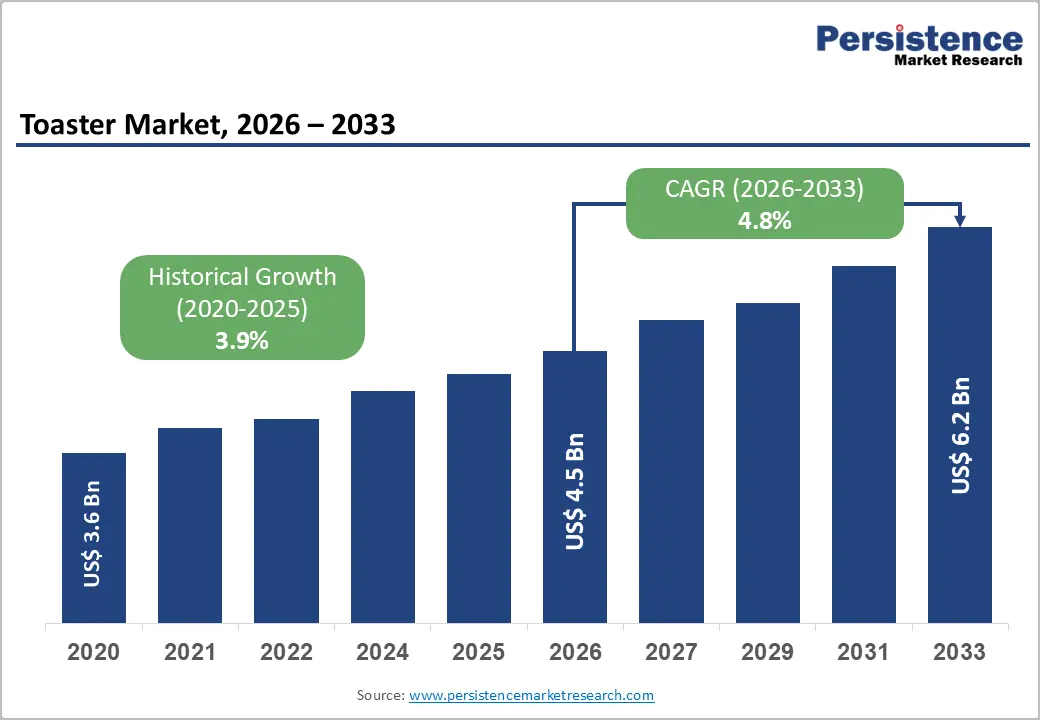
The global Toaster market size is likely to be valued at US$ 4.5 billion in 2026 and is expected to reach US$ 6.2 billion by 2033, growing at a CAGR of 4.8% during the forecast period from 2026 to 2033. The toaster market is experiencing sustained growth driven by rising household appliance replacement cycles, expanding middle-class consumer spending on kitchen upgrades, and the growing adoption of multifunctional and smart-connected toaster formats.
Key Industry Highlights:
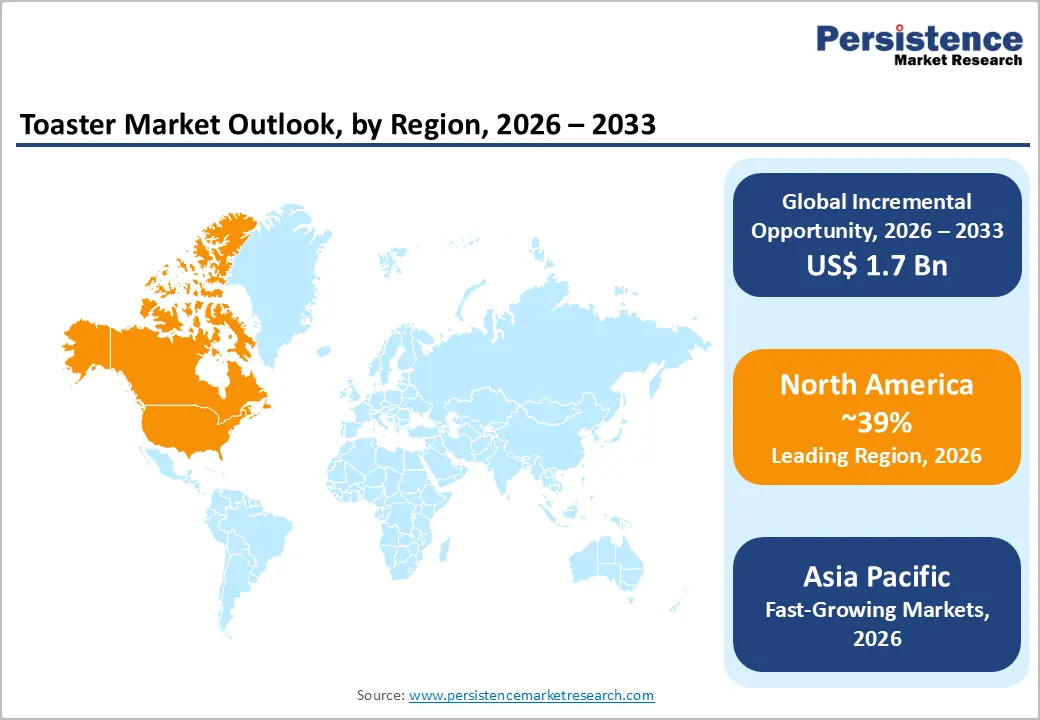
- Leading Region: North America leads the global toaster market, holding 39% share, with near-universal U.S. household penetration tracked by AHAM, strong premium segment demand for Breville and KitchenAid multifunction models, and the U.S. serving as the primary early-adoption market for smart connected toaster technology.
- Fastest Growing Region: Asia Pacific is the fast-growing market, driven by China's urbanizing middle class, India's expanding household appliance adoption, and ASEAN e-commerce growth, providing first-time toaster ownership access across Indonesia, Vietnam, and Thailand.
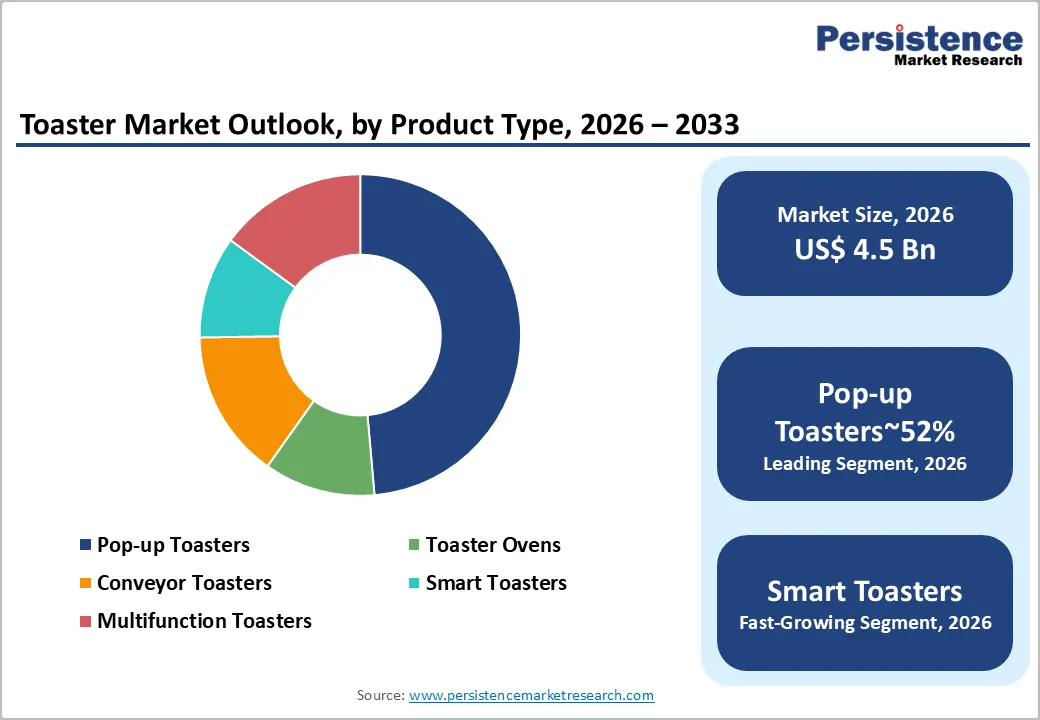
- Dominant Segment: Pop-up toasters lead by product type with approximately 52% market share, driven by universal household adoption, low price entry points, compact footprint, and simple operation that makes them the default first toaster purchase globally across all income levels.
- Fastest Growing Segment: Smart / Connected toasters are the fastest growing technology segment, driven by Consumer Technology Association-validated smart home adoption growth and premium brand launches by Breville and Smeg, integrating Amazon Alexa and Google Home compatibility.
- Key Market Opportunity: Emerging market first-time toaster ownership represents the largest volume growth opportunity, with UN-projected urbanization reaching 68% globally by 2050, and affordable brands Black+Decker, Oster, and Proctor Silex well-positioned to capture expanding Asian and Latin American household appliance markets

Market Dynamics
Drivers - Post-Pandemic Home Cooking Surge and Kitchen Appliance Premiumization
The pandemic-driven transformation of cooking habits has created a structural and lasting uplift in consumer investment in premium kitchen appliances. According to the Association of Home Appliance Manufacturers (AHAM), U.S. household appliance shipments experienced sustained above-trend growth during 2020-2022, driven by consumers equipping home kitchens for increased at-home meal preparation.
This behavioral shift has persisted, with consumers continuing to seek premium, feature-rich countertop appliances. Toasters - as an everyday kitchen essential - have benefited from premiumization trends, with consumers trading up from basic 2-slice pop-up models to 4-slice, long-slot, and multifunction formats. Premium brands including Breville, KitchenAid, and Dualit have reported strong demand for their mid-to-premium toaster lines, reinforcing the market's resilient growth profile through new appliance purchase and replacement cycles.
Expanding Global Foodservice and Quick-Service Restaurant Sector Driving Commercial Toaster Demand
The global foodservice industry's robust expansion is generating significant commercial toaster demand, particularly for high-throughput conveyor and commercial pop-up toasters. The National Restaurant Association (NRA) reported that U.S. restaurant industry sales surpassed US$ 1 trillion in 2023 for the first time. Quick-service restaurants (QSRs), hotel breakfast operations, and institutional food service - all high-frequency toast production environments - rely on commercial conveyor toasters for consistent, high-volume output.
Brands including Waring and Hamilton Beach supply dedicated commercial toaster solutions to this sector. As global hotel occupancy rebounds per the World Tourism Organization (UNWTO) and QSR outlet expansion continues across Asia Pacific, Latin America, and the Middle East, commercial toaster demand is set for sustained incremental growth through 2033.
Restraints - Market Saturation and Long Product Replacement Cycles in Developed Markets
In mature markets including the United States, Germany, and the United Kingdom, toaster penetration is extremely high - approaching near-universal household ownership - and product replacement cycles are typically 5 to 10 years for standard pop-up toasters. This penetration and infrequent replacement dynamic limits unit volume growth in developed markets, making overall market expansion largely dependent on trade-up to premium or multifunction models, rather than new household adoption. The U.S. Bureau of Labor Statistics (BLS) Consumer Expenditure Survey reflects modest annual per-household spending on small kitchen appliances, consistent with infrequent replacement behavior that constrains volume-based growth.
Energy Efficiency Regulatory Pressure and Compliance Costs
Increasingly stringent energy efficiency standards for small household appliances are creating compliance complexity and product development cost pressures for toaster manufacturers. The European Union's Ecodesign Directive and related Energy Labelling Regulation (EU) 2021/341 extend energy performance requirements across small domestic appliances.
In the United States, the U.S. Department of Energy (DOE) periodically reviews appliance energy efficiency standards. While toasters are lower-priority compared to larger appliances, the broader trend toward energy labeling and ecodesign compliance is increasing product development overhead, particularly for smaller manufacturers with limited R&D resources.
Market - Smart and IoT-Connected Toasters Targeting the Premium Home Kitchen Segment
The convergence of smart home technology and kitchen appliance innovation is creating a compelling growth opportunity for connected, IoT-enabled toasters that integrate with broader smart home ecosystems. The Consumer Technology Association (CTA) reported that smart home device adoption in the U.S. has grown consistently, with connected kitchen appliances among the fastest-growing smart home product categories.
Smart toasters - featuring smartphone app control, programmable browning profiles, automatic bread detection, and integration with platforms like Amazon Alexa and Google Home - are gaining consumer interest, particularly among tech-savvy millennial and Gen Z households. Breville's Lift & Look Pro and Smeg's retro-connected toasters represent early movers in this premium connected segment. As smart home penetration deepens globally, connected toasters offering personalization and remote operation represent a high-margin growth avenue for premium appliance brands.
Emerging Market Household Appliance Adoption and Urbanization
Rapid urbanization and rising middle-class household incomes across Asia Pacific, Latin America, the Middle East and Africa are creating significant new first-time toaster ownership opportunities. The United Nations projects that global urban population will reach 68% of total world population by 2050, with urbanization rates highest in emerging economies.
Urban households in China, India, Indonesia, Brazil, and the Gulf states are increasingly adopting Western breakfast habits - where toast is a staple - alongside purchasing entry-level and mid-range toasters for newly equipped kitchens. The expanding modern retail and e-commerce infrastructure in these markets, alongside affordable product ranges from Black+Decker, Oster, and Proctor Silex, is making toaster ownership accessible to a rapidly expanding new consumer base.
Category-wise Analysis
By Product Type Insights
Pop-up Toasters dominate the toaster market by product type, commanding an estimated market share of approximately 52%. The pop-up toaster's dominance reflects its universal positioning as the most compact, affordable, and functionally straightforward toasting appliance for everyday household use. Its simple operation - requiring no learning curve - and low price entry point make it the default appliance choice for initial household appliance purchases globally.
The Association of Home Appliance Manufacturers (AHAM) consistently tracks pop-up toasters as one of the highest household penetration small appliances in developed markets. Brands including Hamilton Beach, Black+Decker, Russell Hobbs, and Morphy Richards maintain dominant mass-market positions in the pop-up segment through competitive pricing and extensive retail distribution.
By Slice Capacity Insights
2-Slice toasters lead the slice capacity segment with an estimated market share of approximately 55%. The 2-slice format is the most compact and affordable toaster configuration, making it the standard choice for single-person and small households - the predominant household type across developed markets.
A single-person households represent the most common household type in the European Union, accounting for approximately 34% of all EU households, a demographic that almost exclusively purchases 2-slice appliances. The U.S. Census Bureau similarly identifies single-person and two-person households as the largest household size categories in the United States. This household size trend reinforces the 2-slice format's market leadership, despite the growing popularity of 4-slice models in family-oriented households.
By Technology Analysis
Electric toasters represent the dominant technology segment, accounting for an estimated 78% of the global toaster market. Virtually all modern residential and commercial toasters are electrically powered, as electrical heating elements provide precise, controllable, and efficient heat delivery for consistent toasting performance.
The International Electrotechnical Commission (IEC) establishes safety standards for electrically heated kitchen appliances including toasters under IEC 60335-2-9, which governs global product certification. Standard electric toasters with adjustable browning controls remain the overwhelming majority of unit sales globally. The Smart / Connected technology segment is the fastest growing, driven by consumer demand for programmable browning profiles and smart home integration, though it currently represents a small share of the overall market dominated by conventional electric models.
By Application Insights
Residential applications dominate the toaster market, accounting for an estimated 72% of total market revenue. The residential segment encompasses household pop-up toasters, toaster ovens, and multifunction toasters purchased for individual and family kitchen use - the foundational demand driver for the overall market.
The U.S. Energy Information Administration (EIA) Residential Energy Consumption Survey (RECS) identifies toasters as among the most universally owned small kitchen appliances across American households. While residential dominates by volume, the Commercial segment commands higher per-unit revenue through professional-grade conveyor toasters and heavy-duty commercial pop-up models. Foodservice growth through QSR and hotel sector expansion, particularly in emerging markets, is driving the commercial segment's above-average growth rate within the toaster market.
By Distribution Channel Insights
Offline distribution channels retain the leading share of toaster sales, estimated at approximately 60%. Physical retail - spanning electronics specialty stores, hypermarkets, department stores, and home appliance chains - remains the primary purchase environment for toasters, where consumers can assess product build quality, size, and design aesthetics in person before committing to a purchase.
Major retailers, including Best Buy (USA), John Lewis (UK), Media Markt (Europe), and Boulanger (France) provide dedicated kitchen appliance sections that anchor offline toaster sales. The Online channel is the fast-growing distribution segment, driven by e-commerce growth through Amazon, brand direct websites, and emerging market online platforms, offering competitive pricing and extensive product review content that facilitates informed online toaster purchases.
Regional Insights
North America Toaster Market Trends and Insights
North America is the largest regional toaster market, driven by near-universal household penetration and strong replacement demand. The U.S. dominates with high adoption of premium toaster ovens and multifunctional appliances. Smart and connected toasters are gaining traction, while strict safety certifications and energy efficiency expectations support steady market growth and product innovation.
- United States Toaster Market Size
The U.S. accounts for approximately 78% of the North American toaster market, valued at around US$ 1.3 billion in 2026. Growth is driven by premiumization, replacement cycles, and demand for multifunctional countertop appliances. Increasing adoption of smart kitchen devices and strong retail distribution further support sustained market expansion.
Europe Toaster Market Trends and Insights
Europe is the second-largest toaster market, supported by strong toast consumption habits and high appliance ownership across households. Demand is driven by energy-efficient designs under EU regulations and premium brand positioning. Established domestic brands and strong retail networks enable stable growth, with increasing focus on sustainability and product durability.
- Germany Toaster Market Size
Germany represents a leading European market, contributing around 22% of the regional share, with an estimated value of US$ 330 million in 2026. Growth is supported by strong retail distribution, consumer preference for durable appliances, and rising demand for energy-efficient toaster models aligned with EU regulations.
- United Kingdom Toaster Market Size
The U.K. holds approximately 25% of the European toaster market, valued at US$ 380 million in 2026. High household penetration and strong toast consumption culture drive consistent replacement demand. Premium heritage brands and consumer preference for stylish, high-performance appliances support steady growth.
- France Toaster Market Size
France contributes about 12% of the European market, with an estimated size of US$ 210 Million in 2026. Growth is driven by premium appliance demand, aesthetic-focused product designs, and increasing adoption of energy-efficient kitchen appliances in urban households.
Asia Pacific Toaster Market Trends and Insights
Asia Pacific is the fastest-growing toaster market, fueled by urbanization, rising disposable incomes, and evolving breakfast habits. E-commerce expansion and increasing first-time appliance purchases drive growth. The region benefits from both strong manufacturing capabilities and growing domestic demand, with premiumization emerging in developed markets.
- China Toaster Market Size
China accounts for approximately 33% of the Asia Pacific toaster market, valued at US$ 480 Million in 2026. Growth is driven by expanding middle-class consumption, strong e-commerce penetration, and its dual role as a major manufacturing hub and rapidly growing consumer market.
- India Toaster Market Size
India represents around 12% of the regional market, with an estimated value of US$ 150 Million in 2026. Growth is driven by urbanization, increasing adoption of modern kitchen appliances, and changing breakfast habits. Rising e-commerce usage and affordable product offerings further accelerate market penetration.
- Japan Toaster Market Size
Japan contributes approximately 20% of the Asia Pacific market, valued at US$ 270 Million in 2026. The market is characterized by demand for compact, high-performance, and energy-efficient toaster ovens. Premiumization and technological innovation remain key growth drivers in this mature yet sophisticated market.
Competitive Landscape
The toaster market is moderately fragmented, with no single brand holding a globally dominant position across all segments and geographies. Premium tier leadership is held by Breville, KitchenAid, De'Longhi, and Smeg, competing on design, materials quality, and feature innovation. The mass market is competitive, with Hamilton Beach, Black+Decker, Oster, Russell Hobbs, and Morphy Richards competing primarily on price and retail distribution scale.
Key differentiators include heating element technology (quartz vs. nichrome), build quality, warranty, smart connectivity, and design aesthetics. R&D focus areas include smart connected technology, energy efficiency improvements, and multifunctionality. Brand licensing and geographic expansion partnerships are emerging strategies for mid-tier brands targeting Asia Pacific growth markets.
Key Developments:
- February, 2025: Breville launched the updated Lift & Look Pro smart toaster with enhanced AI-powered browning sensor technology and expanded smart home platform compatibility, targeting the North American and European premium connected kitchen appliance segment.
- September, 2024: De'Longhi introduced a new Icona Capitals collection toaster range featuring energy-efficient quartz heating elements and EU Ecodesign-compliant standby power specifications, aligned with European regulatory requirements and premium consumer design preferences.
- April, 2024: Hamilton Beach expanded its commercial toaster range with a new high-throughput conveyor toaster model targeting hotel and QSR foodservice customers in North America and Asia Pacific, responding to the foodservice sector's post-pandemic capacity expansion.
Global Toaster Market – Key Insights & Details
| Key Insights | Details |
|---|---|
|
Historical Market Value (2020) |
US$ 3.6 Billion |
|
Current Market Value (2026) |
US$ 4.5 Billion |
|
Projected Market Value (2033) |
US$ 6.2 Billion |
|
CAGR (2026–2033) |
4.8% |
|
Leading Region |
North America (39.0%) |
|
Dominant Product Type |
Pop-up Toasters (52.0%) |
|
Top-ranking Slice Type |
2-Slice (55.0%) |
|
Top-ranking Technology |
Electric (78.0%) |
|
Top-ranking Application |
Residential (72.0%) |
|
Top-ranking Distribution Channel |
Offline (60.0%) |
|
Incremental Opportunity (2026–2033) |
US$ 1.7 Billion |
Companies Covered in Toaster Market
- KitchenAid
- Cuisinart
- Breville
- Dualit
- Smeg
- Black+Decker
- Oster
- Hamilton Beach
- Proctor Silex
- Chefman
- Russell Hobbs
- Morphy Richards
- De'Longhi
- Krups
- Waring
- Kenwood Limited
- Panasonic Corporation
- Sunbeam Products
Frequently Asked Questions
The global toaster market is estimated to be valued at US$ 4.5 Billion in 2026 and is projected to reach US$ 6.2 Billion by 2033, expanding at a CAGR of 4.8% during the forecast period.
The primary drivers are the post-pandemic home cooking and kitchen appliance premiumization trend - with AHAM tracking sustained above-trend small appliance growth in the U.S. - and the global foodservice industry expansion, with the NRA reporting U.S. restaurant sales surpassing US$ 1 trillion in 2023, driving significant commercial conveyor and high-throughput toaster demand from QSRs and hotel food service operations globally.
Pop-up Toasters lead the toaster market by product type with approximately 52% share, driven by their universal household adoption as the most affordable, compact, and operationally simple toasting appliance. AHAM identifies toasters as among the highest household penetration small kitchen appliances in developed markets, with pop-up models representing the default first-purchase and replacement choice across all income segments globally.
North America leads the global toaster market, with the United States' near-universal household toaster penetration, strong consumer spending on premium kitchen appliances tracked by AHAM, and a vibrant premium appliance innovation ecosystem anchored by Breville, KitchenAid, and Cuisinart positioning the U.S. as both the largest national toaster market and the primary global smart toaster launch market.
Smart and IoT-connected toasters represent the highest-margin growth opportunity in developed markets, with CTA-validated smart home adoption growth and premium brand launches integrating Amazon Alexa and Google Home compatibility. In emerging markets, first-time toaster ownership driven by UN-projected urbanization reaching 68% globally by 2050 represents the largest volume growth opportunity for affordable mass-market brands.
Key companies include KitchenAid, Cuisinart, Breville, Dualit, Smeg, Black+Decker, Oster, Hamilton Beach, Proctor Silex, Chefman, Russell Hobbs, Morphy Richards, De'Longhi, Krups, and Waring, spanning premium heritage brands in North America and Europe to mass-market global appliance manufacturers serving emerging market growth opportunities.


