




- Off-Road Equipment & Machinery
- Ship to Shore Cranes Market
Ship to Shore Cranes Market Size, Share, and Growth Forecast, 2026 - 2033
Ship to Shore Cranes Market by Product Type (High Profile Cranes, Low Profile Cranes), Power Supplies (Diesel, Electric, Hybrid), Lifting Capacity (Panamax STS Cranes, Others), and Regional Analysis for 2026 - 2033

Ship to Shore Cranes Market Size and Trends Analysis
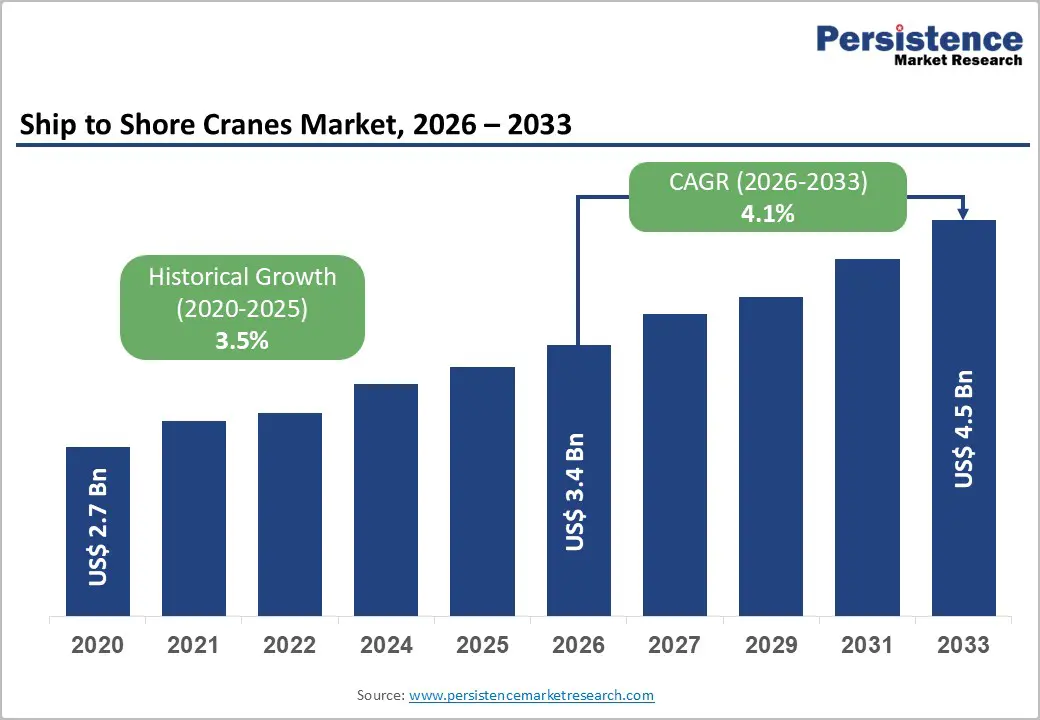
The global ship to shore cranes market size is likely to be valued at US$3.4 billion in 2026, and is expected to reach US$4.5 billion by 2033, growing at a CAGR of 4.1% during the forecast period from 2026 to 2033, driven by surging global container trade volumes, port modernization programs to accommodate mega-vessels, and rising demand for efficient, automated cargo-handling solutions. Increasing adoption of advanced ship-to-shore cranes for faster turnaround times in busy ports and the shift toward sustainable power options remain major drivers of market growth.
Key Industry Highlights:
- Leading Region: Asia Pacific, anticipated to account for a 45% market share in 2026, driven by massive port expansions in China and India.
- Fastest-growing Region: Asia Pacific, fueled by infrastructure investments and rising trade activity.
- Dominant Product Type: High-Profile Cranes, holding approximately 52% of the market share, as they remain the preferred choice for handling larger container ships.
- Leading Power Supply: Diesel, set to dominate due to proven reliability and widespread availability.
| Key Insights | Details |
|---|---|
| Ship to Shore Cranes Market Size (2026E) | US$3.4 Bn |
| Market Value Forecast (2033F) | US$4.5 Bn |
| Projected Growth CAGR (2026 - 2033) | 4.1% |
| Historical Market Growth (2020 - 2025) | 3.5% |
Market Factors - Driver, Restraint, and Opportunity Analysis
Driver Analysis - Growth in Global Trade & Containerization
The expansion of international trade and the increasing reliance on containerized shipping have created a substantial demand for efficient port operations. As global commerce grows, the volume of goods transported across oceans rises, requiring ports to handle larger numbers of containers in shorter time frames. This necessitates the deployment of high-capacity, reliable ship-to-shore cranes that can load and unload vessels quickly, minimizing vessel turnaround time and reducing congestion at busy ports. Containerization standardizes cargo handling, enabling smoother transfer between ships, trucks, and rail, which in turn drives ports to invest in cranes capable of precise, high-speed operations.
The growth of e-commerce and global supply chains has intensified the pressure on ports to maintain timely shipments, further elevating the importance of automated and technologically advanced crane systems. Ports adopting modern cranes can handle larger vessels and increased container throughput, directly supporting trade efficiency and competitiveness. The trend toward larger ships, such as Ultra-Large Container Vessels (ULCVs), also pushes ports to upgrade their equipment to cranes with extended outreach and higher lifting capacities. Overall, the evolution of international trade and containerization acts as a primary driver, influencing port modernization strategies and fostering continuous investment in advanced ship-to-shore crane infrastructure.
Port Infrastructure Expansion
The modernization and expansion of port facilities have become essential to accommodate growing maritime traffic and larger vessels. As international trade intensifies, ports are under pressure to increase their handling capacity, reduce vessel turnaround times, and maintain operational efficiency. Upgrading infrastructure often involves extending berths, reinforcing quays, dredging deeper channels, and installing advanced cargo handling equipment, including high-capacity ship-to-shore cranes. These improvements enable ports to serve larger container ships and higher cargo volumes without bottlenecks, supporting smoother logistics and supply chain continuity.
Alongside physical expansion, ports are increasingly investing in integrated terminal systems to enhance container movement and storage efficiency. These systems include optimized yard layouts, automated stacking solutions, and real-time tracking technologies that coordinate with modern cranes to streamline workflows. Expansion initiatives also emphasize sustainability, incorporating energy-efficient equipment and environmentally friendly designs to minimize the ecological impact of port operations. In emerging economies, such infrastructure upgrades play a critical role in attracting global shipping lines, improving trade competitiveness, and supporting overall economic growth.
Restraint Analysis - High Capital Investment & Cost Barriers
Acquiring and operating ship-to-shore cranes requires significant financial commitment, which can be a major challenge for many ports. These cranes are complex, heavy-duty machines with advanced mechanical, electrical, and control systems, making their purchase price extremely high. Beyond the initial investment, ports must also consider ongoing costs, including installation, regular maintenance, spare parts, and skilled labor for operations. Smaller ports or those with limited budgets may struggle to justify the expense, delaying modernization or expansion projects.
The long payback period further increases financial risk, as returns on investment depend on consistent cargo volumes and efficient operations over several years. Upgrading existing infrastructure to support these cranes, such as reinforcing quays or expanding storage areas, increases overall expenditure.
Technical & Operational Complexity
Modern ship-to-shore cranes are highly sophisticated machines that combine mechanical, electrical, and digital systems, making their operation and maintenance complex. Effective use requires skilled personnel trained in both equipment handling and troubleshooting advanced control systems. Ports with insufficiently trained staff may experience operational inefficiencies, downtime, or even safety risks during crane operations.
The integration of automation, remote monitoring, and digital management systems adds further layers of complexity. Ensuring seamless communication between cranes, terminal operating systems, and other equipment requires careful configuration and regular updates. Even minor technical issues can disrupt container handling schedules, affecting overall port productivity.
Opportunity Analysis - Upgrading to Higher Capacity Cranes
As global shipping trends evolve, ports increasingly face the need to handle larger vessels with higher container capacities. Standard cranes often struggle to reach across the wider beams of modern container ships or lift heavier container loads efficiently. To maintain operational efficiency and reduce vessel turnaround times, ports are turning to higher-capacity ship-to-shore cranes. These cranes are designed with extended outreach, increased lifting height, and greater load-bearing capabilities, enabling them to service Ultra-Large Container Vessels (ULCVs) and accommodate diverse cargo types.
Upgrading to higher-capacity cranes allows ports to manage larger cargo volumes without increasing the number of cranes, thereby optimizing space and labor utilization. Modern designs often incorporate advanced control systems, automation, and energy-efficient features, which improve precision, reduce operational costs, and enhance safety during handling operations. The move toward higher capacity cranes is also driven by competitive pressures, as ports aim to attract shipping lines that operate the largest vessels.
Automation & Technological Advancements
Modern ship-to-shore cranes have evolved far beyond basic mechanical lifting, incorporating advanced technologies that improve efficiency, safety, and precision in port operations. Automation enables cranes to perform repetitive tasks with minimal human intervention, reducing errors and increasing container-handling speed. Operators can now control cranes remotely or rely on semi-autonomous systems that optimize movements, ensuring smoother and faster loading and unloading of vessels.
Integration with digital platforms enhances coordination across the entire terminal. Sensors, cameras, and real-time monitoring systems provide critical data on crane position, load weight, and operational status, enabling predictive maintenance and reducing downtime. Advanced software also allows for intelligent scheduling and path optimization, minimizing bottlenecks and maximizing throughput. Technological improvements extend to energy efficiency, with regenerative braking systems and optimized power management reducing electricity consumption and operational costs. Safety is also enhanced through collision detection, anti-sway mechanisms, and automated emergency stops, which protect both cargo and personnel.
Category-wise Analysis
Product Type Insights
High-profile cranes are anticipated to dominate the ship-to-shore cranes market, accounting for 52% of the market share in 2026, owing to their extended outreach and ability to handle larger container vessels effectively. Their taller structure and longer boom allow them to service ultra-large ships, reaching across wider beams and higher container stacks. This capability reduces the need for multiple cranes, improves operational efficiency, and shortens vessel turnaround times. Liebherr’s supply of advanced high-capacity ship-to-shore cranes to major U.S. ports. In 2024, Liebherr delivered two modern STS cranes to the Port Newark Container Terminal, designed specifically to handle the next generation of ultra-large container vessels with extended outreach and lifting capacity.
Low-profile cranes represent the fastest-growing segment, driven by adaptability in ports with height restrictions or space constraints. Their shorter structure allows them to operate under airspace limitations, near bridges, or in urban port environments where taller cranes are impractical. Despite their smaller size, modern low-profile cranes are equipped with advanced automation, precise handling systems, and sufficient lifting capacity for medium-sized vessels. Shanghai Zhenhua Heavy Industries Co., Ltd. (ZPMC) is supplying low-profile shi-toshore cranes to Port Everglades in Florida. To comply with height restrictions near Fort Lauderdale-Hollywood International Airport, ZPMC designed and delivered cranes with a fixed, extended boom that operates without a tall superstructure, allowing them to reach 22 containers across a ship while keeping overall height low to avoid interfering with aircraft flight paths.
Power Supplies Insights
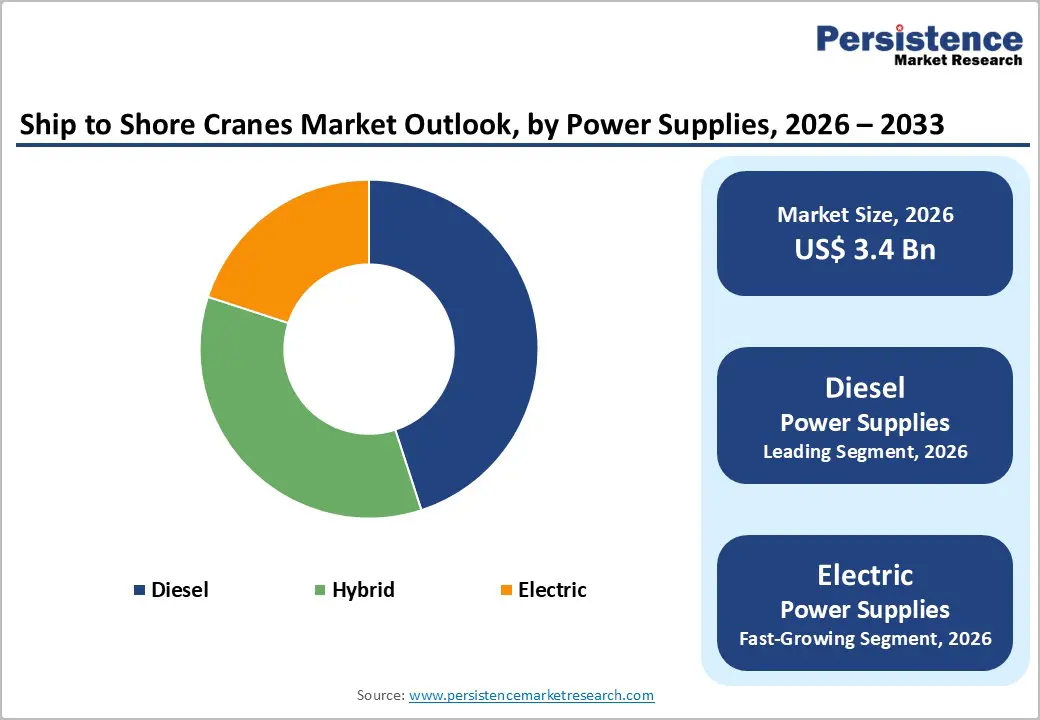
Diesel power supplies are expected to dominate, with over 45% share in 2026, fueled by their proven reliability and ability to operate continuously in high-throughput environments. These cranes can deliver consistent power for lifting heavy containers without relying on the electrical grid, making them ideal for busy terminals or regions with unstable power supply. Diesel engines provide robust performance under varying weather conditions and long operational hours, ensuring minimal downtime. Liebherr’s LHM series of mobile harbour cranes. These cranes, used widely in seaports for lifting containers and other cargo, are available with diesel engines as the primary power source, providing strong torque and reliable output even in locations where electrical infrastructure may be limited or unstable.
Electric power supplies are emerging as the fastest-growing option, supported by their energy efficiency, lower operating costs, and reduced environmental impact compared to diesel-powered systems. They draw power directly from the grid or on-site energy storage, providing consistent and controllable performance while minimizing emissions and noise. Electric cranes support advanced automation and precision control, enhancing operational efficiency and safety in modern ports. Konecranes is supplying electric ship-to-shore (STS) cranes to the Port of Savannah in the United States. In early 2025, the Georgia Ports Authority added several new electric STS cranes from Konecranes at the Ocean Terminal, enhancing the port’s ability to serve modern container vessels with efficient, electrically powered handling equipment.
Regional Insights
North America Ship-to-Shore Cranes Market Trends
The North America market is evolving rapidly as ports modernize to handle increasing container volumes and larger vessels. Major terminals, including those in Los Angeles, Long Beach, Savannah, and New York-New Jersey, are investing in higher-capacity cranes with extended outreach and advanced automation to improve efficiency and reduce vessel turnaround times. These upgrades allow ports to compete effectively on international trade routes and accommodate the growing size of container ships.
There is also a strong focus on sustainability and energy efficiency. Ports are increasingly adopting electric and hybrid cranes to reduce emissions and operating costs while meeting environmental standards. Integration with digital systems, such as terminal operating platforms and real-time monitoring, enhances operational precision, predictive maintenance, and overall productivity. North American ports are navigating operational challenges, including labor availability, infrastructure constraints, and regulatory compliance. These factors are encouraging investment in versatile, technologically advanced cranes that can adapt to changing trade patterns and ensure consistent throughput.
Europe Ship-to-Shore Cranes Market Trends
Market growth in Europe is characterized by a strong emphasis on port modernization, sustainability, and technological innovation. European ports are focused on handling increased cargo volumes while meeting stringent environmental standards. As a result, many terminals are investing in electric and hybrid STS cranes that reduce emissions and noise, and allow integration with renewable energy infrastructure. This transition supports broader European climate goals and helps ports lower operating costs associated with fuel and maintenance.
The growing adoption of automation and digitalization is transforming port operations across Europe. Major hubs such as Rotterdam, Antwerp, and Hamburg are leveraging advanced crane control systems, remote operation capabilities, and real-time data analytics to enhance handling efficiency and safety. These technologies enable more precise container movements, support predictive maintenance, and improve coordination between cranes and terminal operating systems. European terminals are also adapting to accommodate larger container vessels, driving demand for cranes with extended outreach and higher lifting capacities to efficiently service ultra-large ships. There is also increasing interest in low-profile crane designs, particularly in ports with height restrictions or those located in densely populated urban environments.
Asia Pacific Ship-to-Shore Cranes Market Trends
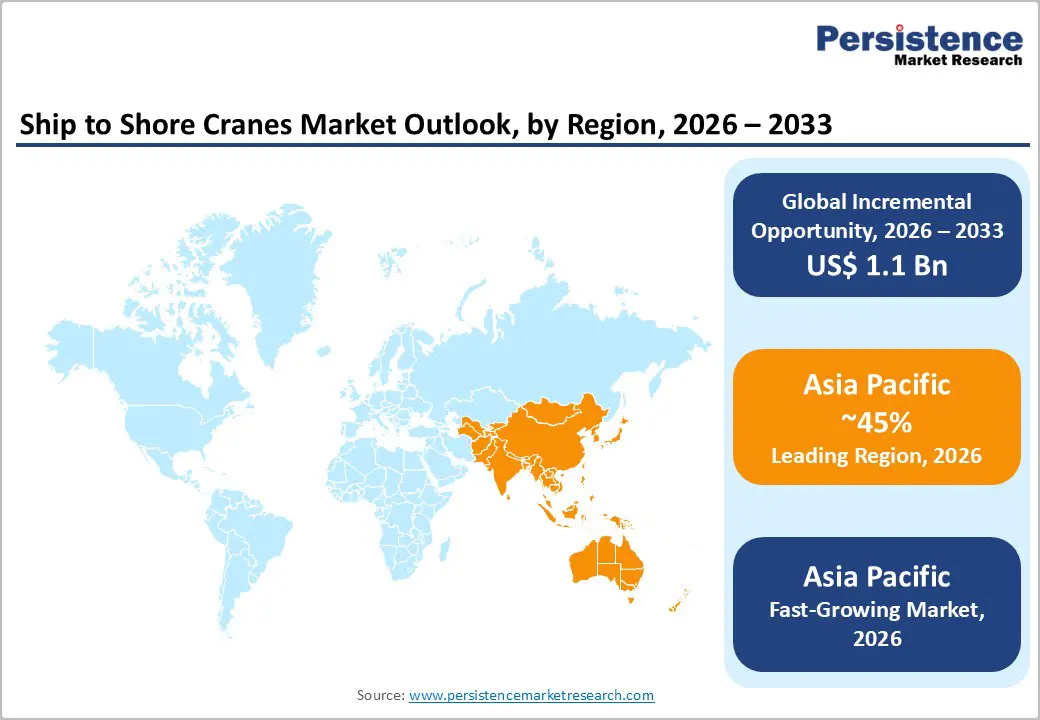
Asia Pacific is projected to dominate and be the fastest-growing region, capturing 45% share in 2026. Ship-to-shore crane development is closely tied to the rapid expansion of container ports, increasing trade flows, and fleet upsizing. As the busiest and fastest-growing trade corridor globally, Asia Pacific ports are continually upgrading terminal equipment to handle surging cargo volumes, especially from China, Southeast Asia, and India. Major gateways in Shanghai, Singapore, and Busan are replacing older cranes with higher-capacity and extended-reach STS cranes that can service the latest generation of large container vessels efficiently and reduce vessel dwell times.
There is also a significant focus on automation and digital integration. Terminals in the region are adopting advanced control systems, remote operation technologies, and real-time analytics to improve productivity and safety while meeting high-throughput demands. These digital enhancements help streamline operations and optimize crane utilization across complex, multi-shift port environments. Environmental sustainability is another key trend. Many ports are transitioning to electric-powered cranes and incorporating energy-saving features to reduce emissions, noise, and operating costs in densely populated coastal areas.
Competitive Landscape
The global ship-to-shore cranes market is intensely competitive, driven by the need to serve growing container volumes and increasingly larger vessels. Leading multinational manufacturers, alongside regional specialists, continuously invest in innovation to offer cranes with higher lifting capacities, extended outreach, and advanced automation capabilities. Companies differentiate themselves through engineering excellence, ensuring their cranes operate reliably under high-throughput conditions and challenging environments.
Sustainability is a key competitive factor, with manufacturers developing electric and hybrid crane models to reduce emissions, energy consumption, and operational costs. Firms also emphasize after-sales support, including maintenance, spare parts availability, and training programs, which are critical for ensuring continuous port operations. Strategic partnerships with ports and terminal operators allow companies to tailor crane designs to specific operational, spatial, or regulatory requirements, enhancing efficiency and productivity.
Key Industry Developments:
- In February 2026, Liebherr Container Cranes Ltd. completed a major crane raise project at Forth Ports Grangemouth. The company increased the lift height of two ship-to-shore (STS) gantry cranes by 2.2 metres, enhancing operational capabilities at Scotland’s largest container port.
- In December 2025, Liebherr built new cranes at its Killarney, Ireland, facility, featuring a 60 m outreach, 50 m lift height, 20 m back reach, and a 65-tonne twin-lift capacity to handle larger vessels efficiently. Equipped with anti-collision, anti-sway, snag-load protection, and a curve-going gantry system, they ensured stable operations. Advanced remote diagnostics, predictive maintenance, and ship-profiling technology further optimized performance and reliability.
Companies Covered in Ship to Shore Cranes Market
- Anupam Industries Limited
- Bekaert
- Dana Limited
- HD Hyundai Samho Co., Ltd.
- Konecranes
- Liebherr Group
- Paceco Corp.
- SANY Group
- Shanghai Zhenhua Heavy Industries Co., Ltd.
Frequently Asked Questions
The global ship to shore cranes market is projected to reach US$3.4 billion in 2026.
The ship to shore cranes market is primarily driven by expanding global maritime trade and the need for faster cargo handling at busy ports. Port authorities are upgrading facilities to accommodate larger vessels, while sustainability goals accelerate the shift toward electric and hybrid cranes.
The ship to shore cranes market is poised to witness a CAGR of 4.1% from 2026 to 2033.
Key opportunities in the ship to shore cranes market lie in electric and hybrid crane adoption driven by green port initiatives.
Key players in the ship to shore cranes market include Konecranes, Liebherr Group, Shanghai Zhenhua Heavy Industries Co., Ltd., SANY Group, and Paceco Corp. These companies lead through advanced engineering, global service networks, and focus on sustainable solutions.


