




- Clothing, Footwear, & Accessories
- Second Hand Apparel Market
Second Hand Apparel Market Size, Share, and Growth Forecast 2026 - 2033
Second Hand Apparel Market by Product Type (Tops & T-Shirts, Bottom Wear, Dresses & Ethnic Wear, Jackets & Coats, Loungewear & Sleepwear, Activewear), Category (Men’s Wear, Women’s Wear, Kids’ Wear, Unisex), Price Segment (Budget, Mid-range, Premium/Luxury), Sales Channel (Online Platforms, Offline Platforms), and Regional Analysis, 2026 - 2033

Second Hand Apparel Market Size and Trend Analysis
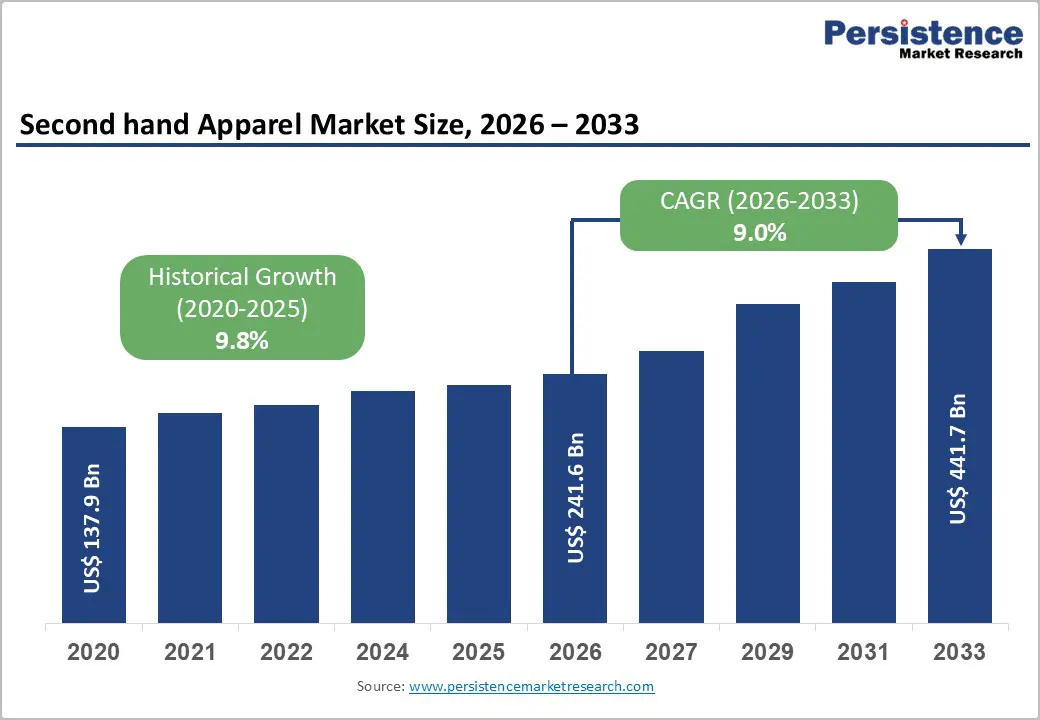
The global second hand apparel market size is expected to be valued at US$ 241.6 billion in 2026 and projected to reach US$ 441.7 billion by 2033, growing at a CAGR of 9.0% between 2026 and 2033. This robust expansion is primarily propelled by a structural reorientation in global consumer behavior toward sustainable and circular fashion, wherein a growing proportion of shoppers, particularly Gen Z and Millennial demographics, are actively choosing pre-owned clothing to reduce textile waste and personal carbon footprints.
The proliferation of mobile-first digital resale platforms, growing institutional involvement through brand-owned recommerce programs, and rising regulatory focus on textile circularity are further amplifying market reach across both developed and emerging economies.
Key Industry Highlights
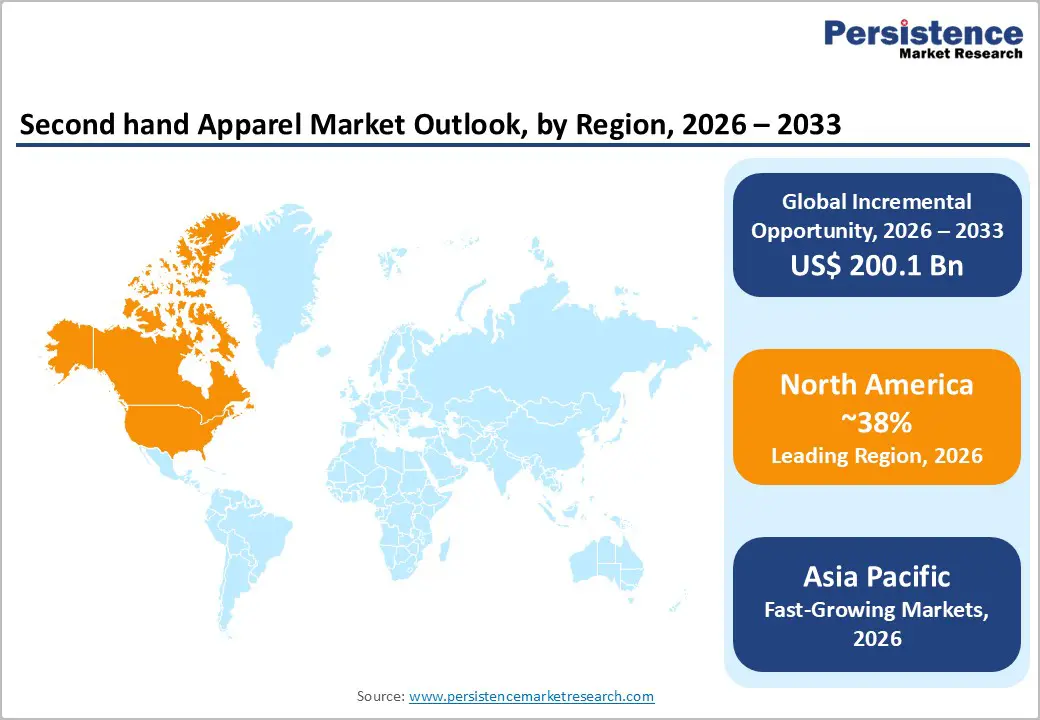
- Leading Region: North America leads the global second hand apparel market with approximately 38% revenue share in 2025, underpinned by a mature thrift retail culture, established digital resale platforms, and strong consumer demand for sustainable fashion alternatives driven by growing environmental awareness.
- Fastest Growing Region: Asia Pacific is the fastest growing region in the second hand apparel market through 2033, propelled by China’s expansive resale platform ecosystem, India’s rapidly growing middle class, and accelerating mobile commerce adoption across Southeast Asian economies.
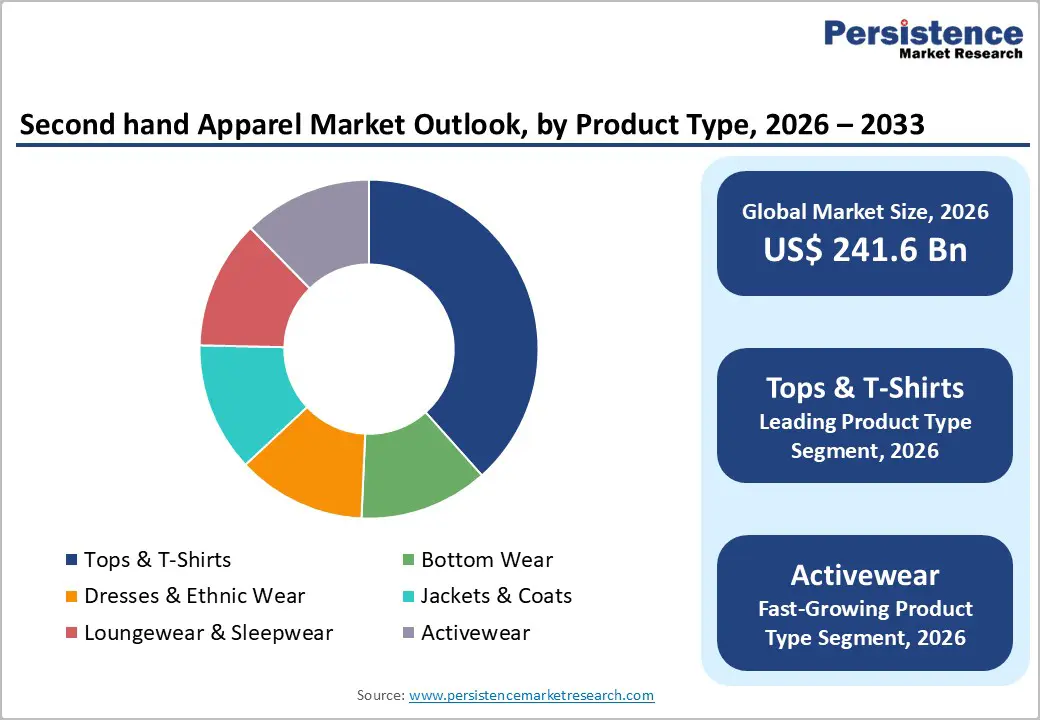
- Dominant Product Type: Tops & T-Shirts dominate the product type segmentation with approximately 35% global market share in 2025, reflecting high wardrobe turnover, universal cross-demographic demand, and ease of condition assessment across both digital peer-to-peer and offline thrift retail channels.
- Fastest Growing Sales Channel: Online Platforms are the fastest growing sales channel in the second hand apparel market, fueled by mobile-first resale applications, AI-driven product discovery, and the global expansion strategies of platforms such as ThredUp, Poshmark, and Vinted attracting digital-native consumer cohorts.
- Key Market Opportunity: Brand-owned recommerce programs and luxury authentication technology represent the most transformative market opportunity, enabling platform operators and fashion brands to capture premium resale margins while meeting escalating consumer demand for verified sustainable luxury fashion alternatives.

Market Dynamics
Drivers - Accelerating Consumer Shift Toward Sustainable and Circular Fashion
The global fashion industry contributes approximately 10% of annual global carbon emissions and is among the largest consumers of freshwater resources, according to the United Nations Environment Programme (UNEP). This environmental reckoning has catalyzed a sweeping consumer pivot toward secondhand apparel as a responsible alternative to fast fashion.
A 2024 ThredUp Resale Report revealed that 52% of consumers surveyed had purchased secondhand clothing in the past year, up from 45% just two years earlier. Advocacy by organizations such as the Ellen MacArthur Foundation has mainstreamed circular economy principles across retail supply chains, while sustainability-linked campaigns by apparel brands are reinforcing behavioral change. This confluence of awareness, policy momentum, and evolving consumer values is establishing secondhand fashion as a mainstream consumer segment rather than a niche category.
Digital Resale Infrastructure and Platform Technology Expansion
The digitization of the secondhand clothing sector has been arguably the single most transformative catalyst for the second hand apparel market. Platforms such as ThredUp, Poshmark, Vinted, and Vestiaire Collective have systematically lowered barriers to entry for buyers and sellers through AI-assisted listing tools, dynamic pricing engines, and trust-building authentication services.
According to Statista, global e-commerce revenues exceeded US$ 5.8 trillion in 2023, with fashion resale emerging as one of its fastest-growing sub-segments. Integration of machine learning algorithms for personalized product recommendations, augmented reality (AR) for virtual try-ons, and blockchain-based provenance verification are collectively enhancing user experience, boosting conversion rates, and expanding the addressable buyer base for secondhand apparel commerce on a global scale.
Restraints - Quality Inconsistency and Consumer Trust Deficits
A persistent challenge restraining broader adoption in the second hand apparel market is the lack of standardized product condition grading across resale channels. Unlike new apparel retail, where consistent quality benchmarks are enforced, secondhand items vary significantly in wear level, hygiene standards, and authenticity, particularly in the mid-to-lower price tiers.
Research published in the Journal of Consumer Psychology found that approximately 38% of potential secondhand buyers cite concerns over product hygiene and undisclosed defects as key purchase deterrents. While premium platforms such as The RealReal and Vestiaire Collective have invested heavily in physical inspection and authentication services, the broader offline thrift market lacks uniform grading frameworks, creating a systemic trust gap that limits new customer acquisition and repeat purchase frequency across the value chain.
Operational Complexity and Elevated Logistics Costs
Managing the logistics of a large inventory of unique, non-standardized items presents formidable operational challenges for secondhand apparel businesses at scale. Unlike conventional fashion retail that benefits from bulk inventory efficiencies, resale platforms must process, photograph, grade, and warehouse individual one-off garments, driving disproportionately high per-unit fulfillment costs.
Industry-level data indicates that return rates in the online secondhand apparel channel range between 15% and 20%, driven primarily by fit discrepancies and product misrepresentation in item listings. These elevated return rates and logistics overheads compress platform margins, constrain seller incentives, and limit the scalability of digital resale operations, posing a structural headwind to rapid market expansion, particularly in categories with high size sensitivity such as bottoms and ethnic wear.
Opportunities - Luxury Resale and Advanced Authentication Technology
The premium and luxury secondhand apparel segment represents one of the most compelling high-margin growth opportunities in the broader resale market. A study by Bain & Company in collaboration with Altagamma reported that the global personal luxury goods market surpassed €362 billion in 2023, with its resale counterpart growing at nearly twice the rate of primary luxury retail. Advanced authentication technologies powered by artificial intelligence (AI), blockchain ledger verification, and NFC (Near Field Communication) tagging are rapidly resolving the trust deficit that historically constrained luxury resale transaction volumes.
Platforms investing in these capabilities are positioned to levy premium service fees and cultivate high-lifetime-value customer segments. As younger affluent consumers, particularly Gen Z and younger Millennials, increasingly normalize secondhand luxury over new retail, this segment stands to generate disproportionate incremental revenue through the forecast period.
Brand-Owned Recommerce and Resale-as-a-Service (RaaS) Programs
An emerging and highly strategic opportunity for market participants lies in the institutionalization of brand-owned take-back and recommerce programs. Leading fashion brands including Patagonia, Levi Strauss & Co., and Eileen Fisher have already launched proprietary resale platforms, capturing secondhand margins while reinforcing their sustainability brand equity.
According to the Global Fashion Agenda, over 40% of fashion brands surveyed in 2024 were either actively piloting or scaling circular recommerce initiatives. This trend is creating a robust B2B revenue stream for specialized Resale-as-a-Service (RaaS) providers that supply logistics, technology, and platform infrastructure to brands entering the secondhand space. For platform operators and logistics specialists, partnering with fashion brands seeking plug-and-play recommerce solutions represents a scalable, asset-light growth avenue with strong defensibility.
Category-wise Analysis
Product Type Insights
Tops & T-Shirts dominate the second hand apparel market by product type, commanding approximately 35% of global market share in 2025. This market leadership is attributable to the universally high wardrobe turnover rate for casual tops, driven by seasonal fashion cycles, trend sensitivity, and the near-commodity nature of the segment.
Data from the ThredUp 2024 Resale Report confirmed that casual wear, including tops and T-shirts, consistently ranks as the most-listed and most-transacted category on peer-to-peer resale platforms globally. The segment benefits from low authenticity concerns, straightforward condition assessment, and broad cross-demographic demand, making it the highest-volume category across both digital platforms and brick-and-mortar thrift environments. Activewear represents the fastest growing product type segment, propelled by the global athleisure movement and consumers’ growing preference for quality, long-lasting athletic garments acquired through resale channels.
Category Insights
Women’s Wear leads the second hand apparel market within the gender-based category, accounting for approximately 52% of global market share in 2025. Women have historically been the primary drivers of secondhand fashion adoption, reflecting higher purchase frequency, broader fashion variety in the women’s assortment, and greater engagement with sustainability-oriented consumption values.
A 2023 YouGov consumer survey indicated that women are 1.7 times more likely than men to have purchased secondhand clothing in the preceding twelve months. Social commerce and influencer-driven resale activity on platforms such as Poshmark and Depop further concentrate secondhand transaction volumes in the women’s segment. The category encompasses a diverse product ecosystem, ranging from casual tops and ethnic wear to premium fashion and accessories, cementing its position as the dominant revenue anchor of the global secondhand apparel market. Kids’ Wear is the fastest growing gender-category segment.
Price Segment Insights
The Mid-range price segment leads the second hand apparel market, representing approximately 45% of global market share in 2025. Mid-range secondhand apparel occupies the optimal intersection of affordability and perceived quality, attracting a broad consumer base that includes budget-conscious shoppers trading up from basic thrift tiers and value-oriented buyers opting out of full-priced mid-market retail.
According to the U.S. Bureau of Labor Statistics, apparel expenditure as a share of household income has remained under sustained downward pressure since 2020, reinforcing demand for competitively priced quality alternatives. The mid-range segment benefits from strong cross-platform supply availability and consistent demand from professional and working consumers seeking wardrobe versatility at accessible price points. The Premium/Luxury segment is the fastest growing price tier, driven by expanding authentication infrastructure and increasing consumer aspiration for accessible designer labels through resale.
Sales Channel Insights
Offline platforms, encompassing thrift stores, consignment shops, flea markets, and charity resale outlets, retain market leadership in the second hand apparel industry with approximately 55% of global market share in 2025. Physical secondhand retail continues to attract a loyal and growing consumer segment that values tactile product assessment, the thrill of in-store discovery, instant gratification, and community-embedded shopping experiences.
Goodwill Industries International alone operates over 3,300 retail locations across North America, generating annual revenues exceeding US$ 7 billion through donated goods resale, illustrating the scale and resilience of the offline channel. However, Online Platforms are the fastest growing sales channel, driven by accelerating digital penetration, mobile-first peer-to-peer commerce applications, and the expanding global reach of platforms including eBay Inc., Vinted, and ThredUp Inc., which are continuously attracting first-time secondhand shoppers from younger demographic cohorts worldwide.
Regional Insights
North America Second Hand Apparel Market Trends and Insights
North America leads the global second hand apparel market, capturing approximately 38% of global revenue in 2025. The region benefits from a deeply embedded thrift retail culture, mature e-commerce infrastructure, and a rapidly scaling peer-to-peer resale ecosystem anchored by leading digital platforms. Consumer demand for sustainable fashion alternatives, amplified by growing regulatory attention to textile waste reduction, continues to drive consistent volume and value growth across both online and offline secondhand channels.
U.S. Second Hand Apparel Market Size
The United States is the world’s single largest national secondhand apparel market, representing approximately 85% of North American revenue share. The dominance of homegrown platforms such as ThredUp, The RealReal, and Poshmark, combined with a well-established brick-and-mortar thrift retail network, underpins this leadership. Seasonal resale spikes aligned with back-to-school and Black Friday cycles continue to drive transaction volumes, reinforcing the U.S. as the global benchmark for resale commerce maturity.
Europe Second Hand Apparel Market Trends and Insights
Europe is the second largest regional market, supported by strong environmental legislation, high consumer recycling awareness, and a cultural affinity for vintage and pre-owned fashion. The European Union’s Textiles Strategy for a Sustainable and Circular Economy is creating binding circularity commitments at the industry level, generating durable regulatory tailwinds for the secondhand apparel sector across EU member states and amplifying platform activity throughout the region.
Germany Second Hand Apparel Market Size
Germany is Europe’s largest single-country secondhand apparel market, commanding an estimated 22–24% of European regional market share. The country’s entrenched circular economy tradition, reflected in its widely adopted Kreislaufwirtschaft principles, and rising thrift consciousness among urban consumers underpin robust demand. Germany’s advanced logistics network and high e-commerce adoption also facilitate the scaling of digital resale platforms serving both domestic and cross-border transactions.
U.K. Second Hand Apparel Market Size
The United Kingdom holds approximately 20% of the European secondhand apparel market, supported by a vibrant vintage fashion culture and widespread charity shop retail. Digital platforms including Vinted and Depop have attained significant scale in the U.K., with Depop reporting over 4 million active U.K. users in 2024, underscoring the country’s position as one of Europe’s most digitally advanced secondhand fashion markets.
France Second Hand Apparel Market Size
France accounts for approximately 17% of the European second hand apparel market. The country’s cultural prestige in fashion, combined with a growing sustainability movement among urban consumers, has normalized luxury and mid-range resale activity. Vestiaire Collective, headquartered in Paris, exemplifies France’s strengths in authenticated premium resale, while the French Anti-Waste for a Circular Economy (AGEC) Law continues to institutionalize circular apparel practices at the regulatory level.
Asia Pacific Second Hand Apparel Market Trends and Insights
Asia Pacific is the fastest growing regional market for second hand apparel, propelled by surging digital penetration, an expanding middle class, and rising sustainability awareness among urban youth demographics. China is the region’s largest national contributor, with a growing domestic resale ecosystem anchored by Idle Fish (Xianyu) under Alibaba Group, which reported over 500 million registered users by 2024. High smartphone ownership rates and robust mobile commerce infrastructure across South and Southeast Asia are further catalyzing secondhand market expansion across the region.
India Second Hand Apparel Market Size
India is among the fastest growing country-level markets in Asia Pacific for secondhand apparel, contributing approximately 12% of regional market share. Rising middle-class income growth, increasing environmental consciousness among urban youth, and expanding e-commerce platform access are primary demand drivers. Per data from Invest India, the country’s online fashion market is projected to scale significantly through the forecast period, offering strong tailwinds for organized secondhand apparel platforms targeting budget and mid-range consumers.
Japan Second Hand Apparel Market Size
Japan represents a mature and well-developed secondhand apparel ecosystem, accounting for approximately 18% of the Asia Pacific regional market. Japan’s deep-rooted furima (flea market) culture and tradition of high-quality garment preservation support robust supply-side activity. Mercari, Japan’s leading peer-to-peer resale platform, reported over 22 million monthly active users in Japan for fiscal year 2024, reflecting the country’s advanced digital resale maturity.
Southeast Asia Second Hand Apparel Market Size
Southeast Asia is an emerging but rapidly expanding sub-region within the Asia Pacific secondhand apparel landscape, contributing an estimated 10% of regional market share. Countries including Thailand, Vietnam, and the Philippines are witnessing accelerating growth in organized secondhand retail, driven by rising internet penetration and the popularity of social commerce. Cross-border resale facilitated through Shopee and Lazada platforms is further integrating the sub-region into the broader global secondhand fashion supply chain.
Competitive Landscape
The global second-hand apparel market demonstrates a moderately fragmented structure, with competition spanning global digital marketplaces, regional resale platforms, and nonprofit retail networks serving varied consumer segments. Market participants differentiate through technology-led capabilities such as AI-based pricing, authentication systems, and seamless mobile-first interfaces, alongside strong positioning around sustainability and circular fashion.
Strategically, the market is witnessing gradual consolidation through partnerships, acquisitions, and resale-as-a-service models, enabling brands to integrate recommerce into their core offerings. Companies are also investing in cross-border logistics, digital infrastructure, and data analytics to enhance inventory management and customer engagement. Emerging models such as subscription-based resale, curated collections, and brand-led take-back initiatives are reshaping competition. Overall, success increasingly depends on scalability, trust-building mechanisms, and the ability to align with evolving consumer preferences toward affordability and sustainability.
Key Developments
- April 2026: Vinted completed an oversubscribed €880 million secondary share sale led by EQT and new investors, valuing the company at €8 billion and strengthening its investor base while providing liquidity to existing shareholders.
- January 2024: HERA Clothing launched an integrated “HERA Rewear” resale platform, enabling customers to buy, sell, and trade pre-owned items directly on its website, supporting circular fashion and extending product life while enhancing customer experience.
- January 2024: Tata CLiQ Luxury launched its “ReLoved Store” to enter the pre-owned segment, offering authenticated vintage luxury timepieces via partner Jay’s Watch Store, targeting rising demand for sustainable and exclusive second-hand products.
Second Hand Apparel Market - Key Insights
| Key Insights | Details |
|---|---|
| Historical Market Value (2020) | US$ 137.9 Billion |
| Current Market Value (2026) | US$ 241.6 Billion |
| Projected Market Value (2033) | US$ 441.7 Billion |
| CAGR (2026 - 2033) | 9.0% |
| Leading Region | North America, 38% market share (2025) |
| Dominant Product Type | Tops & T-Shirts, 35% market share (2025) |
| Top-ranking Category | Women’s Wear, 52% market share (2025) |
| Incremental Opportunity (2026 - 2033) | US$ 200.1 Billion |
Companies Covered in Second Hand Apparel Market
- Vestiaire Collective
- Catchys
- Chikatex
- ThredUp Inc.
- The RealReal, Inc.
- Think2
- Poshmark, Inc.
- eBay Inc.
- The Thrift Kart
- amerikanika-thrift
- Goodfair
- LavishMark
- Preloved
- Vinted
- Goodwill Industries International
- Depop (Etsy, Inc.)
- Mercari, Inc.
- Crossroads Trading Co.
- Buffalo Exchange
- Swap.com
Frequently Asked Questions
The second hand apparel market is projected to reach approximately US$ 241.6 billion in 2026.
Growth is driven by sustainability awareness and expansion of digital resale platforms.
North America leads, accounting for around 38% of global revenue.
Key opportunitiess lie in luxury resale and AI/blockchain-based authentication technologies.
Major players include ThredUp Inc., The RealReal Inc., Vestiaire Collective, Poshmark Inc., Vinted, eBay Inc., Goodwill Industries International, Depop, Mercari Inc., and Preloved.


