




- Clothing, Footwear, & Accessories
- Luggage Market
Luggage Market Size, Share, and Growth Forecast 2026 - 2033
Luggage Market by Product Type (Travel Bags, Casual Bags, Business Bags), Size (Large, Medium, Small), Luggage Type (Hardside Luggage, Softside Luggage), Distribution Channel (Hypermarkets/Supermarkets, Specialty Retailers, Discount Stores, Exclusive Stores, Independent Small Retailers, Online Retailers, Others), by Regional Analysis, 2026 - 2033

Luggage Market Size and Trend Analysis
The global luggage market size is expected to be valued at US$ 40.8 billion in 2026 and projected to reach US$ 57.8 billion by 2033, growing at a CAGR of 5.1% between 2026 and 2033. The market is experiencing strong momentum driven by rising global travel volumes and higher disposable incomes across emerging economies.
The United Nations World Tourism Organization highlights that international tourist arrivals reached around 1.3 billion in 2023, supporting luggage demand. Additionally, the growing trend of bleisure travel and recovery in business travel is encouraging consumers to invest in durable, stylish, and multifunctional luggage, driving sustained growth globally.
Key Industry Highlights:
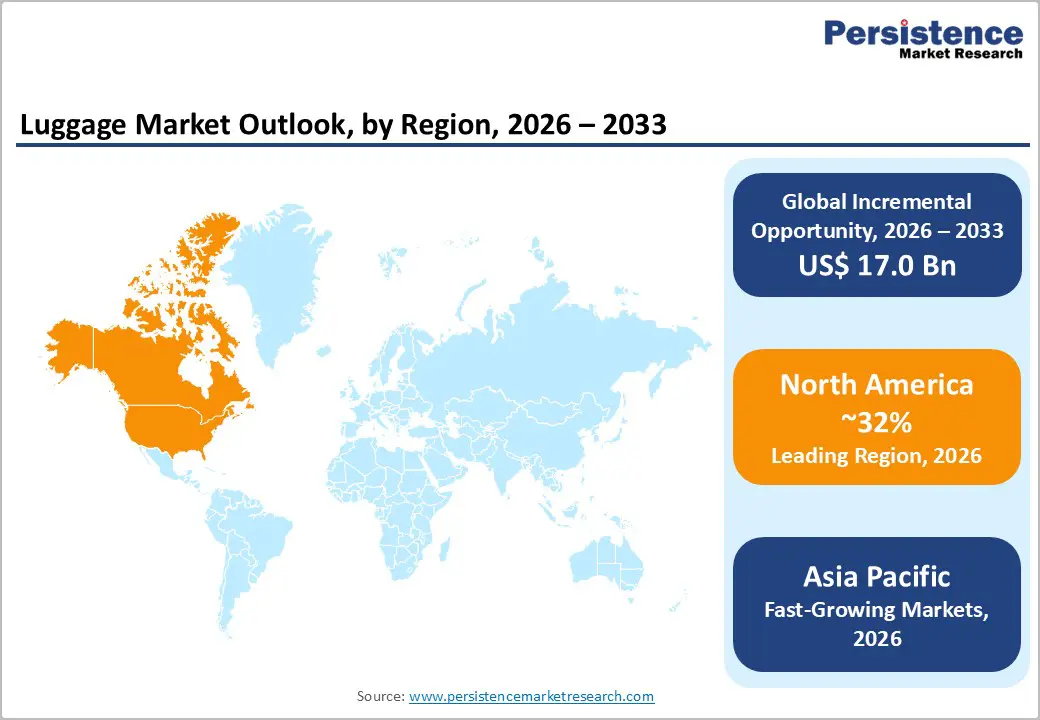
- Leading Region: North America leads the global luggage market with around 32% share in 2025, supported by high travel spending, advanced airline infrastructure, strong premium brand adoption, and a well-established retail and e-commerce ecosystem driving consistent demand.
- Fastest Growing Region: Asia Pacific is the fastest-growing region, driven by rising outbound tourism from China, increasing middle-class travel in India, and the rapid expansion of low-cost airlines across Southeast Asia, boosting luggage consumption.
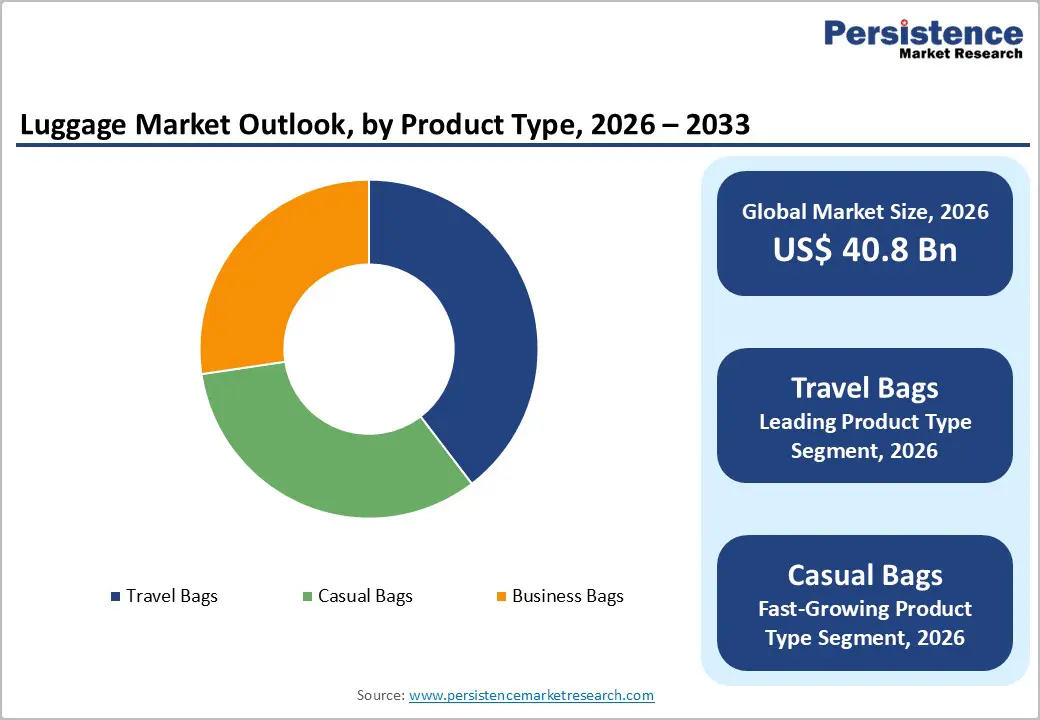
- Dominant Segment: Travel Bags dominate the product type segment with approximately 55% share in 2025, owing to strong consumer preference for suitcases and trolley bags that offer durability, storage efficiency, and airline compatibility.
- Fastest Growing Distribution Segment: Online Retailers are emerging as the fastest-growing distribution channel, fueled by expanding direct-to-consumer strategies, competitive pricing, and increasing consumer reliance on digital purchasing platforms.
- Key Opportunity: Smart luggage equipped with GPS tracking, USB charging, and IoT-enabled features presents a strong growth opportunity, driven by rising demand for connected and convenience-focused travel solutions.

Market Dynamics
Drivers - Resurgence of Global Travel and Tourism Fueling Sustained Luggage Demand
The resurgence of global travel and tourism following the pandemic has emerged as a major growth engine for the luggage market. The International Air Transport Association reported that global air passenger traffic exceeded 4.5 billion in 2023, surpassing pre-pandemic levels across several key routes. This recovery has significantly increased travel frequency, driving higher consumer spending on luggage and related travel accessories across global markets.
In parallel, the World Travel and Tourism Council estimated that the sector contributed over US$ 9.9 trillion to the global economy in 2023. Rising domestic and international travel, particularly among the Asia Pacific’s growing middle class, continues to support sustained demand for diverse luggage categories, including suitcases, trolley bags, and business travel solutions.
Millennial and Gen Z Preferences Driving Premium Luggage Demand
The growing influence of millennials and Gen Z is significantly reshaping the luggage market toward premium and design-oriented products. According to the National Retail Federation, younger consumers allocate a larger share of their discretionary income toward travel and experiences, encouraging higher spending on premium luggage bags that combine durability, aesthetics, and advanced features such as lightweight materials and smart functionalities.
Additionally, the impact of social media platforms such as Instagram and TikTok has amplified brand visibility and aspiration. Luggage is increasingly viewed as a lifestyle statement, pushing consumers toward branded, high-quality products that reflect personal identity, thereby accelerating premiumization and sustaining strong revenue growth across global markets.
Restraints - Fluctuating Raw Material Costs and Supply Chain Disruptions
The luggage manufacturing industry is highly exposed to volatility in raw material prices, particularly for polycarbonate, ABS plastic, aluminum, and textiles. The World Bank reported that petrochemical-derived materials witnessed price increases of over 30-40% during 2021-2022, with continued fluctuations thereafter. These rising input costs significantly increase production expenses, putting pressure on manufacturers’ profitability and operational efficiency across global markets.
In addition, persistent global supply chain disruptions driven by geopolitical tensions, port congestion, and residual pandemic effects have further escalated logistics costs. These challenges often translate into higher retail prices for luggage products, limiting affordability. As a result, demand is constrained in price-sensitive regions such as Latin America, Africa, and parts of Southeast Asia, where consumer purchasing power remains comparatively lower.
Rising Counterfeit Products and Unorganized Market Competition Challenges
The global luggage market faces increasing pressure from counterfeit products and unorganized local manufacturers, particularly in developing economies. The International Chamber of Commerce estimates that counterfeit and pirated goods account for nearly US$ 4.5 trillion annually, with luggage and fashion accessories among the most affected categories. These low-cost alternatives significantly disrupt pricing structures and competitive positioning for established brands.
Furthermore, the widespread availability of unbranded and locally manufactured luggage in regions such as Southeast Asia and Africa limits the market penetration of premium brands. These products attract cost-conscious consumers despite their lower quality, thanks to their affordability. This ongoing competition erodes brand equity, reduces consumer trust, and restricts revenue growth opportunities for organized and global luggage manufacturers.
Opportunities - Rapid Growth of E-Commerce and Direct-to-Consumer Sales Channels
The rapid expansion of e-commerce is creating strong growth opportunities for luggage manufacturers to reach wider consumer bases efficiently. The United Nations Conference on Trade and Development reported that global e-commerce sales surpassed US$ 5.8 trillion in 2023, with luggage and travel accessories among the fastest-growing categories. Digital platforms enable brands to reduce reliance on intermediaries, improve profit margins, and expand product visibility across diverse geographies.
Furthermore, direct-to-consumer models adopted by brands such as Away Travel and Monos are transforming traditional retail dynamics. These platforms offer personalized experiences, seamless purchasing journeys, and subscription-based services. Enhanced digital engagement and convenience are increasing repeat purchase rates, enabling scalable long-term growth while strengthening brand-consumer relationships globally.
Advancements in Smart Luggage and Connected Travel Technologies
The integration of advanced technologies into luggage design is unlocking significant growth potential within the premium segment. Features such as GPS tracking, USB charging ports, biometric locks, and self-weighing systems are enhancing product functionality and consumer convenience. Leading manufacturers like Samsonite and Delsey have introduced smart luggage offerings, gaining traction among tech-savvy travelers seeking enhanced security and efficiency.
According to the Consumer Technology Association, demand for connected travel accessories grew by approximately 18% in 2023. Increasing consumer preference for seamless connectivity and real-time tracking is positioning smart luggage as a high-growth category. This trend is expected to accelerate premiumization and support sustained market expansion across global regions through 2033.
Category-wise Analysis
Product Type Insights
Travel bags dominate the global luggage market, accounting for approximately 55% of the total market share in 2026. Within this segment, suitcases and trolley bags represent the most commercially significant sub-category due to their widespread use in air travel and their strong durability. Their universal acceptance among leisure and business travelers, along with continuous product innovation, including lightweight materials and spinner wheels, continues to reinforce their global segment leadership.
Casual bags are emerging as the fastest-growing category, driven by rising urban mobility and lifestyle changes. The increasing demand for backpacks and messenger bags among students and working professionals is driving growth. The shift toward multifunctional, stylish, and everyday-use bags, coupled with the expansion of e-commerce, is accelerating adoption among younger demographics and urban consumers worldwide.
Size Insights
Medium-sized luggage leads the size segment, capturing around 42% of the market in 2025. Typically ranging between 55 to 75 liters, this category offers an ideal balance between storage capacity and portability. It is widely preferred for short-to-medium trips and aligns well with airline baggage policies. Its versatility across leisure and business travel makes it the most commonly purchased luggage size globally.
Small-sized luggage is the fastest-growing segment, supported by increasing short-duration travel and rising preference for carry-on baggage. Travelers are prioritizing convenience, mobility, and avoidance of checked baggage fees. Compact luggage options are gaining popularity among frequent flyers, especially for business trips and weekend travel, reflecting evolving travel patterns and consumer preferences globally.
Luggage Type Insights
Hardside luggage dominates the luggage type segment, accounting for approximately 57% of market share in 2025. Its popularity is driven by superior durability, impact resistance, and enhanced security features. Materials such as polycarbonate and ABS provide lightweight yet strong protection, while aesthetic appeal and premium designs further strengthen consumer preference for hardside luggage across global markets.
Softside luggage is emerging as the fastest-growing segment due to its flexibility and lightweight characteristics. Consumers prefer softside options for their expandable storage capacity and ease of handling. Increasing demand for versatile travel solutions, especially for flexible packing needs, is driving adoption, particularly among budget-conscious and frequent travelers seeking convenience and adaptability.
Distribution Channel Insights
Specialty retailers hold the leading position in the distribution channel segment, accounting for approximately 30% of market share in 2025. These stores provide personalized shopping experiences, product demonstrations, and expert guidance, which are crucial for high-value purchases such as luggage. Their ability to offer hands-on evaluation continues to attract consumers, particularly in the premium and mid-range segments.
Online retailers are the fastest-growing distribution channel, driven by increasing digital adoption and convenience. E-commerce platforms enable easy product comparison, access to a wider assortment, and competitive pricing. The growing influence of direct-to-consumer strategies and digital marketing is further accelerating online sales, reshaping consumer purchasing behavior across global markets.
Regional Insights
North America Luggage Market Trends and Insights
North America leads the global luggage market with approximately 32% revenue share in 2025. The region benefits from high per-capita travel expenditure, a well-established airline network, a strong culture of both domestic leisure and international business travel, and an advanced organized retail infrastructure. Premiumization trends and the early adoption of smart luggage technologies are notable regional characteristics shaping demand and product innovation.
- U.S. Luggage Market Size
The United States dominates North American luggage revenue, contributing over 80% of the regional share in 2026. The U.S. Travel Association reports that American travelers took approximately 2.3 billion domestic person-trips in 2023, sustaining consistently high luggage demand. A well-developed e-commerce retail ecosystem and strong brand awareness for premium luggage labels further reinforce U.S. market leadership.
Europe Luggage Market Trends and Insights
Europe represents the second-largest regional market, driven by the continent's dense intra-regional travel network, robust tourism infrastructure, and high consumer willingness to invest in quality travel products. The European Union Aviation Safety Agency (EASA) confirms sustained aviation capacity growth across European routes. Sustainability-focused product innovation and growing consumer preference for eco-friendly luggage materials are distinctly prominent market trends shaping the region's competitive landscape.
- Germany Luggage Market Size
Germany is the largest single-country market within Europe, representing approximately 18% of regional luggage revenue in 2026. Germany's strong outbound tourism culture, with over 90 million outbound trips annually, generates consistent high-volume luggage demand. German consumers demonstrate a strong preference for durable, high-quality hardside luggage from established European and international premium brands.
- U.K. Luggage Market Size
The United Kingdom holds approximately 15% of the European luggage market share in 2025. The Civil Aviation Authority (CAA) reported that UK airports handled over 230 million passengers in 2023, reflecting high travel propensity. The premium and lifestyle luggage segment is particularly buoyant, supported by London's global status as a fashion and retail hub attracting strong brand-conscious consumer spending.
- France Luggage Market Size
France accounts for approximately 13% of the European luggage market in 2025. As a premier global tourist destination, France receives over 100 million international arrivals at peak, and maintains robust inbound and outbound travel flows. French consumers exhibit strong brand loyalty toward premium luggage brands, with domestic brands such as Delsey Paris holding significant market presence both domestically and internationally.
Asia Pacific Luggage Market Trends and Insights
Asia Pacific is the fastest-growing regional market, projected to register a CAGR of approximately 6.3% during 2026 - 2033. The region is fueled by a rapidly expanding middle class, surging outbound tourism, and rapid e-commerce penetration. China accounts for over 35% of Asia Pacific luggage revenue in 2025, with domestic travel volumes exceeding 4 billion trips annually, according to China National Tourism Administration data, underscoring the region's extraordinary market scale and growth momentum.
- India Luggage Market Size
India represents one of the most attractive high-growth markets in the region, contributing approximately 8% of Asia Pacific luggage revenue in 2025. The Ministry of Tourism, Government of India, projects outbound travelers to exceed 50 million by 2030. The surge in domestic air travel, driven by budget carriers such as IndiGo, combined with rapid expansion of organized retail, is driving robust luggage demand across urban and tier-2 cities alike.
- Japan Luggage Market Size
Japan holds approximately 12% of the Asia Pacific luggage market revenue in 2026. Japan's mature travel culture, high-income consumer base, and strong domestic and outbound tourism infrastructure support steady, consistent luggage demand. The Japan Tourism Agency reported that both domestic travel and outbound trips resumed strongly post-pandemic, with particular growth toward Asia Pacific regional destinations, sustaining demand for premium and mid-range luggage products.
- Southeast Asia Luggage Market Size
Southeast Asia contributes approximately 10% of the Asia Pacific luggage market share in 2025. The ASEAN region's booming intra-regional tourism, supported by the expansion of low-cost carriers such as AirAsia and Lion Air, has driven strong luggage demand among young, mobile, and travel-enthusiastic consumers across Indonesia, Thailand, Vietnam, and the Philippines.
Competitive Landscape
The global luggage market is characterized by a moderately consolidated structure, where a few large multinational players hold strong positions, while numerous regional and domestic manufacturers contribute to fragmentation, particularly in mid-range and value segments. This competitive mix creates a dynamic environment where both global reach and localized strategies play a crucial role in sustaining market presence.
Market participants are increasingly focusing on product premiumization, sustainable material innovation, and expansion through digital sales channels. Strategic initiatives such as partnerships, mergers, and technology integration are being widely adopted to enhance product differentiation. Additionally, investments in smart luggage features and evolving consumer-centric designs are helping companies strengthen brand positioning and maintain long-term competitiveness.
Key Developments:
- In March 2024, Samsonite International S.A. announced the global launch of its Magnum Eco collection featuring luggage shells made from 100% recycled PET plastic, reinforcing the company's sustainability commitments across its premium product portfolio.
- In July 2024, RIMOWA (owned by LVMH) unveiled its updated Electronic Tag luggage system with enhanced NFC connectivity, enabling seamless baggage check-in integration with major international airlines across 10+ countries globally.
- In February 2025, Delsey Paris launched a new line of lightweight hardside luggage featuring an advanced Securitech 3 locking mechanism and Flex-Shield polycarbonate shell technology, targeting premium European and North American consumers seeking enhanced travel security.
Luggage Market Report - Key Insights & Details
| Key Insights | Details |
|---|---|
| Historical Market Value (2020) | US$ 31.0 Billion |
| Current Market Value (2026) | US$ 40.8 Billion |
| Projected Market Value (2033) | US$ 57.8 Billion |
| CAGR (2026 - 2033) | 5.1% |
| Leading Region | North America, 32% market share (2025) |
| Dominant Category-1 (Product Type) | Travel Bags, 55% market share (2025) |
| Top-ranking Category-2 (Size) | Medium, 42% market share (2025) |
| Incremental Opportunity (2026 - 2033) | US$ 17.0 Billion |
Companies Covered in Luggage Market
- Samsonite International S.A.
- VIP Industries Ltd.
- Delsey
- Tumi Inc.
- Rimowa
- VF Corporation
- Briggs & Riley
- Travelpro
- Victorinox
- Away
- Antler Ltd.
- Herschel Supply Co.
- American Tourister
- Bric's
- Safari Industries (India) Ltd.
Frequently Asked Questions
The global luggage market is valued at US$ 40.8 billion in 2026, driven by travel recovery, rising disposable incomes, and strong demand from emerging middle-class consumers.
Key drivers include rising global air travel, higher disposable incomes, growing travel culture among younger consumers, and increasing adoption of smart and premium luggage.
North America leads with around 32% share in 2025, supported by strong travel spending, premium brand demand, and advanced retail infrastructure.
Major opportunities include smart luggage innovation, expansion of e-commerce channels, sustainable materials, and rapid growth in Asia Pacific markets.
Leading players include Samsonite International S.A., LVMH, VF Corporation, Delsey Paris, Tumi Holdings, and others competing on innovation and branding.


