




- Beauty & Personal Care
- Portable Tattoo Printer Market
Portable Tattoo Printer Market Size, Share, and Growth Forecast, 2026 - 2033
Portable Tattoo Printer Market by Product Type (Inkjet, Thermal, Laser), Application (Personal Use, Professional Use), Distribution Channel (Online Stores, Specialty Stores, Supermarkets/Hypermarkets, Others), and Regional Analysis for 2026 - 2033

Portable Tattoo Printer Market Size and Trends Analysis
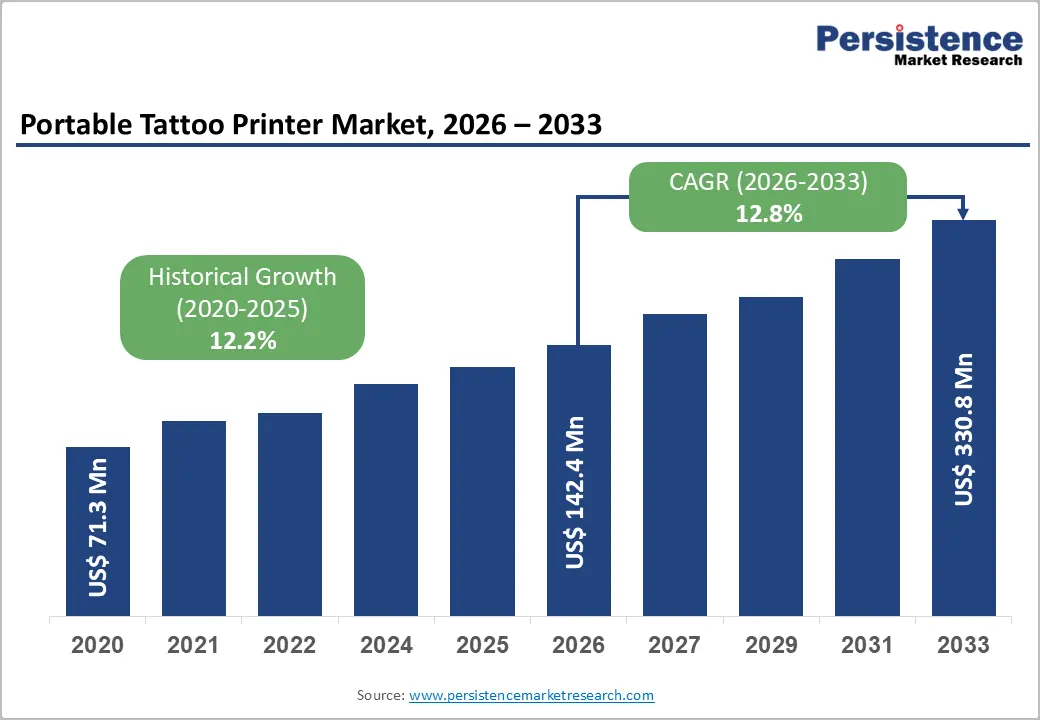
The global portable tattoo printer market size is likely to be valued at US$142.4 million in 2026, and is expected to reach US$330.8 million by 2033, growing at a CAGR of 12.8% during the forecast period from 2026 to 2033, driven by the rising popularity of temporary tattoos, increasing demand for customizable body art, and technological advancements in portable printing devices.
Increasing consumer interest in painless, non-permanent, and easy-to-apply tattoo designs remains a major driver of portable tattoo printer market growth.
Key Industry Highlights:
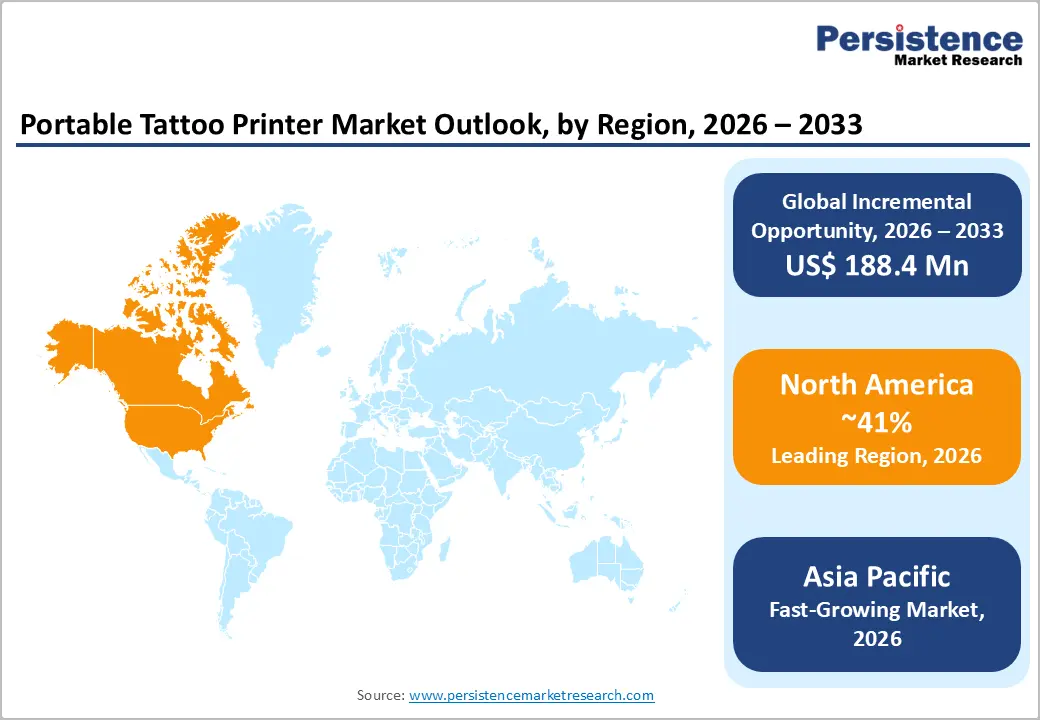
- Leading Region: North America, anticipated to account for a 41% market share in 2026, driven by high adoption of innovative personal care gadgets in the U.S.
- Fastest-growing Region: Asia Pacific, fueled by rising youth population, growing social media influence, and increasing disposable income in China and India.
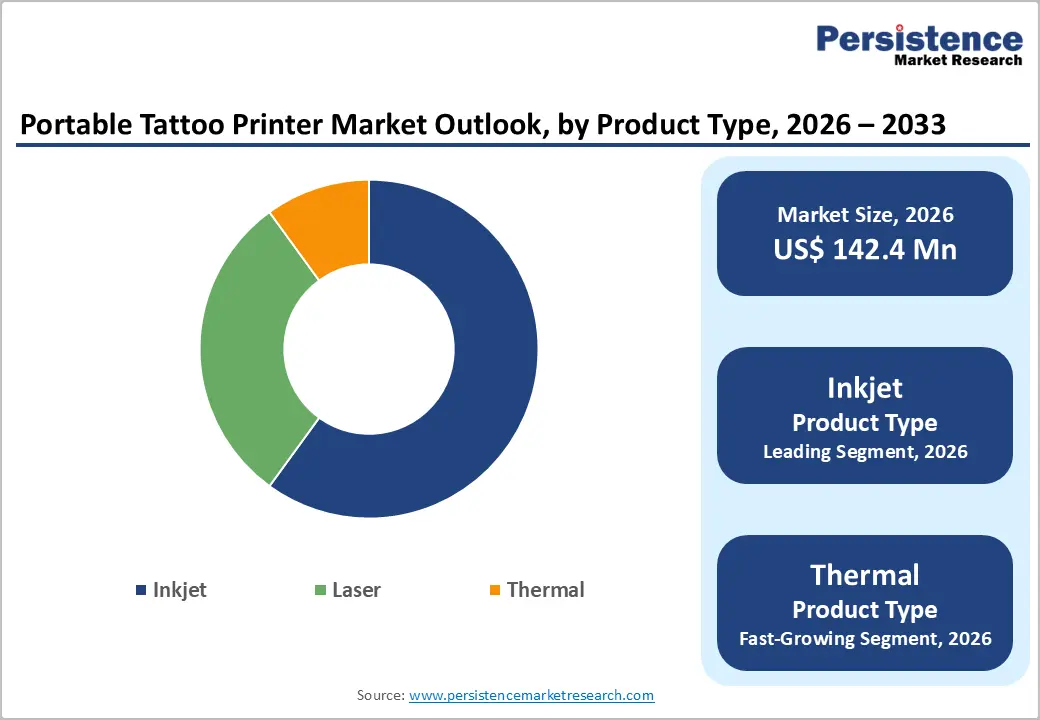
- Dominant Product Type: Inkjet, to hold approximately 58% of the market share, due to superior print quality and color accuracy.
- Leading Application: The personal use segment is set to dominate with strong demand for at-home tattoo customization.
| Key Insights | Details |
|---|---|
| Portable Tattoo Printer Market Size (2026E) | US$142.4 Mn |
| Market Value Forecast (2033F) | US$330.8 Mn |
| Projected Growth CAGR (2026 - 2033) | 12.8% |
| Historical Market Growth (2020 - 2025) | 12.2% |
DRO Analysis
Driver Analysis - Rising Demand for Temporary & Non-Permanent Tattoos
Consumer preference is shifting toward body art that offers flexibility without long-term commitment. Many individuals, especially younger demographics, are drawn to designs they can change frequently to match fashion trends, moods, or social occasions. Temporary tattoos provide a convenient way to experiment with different styles without the permanence, pain, or cost associated with traditional tattooing. This makes them particularly appealing for first-time users who may be hesitant about permanent ink.
The growing influence of social media and celebrity culture has also accelerated this trend, as users seek visually appealing and shareable designs for events, festivals, and digital content. Temporary tattoos are gaining traction in professional and personal settings where permanent tattoos may not be acceptable, offering a discreet and reversible alternative. Advancements in skin-safe inks and printing technologies have further improved the quality, realism, and durability of temporary tattoos, enhancing user confidence and satisfaction. Portable tattoo printers benefit directly from this shift, as they enable instant, customized designs on demand.
Influence of Social Media & Celebrity Culture
Digital platforms have transformed how body art trends emerge and spread, turning tattoos into highly visible and shareable forms of self-expression. Platforms like Instagram, TikTok, and Pinterest allow users to discover new designs, follow artists, and replicate trending styles almost instantly. Viral challenges, reels, and short-form videos often showcase creative or minimalist tattoos, encouraging rapid adoption among younger audiences.
Celebrities, influencers, and content creators play a crucial role in shaping these preferences. When public figures display unique or temporary tattoo designs, their followers are quick to emulate the look, driving demand for easily accessible and customizable solutions. Temporary tattoos align well with this trend as they allow individuals to recreate celebrity-inspired styles without long-term commitment. Social media also fosters a culture of experimentation, where users frequently change their appearance for content creation, events, or personal branding. This continuous need for new and visually appealing designs boosts the relevance of portable tattoo printers, which enable instant and on-demand application.
Restraint Analysis - Concerns Over Skin Safety & Health Risks
Safety considerations remain a key barrier for wider adoption of portable tattoo printers, as users are cautious about how inks and application methods interact with the skin. Some individuals may experience allergic reactions, irritation, or redness, particularly if the ink contains unfamiliar or low-quality ingredients. The lack of universal standards for temporary tattoo inks in certain regions further adds to consumer uncertainty.
Hygiene is another concern, especially when devices are shared or used in public settings. Improper cleaning or maintenance can increase the risk of skin infections or contamination. Additionally, users may question the long-term effects of repeated application, even for temporary designs. Inconsistent product quality across brands also impacts trust, as poorly formulated inks or substandard devices can lead to uneven results or adverse reactions.
Presence of Low-Quality & Counterfeit Products
The market faces challenges from the widespread availability of inexpensive imitations that often compromise on quality and safety. These products are typically manufactured using substandard components and uncertified inks, which can lead to poor print clarity, inconsistent performance, and potential skin irritation. Consumers who encounter such issues may develop negative perceptions about portable tattoo printers overall, even if higher-quality options exist.
Counterfeit devices also disrupt fair competition by undercutting established brands on price while failing to meet expected standards. This creates confusion in the market, making it difficult for buyers to differentiate between reliable and unreliable products. In many cases, these low-cost alternatives lack proper instructions, safety guidelines, or after-sales support, increasing the risk of misuse.
Opportunity Analysis - Integration with Mobile Apps & AI-Based Design Tools
Advancements in digital connectivity are transforming how users create and apply body art, making the process more interactive and personalized. Mobile applications now serve as the central interface for portable tattoo printers, allowing users to browse design libraries, edit patterns, and directly send them to the device within seconds. This seamless connection enhances convenience and removes the need for specialized skills or equipment.
Artificial intelligence further elevates the experience by enabling automated design generation based on user preferences, images, or text inputs. Users can experiment with styles, adjust size and placement, and preview tattoos virtually on their skin using augmented reality features before printing. This reduces uncertainty and improves satisfaction with the result. Cloud-based platforms also allow users to access a wide range of templates, share designs, and stay updated with trending artwork. Continuous software updates introduce new features and improve functionality over time.
Rising Demand for Customization & On-Demand Printing
Personalization has become a defining factor in consumer choices, with individuals seeking products that reflect their identity, mood, or occasion. In the context of body art, this preference is driving interest in solutions that allow users to create unique designs rather than relying on pre-made templates. Portable tattoo printers address this need by enabling instant customization, where users can upload images, modify patterns, or generate new designs in real time.
The ability to print tattoos on demand adds a layer of convenience that traditional methods cannot match. Users no longer need to visit a studio or wait for an appointment, making the process quicker and more accessible. This is particularly valuable for events, social gatherings, and content creation, where immediate application is often required. Frequent design changes are also becoming common, as consumers experiment with different looks without long-term commitment. This flexibility encourages repeated usage and increases overall engagement with the product.
Category-wise Analysis
Product Type Insights
Inkjet printers are anticipated to dominate, accounting for 58% of the market share in 2026, driven by their ability to deliver high-resolution, detailed, and multi-color designs that closely mimic real tattoos. Their compatibility with a wide range of skin-safe inks and ease of integration with digital design tools make them highly versatile for both personal and professional use. Inkjet technology is relatively affordable and widely available, further supporting its adoption. Prinker devices (such as Prinker S and Prinker M) use miniaturized inkjet printing technology to apply high-resolution, full-color temporary tattoos directly onto the skin. The device allows users to upload custom designs via a mobile app and print them instantly in a few seconds with detailed precision.
Thermal printers are expected to be the fastest-growing segment, due to their simplicity, speed, and portability. These devices do not require ink, reducing maintenance and operational costs while ensuring consistent performance. Their lightweight and compact design makes them ideal for mobile use, especially for artists and event-based applications. Thermal printers are widely used for quick stencil creation, enabling faster tattoo preparation and improved workflow efficiency. The Brother PocketJet Series (PJ-723 / PJ-763MFi), developed by Brother Industries, Ltd., utilizes advanced thermal technology and is widely adopted by tattoo artists for mobile stencil printing. These compact and portable devices support wireless connectivity, including Bluetooth and Wi-Fi, enabling seamless operation from smartphones and laptops.
Application Insights
Personal use is projected to dominate with over 60%, fueled by growing preference for at-home, convenient, and cost-effective tattoo solutions. Consumers are increasingly adopting these devices to create temporary tattoos for self-expression, social events, and content creation without visiting professional studios. The ease of use, mobile app connectivity, and ability to customize designs instantly make them highly appealing to individual users. Prinker, developed by Prinker Korea Inc., is tailored for individual users, enabling them to create and apply temporary tattoos conveniently at home without professional help. Using its companion mobile app, users can browse a wide range of designs or upload their own artwork and instantly print it onto their skin within seconds.
Professional use is the fastest-growing application, driven by increasing adoption by tattoo artists, salons, and event professionals. These devices enhance workflow efficiency by enabling quick stencil printing, precise design replication, and reduced manual effort. Artists can handle higher client volumes while maintaining consistency and accuracy in designs. Additionally, portable printers are widely used at events, exhibitions, and promotional activities where instant tattoo application is required. Brother PocketJet Series Tattoo Stencil Printers, developed by Brother Industries, Ltd., are portable thermal devices tailored for professional tattoo artists and studios. They allow high-resolution stencil printing (300 dpi) directly from laptops or mobile devices, ensuring precision and efficiency.
Regional Insights
North America Portable Tattoo Printer Market Trends
North America is projected to dominate, holding 41% of the market share in 2026, driven by a strong culture of self-expression and early adoption of innovative consumer technologies. Users increasingly prefer temporary and customizable body art that aligns with changing fashion trends, social events, and digital content creation. This has led to higher demand for compact, user-friendly devices that can deliver quick and high-quality tattoo designs at home or on the go.
The region is also witnessing growing integration of mobile applications and digital design platforms, allowing users to create, modify, and print tattoos instantly. Social media influence plays a significant role, as trends spread quickly and encourage frequent design changes, boosting repeat usage. Professional adoption is rising, with tattoo artists and event organizers using portable printers for efficient stencil creation and live experiences. Consumers in North America place strong emphasis on product quality and safety, encouraging manufacturers to develop skin-safe inks and reliable devices. E-commerce channels further support market growth by improving accessibility and product awareness.
Europe Portable Tattoo Printer Market Trends
Europe is witnessing steady growth, supported by a strong inclination toward fashion, art, and personal expression. Consumers across the region are increasingly exploring temporary body art as a flexible and non-permanent way to showcase individuality. This trend is particularly prominent among younger demographics who prefer frequently changing styles aligned with seasonal fashion and social influences.
Technological adoption is another key trend, with rising demand for compact, app-connected devices that enable instant customization. Users prioritize features like high-resolution output, user-friendly operation, and seamless integration with digital design tools. The integration of augmented reality for previewing tattoo placement is also gaining traction, enhancing the overall user experience. Europe’s emphasis on safety and regulatory compliance is shaping product development, encouraging the use of skin-friendly, dermatologically tested inks and high-quality materials. Sustainability is an emerging focus, with consumers showing interest in eco-friendly inks and reusable components.
Asia Pacific Portable Tattoo Printer Market Trends
Asia Pacific is likely to be the fastest-growing region, powered by a large youth population and increasing interest in fashion, beauty, and self-expression. Consumers in countries such as Japan, South Korea, China, and India are actively adopting temporary body art to experiment with personal style without long-term commitment. The influence of pop culture, K-pop trends, and social media platforms is significantly shaping consumer preferences and accelerating product adoption.
Rising disposable incomes and expanding middle-class populations are enabling greater spending on lifestyle and personal care products, including portable tattoo devices. The region is highly receptive to mobile-first technologies, leading to strong demand for app-enabled printers that offer customization and instant design creation. E-commerce platforms play a crucial role in improving accessibility, allowing consumers to explore and purchase a wide variety of devices online. The growing popularity of events, festivals, and digital content creation is boosting the use of temporary tattoos for entertainment and branding purposes.
Competitive Landscape
The global portable tattoo printer market is highly competitive and driven by continuous innovation, with both technology companies and specialized tattoo brands striving to enhance product performance and user experience. Key players such as Prinker, Tattoo Tech, and Inkbox focus on consumer-friendly devices that offer easy customization, mobile app integration, and safe, temporary tattoo solutions. Meanwhile, established printing companies like Epson, Brother International Corporation, Canon Inc., and HP Inc. leverage their expertise in printing technology to deliver high-resolution output, reliability, and advanced connectivity features.
Competition in the market is shaped by factors such as product design, print precision, portability, and affordability. Companies are also investing in digital ecosystems, including mobile applications and design libraries, to improve customer engagement. Additionally, a strong online presence and e-commerce strategies play a crucial role in expanding global reach and attracting tech-savvy consumers.
Key Industry Developments:
- In March 2026, Phomemo showcased its M08F Plus Wireless Tattoo Stencil Printer for Spring 2026, targeting professional tattoo artists. The device featured 203 DPI thermal printing, a touchscreen interface, and mobile app connectivity, enabling efficient stencil creation. It also included AI-assisted design tools and anti-wrinkle paper technology to improve accuracy and workflow.
- In February 2023, LG Household & Health Care launched a portable tattoo printer, Imprintu, at Mobile World Congress in Barcelona. The device connects with smartphones to print high-resolution (600 dpi) temporary tattoos directly onto the skin, lasting about a day. The launch strengthened the company’s position in beauty tech and personalized body art solutions.
Companies Covered in Portable Tattoo Printer Market
- Prinker
- Tattoo Tech
- Inkbox
- Epson
- Brother International Corporation
- Canon Inc.
- HP Inc.
- Xerox Corporation
- Silhouette America
- Tattly
- Tattoodo
- Tattify
- Momentary Ink
Frequently Asked Questions
The global portable tattoo printer market is projected to reach US$142.4 million in 2026.
The portable tattoo printer market is mainly driven by the growing demand for painless, temporary tattoos, along with continuous advancements in compact and high-performance printing technologies that enhance design quality and user convenience.
The portable tattoo printer market is poised to witness a CAGR of 12.8% from 2026 to 2033.
Key opportunities in the portable tattoo printer market include the development of skin-safe and user-friendly inks, integration with AR-enabled design applications, and expansion into professional tattoo studios and emerging markets through growing online distribution channels.
Key players in the portable tattoo printer market include Prinker, Inkbox, Epson, Brother International Corporation, and Canon Inc.


