




- Healthcare Services
- Ovum Egg Banking Market
Ovum Egg Banking Market Size, Share and Growth Forecast, 2026 - 2033
Ovum Egg Banking Market by Indication (Medical, Elective, Fertility Treatment-linked), Service Type (Freezing, Storage, Thawing & Utilization), Biological Source (Autologous, Donor), and Regional Analysis for 2026 - 2033

Ovum Egg Banking Market Share and Trends Analysis
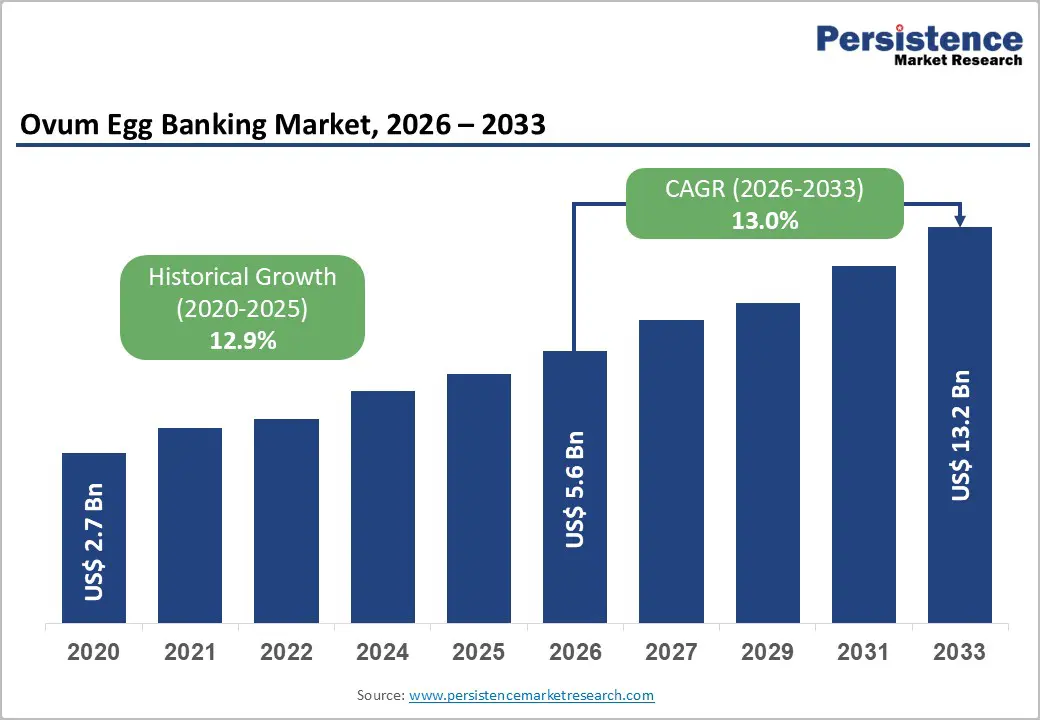
The global ovum egg banking market size is likely to be valued at US$ 5.6 billion in 2026 and is projected to reach US$ 13.2 billion by 2033, growing at a CAGR of 13.0% during the forecast period 2026 - 2033.
The market is growing rapidly due to shifting reproductive behavior, where consumers increasingly delay parenthood for education, career progression, and financial stability. This delay has intensified demand for fertility preservation and egg freezing services, especially among urban populations. At the same time, rising infertility rates linked to lifestyle factors, such as stress, obesity, and environmental exposure, are expanding clinical need.
Technological advances in cryopreservation and vitrification have increased egg survival and IVF success rates, thereby boosting consumer confidence. Additionally, rising disposable incomes and expanding fertility clinic networks in emerging markets are improving accessibility. These factors are accelerating adoption across both medical and elective fertility applications globally.
Key Industry Highlights:
- Leading & Fastest-Growing Indications: The medical indication segment leads with a 56% share in 2026, while the elective segment is the fastest-growing, driven by delayed childbirth and rising egg-freezing adoption.
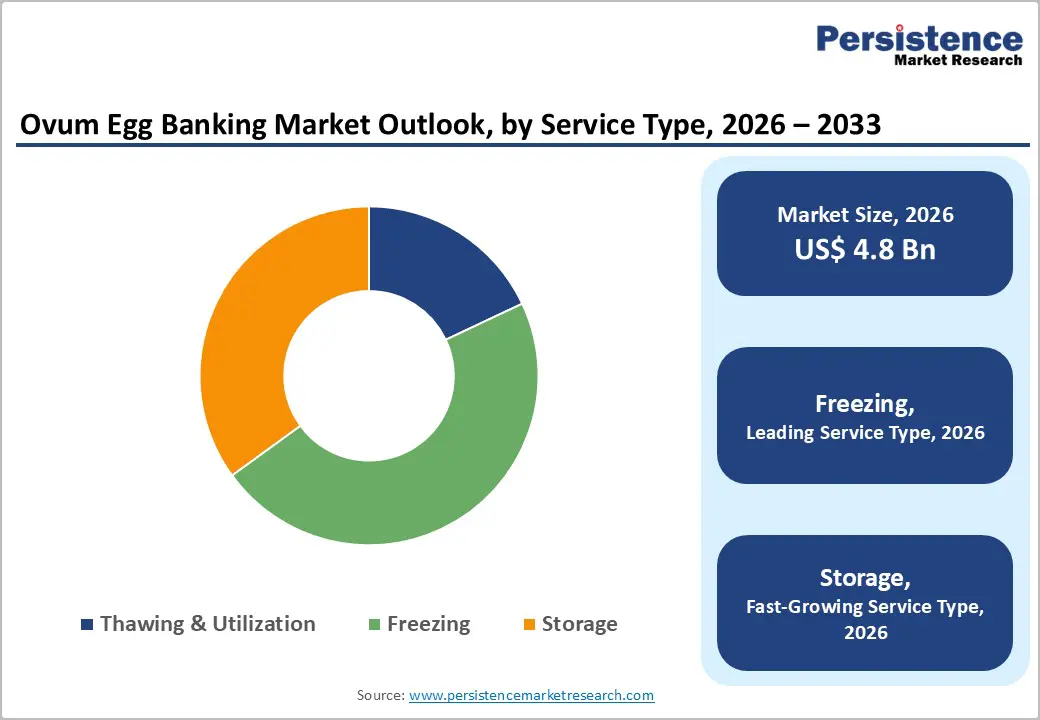
- Service Type Dynamics: Freezing services lead with 47% share in 2026, while storage services grow fastest, supported by recurring revenue and long-term preservation demand.
- Biological Source Landscape: The autologous segment leads with 62% share in 2026, while the donor segment is emerging as the fastest-growing, driven by rising infertility cases and expanding ART applications.
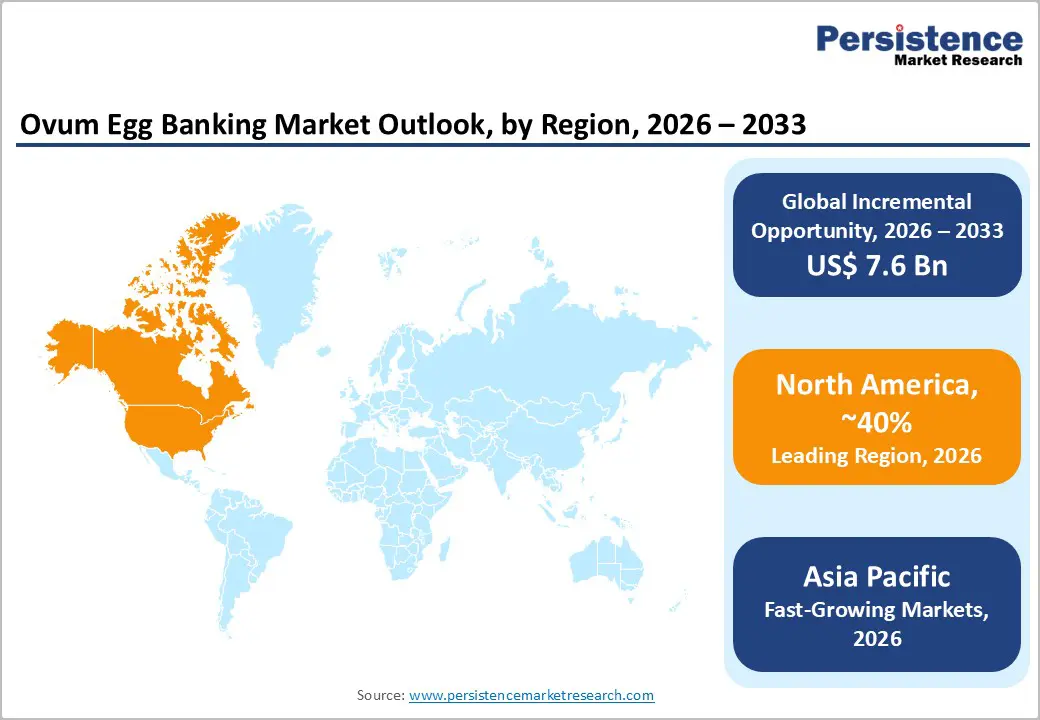
- Regional Leadership: North America is expected to lead the global market with 40% share in 2026, while the Asia Pacific is poised to be the fastest-growing region due to expanding fertility infrastructure and rising awareness of ovum banking services.
- Technology Transformation: Growing adoption of AI-enabled fertility tools and digital platforms is improving clinical outcomes and reshaping the fertility preservation market landscape.
| Key Insights | Details |
|---|---|
| Ovum Egg Banking Market Size (2026E) | US$ 5.6 Bn |
| Market Value Forecast (2033F) | US$ 13.2 Bn |
| Projected Growth (CAGR 2026 to 2033) | 13.0% |
| Historical Market Growth (CAGR 2020 to 2025) | 12.9% |

DRO Analysis
Driver - Rising Infertility Rates and Delayed Parenthood Trends
Global infertility prevalence is increasing, with the World Health Organization (WHO) estimating that 1 in 6 people globally experience infertility. Socioeconomic factors such as delayed marriages, career prioritization, and lifestyle changes have shifted reproductive timelines. In developed markets, the average maternal age at first childbirth has exceeded 30 years, reducing the potential for natural fertility. This structural demographic shift is directly strengthening demand for egg-freezing services and ovum-preservation solutions. Individuals are increasingly adopting fertility preservation services to secure long-term reproductive options. The ovum egg banking market is benefiting from both medical necessity and elective adoption, where lifestyle-driven fertility planning is becoming more mainstream.
The U.S. Centers for Disease Control and Prevention (CDC) Assisted Reproductive Technology (ART) reporting framework continues to standardize national IVF and egg freezing outcome reporting across clinics, improving transparency and patient trust in fertility outcomes. This has indirectly strengthened the adoption of Ovum egg banking services by improving measurable success tracking and clinic accountability. In parallel, updated 2025 clinical guidance from the American Society for Reproductive Medicine (ASRM) reinforces early fertility preservation counseling for patients at risk of infertility due to medical treatments, particularly oncology care pathways. This has increased hospital-based referrals for egg-freezing procedures, thereby expanding medically indicated demand. These policy-driven shifts are accelerating the structured integration of fertility preservation into mainstream healthcare delivery systems.
Technological Advancements in Cryopreservation
The introduction of vitrification has significantly improved egg survival rates, with clinical studies reporting survival rates above 90% compared to older slow-freezing methods. Organizations such as the American Society for Reproductive Medicine (ASRM) recognize vitrification as a standard practice, reinforcing clinical reliability. This has improved confidence in fertility preservation services globally. Higher IVF success rates using frozen eggs have reduced clinical uncertainty and increased physician recommendation rates. Automation in cryogenic storage systems and improved thawing protocols are also improving consistency in laboratory outcomes. These advancements are strengthening operational scalability across fertility clinics and reducing variability in treatment success rates.
ASRM updated its clinical framework to emphasize standardized oocyte cryopreservation protocols and to improve access to fertility preservation pathways, particularly for patients undergoing urgent gonadotoxic treatments. This has significantly reduced procedural delays, making egg banking services more accessible within hospital systems. Additionally, regulatory modernization in Europe, under the European Union's healthcare quality and cross-border reproductive care frameworks, has strengthened laboratory safety and storage compliance standards for gamete preservation. This has improved trust in cryopreservation infrastructure and supported the adoption of cross-border fertility treatment, further expanding the global ovum egg banking ecosystem.
Restraints - High Cost of Fertility Preservation Procedures
The cost of egg freezing cycles ranges between US$6,000 and US$15,000 per cycle, excluding annual storage fees, according to clinical data from fertility centers. Multiple cycles are often required to ensure sufficient egg quantity, increasing the overall financial burden on patients. This cost barrier significantly limits accessibility, especially in low- and middle-income countries, while inconsistent insurance coverage across global healthcare systems further restricts broader market penetration, resulting in the ovum egg banking market growth remaining concentrated within higher-income population groups and creating a persistent demand imbalance across socioeconomic segments worldwide, with affordability continuing to act as a structural constraint on large-scale adoption of fertility preservation services.
Beyond direct procedural expenses, additional costs such as hormonal stimulation drugs, diagnostics, and laboratory handling charges further increase total treatment expenses, making each cycle financially intensive for patients seeking fertility preservation and positioning fertility preservation services as a premium healthcare offering rather than a universally accessible solution, while recent U.S. policy updates have expanded employer-linked fertility benefits in select states and organizations, although adoption remains uneven as reflected in healthcare benefit disclosures and employer coverage variability, resulting in elective egg freezing services continuing to face affordability challenges at scale and limiting access across both urban and semi-urban population groups.
Ethical, Legal, and Cultural Constraints
Ethical concerns related to gamete storage, donor anonymity, and embryo ownership rights continue to shape market behavior, while regulatory frameworks differ widely across regions with strict storage duration limits enforced in several countries and some jurisdictions imposing partial or complete restrictions on elective egg freezing procedures, alongside cultural attitudes toward assisted reproduction remaining conservative in multiple societies, collectively creating significant regulatory fragmentation for service providers globally and limiting cross-border fertility treatment services due to inconsistent ethical and legal standards, which continues to restrict the scalability of ovum egg banking services worldwide.
The UK's fertility regulator, the Human Fertilization and Embryology Authority (HFEA), has flagged an urgent need to update Britain's fertility laws. The existing framework, built on the Human Fertilization and Embryology Act 1990, is now considered outdated, with notable gaps in how donor identities are managed, how patients are protected, and how modern assisted reproductive technology (ART) practices are overseen.
At the same time, regulators across Europe and North America are tightening the rules around genetic data, specifically pushing for greater transparency and traceability in how donor genetic information is recorded, stored, and shared. This means fertility clinics and egg banks must now meet stricter documentation and disclosure standards than ever before. For egg banking providers operating across multiple countries, this creates a growing compliance burden. Each jurisdiction has its own evolving rulebook, and keeping up with all of them simultaneously demands significant legal, administrative, and operational resources.
The overall picture is a double-edged shift. On one hand, these regulatory changes are genuinely positive; they strengthen ethical standards and better protect patients and donors. On the other hand, they make running a fertility business harder, driving up administrative costs, slowing down clinic expansion into new markets, and adding layers of complexity to day-to-day operations.
Opportunities - Expansion in Emerging Markets and Rising Fertility Preservation Adoption
Emerging markets continue to strengthen their position in the ovum egg banking market, supported by rising reproductive health awareness and improving access to assisted reproductive technologies, with government health agencies across Asia and Europe reporting a steady increase in fertility treatment utilization, particularly among the urban population.
In 2025, national health statistics released through public fertility registries in several developed economies highlighted continued growth in elective egg freezing demand, reflecting shifting reproductive behavior patterns and greater acceptance of fertility preservation as a planned healthcare choice, while major verified media such as BBC News reported that delayed parenthood and workplace flexibility trends are accelerating adoption of fertility preservation services among younger demographics.
In parallel, government-led healthcare expansion programs in parts of the Asia Pacific are increasingly integrating reproductive health into broader women’s health initiatives, improving clinic accessibility and expanding IVF infrastructure in Tier 1 and Tier 2 cities. These policy-supported healthcare investments are enabling private fertility providers to scale services more efficiently, while rising disposable incomes and urban migration are further strengthening demand concentration in metropolitan areas. This combination of policy enablement and socioeconomic transition is accelerating the mainstream adoption of ovum egg banking services in emerging economies, positioning them as a key incremental growth frontier for the global market.
Policy Support, Corporate Fertility Benefits, and Digital Healthcare Integration
In 2026, regulatory and workplace policy developments in advanced healthcare markets have continued to support the adoption of fertility preservation, with public health bodies and labor policy frameworks increasingly recognizing reproductive healthcare as part of employee wellness, particularly in regions where corporate fertility benefit programs are expanding. Government labor statistics and employer benefit disclosures in the U.S. and parts of Europe indicate a growing number of large organizations integrating fertility support packages, including egg freezing coverage, as part of competitive talent retention strategies, a trend also covered by Reuters, highlighting the expansion of family-forming benefits among multinational employers.
The healthcare digitization initiatives led by national health systems and supported by public health innovation programs are accelerating the adoption of AI-enabled reproductive health tools, improving treatment personalization and clinic efficiency. Government-backed digital health frameworks in countries such as the UK and Singapore are encouraging integration of telemedicine and data-driven fertility monitoring platforms, which are enhancing patient access and reducing treatment friction. These developments are collectively strengthening the operational scalability of Ovum egg banking services by improving patient outreach, lowering engagement barriers, and enabling more standardized fertility care delivery across geographically dispersed populations.
Category-wise Analysis
Indication Insights
The medical indication segment is expected to continues to lead the ovum egg banking market, holding around 56% share, driven by its integration into oncology care pathways where patients undergoing chemotherapy or other gonadotoxic treatments are routinely advised to freeze eggs in advance.
Additionally, a 2025 ASRM Scientific Congress update (reported via U.S. clinical networks) highlighted improved egg survival and pregnancy outcomes in women above 35, expanding eligibility and reinforcing physician confidence in earlier intervention; the WHO-linked 2025 reproductive health updates indicates rising global infertility prevalence, while adoption is increasingly enhanced by clinical technologies such as Presagen’s Life Whisperer AI for embryo assessment and Vitrolife’s EmbryoScope+ imaging systems, which improve consistency in embryo selection and are steadily standardizing fertility preservation workflows across hospital-linked egg banking programs.
The elective indication segment is anticipated to be the fastest-growing, driven by delayed parenthood, lifestyle-based fertility planning, and rising awareness of age-related fertility decline, particularly among the urban working population, with the normalization supported by increasing corporate fertility benefits. In 2025, Business Standard reported a notable rise in egg-freezing demand at metropolitan clinics, linked to career prioritization among working women, while HFEA recorded continued growth in elective egg-freezing cycles.
Service Type Insights
The freezing segment is likely to dominate with an estimated 47% share, as it represents the essential first step in all egg banking procedures, supported by widespread adoption of vitrification techniques that significantly improve oocyte survival rates and clinical outcomes. A 2025 ASRM clinical update reported improved post-thaw viability with next-generation vitrification protocols, while CDC ART monitoring data show continued growth in IVF procedures in the U.S., supporting higher demand for egg-freezing services as part of fertility treatment cycles.
The storage segment is projected to be the fastest-growing, driven by increasing demand for long-term egg preservation and rising reliance on recurring storage-based revenue models as patients delay parenthood for longer durations; a 2026 HFEA regulatory update introduced stricter traceability and compliance standards for gamete storage, pushing clinics toward upgraded cryogenic infrastructure and improved monitoring systems, while Reuters reported expanding corporate fertility benefits that indirectly increase long-term storage uptake as more employers cover fertility preservation services.
This segment is further evolving through the adoption of advanced storage technologies such as Chart MVE HEco™ cryogenic systems and Cryoport digital chain-of-custody platforms, which enhance real-time monitoring, safety assurance, and operational efficiency, transforming storage into a highly regulated and digitally managed component of the ovum egg banking ecosystem.
Regional Analysis
North America Ovum Egg Banking Market Trends
North America is expected to be the leading regional market, accounting for an estimated 38-40% market share, driven by advanced fertility clinic infrastructure, high ART adoption, and strong normalization of elective egg freezing across medical and lifestyle use cases in the U.S. and Canada. The market growth is further supported by expanding employer-sponsored fertility benefits, where large corporate employers in technology and finance increasingly cover egg freezing and cryopreservation, improving affordability and boosting demand among urban working populations. Rising awareness and earlier fertility planning among women in high-income cities is also strengthening procedure volumes.
A key development is the expansion of standardized ART reporting frameworks across U.S. fertility networks, improving transparency in oocyte retrieval outcomes, vitrification success rates, and storage quality tracking across clinics. In parallel, fertility centers are adopting AI-enabled embryology tools such as EmbryoScope-based time-lapse monitoring and oocyte grading algorithms, improving selection consistency and lab efficiency. Several high-volume clinics are also deploying automated vitrification and closed-system cryopreservation technologies, enhancing sample safety and reducing handling variability. These combined advances reinforce North America’s leadership in the global ovum egg banking market.
Europe Ovum Egg Banking Market Trends
Europe remains a strong regional market, supported by advanced healthcare systems, rising infertility rates, and growing adoption of fertility preservation in countries such as Germany, France, Spain, Italy, and the U.K., driven by delayed parenthood trends. A 2025-2026 development is the gradual expansion of publicly funded fertility preservation for oncology patients, particularly within national health systems in France and the U.K., where egg freezing is increasingly integrated into cancer care pathways. This is improving access and strengthening hospital-based adoption.
At the same time, Europe is advancing harmonized regulations for gamete storage, donor traceability, and cross-border fertility treatments, improving clinical consistency across clinics and biobanks. Countries such as Spain and Denmark are also upgrading fertility infrastructure with modern vitrification labs and centralized cryostorage systems. Additionally, clinics are increasingly adopting digitally monitored cryogenic storage and next-generation vitrification protocols, improving egg survival rates and long-term safety. Despite regulatory differences for elective freezing, demand continues to rise due to infertility and delayed childbirth trends.
Asia Pacific Ovum Egg Banking Market Trends
Asia Pacific is projected to be the fastest-growing region, projected at 13.4% CAGR, driven by large population, declining fertility rates, rising incomes, and increasing acceptance of assisted reproductive technologies across China, Japan, South Korea, India, and Australia. The regional development is the inclusion of fertility preservation in national demographic and reproductive health strategies, especially in Japan and South Korea, where governments are supporting ART expansion to address population decline and improve reproductive access.
China is expanding fertility clinic approvals and upgrading reproductive hospitals in major cities, improving access to egg freezing services. India is also witnessing rapid growth in private fertility networks across metros such as Mumbai, Delhi, and Bengaluru, while medical tourism is expanding in Thailand and Malaysia due to cost advantages and improving clinical standards. The region is further adopting cost-efficient vitrification systems and AI-based ovarian response prediction tools, improving cycle optimization and treatment efficiency.
Competitive Landscape
The ovum egg banking market is moderately consolidated, led by large IVF networks and fertility service providers in North America and Europe, along with specialized cryobanking players such as Cryos International and Vitrolife-linked embryology ecosystems. These players dominate due to strong clinical referral networks, advanced lab infrastructure, and established physician partnerships. In 2026, their position is further strengthened by AI-based embryo assessment tools and automated vitrification systems that improve lab consistency and scaling efficiency.
Regional fertility providers across the Asia Pacific and select European and Middle Eastern hubs are expanding through affordable egg freezing services and fertility tourism in countries such as India, Thailand, Malaysia, and Spain. Competition is increasingly driven by adoption of AI-based ovarian response prediction, digital lab systems, and advanced cryostorage technologies. While entry barriers remain high due to regulation and capital needs, tech-enabled startups are entering via partnerships with established clinics. Market consolidation is expected to continue through acquisitions and platform integration by large IVF networks.
Key Developments:
- In April 2025, Future Family secured a US$ 400 million forward-flow financing program from Clear Haven Capital Management to scale its IVF and egg freezing lending platform.
This development strengthens access to fertility care by expanding “Buy Now, Pay Later” models and insurance-style IVF repayment plans, reducing upfront cost barriers for egg freezing and increasing procedure adoption. - In January 2024, KKR, via IVI RMA, completed the acquisition of Eugin Group’s 69-clinic network across 11 countries in a deal valued up to €500 million, expanding its global fertility footprint. This consolidation strengthens large IVF platform dominance by integrating multi-region clinic networks across North America, Europe, and Latin America, improving scalability of egg freezing and embryo banking services.
Companies Covered in Ovum Egg Banking Market
- IVI RMA Global
- Virtus Health
- CooperSurgical Inc.
- Vitrolife AB
- Monash IVF Group
- Progyny Inc.
- Cryos International
- Ovation Fertility
- Genea Limited
- Kindbody
- Extend Fertility
- Bloom IVF
- Nova IVF Fertility
- Medicover Fertility
Frequently Asked Questions
The global ovum egg banking market is projected to reach approximately US$ 5.6 billion in 2026.
Rising infertility rates, increasing elective fertility preservation, and expanding use of ART procedures drive market growth.
The market is expected to grow at a CAGR of around 13% from 2026 to 2033.
Growing adoption of elective egg freezing, AI-enabled fertility technologies, and expanding fertility clinic networks create key opportunities.
Key players include leading IVF clinic networks, Cryos International, and fertility technology providers such as Vitrolife-linked ecosystems.


