




- Medical Devices
- Medical Fluoropolymers Market
Medical Fluoropolymers Market Size, Share, and Growth Forecast, 2026 - 2033
Medical Fluoropolymers Market by Product (Polytetrafluoroethylene (PTFE), Ethylene Tetrafluoroethylene (ETFE), Others), Application (Medical Tubing, Catheters, Others), End-use Industry, and Regional Analysis for 2026 - 2033

Medical Fluoropolymers Market Size and Trends Analysis
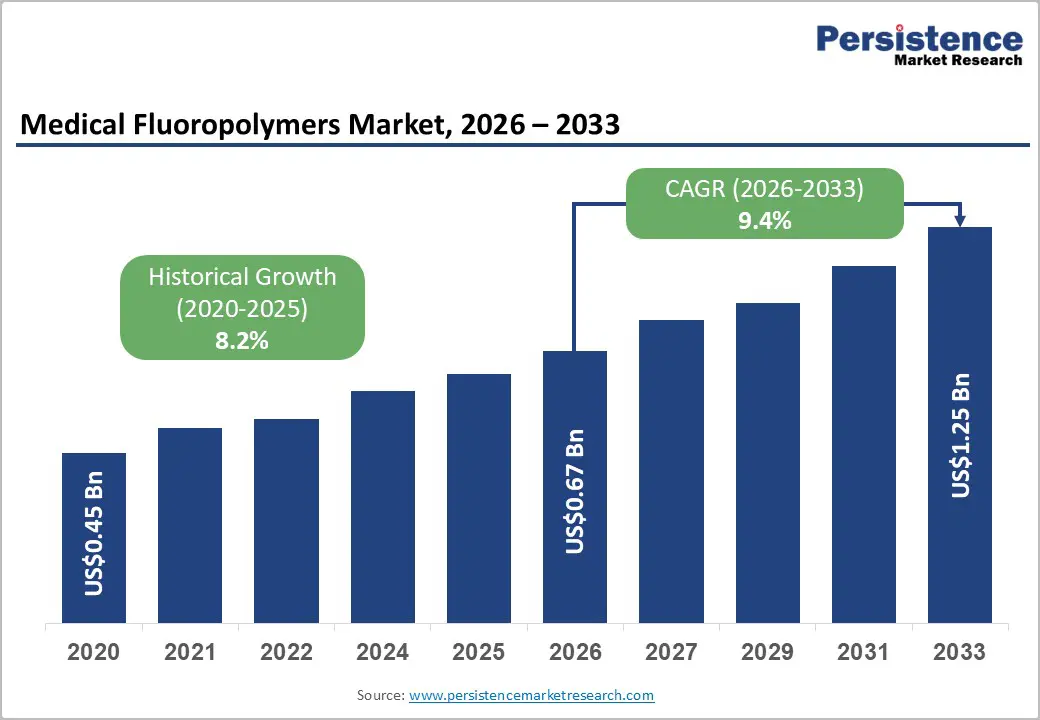
The global medical fluoropolymers market size is likely to be valued at US$0.67 billion in 2026 and is expected to reach US$1.25 billion by 2033, growing at a CAGR of 9.4% between 2026 and 2033, driven by increasing adoption of minimally invasive medical procedures, rising demand for chemically inert and biocompatible materials, and the growing prevalence of cardiovascular and chronic diseases globally.
Fluoropolymers continue to gain importance in advanced medical applications owing to their low friction coefficient, sterilization compatibility, thermal stability, and long-term biostability.
Key Industry Highlights:
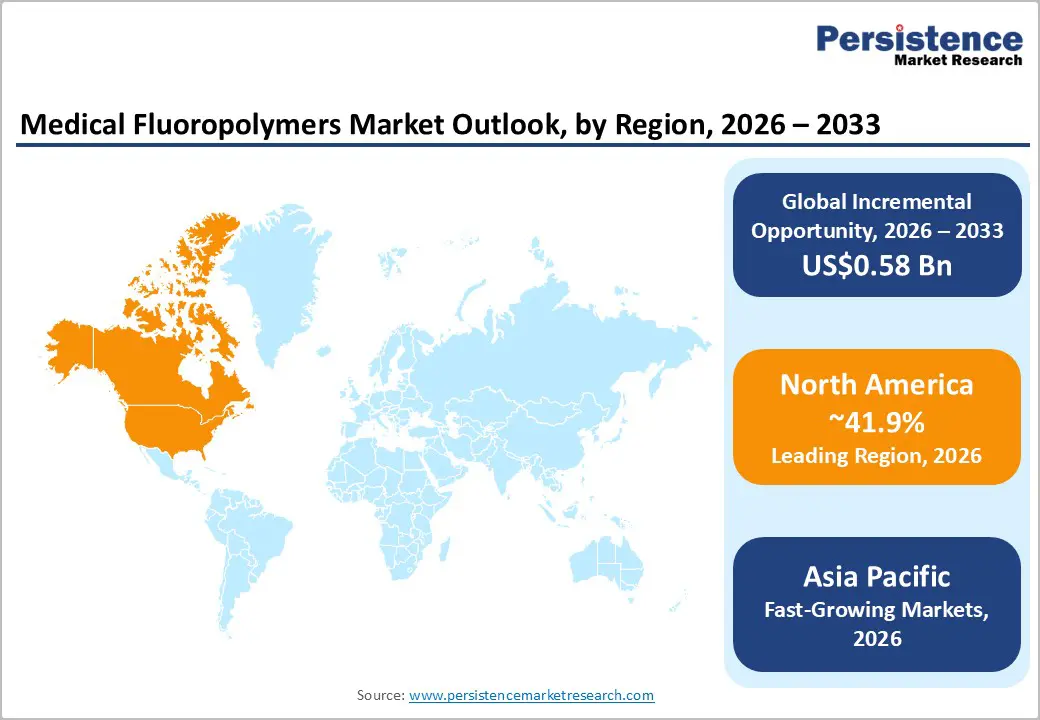
- Leading Region: North America is projected to account for 41.9% market share in 2026, supported by advanced healthcare infrastructure, strong medical-device manufacturing capabilities, and high adoption of minimally invasive procedures.
- Fastest-growing Region: Asia Pacific is projected to be the fastest-growing regional market during the forecast period, driven by expanding healthcare infrastructure, increasing domestic medical-device production, and rising investments in catheter and implantable-device manufacturing.
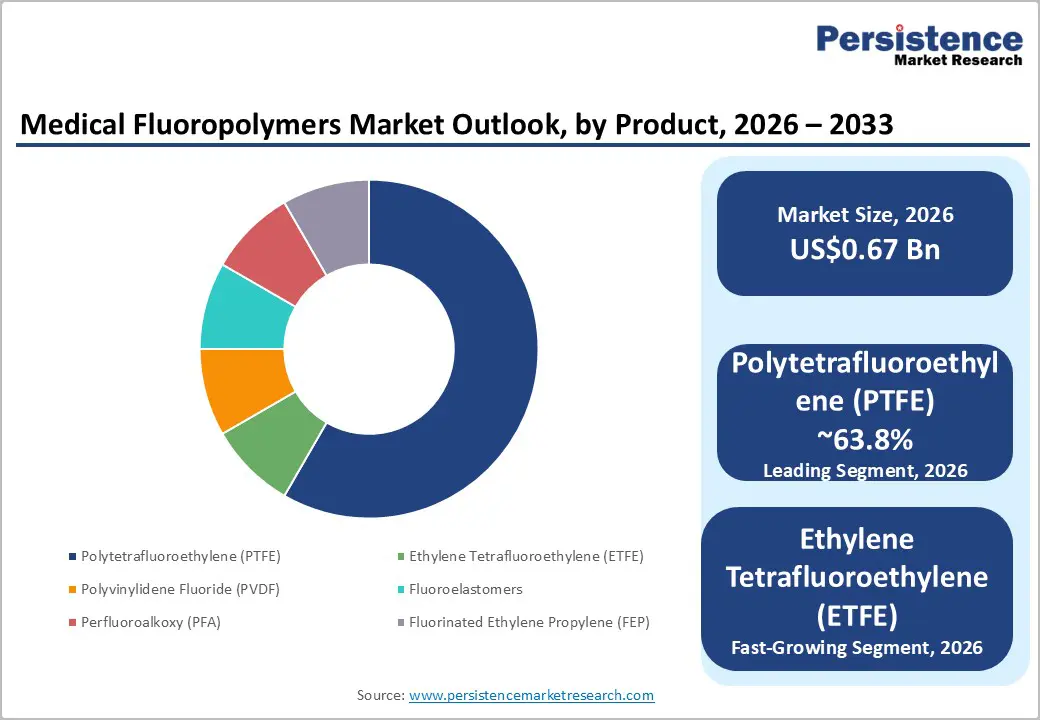
- Dominant Product: Polytetrafluoroethylene (PTFE) is anticipated to account for 63.8% market share in 2026, driven by strong demand across catheter liners, guidewires, implantable grafts, and biopharmaceutical fluid-handling systems.
- Leading Application: Medical tubing is estimated to hold 38.1% of market share in 2026, supported by increasing utilization in respiratory systems, dialysis equipment, drug-transfer systems, and sterile biopharmaceutical processing applications.
DRO Analysis
Driver - Rising Demand for Minimally Invasive and Cardiovascular Devices
Medical fluoropolymers are witnessing strong demand due to the rapid expansion of minimally invasive surgical procedures and cardiovascular interventions. Catheter-based systems, guidewires, vascular grafts, and implantable devices require materials with superior lubricity, chemical resistance, flexibility, and sterilization tolerance. Fluoropolymers such as PTFE, FEP, and ePTFE provide these critical properties, making them essential for high-performance medical applications.
The increasing global incidence of cardiovascular disease continues to accelerate demand for advanced interventional devices. Healthcare systems are also prioritizing minimally invasive procedures as they reduce patient recovery time, minimize surgical complications, and lower hospitalization costs. As medical device manufacturers focus on developing lower-profile and more durable delivery systems, fluoropolymer-based components are becoming increasingly important across cardiovascular, neurovascular, and endoscopic applications.
Growing Aging Population and Rising Healthcare Utilization
Global demographic changes are creating sustained demand for medical fluoropolymers across diagnostic, therapeutic, and implantable device applications. Aging populations require more cardiovascular treatments, chronic disease management devices, drug-delivery systems, and long-term care solutions, all of which depend heavily on reliable and biocompatible materials. Medical fluoropolymers are widely used as they support repeat sterilization, low extractables, high purity, and long operational life in demanding clinical environments.
Rising healthcare expenditure across developed and emerging economies is further supporting the adoption of advanced medical devices incorporating fluoropolymer components. Device manufacturers increasingly prioritize materials that reduce failure risk, improve procedural accuracy, and support long-term patient safety. This trend is expected to sustain long-term demand for fluoropolymer tubing, liners, coatings, and implantable materials throughout the forecast period.
Restraint - PFAS Regulatory Scrutiny and High Qualification Costs
One of the major restraints affecting the medical fluoropolymers market is the increasing regulatory scrutiny surrounding PFAS-related materials. Regulatory agencies in Europe and other regions continue to evaluate restrictions on selected fluorinated compounds due to environmental and health concerns. Although medical applications often receive differentiated consideration due to their critical healthcare role, manufacturers still face rising compliance requirements, documentation obligations, and material traceability expectations.
Medical device qualification cycles are already lengthy and expensive, and additional regulatory pressure increases development timelines and validation costs. Supply-chain complexity also remains a challenge as medical-grade fluoropolymer production requires specialized processing capabilities and stringent quality control systems. These factors create barriers for smaller suppliers and may increase procurement and operational costs for medical device manufacturers globally.
Opportunity - Expansion of Medical Manufacturing in Asia Pacific
Asia Pacific represents a major growth opportunity for the medical fluoropolymers market due to expanding medical-device manufacturing capacity, rising healthcare investments, and increasing demand for advanced medical technologies. Countries such as China, Japan, India, and several ASEAN economies are strengthening domestic medical-device ecosystems while attracting foreign investment in healthcare manufacturing. The region offers competitive production costs, skilled technical labor, and rapidly expanding healthcare infrastructure. Localized manufacturing of catheters, tubing systems, diagnostic devices, and implantable components is increasing demand for high-performance fluoropolymer materials.
Regional supply-chain development also enables faster customer qualification, reduced lead times, and improved cost efficiency. As healthcare access expands across emerging Asian economies, demand for fluoropolymer-enabled medical technologies is expected to accelerate significantly during the forecast period.
Development of High-Value Application-Specific Fluoropolymer Grades
The market is increasingly shifting from commodity fluoropolymer products toward specialized, high-value medical grades designed for advanced clinical applications. Medical device manufacturers are demanding thinner tubing walls, improved bondability, lower friction surfaces, and enhanced chemical purity to support next-generation device designs. This transition is creating opportunities for suppliers that can provide customized fluoropolymer solutions for catheter systems, implantable devices, ophthalmic delivery systems, and drug-delivery platforms.
Product innovation in thin-wall PTFE liners, peelable heat-shrink tubing, implant-grade ePTFE, and high-purity fluoropolymer components is enabling suppliers to strengthen long-term partnerships with medical OEMs. The opportunity extends beyond material supply toward collaborative engineering, product development support, and integrated manufacturing services.
Category-wise Analysis
Product Insights
Polytetrafluoroethylene (PTFE) is anticipated to account for 63.8% of market share in 2026. PTFE remains the preferred fluoropolymer in medical applications due to its exceptional chemical resistance, low friction coefficient, thermal stability, and long-term biocompatibility. The material is extensively used in catheter liners, guidewires, implantable vascular grafts, and fluid-transfer tubing.
For example, PTFE is widely integrated into cardiovascular catheters and minimally invasive delivery systems where smooth navigation and sterilization compatibility are essential. Strong demand from cardiovascular, neurovascular, and biopharmaceutical applications continues to reinforce PTFE’s market leadership.
Ethylene Tetrafluoroethylene (ETFE) is anticipated to grow at the fastest pace between 2026 and 2033. ETFE is increasingly adopted in advanced tubing systems, multilayer medical assemblies, and diagnostic devices as it combines strong chemical resistance with improved flexibility and easier processing compared with conventional fluoropolymers. The material is particularly suitable for precision extrusion and lightweight medical-device designs.
For instance, ETFE is being increasingly utilized in minimally invasive surgical tubing and flexible diagnostic components requiring durability and design precision. Rising demand for compact, high-performance medical devices and scalable manufacturing solutions is expected to support continued ETFE adoption globally.
Application Insights
Medical tubing is anticipated to account for 38.1% of the market share in 2026. Fluoropolymer-based tubing is extensively used in respiratory systems, dialysis equipment, anesthesia delivery systems, biopharmaceutical processing, and drug-transfer applications due to its chemical inertness, sterilization resistance, and high-purity performance. PTFE, FEP, and PFA tubing products are widely preferred in critical healthcare environments where contamination control and consistent fluid flow are essential.
For example, fluoropolymer tubing is commonly used in biopharmaceutical fluid-transfer systems and minimally invasive surgical instruments. Growing demand for sterile processing systems and advanced healthcare infrastructure continues to support segment growth.
Catheters are anticipated to expand their market share steadily and are projected to grow during the forecast period. Growth is strongly linked to the increasing adoption of minimally invasive cardiovascular, neurovascular, and endoscopic procedures. Modern catheter systems require ultra-thin liners, low-friction surfaces, and precise torque response, making fluoropolymers highly suitable materials.
For instance, PTFE-lined catheters are widely used in angioplasty and interventional cardiology procedures to improve device maneuverability and procedural accuracy. Innovations in multilayer catheter assemblies and etched PTFE liners are also enabling the development of lower-profile and higher-performance catheter systems, further accelerating market demand.
Regional Insights
North America Medical Fluoropolymers Market Trends
North America is projected to account for 41.9% of the market share in 2026, maintaining its leadership position due to advanced healthcare infrastructure, strong medical-device manufacturing capabilities, and high adoption of minimally invasive technologies.
U.S. Medical Fluoropolymers Market Trends
The U.S. represents the largest market within North America due to its concentration of major medical-device OEMs, specialized material suppliers, and healthcare research institutions. Demand for fluoropolymers is increasing across cardiovascular intervention systems, neurovascular devices, drug-delivery platforms, and minimally invasive surgical technologies. U.S.-based manufacturers continue investing in advanced fluoropolymer solutions such as thinner-wall catheter liners, implant-grade PTFE materials, and silicone-free medical components to improve procedural performance and patient safety.
The country also benefits from extensive investment in biologics manufacturing, pharmaceutical processing, and precision-engineered medical tubing systems. Growth in catheter-based procedures, increasing chronic disease prevalence, and rising adoption of robotic-assisted surgeries are supporting long-term demand for high-performance fluoropolymer materials. However, manufacturers must also address increasing environmental scrutiny surrounding PFAS-related substances, which is encouraging investment in sustainable processing technologies and improved supply-chain transparency.
Canada Medical Fluoropolymers Market Trends
Canada represents a growing market for medical fluoropolymers, supported by expanding healthcare expenditure, strong medical research activities, and increasing adoption of advanced diagnostic and surgical technologies. Demand is particularly rising in biopharmaceutical manufacturing, diagnostic equipment, and minimally invasive treatment systems. Canadian healthcare providers continue investing in advanced catheter systems, respiratory devices, and sterile fluid-transfer technologies, which is contributing to higher utilization of fluoropolymer-based medical components.
The country also benefits from supportive healthcare policies and increasing collaboration between research organizations and medical-device manufacturers. Growing emphasis on healthcare modernization and infection-control technologies is expected to create additional opportunities for fluoropolymer tubing, filtration systems, and implantable-device applications over the forecast period.
Europe Medical Fluoropolymers Market Trends
Europe represents a technologically advanced and highly regulated market for medical fluoropolymers, supported by strong healthcare systems, advanced manufacturing capabilities, and strict quality standards.
Germany Medical Fluoropolymers Market Trends
Germany remains one of the leading markets in Europe due to its strong engineering expertise, advanced healthcare infrastructure, and well-established medical-device manufacturing sector. The country is a major hub for minimally invasive surgical systems, cardiovascular devices, and industrial healthcare equipment. German manufacturers continue investing in precision fluoropolymer tubing, implant-grade materials, and advanced catheter technologies to support high-performance medical applications.
The country also benefits from strong pharmaceutical and biotechnology industries, which are increasing demand for high-purity fluoropolymer fluid-handling and filtration systems. Regulatory compliance and product reliability remain critical competitive factors within the German market.
U.K. Medical Fluoropolymers Market Trends
The U.K. maintains a significant position in the European medical fluoropolymers market due to strong medical research capabilities and expanding adoption of advanced healthcare technologies. Demand for fluoropolymers is increasing across diagnostic equipment, drug-delivery systems, and minimally invasive surgical devices. The country’s focus on healthcare innovation and specialized medical manufacturing continues to support market growth.
Rising investments in life sciences and biopharmaceutical manufacturing are also contributing to higher utilization of fluoropolymer tubing and sterile processing systems. The U.K. market benefits from strong collaboration between research institutions, healthcare providers, and medical-device manufacturers.
Asia Pacific Medical Fluoropolymers Market Trends
Asia Pacific is projected to be the fastest-growing regional market for medical fluoropolymers during the forecast period. The region’s growth is being driven by expanding healthcare infrastructure, increasing domestic medical-device manufacturing, rising healthcare expenditure, and growing demand for advanced medical technologies.
China Medical Fluoropolymers Market Trends
China represents one of the fastest-expanding markets within Asia Pacific due to rapid healthcare modernization, increasing domestic medical-device production, and government support for advanced manufacturing industries. Demand for fluoropolymer materials is rising across cardiovascular devices, diagnostic systems, implantable technologies, and minimally invasive surgical applications.
The country also benefits from strong manufacturing capabilities, competitive production costs, and expanding healthcare access. Increasing investments in local medical-device innovation and biopharmaceutical manufacturing are expected to accelerate demand for fluoropolymer tubing, PTFE liners, and high-purity fluid-transfer systems.
Japan Medical Fluoropolymers Market Trends
Japan remains a major innovation hub for fluoropolymer technologies and advanced medical materials. The country benefits from high healthcare standards, strong engineering capabilities, and extensive expertise in precision medical-device manufacturing. Japanese companies continue investing in advanced fluoropolymer extrusion technologies, thin-wall catheter systems, and high-performance implantable materials.
Demand remains particularly strong in cardiovascular devices, neurovascular systems, and minimally invasive surgical applications. Japan’s aging population and advanced healthcare infrastructure continue to support long-term growth in fluoropolymer-enabled medical technologies.
Competitive Landscape
The global medical fluoropolymers market is moderately concentrated at the material-supply level, while downstream component manufacturing remains relatively fragmented. Large global fluoropolymer suppliers maintain strong positions due to their technological expertise, regulatory experience, and established relationships with medical-device OEMs. Competition is primarily based on material quality, regulatory compliance, application engineering capabilities, manufacturing reliability, and product innovation. Market participants increasingly focus on customized fluoropolymer solutions designed for advanced catheter systems, implantable devices, and high-purity fluid-handling applications.
Leading companies are prioritizing application-specific innovation, regulatory compliance, and regional manufacturing expansion to strengthen market position. Strategic focus areas include thinner-wall fluoropolymer tubing, implant-grade materials, advanced catheter solutions, and high-purity biopharmaceutical processing systems. Companies are also emphasizing collaborative product development, supply-chain localization, and sustainable fluoropolymer processing technologies to improve competitiveness and support long-term customer relationships.
Key Industry Developments:
- In May 2025, W. L. Gore & Associates launched the 0.5 mL silicone-free GORE IMPROJECT Syringe Plunger for ophthalmic prefilled syringes, targeting improved contamination control and reduced silicone-related complications in injectable drug-delivery systems.
- In April 2025, Junkosha introduced new developments in its Etched PTFE Liner portfolio, including ultra-thin wall catheter liner technologies with enhanced tensile strength and improved process consistency.
Companies Covered in Medical Fluoropolymers Market
- DuPont
- W. L. Gore & Associates
- Saint-Gobain Performance Plastics
- AGC Inc.
- Solvay
- Daikin Industries Ltd.
- Zeus Industrial Products, Inc.
- Arkema S.A.
- Junkosha Inc.
- TekniPlex Healthcare
- Freudenberg Medical
- Lubrizol Life Science Health
- Fluorotherm Polymers, Inc.
- Trelleborg Healthcare & Medical
- Teleflex Incorporated
- Elkem Silicones & Fluoropolymers Division
Frequently Asked Questions
The global medical fluoropolymers market is anticipated to be valued at US$0.7 billion in 2026.
The market is projected to reach approximately US$1.25 billion by 2033.
Key market trends include increasing adoption of minimally invasive surgical procedures, rising use of fluoropolymer-based catheter systems, growing demand for high-purity medical tubing, expansion of biopharmaceutical manufacturing, and increasing investment in implant-grade PTFE and advanced fluoropolymer technologies.
Polytetrafluoroethylene (PTFE) is the leading product segment, accounting for 63.8% market share, due to its superior chemical resistance, low-friction properties, and extensive use in catheters, guidewires, and implantable devices.
The medical fluoropolymers market is projected to grow at a CAGR of 9.4% between 2026 and 2033.
Major companies operating in the market include DuPont, W. L. Gore & Associates, Saint-Gobain, AGC Inc. and Solvay.


