




- Industrial Machinery
- High Shear Mixer Market
High Shear Mixer Market Size, Share, and Growth Forecast 2026 - 2033
High Shear Mixer Market by Product Type (Batch High Shear Mixers, Inline High Shear Mixers, Multi-stage High Shear Mixers, Laboratory High Shear Mixers, Recirculating High Shear Mixers, Portable High Shear Mixers), Operation Mode (Batch Processing, Continuous Processing, Semi-Continuous Processing), Application, End-user, and Regional Analysis, 2026 - 2033

High Shear Mixer Market Size and Trend Analysis
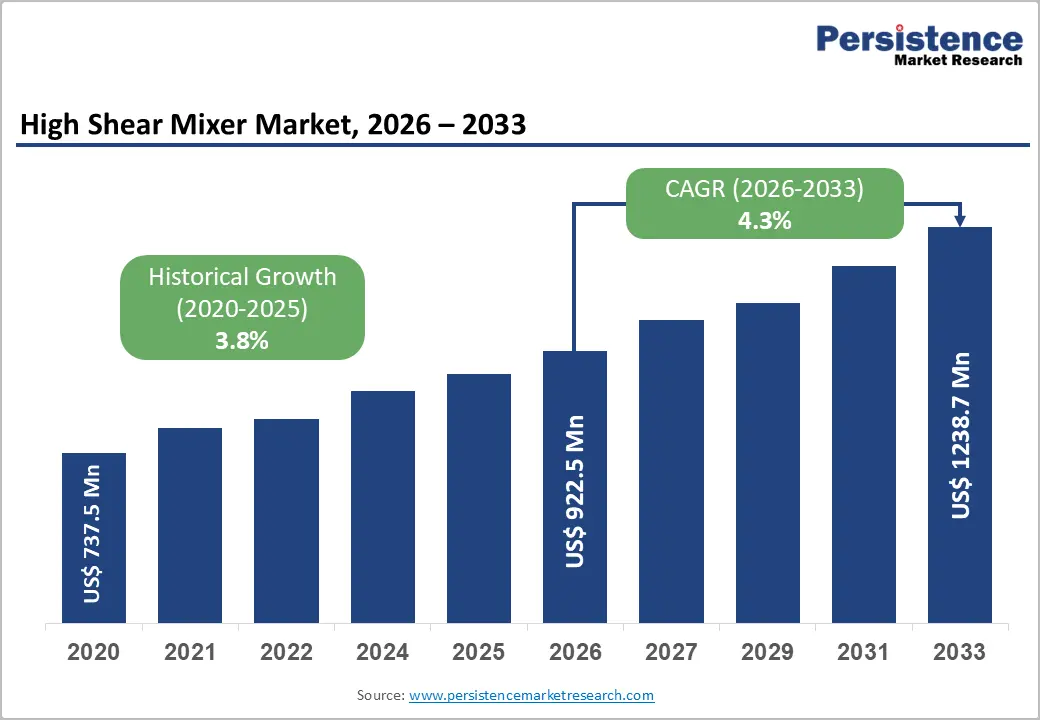
The global high shear mixer market size is likely to be valued at US$ 922.5 million in 2026 and is expected to reach US$ 1,238.7 million by 2033, growing at a CAGR of 4.3% during the forecast period from 2026 to 2033.
The high shear mixer market is on a steady and broadening growth path, driven by expanding industrial processing requirements across pharmaceuticals, food and beverages, personal care, and specialty chemicals, all sectors demanding consistent particle size reduction, stable emulsification, and homogeneous dispersion that only high shear mixing technology can reliably deliver at commercial scale.
Key Industry Highlights:
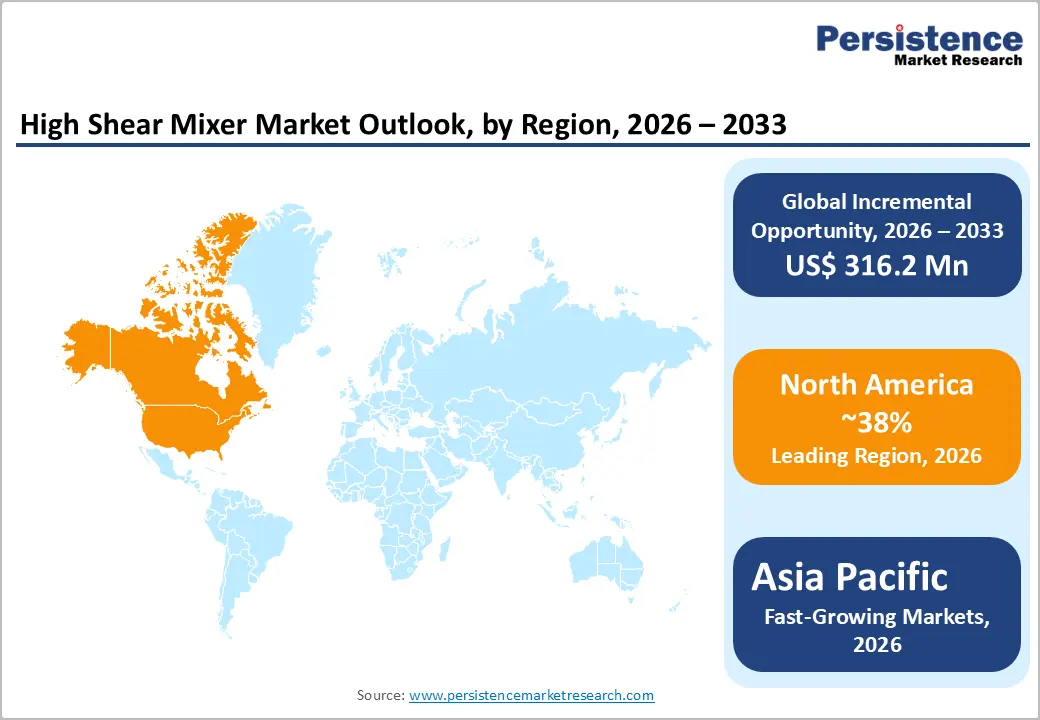
- Leading Region: North America leads the high shear mixer market, holding 38% share, anchored by the U.S.’s world-leading pharmaceutical manufacturing sector requiring GMP-compliant ASME BPE-standard equipment, supported by FDA FSMA food processing regulations and a strong domestic manufacturing base including Silverson, Ross, and Admix.
- Fastest Growing Region: Asia Pacific is the fastest growing region with a rising CAGR of 9.1%, driven by China’s massive generic pharmaceutical and food processing industries, India’s status as the world’s largest generic medicine exporter supplying over 20% of global generic drug volume, and ASEAN manufacturing expansion.
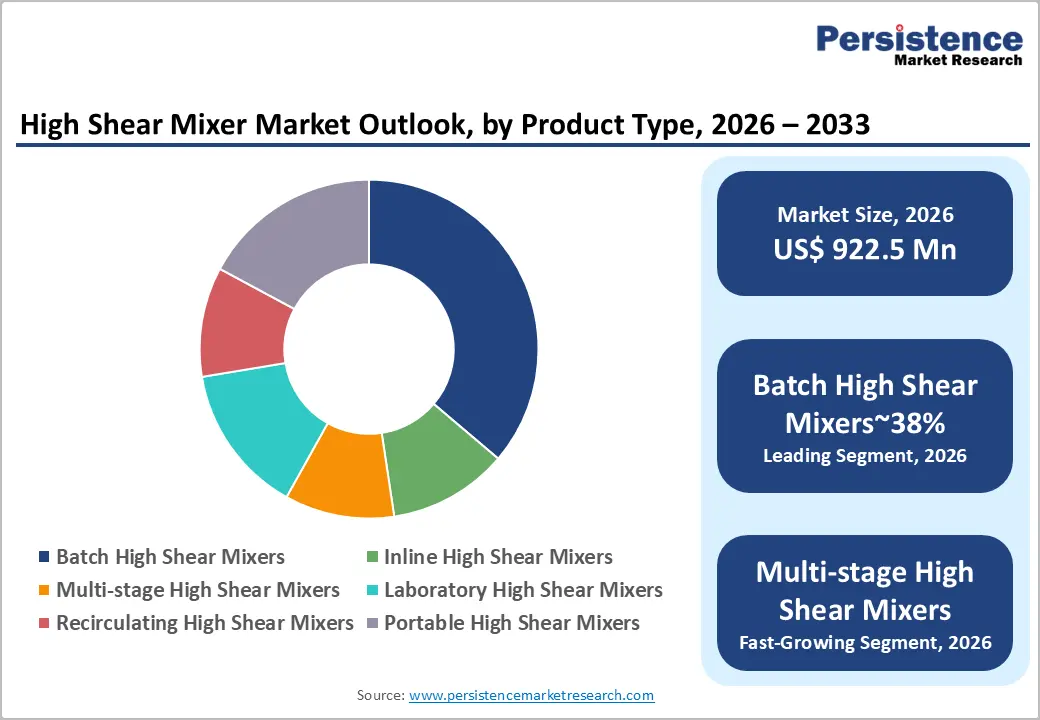
- Dominant Segment: Batch high shear mixers lead the product category with approximately 38% market share, preferred for pharmaceutical, cosmetics, and specialty food production, where formulation flexibility, GMP batch record compliance, and complete vessel cleanout between products are operational requirements.
- Fastest Growing Segment: Inline High Shear Mixers within the By Product Type category are the fastest growing, driven by the pharmaceutical industry’s FDA-encouraged transition to continuous manufacturing and plant-based food processing expansion requiring high-throughput continuous emulsification and homogenization solutions.
- Key Opportunity: FDA-validated inline high shear systems for pharmaceutical continuous manufacturing, actively encouraged by FDA’s Quality by Design guidance, and premium cosmetics emulsification equipment for the growing Asian personal care market represent the highest-value near-term growth opportunities for manufacturers.

Market Dynamics
Drivers - Pharmaceutical Industry Expansion and Drug Formulation Complexity
The pharmaceutical industry represents the most technically demanding and highest-value end-use segment for high shear mixers, with rising global drug production and increasingly complex formulation requirements generating sustained equipment investment. The World Health Organization (WHO) reports that global pharmaceutical sales exceeded US$ 1.4 trillion in 2022, with generics, biologics, and novel drug delivery systems constituting the fastest-growing categories.
High shear mixers are indispensable in manufacturing oral emulsions, topical creams, injectable lipid formulations, and nano-particle drug delivery systems where micron- and sub-micron droplet size distributions are critical to therapeutic efficacy. The U.S. FDA's Process Analytical Technology (PAT) framework and EU's GMP Annex 15 validation requirements mandate process consistency that high shear mixing systems, with their precise rotor-stator geometry and controllable tip speed, are specifically engineered to deliver. Growing investment in biosimilars and mRNA-based vaccines is further driving high shear mixer adoption in pharmaceutical manufacturing globally.
Processed Food Industry Growth and Clean Label Formulation Trends
The global food and beverages processing sector is a major driver of high shear mixer demand, supported by rising urbanization, expanding packaged food consumption in emerging markets, and the clean label movement requiring natural emulsifiers and stabilizers that are more challenging to process uniformly. The Food and Agriculture Organization (FAO) estimates that global processed food production has grown consistently at over 3% annually over the past decade.
High shear homogenizers and emulsifiers are essential for producing stable mayonnaises, salad dressings, dairy beverages, infant formula, and plant-based protein products that require fine droplet emulsification and consistent particle size. The explosive growth of plant-based food categories, with global plant-based food sales exceeding US$ 8 billion annually per Good Food Institute data, is creating a particularly dynamic new demand segment for high-performance emulsification and homogenization equipment.
Restraints - High Capital Cost and Complex Maintenance Requirements
Industrial-scale high shear mixers, particularly multi-stage inline systems and large-batch rotor-stator units, represent significant capital expenditures, with high-end configurations from leading manufacturers ranging from US$ 50,000 to over US$ 500,000. Maintenance requirements, including periodic rotor-stator replacement, seal servicing, and precision alignment checks add to the total cost of ownership.
For small and mid-sized manufacturers in developing markets, these financial barriers constrain equipment upgrade decisions, particularly when conventional mixing alternatives can meet basic product specifications at lower investment levels, limiting addressable market expansion among SME manufacturers.
Stringent Regulatory Validation Requirements in Pharmaceutical Applications
While pharmaceutical industry growth drives high shear mixer demand, the stringent qualification and validation requirements governing pharmaceutical mixing equipment simultaneously create market friction.
FDA 21 CFR Part 11 compliance for electronic batch records, Equipment Qualification (IQ/OQ/PQ) protocols mandated under EU GMP Annex 15, and GAMP 5 software validation requirements impose significant time and cost burdens on procurement and commissioning processes, typically extending project timelines by 6-18 months beyond equipment delivery. These regulatory compliance demands can deter investment at smaller pharmaceutical facilities, moderating overall sector demand growth.
Opportunities - Continuous Manufacturing and Inline High Shear Systems for Pharmaceutical Production
The pharmaceutical industry's transition from traditional batch manufacturing to continuous processing represents one of the most significant near-term growth opportunities for inline high shear mixer manufacturers. The U.S. FDA has actively encouraged continuous pharmaceutical manufacturing through its Quality by Design (QbD) guidance and has approved multiple continuous drug manufacturing processes, signaling strong regulatory support for this transition.
Inline high shear mixers are a core enabling component of continuous pharmaceutical manufacturing lines, delivering consistent emulsification and homogenization without the batch-to-batch variability inherent in traditional processing. Pharmaceutical OEMs including Pfizer, AstraZeneca, and Novartis have publicly committed to expanding continuous manufacturing capabilities. Equipment manufacturers that develop validated, FDA-compliant inline high shear systems with integrated PAT monitoring are positioned to capture a significant share of this accelerating capital investment in pharmaceutical continuous processing infrastructure.
Personal Care and Cosmetics Sector Expansion in Emerging Markets
The global personal care and cosmetics industry represents a rapidly expanding high shear mixer end-use market, driven by rising disposable incomes, urbanization, and beauty culture adoption across Asia Pacific, Latin America, and the Middle East. The Cosmetics Europe industry association reports that the European personal care market alone generates over €90 billion in annual retail sales, while emerging market growth rates are significantly higher.
Premium skincare formulations, including serums, oil-in-water emulsions, sunscreens, and hair conditioning products, require high shear mixing for fine, stable emulsion production that delivers the sensory texture and performance consumers expect. The clean beauty trend is driving formulators toward more challenging natural ingredient combinations that require advanced high shear processing capabilities. Manufacturers offering compact, hygienic-design high shear systems suitable for small-batch artisan cosmetics production alongside industrial-scale units can address the full spectrum of this growth market.
Category-wise Analysis
By Product Type Insights
Batch high shear mixers dominate the product type segment, representing approximately 38% of total market share. Batch processing remains the predominant manufacturing mode across pharmaceutical, cosmetics, and specialty food production, where formulation variability and the need for complete clean-out between product changeovers favor batch over continuous systems.
Batch high shear mixers, characterized by a rotor-stator assembly immersed in a processing vessel, offer maximum process flexibility, ease of validation, and compatibility with a wide range of vessel sizes and product types. Leading manufacturers, including Silverson Machines and IKA Works, have built global market leadership around comprehensive batch high shear mixer product lines serving pharmaceutical GMP, food-grade, and industrial processing environments, reinforcing this segment’s dominant market position.
By Operation Mode Insights
Batch processing remains the dominant operational mode in the High Shear Mixer market, contributing approximately 54% of total revenue share due to its critical alignment with regulated, small-to-medium scale production environments. Industries such as pharmaceuticals, nutraceuticals, cosmetics, and specialty chemicals rely heavily on batch systems to ensure precise formulation control, ingredient traceability, and repeatable product quality across discrete production cycles.
High shear mixers operating in batch mode enable optimized control over critical process parameters such as shear rate, mixing time, particle size reduction, and emulsification efficiency, which are essential for producing homogeneous dispersions and stable emulsions. Additionally, regulatory frameworks enforced by organizations such as the U.S. Food and Drug Administration and the European Medicines Agency necessitate detailed batch documentation, validation, and audit trails, further reinforcing batch adoption. The flexibility to handle multi-product manufacturing, frequent changeovers, and customized formulations continues to position batch processing as the preferred choice despite the gradual emergence of continuous mixing technologies.
By Application Insights
Emulsification is the leading application segment, representing approximately 32% of total market share. Emulsification, the process of forming and stabilizing fine droplet dispersions of two immiscible liquids, is the most universally required high shear mixing operation across pharmaceuticals (injectable lipid emulsions, topical creams), food processing (mayonnaise, salad dressings, dairy emulsions), personal care (lotions, sunscreens), and specialty chemicals (agrochemical emulsifiable concentrates).
High shear rotor-stator mixers generate the intense turbulence and hydraulic shear required to achieve consistent droplet sizes in the 0.5-5 micron range that characterizes stable, commercially viable emulsions. The technical specificity of emulsification as a high shear mixing application, requiring precise control of rotor tip speed, gap geometry, and processing time, ensures this segment remains the core value driver for premium high shear mixer configurations.
By End-user Insights
Pharmaceuticals is the leading end-use segment, commanding approximately 27% of total market share. The pharmaceutical industry’s combination of high equipment investment capacity, mandatory process validation standards, and technically demanding formulation requirements makes it the highest-value and most specifications-driven end-use market for high shear mixers.
GMP-compliant high shear mixers for pharmaceutical applications must meet ASME BPE (Bioprocessing Equipment) standards for surface finish, cleanability, and material compatibility, commanding significant price premiums over food-grade or industrial configurations. The Association for Pharmaceutical Manufacturers and Research (PhRMA) reported U.S. pharmaceutical R&D investment exceeding US$ 100 billion annually, underscoring the sector’s ongoing capital investment intensity that sustains high shear mixer procurement as part of new facility construction and process upgrade programs globally.
Regional Insights
North America High Shear Mixer Market Trends
North America is the dominant high shear mixer market, anchored by the United States’ world-leading pharmaceutical manufacturing base, large food and beverage processing industry, and well-developed personal care sector. The U.S. hosts the world’s largest pharmaceutical manufacturing cluster, with FDA-regulated facilities requiring GMP-compliant high shear mixing equipment that meets ASME BPE standards and 21 CFR Part 11 electronic batch record requirements. U.S.-based manufacturers including Charles Ross & Son Company, Admix, and Quadro Engineering have strong domestic market positions and serve global export markets.
The U.S. regulatory framework, governed by FDA CGMP 21 CFR Parts 210 and 211 for pharmaceutical manufacturing and FDA FSMA for food processing, creates a compliance-driven floor of equipment quality standards that supports premium pricing and sustained replacement demand. Canada’s pharmaceutical and food processing sectors contribute supplementary demand. The North American innovation ecosystem, including strong university-industry research collaboration in process engineering and drug delivery, continuously generates new application development that drives next-generation high shear mixer technology adoption.
Europe High Shear Mixer Market Trends
Europe is a technically sophisticated and regulatory-demanding high shear mixer market, shaped by the European Medicines Agency (EMA) GMP framework, the EU’s Food Information to Consumers Regulation, and stringent chemical safety standards under REACH. Germany is the region’s largest market, home to world-class high shear mixer manufacturers including IKA Works and Hielscher Ultrasonics, alongside major end-use industries in pharmaceuticals (Bayer, Merck KGaA), food processing, and specialty chemicals.
The United Kingdom hosts globally recognized high shear mixer manufacturer Silverson Machines and a substantial pharmaceutical and personal care manufacturing base. France and Spain contribute meaningful demand through their food processing and personal care sectors. The EU Pharmaceutical Legislation Review and the European Green Deal’s sustainability mandates for chemical and food manufacturing are shaping next-generation equipment procurement toward energy-efficient, cleanable, and digitally integrated high shear systems across the region.
Asia Pacific High Shear Mixer Market Trends
Asia Pacific is the fastest-growing regional market for high shear mixers, driven by expanding pharmaceutical manufacturing capacity, growing food processing industrialization, and a rapidly rising personal care industry across China, India, Japan, and ASEAN markets. China is the dominant regional market, hosting the world’s largest generic pharmaceutical manufacturing base and a massive food processing industry. Chinese high shear mixer manufacturers including Changzhou Hywell Machinery supply cost-competitive equipment domestically and internationally, while international brands compete for premium pharmaceutical and food-grade segments.
India is the region’s second-largest market and fastest-growing, supported by its status as the world’s largest generic medicine exporter, supplying over 20% of global generic drug volume per the Indian Pharmaceutical Alliance (IPA), generating substantial demand for GMP-compliant pharmaceutical mixing equipment. Japan’s precision manufacturing culture drives demand for high-specification high shear systems in pharmaceuticals and personal care. ASEAN nations, particularly Thailand, Vietnam, and Indonesia, are expanding their food processing and pharmaceutical manufacturing sectors, creating incremental demand for industrial high shear mixing systems at competitive price points.
Competitive Landscape
The global high shear mixer market is moderately fragmented, with a small number of established Western technology leaders commanding premium market positions alongside a growing base of Asian manufacturers competing in mid-range segments. Companies such as Silverson Machines, IKA Works, Charles Ross & Son Company, and SPX FLOW hold strong competitive positions through decades of application engineering expertise, global service networks, and certified GMP-compliant product lines.
Key differentiators include rotor-stator geometry optimization, material certification (ASME BPE, FDA-compliant materials), clean-in-place compatibility, and digital connectivity features. Emerging business model trends include application laboratory services, process development partnerships, remote monitoring subscriptions, and modular system architectures enabling scalable capacity. Chinese manufacturers are increasing competitive pressure in mid-range industrial segments.
Key Market Developments
- In February 2025: Silverson Machines launched its new L5M-A laboratory high shear mixer series with enhanced digital speed control, data logging capability, and GMP-compliant design for pharmaceutical formulation development applications, targeting small-scale drug product R&D laboratories globally.
- In September 2024: IKA Works introduced an IoT-connected inline high shear mixer platform featuring real-time process parameter monitoring and cloud data integration, targeting pharmaceutical continuous manufacturing facilities requiring FDA 21 CFR Part 11-compliant digital batch records.
- In April 2024: SPX FLOW expanded its high shear homogenizer product range for plant-based food and beverage applications, launching a hygienic-design inline series optimized for pea protein, oat, and almond-based beverage emulsification at commercial production scale.
Companies Covered in High Shear Mixer Market
- Silverson Machines
- IKA Works
- Charles Ross & Son Company
- GEA Group
- SPX FLOW
- Admix
- Quadro Engineering
- Scott Turbon Mixer
- Lee Industries
- Glatt Group
- INOXPA
- Syntegon Technology
- Schold Manufacturing
- Hielscher Ultrasonics
- Changzhou Hywell Machinery
- NETZSCH Group
- Ystral GmbH
- Admix
Frequently Asked Questions
The global High Shear Mixer Market is projected to reach US$ 1,238.7 Million by 2033, growing from US$ 922.5 Million in 2026 at a CAGR of 4.3% during the 2026-2033 forecast period. This builds on a historical CAGR of 3.8% between 2020 and 2025, driven by pharmaceutical manufacturing expansion, food processing industrialization, and specialty chemical sector growth.
The primary drivers are global pharmaceutical industry expansion, with sales exceeding US$ 1.4 trillion and growing investment in biologics, mRNA vaccines, and continuous manufacturing, and the processed food sector’s demand for stable emulsification in plant-based foods, premium dairy beverages, and clean label products growing at over 3% annually per FAO data.
Batch High Shear Mixers lead the By Product Type category with approximately 38% market share, driven by their dominant use in GMP pharmaceutical manufacturing, cosmetics production, and specialty food processing where batch record compliance, formulation flexibility, and complete product changeover cleanout requirements make batch configuration the practical standard choice.
North America leads the global High Shear Mixer Market, underpinned by the U.S.’s world-leading pharmaceutical manufacturing sector governed by FDA CGMP requirements, a large food processing industry subject to FDA FSMA standards, and the presence of globally recognized manufacturers including Silverson Machines, Charles Ross & Son Company, and Admix.
The leading growth opportunities are FDA-validated inline high shear systems for pharmaceutical continuous manufacturing, actively supported by FDA’s Quality by Design framework and commitments from Pfizer, AstraZeneca, and Novartis, and personal care emulsification equipment serving the growing Asian cosmetics market, where European personal care sales alone exceed €90 billion annually.
The key market participants include Silverson Machines, IKA Works, Charles Ross & Son Company, GEA Group, SPX FLOW, Admix, Quadro Engineering, Scott Turbon Mixer, Lee Industries, Glatt Group, INOXPA, Syntegon Technology, Schold Manufacturing, Hielscher Ultrasonics, and Changzhou Hywell Machinery, collectively covering pharmaceutical GMP, food-grade, and industrial high shear mixer applications globally.


