




- Industrial Machinery
- Dew Point Apparatus Market
Dew Point Apparatus Market Size, Share, and Growth Forecast 2026 - 2033
Dew Point Apparatus Market by Product Type (Handheld, Portable, Stationary), by Sample Based Type (Air / Compressed Air, Carbon Dioxide, Methane, Nitrogen, Oxygen, Natural Gas, Other Gas), End-user (Laboratory Research & Development, Research & Academics, Oil & Gas, Chemical & Petrochemical, Food & Beverage, Environmental Agencies, Others), and Regional Analysis, 2026 - 2033

Dew Point Apparatus Market Size and Trend Analysis
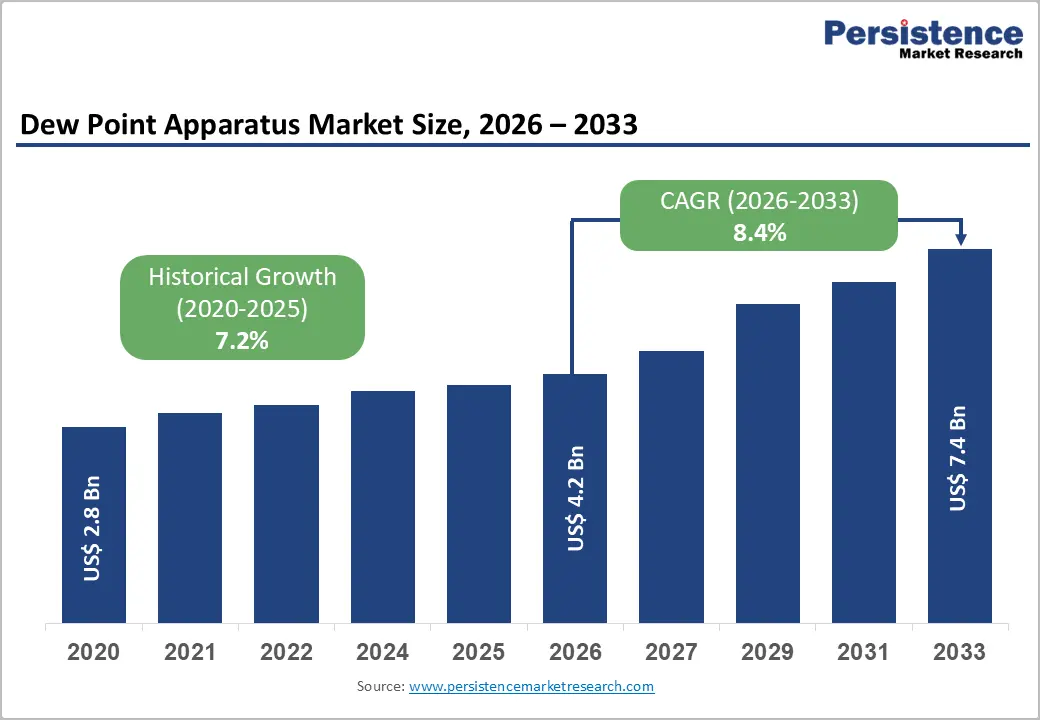
The global dew point apparatus market is projected to reach US$ 4.2 billion in 2026 and grow to US$ 7.4 billion by 2033, registering a CAGR of 8.4%.
Growth is driven by stringent industrial regulations and rising demand for precise moisture control across critical sectors. Industries such as oil & gas and chemicals increasingly depend on dew point measurement to prevent corrosion, ensure operational safety, and maintain product quality. Regulatory frameworks such as EPA guidelines and ISO 8573-1 standards are reinforcing adoption. Additionally, continuous advancements in sensor accuracy and reliability are accelerating deployment across manufacturing and process industries worldwide.
Key Industry Highlights:
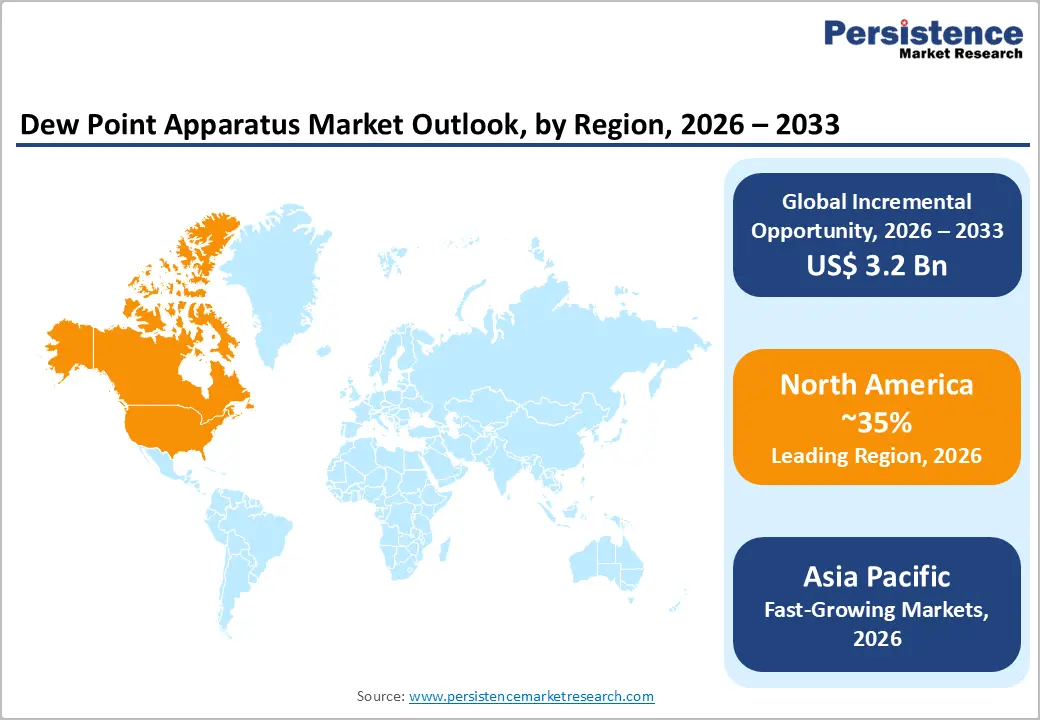
- Leading Region: North America dominates with 35% share in 2025, driven by stringent regulations and strong oil & gas industry presence.
- Fastest Growing Region: Asia Pacific holds 30% share in 2025 and emerges as the fastest-growing region, fueled by rapid industrialization in China and India.
- Leading Product Type: The Stationary segment leads with a 45% share, driven by its reliability in continuous industrial monitoring applications.
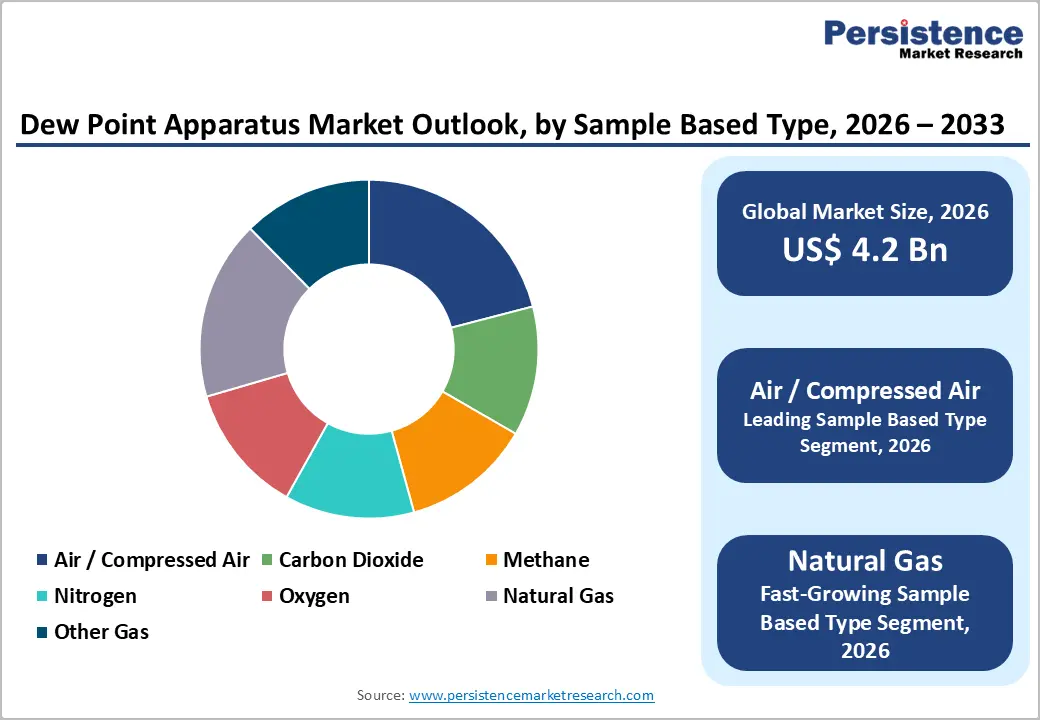
- Leading Sample Type: The Air /Compressed Air segment dominates with a 52% share, supported by widespread use in manufacturing and industrial systems.
- Key Opportunity: Integration of IoT-enabled dew point apparatus for predictive maintenance is creating significant opportunities across renewables and Industry 4.0-driven industries.

Market Dynamics
Driver - Rising Demand for Precise Moisture Control in Industrial Operations
The growing need for accurate moisture measurement in industrial processes is a major driver of the dew point apparatus market. In compressed air systems, excess humidity can lead to contamination, corrosion, and equipment failure, increasing operational risks. Standards such as ISO 8573-1 mandate strict dew-point levels, especially for critical applications requiring ultra-dry air, encouraging industries to adopt advanced monitoring solutions.
Additionally, inefficient moisture control contributes to significant energy losses in compressors, prompting industries to invest in reliable dew point apparatus. Sectors like food & beverage also rely on dry air systems to maintain product quality and extend shelf life. Regulatory compliance and the need for consistent production standards are accelerating the adoption of high-precision moisture measurement technologies across industries.
Advancements in Sensor Technologies Enhancing Measurement Accuracy
Continuous innovation in sensor technologies is significantly boosting the performance and adoption of the dew point apparatus. Modern solutions using capacitive and advanced sensing technologies offer higher accuracy, faster response times, and broader measurement ranges compared to traditional systems. This improved precision is crucial for industries such as oil & gas, where real-time monitoring helps prevent corrosion and ensure safe pipeline operations.
Furthermore, integrating digital features such as IoT-enabled monitoring and remote data logging aligns dew point devices with Industry 4.0 trends. These advancements help reduce downtime, enhance operational efficiency, and lower maintenance costs. As industries increasingly prioritize automation and predictive maintenance, technologically advanced dew point apparatuses are witnessing strong demand globally.
Restraints - High Initial Investment and Ongoing Maintenance Cost Burden
The high upfront cost of the dew point apparatus, along with recurring maintenance expenses, acts as a significant restraint for market growth. Regular calibration requirements, often every 6–12 months, add to operational costs, making ownership expensive for small and medium enterprises. Integration with existing legacy systems further increases installation complexity and overall expenditure.
These cost-related challenges are particularly evident in developing economies, where budget constraints limit the adoption of technology. Many industrial facilities delay equipment upgrades due to financial limitations, reducing market penetration. As a result, despite regulatory requirements and efficiency benefits, high ownership costs continue to restrict widespread adoption across cost-sensitive industries.
Limited Availability of Skilled Workforce for Accurate Operation
The shortage of skilled personnel capable of operating and maintaining dew-point apparatus poses a critical challenge to market expansion. Accurate calibration and data interpretation require technical expertise, which remains limited across many industrial sectors. This skill gap often leads to operational errors and inconsistent measurement outcomes.
Furthermore, inadequate training infrastructure and slow adoption of specialized programs hinder workforce development, particularly in emerging regions. Industries and environmental agencies face compliance risks due to improper usage of monitoring equipment. This shortage of trained professionals reduces confidence in deployment, thereby slowing the adoption of advanced dew point measurement solutions globally.
Opportunities - Growing Opportunities in Renewable Energy and Hydrogen Applications
The rapid expansion of renewable energy, particularly hydrogen production, presents significant opportunities for the Dew Point Apparatus market. Precise moisture control is essential in electrolyzers and fuel cell systems to prevent damage and maintain gas purity. As global hydrogen capacity continues to scale, demand for reliable dew point measurement solutions is expected to rise steadily.
Additionally, increasing investments in clean energy technologies and efficiency improvements are driving the need for advanced monitoring systems. Accurate drying and moisture control enhance system performance and longevity, making the dew point apparatus critical in next-generation energy infrastructure. This creates strong growth potential, especially in emerging energy markets.
Increasing Adoption of Smart and IoT-Integrated Monitoring Systems
The integration of IoT and smart technologies into dew point apparatus is unlocking new growth opportunities across industries. Real-time monitoring, remote diagnostics, and predictive maintenance capabilities help reduce downtime and improve operational efficiency. These features are particularly valuable in sectors like oil & gas and petrochemicals, where continuous monitoring is essential.
Moreover, the shift toward Industry 4.0 and digital transformation is accelerating the adoption of connected devices in laboratory and industrial environments. Portable and smart-enabled instruments are gaining traction due to their scalability and ease of use. As industries prioritize automation and data-driven decision-making, demand for IoT-enabled dew point solutions is expected to grow rapidly.
Category-wise Analysis
Product Type Insights
The stationary segment leads the Dew Point Apparatus market with a 45% share in 2025, driven by its reliability in continuous industrial monitoring applications. These systems are widely preferred in oil & gas and petrochemical industries due to their ability to handle high-volume compressed air systems efficiently. Their superior accuracy, long-term stability, and compliance with stringent industrial standards make them ideal for fixed installations requiring consistent performance.
The portable segment is emerging as the fastest-growing category, driven by increasing demand for field-based measurements and flexible operations. Industries are adopting portable devices for on-site diagnostics, maintenance, and spot-checking applications. Their ease of use, compact design, and compatibility with digital monitoring systems are accelerating adoption across sectors such as manufacturing, environmental monitoring, and laboratory testing.
Sample Based Type Insights
The air / compressed air segment dominates the market with a 52% share in 2025, supported by its extensive use across manufacturing and industrial processes. Strict air quality regulations and the need to maintain low moisture levels in compressed air systems are driving adoption. This segment plays a crucial role in ensuring product quality, preventing contamination, and maintaining operational efficiency across multiple industries.
The natural gas segment is witnessing the fastest growth, driven by increasing demand for moisture control in gas processing and transportation. As natural gas infrastructure expands globally, maintaining optimal dew point levels becomes essential to prevent pipeline corrosion and ensure safe operations. This is encouraging the adoption of advanced dew point measurement solutions in gas-related applications.
End-user Insights
The oil & gas segment holds the largest share at 38% in 2025, driven by the critical need for moisture monitoring in pipelines and processing systems. Dew point apparatus plays a vital role in preventing corrosion, maintaining infrastructure integrity, and ensuring compliance with stringent industry standards. Their use is particularly significant in upstream and midstream operations where safety and reliability are paramount.
The electronics & semiconductor segment is emerging as the fastest-growing end-user, fueled by the need for ultra-dry environments in manufacturing processes. Precise humidity control is essential to avoid defects and maintain product quality in sensitive production settings. As semiconductor manufacturing expands globally, demand for high-precision dew point measurement solutions is increasing rapidly.
Regional Insights
North America Dew Point Apparatus Market Trends and Insights
North America leads the dew point apparatus market with a 35% share in 2025, driven by strong regulatory frameworks and advanced industrial infrastructure. The United States dominates the region due to strict environmental and safety standards mandating moisture monitoring in industries such as oil & gas and chemicals. Continuous technological advancements and widespread adoption of automated systems further strengthen regional leadership.
The region continues to witness steady growth supported by increasing investments in digital monitoring solutions and industrial automation. Expansion in LNG infrastructure and shale gas activities is further driving demand for high-precision dew point apparatus. Additionally, the integration of IoT-enabled devices and smart monitoring systems is enhancing operational efficiency, positioning North America as a mature yet innovation-driven market.
Europe Dew Point Apparatus Market Trends and Insights
Europe represents a well-established market, supported by stringent environmental and industrial safety regulations across countries such as Germany, the UK, and France. Compliance with unified regulatory frameworks and emission standards drives the adoption of advanced dew point monitoring systems across the chemical, food, and manufacturing industries, ensuring high operational standards.
The region is expected to grow at a CAGR of 7.5%, driven by increasing focus on sustainability and industrial efficiency. Adoption of portable and energy-efficient devices is rising, particularly in the food & beverage and pharmaceutical sectors. Regulatory harmonization and continuous technological upgrades are further supporting market expansion, making Europe a key region for advanced and compliant dew point solutions.
Asia Pacific Dew Point Apparatus Market Trends and Insights
Asia Pacific accounts for approximately 30% market share in 2025, driven by rapid industrialization and expanding manufacturing sectors across China, India, and Southeast Asia. China leads with strong production capabilities, while Japan contributes through high-precision technologies in the semiconductor and electronics industries, boosting regional demand for advanced dew point apparatus.
The region is the fastest-growing market, supported by rising investments in industrial infrastructure and energy-efficiency initiatives. Rising adoption of compressed air systems, coupled with regulatory developments in emerging economies, is accelerating demand. Additionally, cost advantages and the expansion of industrial bases are encouraging the widespread deployment of dew point measurement solutions across diverse end-use industries.
Competitive Landscape
The global dew point apparatus market is characterized by a moderately consolidated competitive landscape, driven by continuous innovation and technological advancements. Market participants focus heavily on research and development to enhance sensor accuracy, reliability, and integration capabilities. Strategic collaborations and geographic expansion initiatives are commonly adopted to strengthen market presence and address diverse industrial requirements across regions.
A key trend shaping competition is the high emphasis on IoT-enabled solutions, including wireless connectivity and real-time monitoring features. Companies are also introducing service-based models such as subscription-driven calibration and maintenance. Additionally, ongoing R&D efforts are targeting ultra-low dew point measurement technologies to cater to emerging applications such as hydrogen and advanced energy systems.
Key Developments:
- In June 2025, Vaisala launched the advanced MIKE series dew point transmitters featuring IoT-enabled connectivity, enhancing real-time monitoring and predictive maintenance capabilities for oil & gas applications, improving operational efficiency, and ensuring compliance with stringent industrial standards.
- In March 2024, CS Instruments introduced the FA 550 dew point sensor capable of achieving ultra-low measurements down to -90°C, specifically designed for natural gas drying applications, ensuring high precision, reliability, and improved moisture control in critical industrial environments.
- In October 2023, Michell Instruments unveiled the Easidew Platinum dew point transmitter, certified to ISO 17025 standards, delivering laboratory-grade accuracy, enhanced calibration reliability, and superior performance for demanding industrial and research-based moisture measurement applications.
Dew Point Apparatus Market- Key Insights
| Key Insights | Details |
|---|---|
| Historical Market Value (2020) | US$ 2.8 Bn |
| Current Market Value (2026) | US$ 4.2 Bn |
| Projected Market Value (2033) | US$ 7.4 Bn |
| CAGR (2026-2033) | 8.4% |
| Leading Region | North America, 35% share |
| Dominant End-user | Oil & Gas, 38% share |
| Top-ranking Product | Stationary, 45% |
| Incremental Opportunity | US$ 2.1 Bn |
Companies Covered in Dew Point Apparatus Market
- Vaisala Oyj
- Michell Instruments
- AMETEK Process Instruments
- CS Instruments GmbH
- Alpha Moisture Systems Ltd
- Edgetech Instruments Inc.
- E+E Elektronik GmbH
- Elcometer Limited
- Kahn Instruments Inc.
- Shaw Moisture Meters
- Panametrics (Baker Hughes)
- Process Sensing Technologies
- Rotronic AG
- Testo SE & Co. KGaA
- COSA Xentaur Corporation
Frequently Asked Questions
The global Dew Point Apparatus market is expected to reach US$ 4.2 Billion in 2026, driven by industrial demand and regulations.
Key drivers include ISO 8573-1 compliance for air purity and advancements in sensor tech, enhancing precision in oil & gas and manufacturing.
North America leads with 35% share in 2025, supported by U.S. EPA regulations and innovation in moisture control.
IoT-enabled devices for predictive maintenance in renewables like hydrogen production offer significant growth potential.
Leading companies include Vaisala, CS Instruments, Michell Instruments, and Testo, focusing on innovative sensors.


