




- Medical Devices
- Handheld Wound Imaging Market
Handheld Wound Imaging Market Size, Share, and Growth Forecast, 2026 - 2033
Handheld Wound Imaging Market by Product Type (Infrared Imaging Devices, Digital Imaging Devices, Fluorescence Imaging Devices, Others), Application (Diabetic Foot Ulcers, Others), End-user (Hospitals, Clinics, Ambulatory Surgical Centers, Others), and Regional Analysis for 2026 - 2033

Handheld Wound Imaging Market Size and Trends Analysis
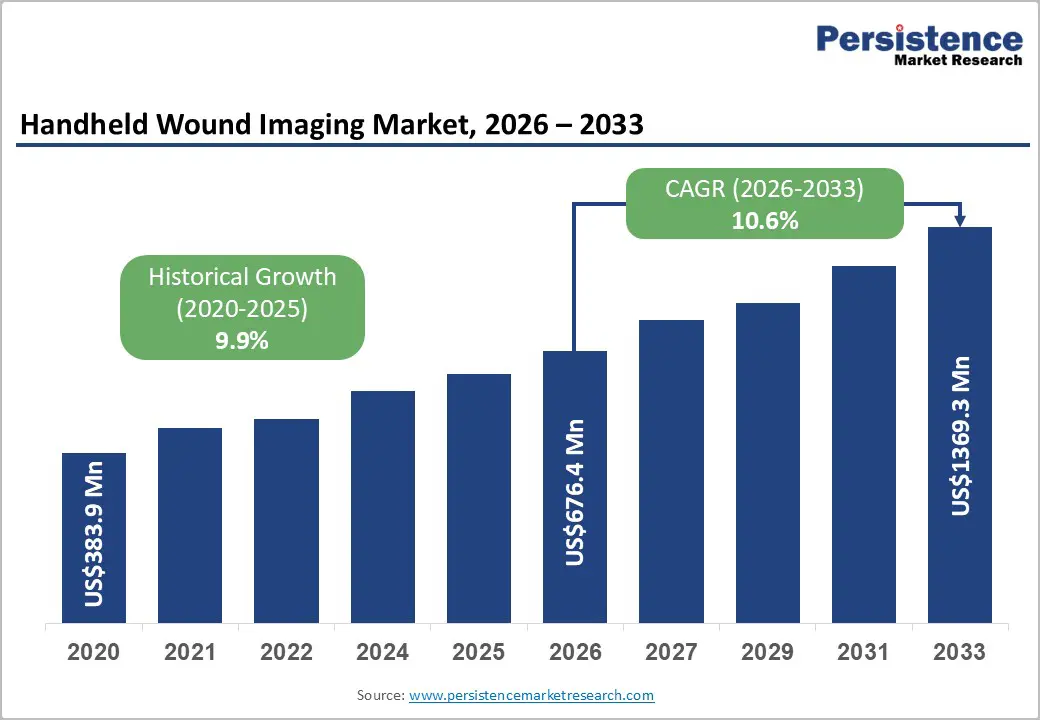
The global handheld wound imaging market size is likely to be valued at US$676.4 million in 2026 and is estimated to reach US$1,369.3 million by 2033, growing at a CAGR of 10.6% during the forecast period from 2026 to 2033, driven by increasing clinical demand for precise wound assessment tools and growing integration of imaging diagnostics into point-of-care workflows.
Growth is supported by demographic aging patterns that increase chronic wound incidence, especially diabetic foot ulcers and pressure injuries. Regulatory emphasis on standardized wound documentation strengthens adoption in hospitals and outpatient settings. Technology adoption across infrared, fluorescence, and digital imaging systems improves diagnostic accuracy.
Key Industry Highlights:
- Leading Product Type: Infrared imaging devices are set to hold around 38% revenue share in 2026, driven by adoption in chronic wound monitoring programs.
- Fastest Growing Product Type: Fluorescence imaging devices are projected as the fastest-growing segment, supported by infection detection accuracy requirements.
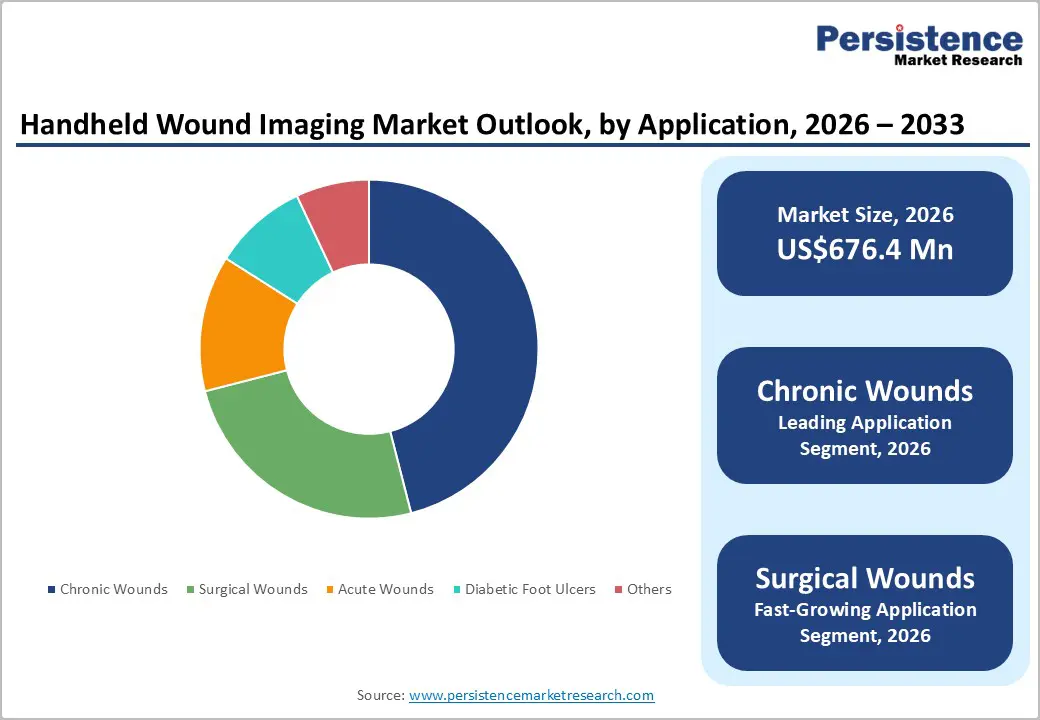
- Leading Application: Chronic wounds are estimated to hold roughly 46% revenue share in 2026, due to high diabetes-related ulcer incidence.
- Fastest Growing Application: Surgical wounds are forecast to record the fastest growth, driven by rising post-operative imaging requirements.
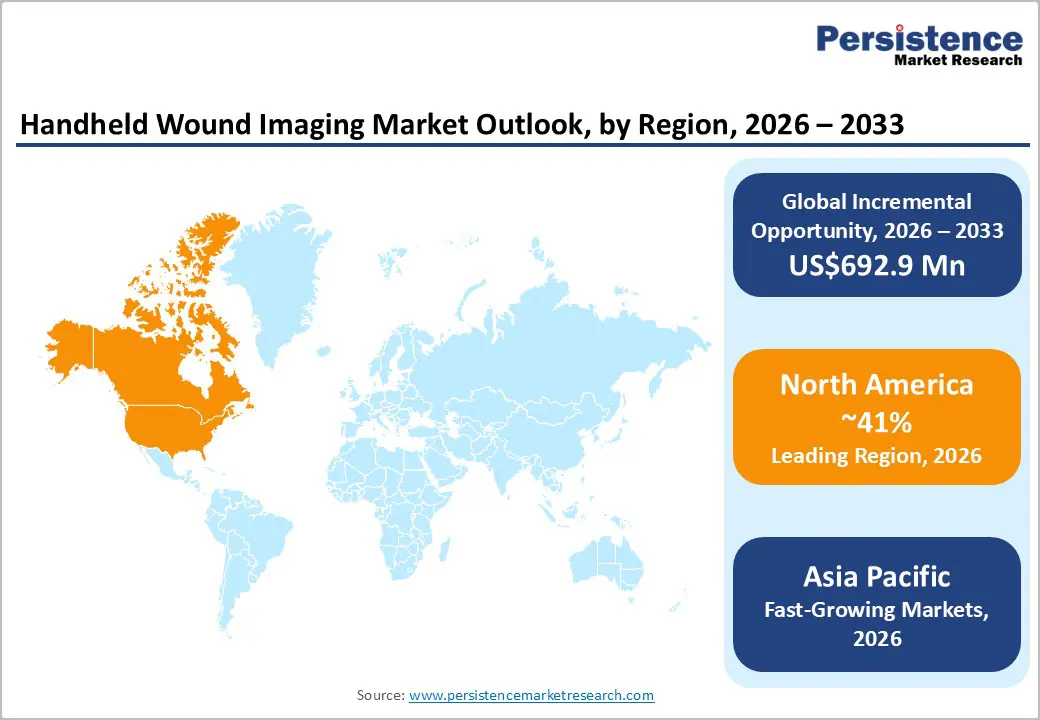
- Regional Leadership: North America is projected to capture roughly 41% of the market share by 2026, driven by advanced healthcare infrastructure.
- Innovation Trends: Artificial intelligence integration and portable imaging system development are reshaping clinical wound assessment workflows.
DRO Analysis
Driver - Rising Prevalence of Chronic Wounds Linked to Diabetes and Vascular Disease
The global diabetes burden is a primary structural driver of demand for handheld wound imaging. The International Diabetes Federation reported in 2024 that approximately 589 million adults worldwide were living with diabetes, a figure projected to reach 853 million by 2050. Diabetic foot ulcers affect 19-34% of diabetic patients over their lifetime, generating a persistent and growing demand for objective, reproducible wound assessment tools at the point of care.
Clinicians managing chronic wounds require technologies capable of identifying tissue perfusion levels, bacterial burden, and healing trajectories without reliance on subjective visual estimation. Handheld imaging devices equipped with infrared and fluorescence modalities directly address these clinical needs, enabling earlier intervention and measurable reductions in hospitalization length.
Restraint - Shortage of Trained Clinical Personnel and Standardized Imaging Protocols
Effective deployment of handheld wound imaging requires clinical staff proficient in device operation, image interpretation, and integration of imaging data with electronic health records. Workforce gaps in wound care nursing and podiatry in rural and underserved settings create a utilization bottleneck.
The absence of universally accepted wound imaging protocols across hospital networks and care settings introduces variability in image acquisition quality, reducing the reliability of longitudinal wound assessments. This inconsistency undermines evidence-based treatment decisions and suppresses physician confidence in imaging-driven care pathways, limiting repeat device utilization and restricting revenue expansion.
Opportunity - Integration of Artificial Intelligence for Automated Wound Measurement and Predictive Analytics
AI-powered wound analysis represents a structurally transformative opportunity for device manufacturers. Machine learning algorithms trained on large annotated wound image datasets can automate area measurement, tissue classification, and healing trajectory prediction, tasks that currently demand significant clinician time. Companies such as Tissue Analytics and Swift Medical have demonstrated commercially viable AI-assisted wound documentation platforms compatible with mobile imaging hardware.
The regulatory pathway for AI as a medical device (AI/ML) has been progressively clarified by the FDA through its 2021 Action Plan and subsequent guidance, reducing development uncertainty for manufacturers embedding predictive analytics into handheld platforms. Manufacturers that achieve regulatory clearance for AI-augmented wound imaging tools will access premium pricing tiers while simultaneously reducing clinician cognitive burden, creating a value proposition sufficient to overcome institutional procurement resistance.
Category-wise Analysis
Product Type Insights
Infrared imaging devices are expected to lead the handheld wound imaging market, accounting for approximately 38% of revenue in 2026. Infrared modalities enable non-contact measurement of wound bed temperature and perfusion, providing clinicians with physiological data critical to infection detection. Wound Vision's Strike IR device is deployed across U.S. Veterans Affairs wound clinics. Cost-effective manufacturing and established clinical evidence sustain the segment dominance.
Fluorescence imaging devices are likely to represent the fastest-growing segment, propelled by the clinical ability to identify bacterial contamination invisible to standard white light assessment. Fluorescence systems enhance bacterial load identification through real-time imaging. Surgical wound monitoring programs adopt fluorescence imaging for postoperative infection prevention, such as use in orthopedic recovery units. Rising demand for precision wound diagnostics accelerates adoption across specialized wound care centers and ambulatory surgical facilities.
Application Insights
Chronic wounds are projected to lead the market, capturing around 46% of the revenue share in 2026. Chronic wound management requires continuous imaging assessment for treatment optimization. Diabetes-related ulcers and pressure injuries contribute to high diagnostic demand. Clinical wound management programs in long-term care facilities use handheld imaging for monitoring wound progression, supporting structured treatment pathways and reducing complication rates.
Surgical wounds are likely to be the fastest-growing segment, fueled by rising surgical procedure volumes and post-operative infection monitoring requirements. Post-surgical imaging supports early detection of complications and improves recovery outcomes. Hospitals integrate handheld imaging in surgical recovery units, such as post-orthopedic procedures requiring wound monitoring. Expansion of surgical volumes across elective procedures supports rapid segment growth.
End-user Insights
Hospitals are likely to be the leading segment with a projected 52% of the handheld wound imaging market share in 2026 due to high patient inflow and advanced diagnostic infrastructure. Hospitals integrate imaging systems into wound care departments to improve diagnostic accuracy and treatment planning. Large tertiary care institutions deploy multi-modal imaging systems for chronic and acute wound management, such as diabetic care units utilizing infrared assessment tools.
Ambulatory surgical centers are anticipated to be the fastest-growing segment, fueled by decentralization of surgical care and outpatient treatment expansion. Outpatient surgical facilities adopt portable imaging devices to support post-operative monitoring. Expansion of same-day discharge procedures increases requirement for compact diagnostic tools, improving wound assessment efficiency in non-hospital environments.
Regional Insights
North America Handheld Wound Imaging Market Trends
North America is anticipated to be the leading region, accounting for a market share of 41% in 2026, driven by an advanced healthcare infrastructure and rapid adoption of digital medicine platforms. Institutional policies prioritize objective data collection to fulfill stringent electronic documentation mandates. Large medical networks invest heavily in connected diagnostic hardware to minimize hospital-acquired condition penalties.
U.S. Handheld Wound Imaging Market Insights
The U.S. is projected to capture a dominant share of 84% within the regional market in 2026 due to expanding integration with enterprise electronic health record systems. This software integration allows clinical data to sync automatically from point-of-care devices to central patient files, reducing manual entry errors. Furthermore, federal policy focuses on value-based reimbursement models, encourages hospital groups to purchase objective validation tools.
Canada Handheld Wound Imaging Market Insights
Canada is forecast to hold approximately 16% of the regional revenue share in 2026 as public health networks expand care access in remote territories. Rural healthcare networks utilize portable optical hardware to connect local nurses with wound care specialists in major urban centers. This remote collaboration helps reduce patient transfer costs and optimizes regional clinical resources.
Europe Handheld Wound Imaging Market Trends
Europe is expected to account for a regional market share of 28% in 2026, supported by structured public healthcare frameworks and strong clinical research initiatives. Regional healthcare systems focus heavily on reducing long-term treatment costs for chronic venous ulcers.
Germany Handheld Wound Imaging Market Insights
Germany is expected to represent around 24% of the regional demand, supported by advanced hospital infrastructure and integration of fluorescence imaging systems in surgical wound management. Expansion of clinical research programs in wound diagnostics strengthens technology adoption across specialized care centers.
U.K. Handheld Wound Imaging Market Insights
The U.K. is expected to contribute around 19% of the Europe market share in 2026 as the National Health Service invests in community care models. Procurement focus shifts toward lightweight, app-based diagnostic tools that help district nursing teams manage chronic conditions more efficiently outside traditional hospital settings.
Asia Pacific Handheld Wound Imaging Market Trends
Asia Pacific is forecast to be the fastest-growing market for handheld wound imaging, stimulated by rapidly developing medical infrastructure and expanding insurance coverage across major developing economies. Regional governments prioritize upgrading rural healthcare facilities to address growing chronic disease burdens.
China Handheld Wound Imaging Market Insights
China is anticipated to secure a leading regional share of 33% in 2026 as local medical device manufacturers scale up production of affordable digital imaging hardware. This expanding domestic manufacturing capability lowers acquisition costs, enabling wider adoption across tier-2 and tier-3 hospital networks.
India Handheld Wound Imaging Market Insights
India is likely to register the highest growth rate in the regional market, contributing 21% of the regional revenue share by 2026 due to the expansion of private hospital networks and specialized diabetes clinics. Outpatient facilities deploy portable imaging devices to manage high volumes of diabetic foot complications, aiming to improve healing outcomes and reduce lower-limb amputation rates.
Competitive Landscape
The global handheld wound imaging market is moderately fragmented, characterized by the presence of multinational medical device companies and specialized diagnostic imaging firms. Competition is driven by product innovation, software integration, and clinical validation requirements. Key companies include Smith and Nephew, 3M, Siemens Healthineers, Canon Medical Systems, and Stryker Corporation.
The competitive environment reflects continuous investment in imaging accuracy, portability, and artificial intelligence integration. Market participants focus on hospital partnerships and outpatient care expansion strategies to strengthen clinical adoption rates.
Companies Covered in Handheld Wound Imaging Market
- MolecuLight
- Swift Medical
- WoundVision
- ARANZ Medical
- eKare
- Healthy.io
- Smith+Nephew
- 3M Company
- ConvaTec Group
- Mölnlycke Health Care
- Hamamatsu Photonics
- Philips Healthcare
- GE HealthCare
- Siemens Healthineers
- Canon Medical Systems
- Stryker Corporation
- WoundVision
- Kent Imaging
- Spectral AI
Frequently Asked Questions
The global handheld wound imaging market is projected to reach US$676.4 million in 2026.
The increasing prevalence of chronic wounds, the expansion of digital wound care infrastructure, and the rising adoption of AI-enabled diagnostic imaging systems drive the handheld wound imaging market.
The handheld wound imaging market is poised to witness a CAGR of 10.6% from 2026 to 2033.
Expansion of outpatient wound care centers, integration of artificial intelligence in wound diagnostics, and growing adoption of portable imaging systems in telehealth-enabled chronic care pathways create key market opportunities.
Some of the key market players include Smith and Nephew, 3M, Siemens Healthineers, Canon Medical Systems, and Stryker Corporation.


