




- Medical Devices
- Cleanroom Robots in Healthcare Market
Cleanroom Robots in Healthcare Market Size, Share, and Growth Forecast 2026-2033
Cleanroom Robots in Healthcare Market by Product Type (Traditional Industrial Robots, Collaborative Robots), by Component (Robotic Arms, End Effectors, Drives, Controllers, Sensors, Power Supply, Motors, Others), End-user (Hospitals, Pharmaceuticals and Medical Devices Manufacturers, Others), Regional Analysis, 2026–2033

Cleanroom Robots in Healthcare Market Size and Trend Analysis
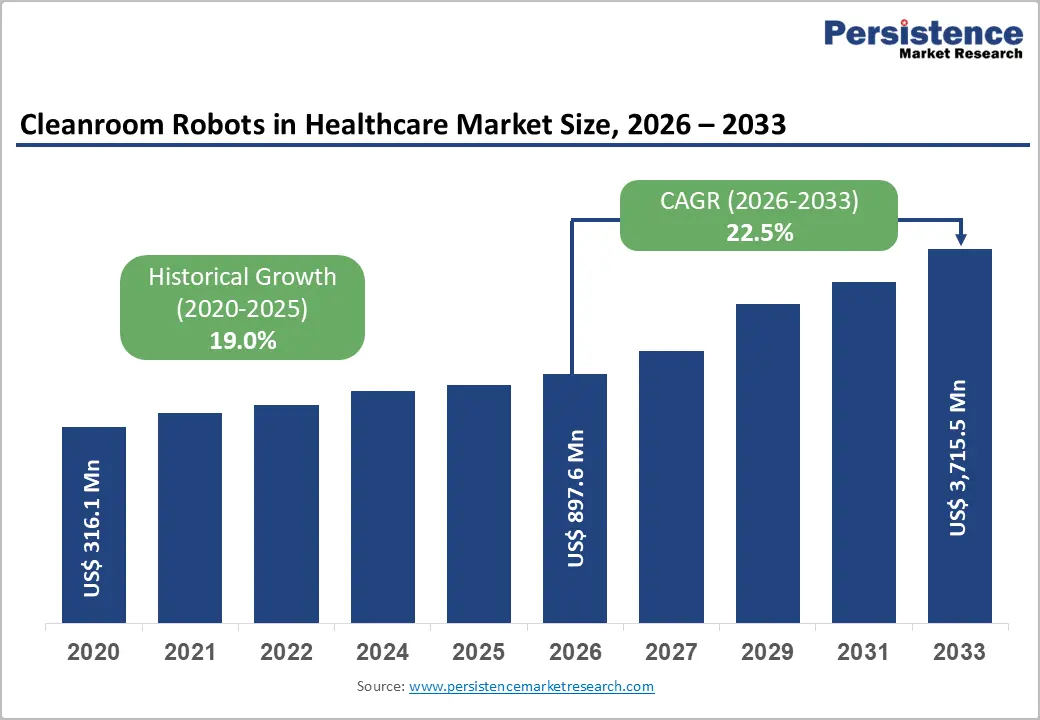
The global cleanroom robots in healthcare market size is expected to be valued at US$ 897.6 million in 2026 and projected to reach US$ 3,715.5 million by 2033, growing at a CAGR of 22.5% between 2026 and 2033.
It is experiencing exceptional growth driven by intensifying regulatory requirements for contamination control in pharmaceutical manufacturing, a surge in biologics and sterile drug production, and rapid adoption of automation to address critical labor shortages in controlled environments.
Mounting stringency under U.S. FDA 21 CFR Part 211, EU GMP Annex 1 (2023 revision), and ISO 14644 cleanroom standards is compelling pharmaceutical and medical device manufacturers to deploy robotic solutions that eliminate human-introduced contamination risks while simultaneously boosting throughput, precision, and traceability across aseptic processing environments.
Key Industry Highlights:
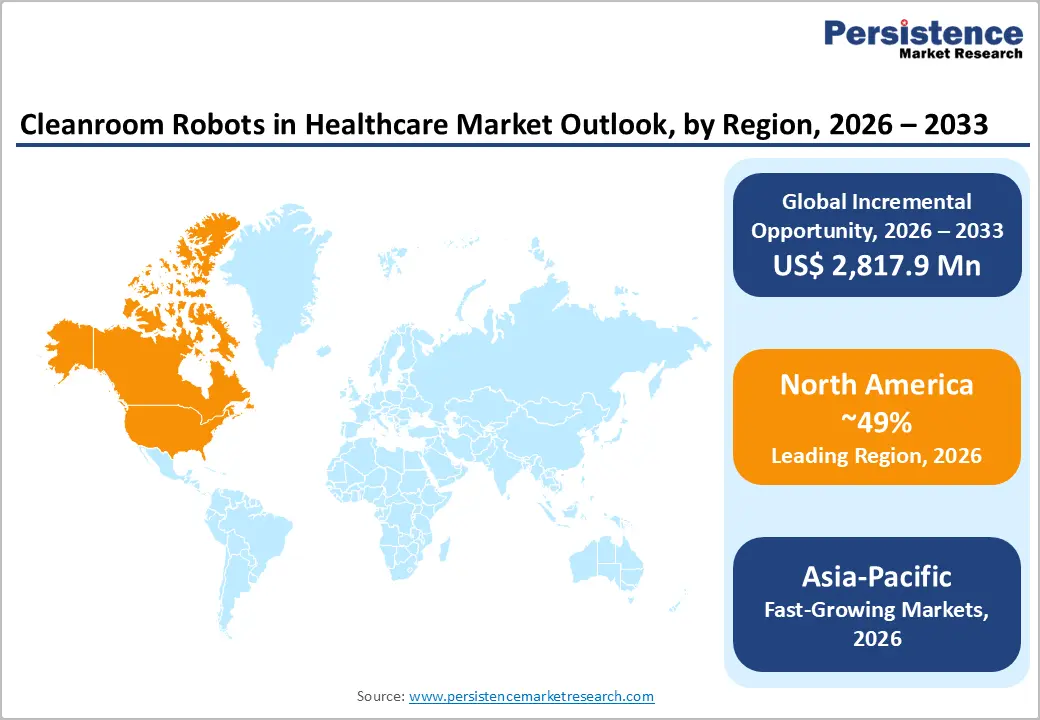
- Leading Region: North America is likely to lead with approximately 49% global share in 2026, driven by the FDA's rigorous aseptic manufacturing oversight, domestic pharma capacity expansion under the Inflation Reduction Act, and a mature cleanroom robotics innovation ecosystem.
- Fast-Growing Market: Asia Pacific is the fast-growing market, fueled by India's PLI Scheme, China's biopharmaceutical FDI exceeding US$ 20 Million, and Japan's robotics manufacturing leadership through FANUC, Yaskawa, and Kawasaki.
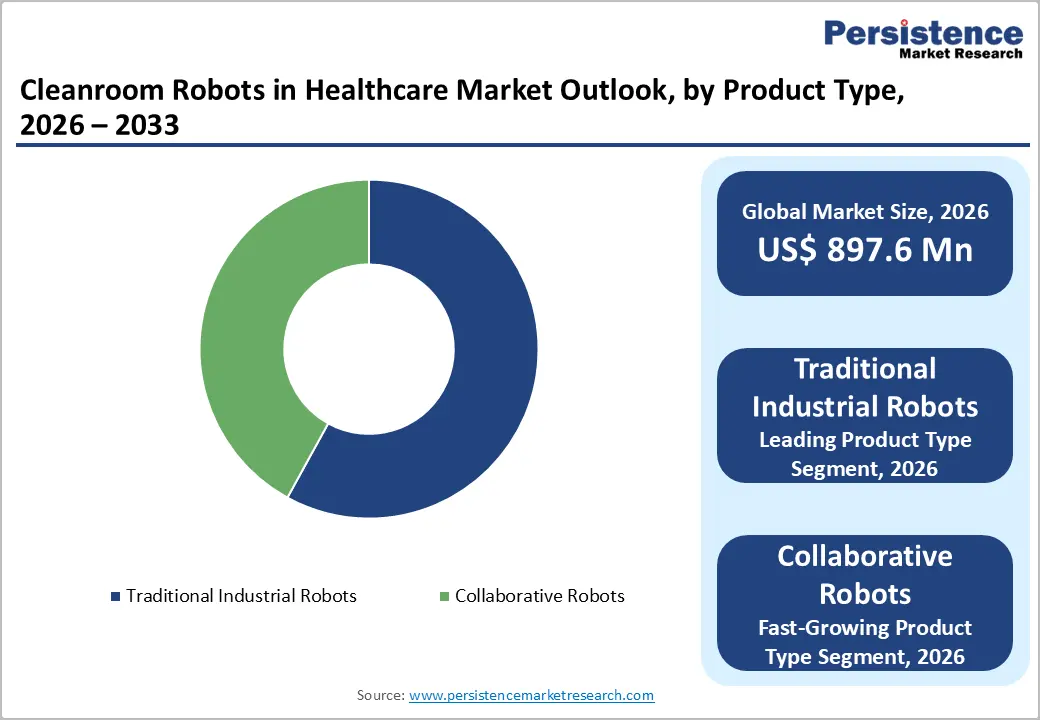
- Dominant Product Type: Traditional industrial robots held approximately 58% share in 2026, underpinned by validated performance in high-throughput aseptic fill-finish operations, ISO Class 5 compatibility, and decades of regulatory precedent in pharmaceutical GMP environments.
- Fast-Growing Product Type: Collaborative robots are the fast-growing segment, driven by growing adoption in hospital compounding pharmacies under USP Chapter 797, lower integration costs, and IFR-documented global cobot installation growth exceeding 50% between 2020 and 2023.
- Key Opportunity: Asia Pacific Pharmaceutical Expansion: India's INR 15,000 crore PLI Scheme and China's 14th Five-Year Plan are driving construction of 50+ new GMP facilities where cleanroom robotics are baseline specifications, creating a multi-Million-dollar demand pipeline through 2033.
Market Dynamics
Drivers - Revised EU GMP Annex 1 and Escalating Regulatory Pressure on Aseptic Manufacturing
The 2023 revision of EU GMP Annex 1 Manufacture of Sterile Medicinal Products introduced significantly enhanced contamination control strategy (CCS) requirements, explicitly promoting the adoption of Restricted Access Barrier Systems (RABS) and isolator technology integrated with robotic manipulation. This landmark regulatory update, mirrored by increasing scrutiny from the U.S. Food and Drug Administration (FDA) in aseptic processing guidance documents, is compelling pharmaceutical manufacturers globally to accelerate cleanroom robot deployment.
With over 7,000 pharmaceutical manufacturing facilities operating under GMP compliance globally per WHO estimates, the scale of potential retrofitting and new facility investment represents a sustained structural demand driver, directly expanding the addressable market for cleanroom robotic solutions across injectable, biologics, and sterile fill-finish manufacturing lines.
Restraints - High Capital Investment and Lengthy Validation Timelines
Deployment of cleanroom-rated robotic systems entails substantial upfront capital expenditure, encompassing equipment procurement, facility modification to maintain ISO Class 5–7 environments, and rigorous Installation Qualification / Operational Qualification / Performance Qualification (IQ/OQ/PQ) validation under FDA and EMA guidelines. Validation cycles for aseptic robotic installations can extend 12–24 months, delaying return on investment and creating significant barriers for mid-sized pharmaceutical manufacturers and hospital compounding facilities operating under constrained capital budgets.
Opportunities - Collaborative Robots: Transforming Human-Robot Interaction in Hospital and Lab Environments
Collaborative robots (cobots) represent the fastest-growing product segment within the cleanroom robots in healthcare market, offering a compelling opportunity for manufacturers targeting hospital compounding pharmacies, clinical laboratories, and point-of-care preparation environments. Unlike traditional industrial robots requiring full physical segregation, cobots are designed for safe human-robot collaboration in shared workspaces, significantly reducing facility modification costs.
The International Federation of Robotics (IFR) reported that cobot installations grew by over 50% globally between 2020 and 2023. Pharmaceutical-grade cobots from companies such as Universal Robots and ABB Ltd. are being validated for aseptic drug preparation applications. As USP Chapter 797 and USP Chapter 800 sterile compounding requirements tighten in the U.S., hospitals deploying cobots stand to achieve both compliance and operational efficiency gains simultaneously.
Category-wise Analysis
Product Type Insights
Traditional industrial robots commanded approximately 58% of the cleanroom robots in healthcare market in 2026, maintaining market leadership through their established performance advantages in high-throughput, high-precision pharmaceutical manufacturing environments. Articulated robots with 6-axis or greater degrees of freedom are the preferred configuration for complex aseptic fill-finish and vial handling operations, while SCARA robots dominate in high-speed pick-and-place and assembly tasks within ISO Class 5 environments.
The International Federation of Robotics (IFR) World Robotics 2023 Report documented pharmaceutical and medical device manufacturing among the fastest-growing industrial robot application sectors globally. Traditional industrial robots benefit from decades of validated performance data, established regulatory precedent, and compatibility with legacy RABS and isolator systems, reinforcing their dominant position in large-scale sterile manufacturing installations despite the rising profile of collaborative alternatives.
Component Insights
Robotic arms constituted the leading component segment of the cleanroom robots in healthcare market, representing approximately 34% of total component revenue in 2025. As the primary functional unit of any cleanroom robotic system, robotic arms manufactured from electropolished stainless steel or specialized polymers compliant with ISO 14644 particle generation standards directly determine system capability, reach, and payload handling.
The growing deployment of 6-axis and 7-axis articulated arm configurations in pharmaceutical fill-finish lines reflects the need for complex, multi-step aseptic manipulation that simpler automation cannot replicate. Key arm manufacturers, including FANUC Corporation, Yaskawa Electric Corporation, and ABB Ltd., have developed dedicated cleanroom arm variants with sealed joints, smooth surface finishes, and internal cable routing specifically engineered to minimize particle generation and withstand repeated hydrogen peroxide vapor (HPV) sterilization cycles.
Regional Insights
North America Cleanroom Robots in Healthcare Market Trends and Insights
North America leads the cleanroom robots in healthcare market due to strong pharmaceutical manufacturing, strict FDA sterility regulations, and high adoption of automation in biologics production. The region benefits from advanced R&D infrastructure and large-scale deployment of robotic systems in drug formulation, sterile packaging, and diagnostics. Increasing demand for contamination-free production environments in the U.S. further strengthens regional dominance.
Regulatory standards established by the U.S. Food and Drug Administration and other healthcare authorities encourage the integration of robotic systems to minimize human intervention and improve sterility assurance. Growing investments in cell and gene therapy manufacturing, vaccine production, and aseptic drug filling operations continue to create demand for cleanroom automation. Additionally, increasing labor shortages and rising operational costs are encouraging pharmaceutical companies to deploy robotic solutions for material handling, inspection, packaging, and laboratory processes.
U.S. Cleanroom Robots in Healthcare Market Trends and Insights
The U.S. is the largest contributor, driven by FDA-regulated biologics manufacturing and strong adoption of AI-enabled robotics in pharma plants. Major investments in cell and gene therapy production are accelerating the demand for cleanroom automation. Expansion of CDMOs and hospital-based compounding robotics further supports growth, with strong federal support for advanced manufacturing technologies.
Additionally, investments in advanced manufacturing technologies, coupled with the expansion of CDMOs and biopharmaceutical research centers, highlight its significance. Healthcare institutions are also increasingly deploying robotic systems for sterile compounding and laboratory automation. Growing adoption of AI-enabled robotic platforms and strong federal support for domestic pharmaceutical production continue to reinforce the country's leading position in the healthcare cleanroom robotics industry.
Canada Cleanroom Robots in Healthcare Market Trends and Insights
Canada is expanding rapidly due to increasing biopharmaceutical investments in Ontario and Quebec. Government funding for life sciences innovation and growing clinical trial activity are driving the adoption of cleanroom robotics. Rising demand for sterile drug production and automation in hospital pharmacies is accelerating growth across research institutes and manufacturing facilities.
Government initiatives supporting innovation and healthcare infrastructure modernization are encouraging automation adoption across pharmaceutical facilities. Rising demand for sterile drug manufacturing and laboratory efficiency is driving implementation of robotic systems in research institutions and hospital pharmacies. Furthermore, the expansion of clinical trial activities and growing partnerships between academia and industry are creating opportunities for cleanroom automation technologies, supporting Canada's emergence as a rapidly developing regional market.
Europe Cleanroom Robots in Healthcare Market Trends and Insights
Europe holds a strong position due to stringent EU GMP standards, a strong pharmaceutical manufacturing base, and the rapid adoption of precision robotics in sterile environments. Countries such as Germany, Switzerland, and the UK lead innovation in automation and pharmaceutical engineering. EU emphasis on contamination-free production in vaccines and biologics strengthens demand for cleanroom robots.
The region benefits from the presence of globally recognized pharmaceutical companies, advanced research institutions, and a highly skilled engineering workforce. Increasing production of biologics, vaccines, and personalized medicines is creating greater demand for contamination-free manufacturing environments. Additionally, rising investments in digitalization, laboratory automation, and precision robotics are accelerating deployment across healthcare facilities.
European governments continue to support Industry 4.0 transformation initiatives, encouraging manufacturers to integrate intelligent robotic systems into cleanroom operations. As pharmaceutical companies seek higher productivity and stricter quality control, cleanroom robots are becoming an essential component of modern healthcare manufacturing across the region.
Germany Cleanroom Robots in Healthcare Market Trends and Insights
Germany dominates due to its advanced pharmaceutical manufacturing ecosystem and strong industrial robotics expertise. The country’s emphasis on precision engineering and automation in biotech and medical device production supports large-scale adoption. Government-backed Industry 4.0 initiatives further accelerate robotic integration in cleanroom environments.
Growing demand for biologics, personalized medicines, and high-precision medical technologies is encouraging pharmaceutical companies to adopt sophisticated cleanroom robotics solutions. Furthermore, Germany’s focus on operational efficiency, quality assurance, and contamination control strengthens its position as the largest and most technologically advanced cleanroom robotics market in Europe.
UK Cleanroom Robots in Healthcare Market Trends and Insights
UK is expected to achieve rapid growth due to expanding biotech clusters in Cambridge and London. NHS-linked research programs and increasing adoption of automation in pharmaceutical R&D facilities are key drivers. Rising investment in AI-driven laboratory systems and sterile manufacturing is accelerating cleanroom robotics deployment.
Growing investments in advanced therapeutics, genomics research, and vaccine development are encouraging the adoption of robotic systems within controlled environments. Collaboration between research institutions, healthcare organizations, and pharmaceutical companies continues to accelerate technology deployment. Additionally, increasing emphasis on productivity, quality control, and contamination reduction across healthcare manufacturing facilities is boosting market growth. AI-driven robotics and smart automation solutions are expected to further support expansion.
Asia Pacific Cleanroom Robots in Healthcare Market Trends and Insights
Asia Pacific is the fast-growing market due to expanding pharmaceutical manufacturing, low-cost production hubs, and strong government support for automation. Countries like China, India, Japan, and South Korea are investing heavily in biotech, vaccines, and semiconductor-linked healthcare manufacturing. Rapid industrialization and CDMO expansion are major growth catalysts.
The presence of cost-effective manufacturing hubs and expanding CDMO operations further supports the adoption of robotic technologies. Governments are actively promoting smart manufacturing and digital transformation initiatives, encouraging pharmaceutical companies to invest in cleanroom automation. Rising healthcare expenditures, growing exports of pharmaceutical products, and increasing focus on quality compliance are accelerating robotic deployment in sterile environments. Additionally, advancements in artificial intelligence, machine vision, and collaborative robotics are improving operational efficiency and reducing contamination risks. As healthcare manufacturing capacity continues to expand across the region, the Asia Pacific is expected to remain the most dynamic and rapidly developing market worldwide.
China Cleanroom Robots in Healthcare Market Trends and Insights
China dominates regional demand due to massive pharmaceutical production capacity and government-driven “Made in China 2025” automation strategy. Expansion of vaccine manufacturing and biologics production facilities is increasing demand for sterile robotics. Strong investment in AI-enabled healthcare automation further accelerates adoption.
Rapid expansion of biologics manufacturing, vaccine production, and advanced pharmaceutical development is increasing demand for cleanroom automation. The country is also investing heavily in artificial intelligence and robotics research, enabling the deployment of increasingly sophisticated cleanroom systems. Growing exports of pharmaceutical products and stricter quality standards are further encouraging manufacturers to adopt automated contamination-control solutions. These factors collectively position China as the largest cleanroom robotics market in the region.
India Cleanroom Robots in Healthcare Market Trends and Insights
India is a fast-growing market due to its expanding generic drug manufacturing base and rising exports of sterile pharmaceuticals. Government initiatives such as “Make in India” and the growth of CDMOs are boosting cleanroom automation. Increasing investment in biotech parks and vaccine production facilities is driving rapid adoption of robotics in clean environments.
Government initiatives promoting domestic manufacturing and advanced technologies are encouraging wider adoption of robotic systems. The growth of CDMOs, biotech parks, and sterile injectable manufacturing facilities is creating substantial demand for cleanroom robotics. Rising pharmaceutical exports, increasing investment in biologics production, and greater focus on contamination-free manufacturing processes are expected to support robust long-term market growth.
Competitive Landscape
The cleanroom robots in healthcare market exhibit a moderately consolidated competitive structure, dominated by large multinational industrial robotics companies, including ABB Ltd., FANUC Corporation, Yaskawa Electric Corporation, and Kawasaki Heavy Industries, that are extending their industrial robot portfolios with healthcare-specific cleanroom configurations. Key competitive differentiators include ISO 14644-certified hardware, validated HPV sterilization compatibility, and modular software architectures supporting FDA 21 CFR Part 11 compliance. Emerging business model trends include robotics-as-a-service (RaaS) platforms, digital twin-enabled remote validation services, and end-to-end system integration partnerships with RABS/isolator manufacturers, differentiating vendors beyond hardware specifications.
Key Developments:
- In January 2026, ABB showcased advanced AI-driven lab automation solutions at SLAS 2026, demonstrating how artificial intelligence was increasingly integrated into cleanroom and laboratory robotics to improve precision, throughput, and contamination control. The company highlighted intelligent robotic systems capable of handling repetitive laboratory workflows such as sample preparation, liquid handling, and analytical testing with minimal human intervention.
- In March 2025, Stäubli Robotics, in partnership with a renowned pharmaceutical company, developed a mobile robot for use in Grade A/B/C/D cleanrooms. Sterimove, the new robot, features multiple motion configurations for smooth integration.
- In April 2024, LionsBot International opened its new robot factory in Singapore. The innovative facility spans an impressive 4,908 square meters and has five times the manufacturing capacity compared to its previous site.
Companies Covered in Cleanroom Robots in Healthcare Market
- ABB Ltd.
- Yaskawa Electric Corporation
- FANUC Corporation
- Denso Corporation
- Avidbots Corp.
- Kawasaki Heavy Industries, Ltd.
- Aerotech, Inc.
- LionsBot International Pte Ltd.
- Nachi Fujikoshi Corporation
- Others
Frequently Asked Questions
The global cleanroom robots in healthcare market is expected to be valued at US$ 897.6 million in 2026.
Sterile manufacturing demand, automation adoption, labor shortages, precision needs, regulatory compliance, and pharmaceutical production growth.
North America leads the market with approximately 49% of the global share in 2026.
Biopharma expansion, lab automation, AI integration, emerging markets, hospital robotics adoption, and personalized medicine growth.
ABB Ltd., FANUC Corporation, Yaskawa Electric Corporation, Kawasaki Heavy Industries Ltd., Denso Corporation, Aerotech, Inc.


