




- Beauty & Personal Care
- Disposable Face Mask Market
Disposable Face Mask Market Size, Share, and Growth Forecast 2026 - 2033
Disposable Face Mask Market by Product Type (Surgical Masks, N95 Respirators, FFP2/FFP3 Respirators, KN95 Masks, Dust Masks, Activated Carbon Masks), Material Type (Non-Woven Fabric, Melt-Blown Fabric, Polypropylene (PP), Activated Carbon Fabric, Biodegradable Materials), Distribution Channel, End-User, and Regional Analysis, 2026-2033

Disposable Face Mask Market Size and Trend Analysis
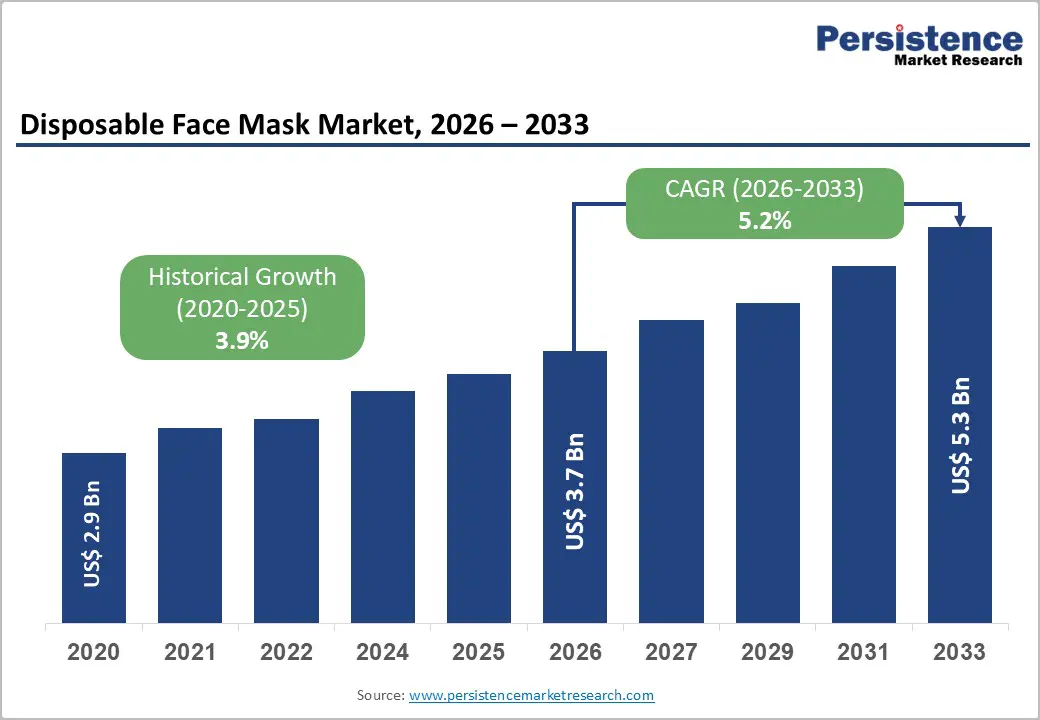
The global disposable face mask market is likely to be valued at US$ 3.7 billion in 2026 and is expected to reach US$5.3 billion by 2033, growing at a CAGR of 5.2% during the forecast period from 2026 to 2033.
This accelerated growth momentum is driven by the convergence of sustained post-pandemic awareness of airborne disease transmission, tightening occupational health and safety regulations across industrial and healthcare sectors, and escalating urbanization-linked air pollution concerns across Asia, Latin America, and the Middle East.
Key Market Highlights
- Leading Region: North America leads the global Disposable Face Mask market having 38% share, underpinned by the U.S. FDA and OSHA regulatory frameworks, HHS Strategic National Stockpile procurement programs, and strong institutional demand from the nation's 65-million-plus healthcare workforce and large regulated industrial sector.
- Fastest-Growing Region: Asia Pacific is the fastest-growing region with rising CAGR of 6.8%, driven by China's unmatched manufacturing scale, Japan's deeply entrenched mask-wearing culture, India's rapidly expanding healthcare infrastructure under the National Health Mission, and growing ASEAN industrial and healthcare sector formalization generating escalating disposable mask procurement volumes.
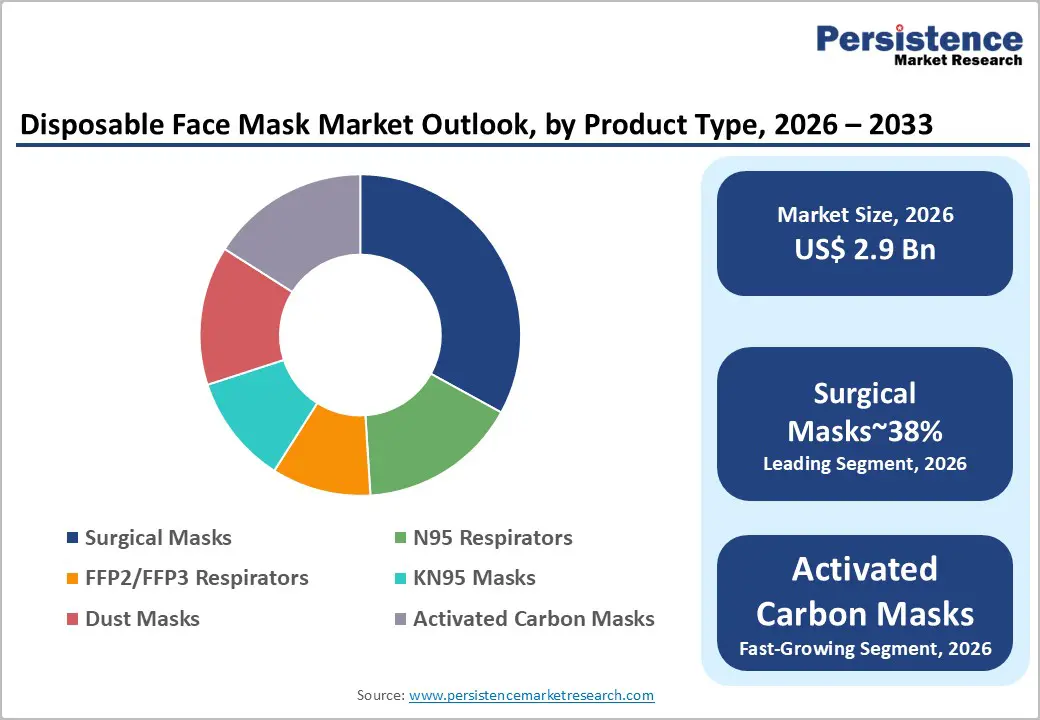
- Leading Segment: The Surgical Masks segment dominates by product type with approximately 38% market share, supported by universal healthcare mandate compliance requirements from the WHO, CDC, and national health ministries, and consistent high-volume procurement from hospital networks and government strategic stockpile programs globally.
- Fastest-Growing Segment: The Biodegradable Materials segment is the fastest-growing material category, driven by the EU Green Deal, Circular Economy Action Plan, and sustainability-linked institutional procurement policies across Northern European healthcare systems, compelling manufacturers to innovate certified eco-friendly mask constructions that meet established filtration performance standards.
- Key Opportunity lies in developing and marketing certified biodegradable and sustainable disposable masks aligned with EU Regulation (EU) 2016/425 and green procurement policies, targeting the rapidly growing institutional buyer segment that is embedding environmental sustainability criteria into annual PPE procurement frameworks across Europe and North America.
| Key Insights | Details |
|---|---|
| Disposable Face Mask Market Size (2026E) | US$ 3.7 Billion |
| Market Value Forecast (2033F) | US$ 5.3 Billion |
| Projected Growth CAGR (2026 - 2033) | 5.2% |
| Historical Market Growth (2020 - 2025) | 3.9% |

Market Dynamics
Driver - Healthcare Sector and Infection Control Protocols Ensure Stable Long-Term Demand for Disposable Face Masks
The healthcare sector continues to be the most stable and reliable demand driver for the global Disposable Face Mask market. Infection control protocols have firmly established mask usage as a mandatory practice across hospitals, clinics, and long-term care facilities worldwide. Organizations such as the World Health Organization (WHO) and the Centers for Disease Control and Prevention (CDC) continue to recommend routine mask usage in clinical environments, especially during influenza seasons and when treating immunocompromised patients.
According to WHO data, the global healthcare workforce exceeds 65 million professionals, each representing recurring procurement demand for surgical masks and respirators. In addition, post-COVID national stockpile replenishment programs across the United States, the European Union, and Japan have created a strong government procurement layer. These strategic reserves ensure consistent above-normal purchasing volumes, sustaining market demand even outside emergency periods.
Strict Occupational Safety Regulations Across Industries Driving Sustained Respirator Procurement and Compliance-Based Demand
Strict occupational health and safety regulations across industries such as mining, construction, pharmaceuticals, chemicals, and manufacturing are creating a stable and long-term demand stream for high-filtration disposable respirators. In the United States, the Occupational Safety and Health Administration (OSHA) mandates respirator use for workers exposed to airborne particles, chemical vapors, and biological hazards, making procurement compliance-driven rather than optional. In Europe, Regulation (EU) 2016/425 replaced Directive 89/686/EEC and enforces strict certification standards, including FFP2 and FFP3 classifications. These regulations require employers to purchase certified respirators regularly due to defined replacement cycles. The International Labour Organization (ILO) estimates approximately 2.78 million annual work-related fatalities globally, including those linked to respiratory diseases. This continues to increase political and regulatory pressure for stricter PPE compliance, ensuring steady and regulation-backed demand growth worldwide.
Restraint - Post-Pandemic Demand Normalization Creating Overcapacity Challenges and Pricing Pressure Across Commodity Mask Segments
A major restraint in the Disposable Face Mask market is demand normalization following the unprecedented surge during the 2020-2022 COVID-19 period. During the pandemic, global production capacity expanded rapidly, with the World Health Organization reporting peak monthly global requirements of approximately 89 million masks. As emergency purchasing declined, many manufacturers, especially those that scaled quickly, faced severe overcapacity issues. This imbalance triggered price erosion, with average selling prices for surgical and KN95 masks declining by more than 80% between 2021 and 2023. As a result, manufacturer margins compressed sharply, forcing operational rationalization and competitive consolidation. Although baseline healthcare and industrial demand remain stable, excess supply continues to moderate pricing power in commodity segments, limiting revenue growth potential and creating long-term profitability pressure across lower-tier product categories.
Rising Environmental Concerns Over Single-Use Plastic Waste Impacting Conventional Disposable Mask Market Growth
Growing environmental awareness and regulatory pressure around single-use plastic waste are emerging as long-term challenges for conventional disposable mask manufacturers. A 2021 study published in Environmental Science & Technology estimated that approximately 1.56 billion masks entered oceans in 2020, contributing significantly to microplastic pollution due to polypropylene components. The European Union’s Single-Use Plastics Directive (EU) 2019/904 has increased regulatory focus on plastic waste, indirectly influencing scrutiny of medical and protective equipment disposal practices. The environmental concern is increasingly shaping institutional procurement decisions, particularly among sustainability-focused healthcare systems and industrial employers in Northern Europe and North America. As a result, growth in traditional polypropylene-based mask segments is gradually moderating. However, this shift is simultaneously encouraging innovation in biodegradable and environmentally certified alternatives, transforming sustainability challenges into strategic product development opportunities.
Opportunity - Growing Investment in Biodegradable and Sustainable Mask Technologies Creating Premium Innovation Opportunities
Environmental pressure is not only a restraint but also a strong innovation opportunity for manufacturers capable of developing sustainable disposable mask solutions. Companies are increasingly investing in plant-based nonwoven fabrics, biodegradable polylactic acid (PLA) materials, and compostable filtration layers that meet regulatory performance standards while reducing environmental impact. The European Commission’s Green Deal and Circular Economy Action Plan have prioritized medical waste reduction, positioning sustainable mask manufacturers favorably for public procurement programs.
Companies such as Honeywell International Inc. are investing in sustainable material research to capture demand from environmentally conscious institutional buyers. This trend is particularly strong in Germany, France, the United Kingdom, and Scandinavian healthcare systems, where sustainability criteria are now integrated into procurement frameworks. As environmental accountability becomes a competitive differentiator, sustainable product innovation is expected to drive premium market positioning.
Digital Procurement Expansion and E-Commerce Growth Enhancing Distribution Efficiency and Market Access Globally
The rapid digitalization of healthcare procurement and the expansion of e-commerce platforms are creating structural growth opportunities for disposable face mask manufacturers. Online marketplaces such as Amazon and Alibaba Group have simplified access for consumers, small businesses, and institutional buyers to source certified mask products globally. Government procurement programs, including those led by the U.S. Department of Health and Human Services (HHS), are increasingly integrating digital inventory and supplier management systems to improve efficiency.
According to the Healthcare Distribution Alliance, digital ordering channels for medical supplies have expanded significantly across North America and Europe since 2020. Manufacturers with strong e-commerce integration and direct-to-institution sales capabilities can improve margins by reducing dependence on multi-tier intermediaries, enhancing both revenue control and customer relationship management.
Category-wise Analysis
Product Type Insights
The surgical masks segment leads the global Disposable Face Mask market by product type, accounting for approximately 38% of the total market. Surgical masks remain the most widely used disposable respiratory protection product worldwide, as they are mandatory in nearly all healthcare environments and are broadly adopted by the general public during disease outbreaks.
The World Health Organization (WHO), along with national authorities such as the Centers for Disease Control and Prevention (CDC) and the European Centre for Disease Prevention and Control (ECDC), recognizes surgical masks as essential components of healthcare PPE protocols. Their low unit cost, strong global manufacturing base, and regulatory approval across multiple end-use sectors ensure steady, high-volume procurement by hospitals, clinics, and government health departments. The N95 Respirators segment is the fastest-growing category, driven by rising demand for high-filtration respiratory protection in both healthcare and industrial applications following increased awareness of airborne disease transmission.
Material Type Insights
The non-woven fabric segment dominates the disposable face mask market by material type, accounting for approximately 45% of the segment's total share. Non-woven polypropylene fabric forms the structural base layer in nearly all major disposable mask categories, as it provides an ideal balance of breathability, filtration efficiency, fluid resistance, and cost-effective large-scale production. International standards such as ASTM F2100 and EN 14683 identify non-woven fabric constructions as the benchmark material platform for certified surgical and procedural masks.
The large-scale production capacity of non-woven materials, particularly in China, South Korea, and the United States, ensures stable and responsive supply chains for mask manufacturers globally. Within this category, Melt-Blown Fabric plays a critical role as the high-efficiency filtration layer in N95 and FFP2/FFP3 respirators. Supply shortages during the COVID-19 pandemic highlighted its strategic importance in producing high-performance respiratory protection products.
Distribution Channel Analysis
The Direct/B2B Sales channel leads the Disposable Face Mask market by distribution channel, accounting for approximately 42% of total channel share. Institutional procurement through direct manufacturer-to-buyer agreements, including hospital group purchasing organizations (GPOs), government health ministries, industrial employers, and large facility management firms, generates the highest transaction volumes and ensures consistent order frequency.
Major procurement programs such as the U.S. Department of Defense and HHS strategic stockpile initiatives, along with the European Union’s joint medical countermeasure frameworks, represent substantial annual purchasing commitments. Leading manufacturers, including 3M, Honeywell International Inc., and Cardinal Health, Inc., maintain dedicated institutional sales teams and long-term supply contracts to strengthen their market position. Direct B2B sales provide greater revenue predictability, lower acquisition costs, and stronger long-term partnerships compared to retail distribution channels.
End-user Insights
The Healthcare segment holds the dominant position in the global Disposable Face Mask market, accounting for approximately 44% of total end-user share. Healthcare professionals, including doctors, nurses, surgeons, dentists, and laboratory staff, represent the most consistent and regulation-driven demand group worldwide. Accreditation and compliance requirements from institutions such as the Joint Commission, NHS England, and various national health ministries require healthcare facilities to maintain adequate certified PPE inventories at all times. According to the World Health Organization, more than 65 million health workers globally depend on continuous PPE supply, creating a structurally stable and high-volume demand base. Following the pandemic, many governments introduced mandatory minimum stockpile requirements, further strengthening annual procurement levels. These structural reforms ensure that healthcare demand remains elevated, even during periods without active public health emergencies.
Regional Insights
North America Disposable Face Mask Trends
North America remains the leading revenue-generating region in the global disposable face mask market, supported by advanced healthcare infrastructure, strict occupational safety regulations, and sustained government stockpile programs. In the United States, the U.S. Food and Drug Administration (FDA) enforces strict performance standards for surgical masks, while OSHA regulations mandate respirator use across various industries, creating strong and consistent demand.
Government initiatives under the Strategic National Stockpile and domestic manufacturing incentives have strengthened regional supply security and supported investments by companies such as 3M and Honeywell International Inc. Canada’s Public Health Agency also maintains strategic reserves that contribute to steady procurement cycles. Ongoing product innovation, including antimicrobial coatings and advanced filtration technologies, further reinforces North America’s premium market position and long-term growth outlook.
Europe Disposable Face Mask Trends
Europe represents a highly regulated and strategically important market for disposable face masks, operating under strict CE certification requirements and the EU Personal Protective Equipment Regulation (EU) 2016/425 framework. Major markets, including Germany, France, the United Kingdom, and Spain, form the core of regional demand. Germany’s strong industrial sector drives substantial respirator usage, supported by strict workplace compliance standards. France and Spain maintain robust public healthcare procurement systems that generate stable mask demand across healthcare and industrial applications.
The European Centre for Disease Prevention and Control continues to provide seasonal disease preparedness guidance that influences institutional purchasing decisions. Post-pandemic policy reforms across EU nations have formalized minimum PPE stock requirements, sustaining procurement above pre-pandemic levels. In the United Kingdom, the Medicines and Healthcare products Regulatory Agency oversees a separate certification pathway, adding regulatory complexity but also creating defined compliance opportunities for suppliers.
Asia Pacific Disposable Face Mask Trends
Asia Pacific serves as both the largest production hub and the fastest-growing consumption market for disposable face masks globally. China leads global manufacturing capacity, supported by strong domestic regulatory oversight from the National Medical Products Administration and a highly scalable industrial base. During the COVID-19 pandemic, China reached peak output levels of hundreds of millions of masks per day, establishing its long-term global supply advantage. Japan maintains one of the highest per-capita mask usage rates worldwide, influenced by strong public health awareness and seasonal allergy prevention practices. India’s expanding healthcare infrastructure and government-backed health initiatives are driving increased demand for certified surgical masks and N95 respirators. Meanwhile, ASEAN countries such as Vietnam, Indonesia, and Thailand are experiencing healthcare and industrial expansion, strengthening regional consumption while also supporting export-oriented manufacturing growth across Southeast Asia.
Competitive Landscape
The global Disposable Face Mask market demonstrates a moderately fragmented competitive structure. A select group of multinational leaders, including 3M, Honeywell International Inc., Kimberly-Clark Corporation, and Cardinal Health, Inc., hold strong brand recognition and institutional contracts, while numerous regional and commodity manufacturers, particularly in China, compete on price. Market leaders differentiate through broad regulatory certifications, proprietary filtration technologies, and established government and GPO relationships.
Post-pandemic overcapacity has increased pricing pressure in commodity mask segments. In response, leading players are investing in product innovation, sustainable materials, and smart mask technologies. Strategic partnerships and acquisitions are gradually reshaping the market structure as companies seek to expand geographic reach and strengthen regulatory compliance capabilities across high-growth regions.
Key Developments:
- In January 2025: 3M repositioned its Safety and Industrial segment to prioritize high-filtration N95 and P100 respirators, reducing emphasis on lower-spec commodity products and reinforcing its leadership in performance-driven respiratory protection. This aligns with broader segment restructuring following the divestiture of its Health Care business.
- In September 2024: Honeywell International Inc. advanced its PPE strategy by integrating sustainably sourced nonwoven materials into new disposable respirator lines, aiming to meet institutional buyers’ sustainability goals in North America and Europe even as the company later planned PPE divestiture.
- In March 2023: Kimberly-Clark Corporation expanded its professional PPE distribution across Southeast Asia and India, strengthening ties with regional medical distributors to improve access to certified surgical masks and respirators amid rising healthcare demand in emerging markets.
Companies Covered in Disposable Face Mask Market
- 3M
- Honeywell International Inc.
- Moldex-Metric, Inc.
- Kimberly-Clark Corporation
- uvex group
- Kowa American Corporation
- SAS Safety Corp.
- The Gerson Companies, Inc.
- DACH
- JIANGSU TEYIN IMP. & EXP. CO., LTD.
- Owens & Minor, Inc.
- Ansell Limited
- Hakugen Earth Co., Ltd.
- Alpha Pro Tech, Ltd.
- Cardinal Health, Inc.
- Prestige Brands Holdings
- Medline Industries, LP
- Protective Industrial Products
- Lakeland Industries, Inc.
- Shanghai Dasheng Health Products Manufacture Co., Ltd.
Frequently Asked Questions
The global Disposable Face Mask market is valued at US$ 3.7 Billion in 2026 and is projected to reach US$ 5.3 Billion by 2033, growing at a CAGR of 5.2% during the forecast period. Historical growth between 2020 and 2025 was recorded at a CAGR of 3.9%, reflecting sustained demand elevated above pre-pandemic levels by regulatory, occupational safety, and public health procurement mandates.
The primary growth drivers are sustained healthcare sector demand reinforced by WHO and CDC infection control guidelines applicable to over 65 million global health workers, and stringent occupational safety regulations, including OSHA mandates in the United States and EU Regulation (EU) 2016/425 in Europe, compelling industrial employers to maintain ongoing certified respirator procurement programs across mining, construction, chemical, and pharmaceutical industries.
The surgical masks segment leads with approximately 38% product type market share, supported by universal mandate compliance across all certified healthcare settings globally, consistent government strategic stockpile procurement programs in the U.S., EU, and Japan, and the segment's cost-effective manufacturability enabling high-volume supply to broad institutional and household consumer markets at accessible price points.
North America is the leading region, anchored by the United States' dual regulatory demand engine combining FDA surgical mask standards and OSHA industrial respirator mandates. The U.S. HHS Strategic National Stockpile procurement program and Buy American PPE sourcing incentives further sustain high annual procurement volumes, while the presence of global market leaders including 3M, Honeywell International Inc., and Cardinal Health, Inc. reinforces regional market depth.
The most significant growth opportunity lies in developing certified biodegradable and sustainable disposable mask products aligned with the EU Green Deal, Circular Economy Action Plan, and sustainability-linked institutional procurement mandates. With the European Commission actively targeting medical PPE waste reduction and institutional buyers across Northern Europe embedding green criteria into procurement policies, eco-certified sustainable mask manufacturers are positioned to capture high-value, long-term institutional contracts with premium pricing power through 2033.
The leading companies in the global Disposable Face Mask market include 3M, Honeywell International Inc., Kimberly-Clark Corporation, Cardinal Health, Inc., Owens & Minor, Inc., Ansell Limited, Moldex-Metric, Inc., Alpha Pro Tech, Ltd., uvex group, Hakugen Earth Co., Ltd., JIANGSU TEYIN IMP. & EXP. CO., LTD., and Medline Industries, LP.


