




- Agrochemicals
- Controlled Release Fertilizers Market
Controlled Release Fertilizers Market Size, Share, and Growth Forecast 2026 - 2033
Controlled Release Fertilizers Market by Product Type (Polymer-Coated Fertilizers, Sulfur-Coated Fertilizers, Polymer-Sulfur Coated Fertilizers, Resin-Coated Fertilizers, Coated & Encapsulated Fertilizers, Slow-Release Fertilizers, Nitrogen Stabilizers), by Crop Type (Cereals & Grains, Fruits & Vegetables, Oilseeds & Pulses, Commercial Crops, Turf & Ornamentals, Others), Form, End-user, and Regional Analysis, 2026 - 2033

Controlled Release Fertilizers Market Size and Trend Analysis
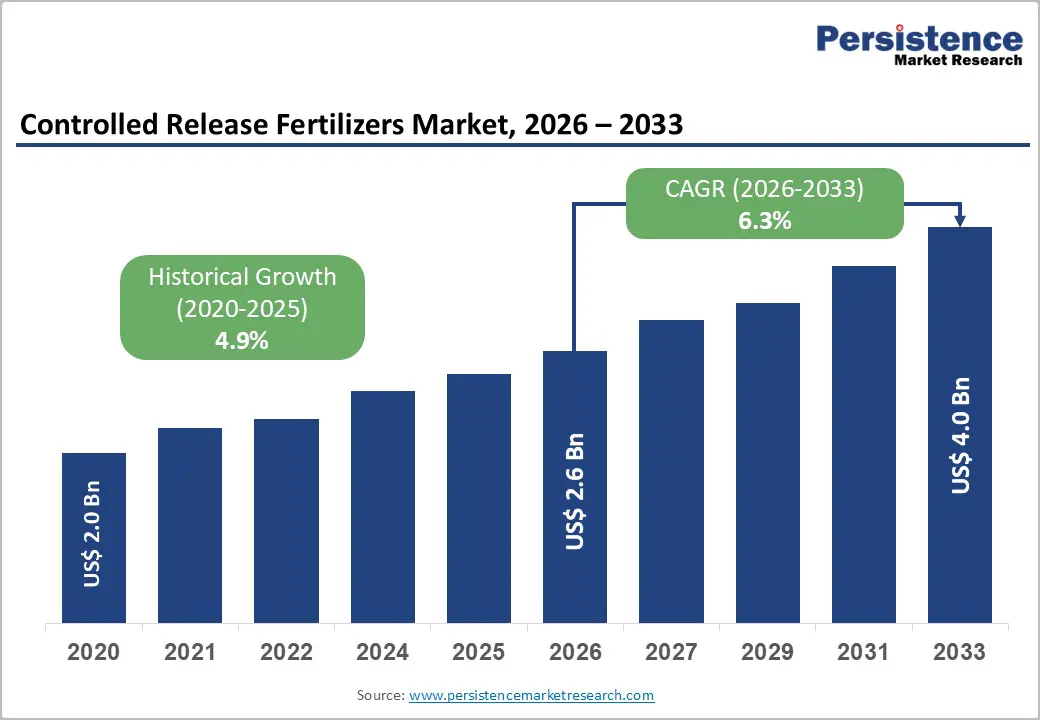
The global controlled release fertilizers market size is likely to be valued at US$ 2.6 billion in 2026 and is expected to reach US$ 4.0 billion by 2033, growing at a CAGR of 6.3% during the forecast period from 2026 to 2033. Sustainability mandates and precision agriculture primarily propel this growth.
Key Industry Highlights:
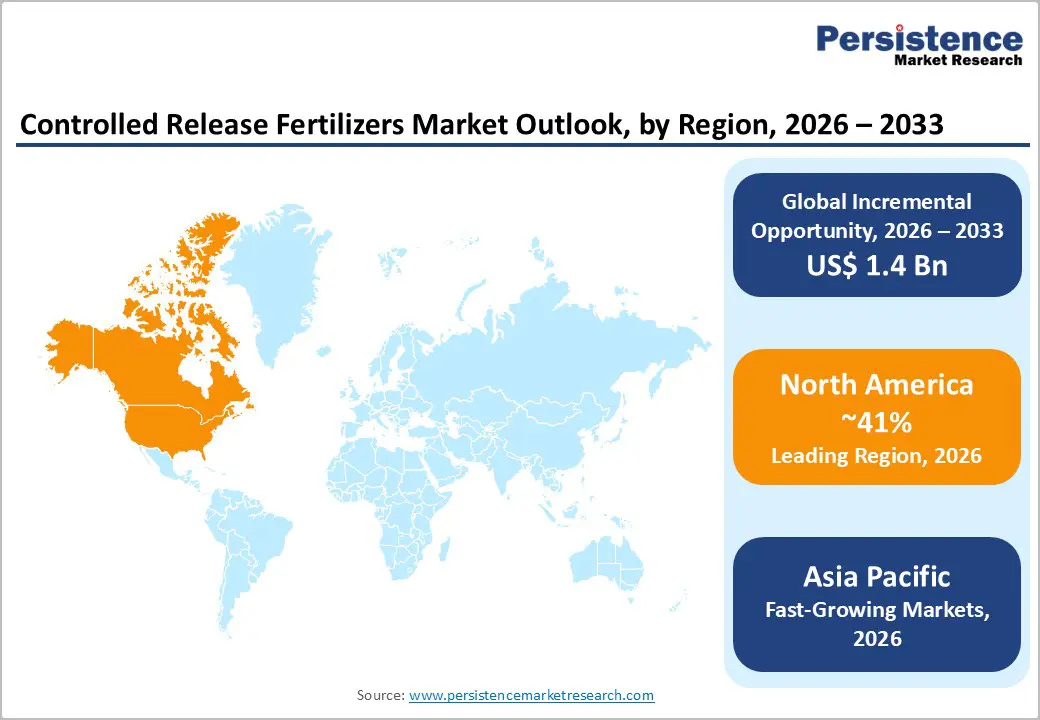
- Leading Region: North America leads the controlled release fertilizers market holding 41% share, due to advanced precision agriculture adoption in the United States and strict environmental regulations from the EPA that encourage efficient nutrient management and reduced fertilizer runoff.
- Fastest-Growing Region: Asia Pacific is the fastest-growing region with rising CAGR of 7.9%, as China and India promote fertilizer efficiency through national policies, while China holds nearly 30% of global production capacity, strengthening regional supply and adoption.
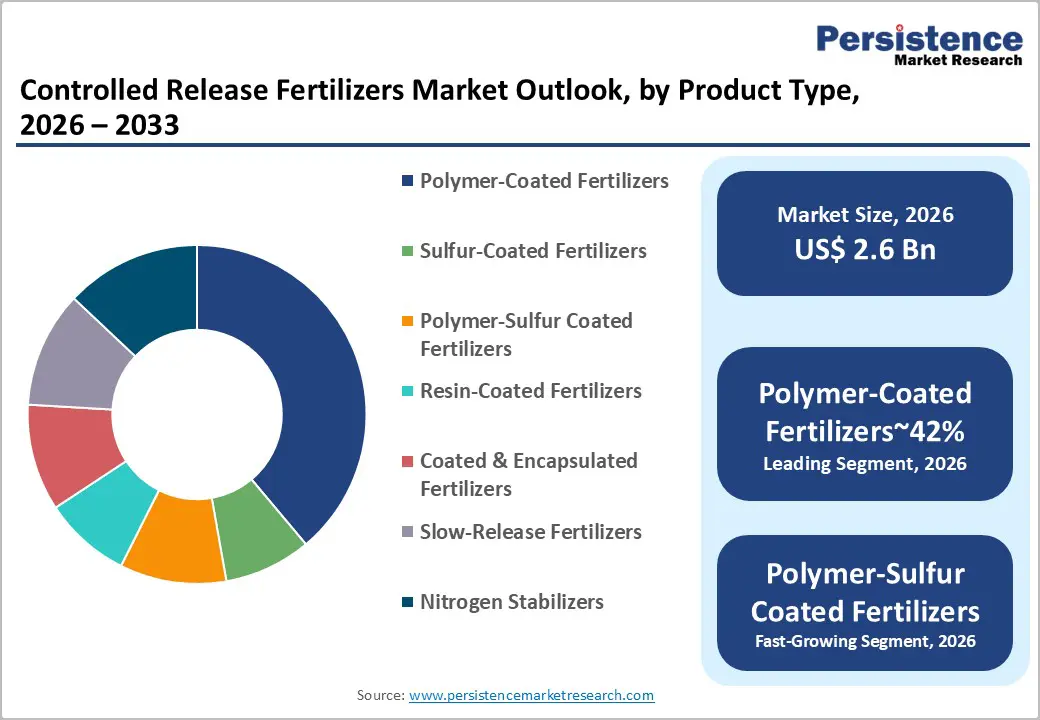
- Leading Segment: Polymer-coated fertilizers hold about 42% market share because they provide controlled nutrient release and up to 90% efficiency, making them highly suitable for cereal crops requiring sustained nitrogen availability.
- Fastest-Growing Segment: Cereals and grains represent the largest crop segment as global production exceeds 2.8 billion tons annually, driving strong demand for efficient fertilizers that enhance yield and support global food security.
- Key Opportunity: Global climate-smart agriculture initiatives are creating major opportunities, with nearly $150 billion in projected funding supporting sustainable fertilizer technologies that reduce emissions, improve nutrient efficiency, and strengthen climate-resilient farming systems.
| Key Insights | Details |
|---|---|
| Controlled Release Fertilizers Market Size (2026E) | US$ 2.6 Billion |
| Market Value Forecast (2033F) | US$ 4.0 Billion |
| Projected Growth CAGR (2026 - 2033) | 6.3% |
| Historical Market Growth (2020 - 2025) | 4.9% |

Market Dynamics
Drivers - Growing precision agriculture technologies and GPS-guided systems increase efficiency and boost global adoption of controlled release fertilizers
The growing adoption of precision agriculture technologies is significantly boosting the use of controlled release fertilizers across global farming systems. According to the FAO, nearly 15% of global farmland is expected to utilize GPS-guided application technologies by 2025, enabling farmers to match nutrient release precisely with crop requirements while reducing fertilizer waste by up to 30%. Modern equipment manufacturers such as John Deere have developed sensor-based systems that integrate with polymer-coated NPK fertilizers, allowing more accurate nutrient management.
Field trials conducted by Embrapa in Brazilian soybean cultivation reported yield improvements of around 18% when controlled release fertilizers were applied through precision farming tools. Furthermore, economic models developed by International Food Policy Research Institute estimate that improved fertilizer efficiency and data-driven farming could generate nearly $500 billion in global agricultural productivity gains by 2030. These advancements are positioning controlled release fertilizers as a critical component of the evolving digital and precision agriculture ecosystem worldwide.
Stricter environmental regulations worldwide are accelerating the adoption of controlled release fertilizers to reduce nutrient runoff and pollution
Stricter environmental regulations aimed at improving nutrient management and protecting water resources are driving the demand for controlled release fertilizers worldwide. In Europe, the EU Nitrates Directive requires groundwater nitrate levels to remain below 50 mg/L, prompting farmers to adopt more efficient nutrient solutions. Data from BLE shows that fertilizer efficiency technologies have contributed to a 25% rise in adoption rates across Germany.
In the United States, the U.S. Environmental Protection Agency has implemented nutrient reduction initiatives under the Chesapeake Bay restoration programs, which require a 25% reduction in phosphorus runoff. Fertilizer producer Nutrien reports that sulfur-coated urea products have helped achieve runoff reductions of nearly 40% in certain applications. Meanwhile, China’s national fertilizer reduction strategy introduced by Ministry of Agriculture and Rural Affairs of China targets a 10% reduction in fertilizer overuse, encouraging the development of advanced resin-coated fertilizer technologies.
Restraints - High manufacturing costs and price premiums limit adoption of controlled release fertilizers among smallholder farmers in developing regions
Despite their agronomic advantages, the high production costs associated with controlled release fertilizers remain a major barrier to widespread adoption, particularly in developing economies. According to the International Fertilizer Development Center, the addition of polymer coatings can increase fertilizer production costs by approximately 30% compared with conventional fertilizers. This price difference makes these products less affordable for smallholder farmers who represent nearly 80% of farmers in developing regions, according to the Food and Agriculture Organization.
In many low-income agricultural markets, farmers prioritize cost efficiency over long-term nutrient optimization, limiting demand for premium fertilizers. Surveys conducted by the World Bank show that adoption rates across African markets remain below 5%, largely due to an average price premium of around $0.50 per kilogram compared to standard fertilizers. As a result, although controlled release fertilizers provide higher yields and better nutrient management, their relatively high cost continues to restrict large-scale adoption.
Field condition variability such as temperature, rainfall, and soil differences affects the reliability and efficiency of controlled release fertilizers
Another major challenge in the controlled release fertilizers market is the variability in nutrient release performance under different field conditions. While laboratory tests often demonstrate highly consistent nutrient release patterns, real-world agricultural environments can produce different results due to climate, soil composition, and irrigation practices. Research conducted by the Agricultural Research Service found that temperature fluctuations and heavy rainfall during monsoon seasons in India can cause nutrient losses of nearly 20%, reducing the expected efficiency of coated fertilizers.
The soil heterogeneity and varying microbial activity influence nutrient availability in agricultural fields. Studies on Integrated Soil Fertility Management conducted by International Fertilizer Development Center suggest that around 25% of fertilizer applications experience uneven nutrient release due to soil variability. These inconsistencies can reduce farmer confidence in advanced fertilizers and slow the transition from conventional fertilizer blends to controlled release alternatives in several emerging agricultural markets.
Opportunities - Rising global investments in climate-smart agriculture programs create major growth opportunities for sustainable controlled release fertilizer technologies
The growing global focus on climate-smart agriculture is creating strong opportunities for the expansion of controlled release fertilizers. Governments and international organizations are increasingly investing in farming solutions that improve productivity while reducing environmental impact. The CGIAR estimates that climate-focused agricultural programs could attract nearly $150 billion in funding by 2030. These initiatives prioritize technologies such as nitrogen stabilizers and controlled release fertilizers that can reduce greenhouse gas emissions from agriculture by nearly 30%, according to the Intergovernmental Panel on Climate Change.
In India, the National Clean Air Programme has introduced fertilizer efficiency measures and subsidies supporting nearly 10 million tons of nutrient-efficient fertilizers annually. Pilot projects conducted by Yara International have demonstrated up to 22% water savings when controlled release fertilizers are used. These developments also align with the agricultural transformation goals of the Alliance for a Green Revolution in Africa, which aims to improve productivity for over 50 million farmers.
Increasing demand for high-value horticulture crops and urban landscaping is expanding the premium market for controlled release fertilizers
The increasing cultivation of high-value crops and the expansion of urban landscaping are opening new growth opportunities for the controlled release fertilizers market. According to the United States Department of Agriculture, the U.S. horticulture industry alone is valued at nearly $60 billion and requires precise nutrient management to maintain crop quality and yield consistency. Controlled release fertilizers are particularly beneficial for fruits and vegetables because they deliver nutrients gradually, improving plant health and crop quality.
Research conducted by the University of California Davis indicates that coated fertilizers can improve crop quality by nearly 35% in certain horticultural applications. In Europe, large-scale urban landscaping and sustainability initiatives under the European Green Deal have allocated approximately €10 billion for urban greening projects. Fertilizer companies such as Haifa Group are developing encapsulated fertilizer products specifically designed for ornamental plants and turf management.
Category-wise Analysis
By Product Type Insights
Polymer-coated fertilizers currently represent the leading product segment in the controlled release fertilizers market, accounting for approximately 42% of the global market share. These fertilizers are widely used because they provide highly controlled nitrogen release over an extended period, improving nutrient efficiency and reducing environmental losses. Trials conducted by the International Fertilizer Development Center show that polymer-coated fertilizers can achieve nutrient use efficiency levels of nearly 80%, compared with about 60% for conventional urea fertilizers.
This performance advantage makes them especially valuable for large-scale cereal production. Companies such as Kingenta Ecological Engineering Group have developed patented polymer-coating technologies capable of releasing nutrients for up to 120 days, reducing the need for multiple fertilizer applications during a growing season. According to the Food and Agriculture Organization, polymer-coated fertilizers are particularly suitable for rice cultivation systems, where Asia accounts for nearly 60% of global fertilizer consumption.
By Crop Type Insights
Cereals and grains represent the largest crop segment in the controlled release fertilizers market, accounting for nearly 45% of total demand. The dominance of this segment is mainly driven by the global importance of staple crops such as wheat, rice, and corn in food production systems. According to the Food and Agriculture Organization, global cereal production exceeds 2.8 billion tons annually, creating substantial demand for efficient nutrient management solutions. Controlled release fertilizers help improve nutrient availability during critical growth stages, resulting in higher yields and better crop quality.
Research conducted by International Maize and Wheat Improvement Center shows that nutrient stabilizers and coated fertilizers can increase wheat yields by nearly 15% under optimized field conditions. In the United States, studies from Purdue University indicate that controlled nitrogen fertilizers contribute to average corn yields of around 180 bushels per acre, further strengthening the role of these fertilizers in major cereal-producing regions.
By Form Insights
Granular fertilizers represent the most widely used form in the controlled release fertilizers market, accounting for nearly 65% of total demand. Their popularity is mainly due to ease of handling, storage, and uniform application in large agricultural fields. According to standards developed by the American Society of Agricultural and Biological Engineers, granular fertilizers allow up to 95% uniform distribution during broadcasting applications, reducing nutrient loss caused by uneven spreading.
Compared with liquid fertilizers, granules are also less prone to drift and evaporation, making them suitable for mechanized farming systems. In major agricultural economies such as Brazil, large soybean farms typically apply around 200 kilograms of fertilizer per hectare. Field studies conducted by Embrapa have shown that controlled release granular fertilizers can increase soybean yields by nearly 10% when applied through mechanized spreading equipment, making them ideal for large-scale commercial farming operations.
By End-user Insights
Agriculture remains the dominant end-use sector for controlled release fertilizers, accounting for nearly 70% of total market demand. The sector requires large volumes of fertilizers to support crop productivity and meet rising global food demand. According to the World Bank, global agriculture consumes nearly 5 billion tons of fertilizers annually across various crop systems. Controlled release fertilizers play an important role in improving nutrient efficiency and reducing environmental losses during crop cultivation.
Research shows that conventional fertilizers can lose nearly 50% of applied nutrients due to runoff, leaching, or volatilization. By gradually releasing nutrients over time, controlled release fertilizers help reduce these losses and improve crop absorption rates. Companies such as ICL Group are developing granular fertilizer products designed for large agricultural fields, enabling farmers to maintain productivity while complying with environmental regulations and sustainable farming practices.
Regional Insights
North America Controlled Release Fertilizers Market Trends
North America remains one of the leading markets for controlled release fertilizers, driven by strong agricultural innovation, advanced farming technologies, and strict environmental regulations. The United States benefits from major agricultural research centers such as Mississippi State University, which has developed advanced polymer coating technologies such as Mullen coatings capable of extending nutrient release for up to 180 days.
Regulatory frameworks implemented by the U.S. Environmental Protection Agency under the Clean Water Act encourage farmers to adopt efficient fertilizer solutions that reduce nutrient runoff into water bodies. Large fertilizer companies including Nutrien have expanded the use of coated fertilizers across the U.S. Corn Belt. Additionally, conservation initiatives under the Natural Resources Conservation Service provide nearly $1 billion annually through EQIP programs to support precision agriculture technologies that optimize nutrient management in major crop systems.
Europe Controlled Release Fertilizers Market Trends
Europe represents a technologically advanced market for controlled release fertilizers, supported by strict environmental policies and sustainable agriculture initiatives. Countries such as Germany have established certification systems through organizations like DLG that ensure the quality and safety of advanced fertilizer technologies. These standards align with regulatory frameworks such as REACH Regulation, which governs the safe use of chemical substances across the European Union.
The organic farming in Europe has increased by nearly 7% in recent years, encouraging the use of nutrient-efficient fertilizers developed by companies such as Yara International. Spain has also benefited from agricultural funding under the Common Agricultural Policy, which supports sustainable olive farming. Research trials conducted under the Joint Research Centre have shown nitrogen savings of nearly 25%.
Asia Pacific Controlled Release Fertilizers Market Trends
Asia Pacific dominates the global controlled release fertilizers market due to large agricultural production volumes and strong fertilizer manufacturing capacity. China plays a central role in regional supply, accounting for nearly 30% of global production capacity according to the Ministry of Agriculture and Rural Affairs of China. Government initiatives aimed at stabilizing fertilizer consumption under the Zero Growth Fertilizer policy have encouraged the use of controlled release nutrient technologies, particularly in rice cultivation.
In India, irrigation expansion programs such as the Pradhan Mantri Krishi Sinchayee Yojana aim to improve water and nutrient management across nearly 50 million hectares of farmland. Specialty fertilizer companies, including Haifa Group, are increasing their presence in the region with advanced nutrient stabilizer products. Japan continues to develop high-precision resin-coated fertilizers for fruit production, while Southeast Asian countries such as Vietnam are reporting rice yield increases of nearly 12%.
Competitive Landscape
The controlled release fertilizers market is moderately fragmented but is gradually moving toward consolidation as major companies invest in research, innovation, and strategic partnerships. Leading fertilizer producers such as ICL Group and Kingenta Ecological Engineering Group together hold nearly 35% of the global market share through continuous investment in advanced bio-polymer coating technologies. Large multinational companies such as Nutrien are strengthening their position through vertical integration strategies that combine fertilizer manufacturing, distribution networks, and agronomic advisory services.
Yara International is focusing on digital agriculture platforms that help farmers apply fertilizers using variable-rate technology. Companies like Haifa Group differentiate themselves by offering customizable nutrient release durations tailored to specific crops and climates. Emerging industry trends include subscription-based nutrient management services and fertilizers linked to carbon-credit programs.
Key Developments:
- In April 2025: Nutrien introduced an upgraded version of its ESN Smart Nitrogen fertilizer designed for U.S. corn growers. The enhanced polymer coating extends nitrogen release up to 180 days, helping reduce nutrient volatility by about 25% while improving nitrogen-use efficiency and crop productivity.
- In October 2024: ICL Group partnered with Bayer to conduct polymer-coated fertilizer trials for soybean cultivation in Brazil. Independent agronomic tests reported yield improvements of nearly 18%, highlighting the potential of controlled nutrient release technologies in large-scale soybean farming.
- In February 2025: Kingenta Ecological Engineering Group launched new bio-resin fertilizer stabilizers in China designed to reduce agricultural emissions and enhance nutrient efficiency. The technology received certification from Ministry of Agriculture and Rural Affairs of China, confirming potential emission reductions of approximately 20%.
Companies Covered in Controlled Release Fertilizers Market
- Kingenta Ecological Engineering Co. Ltd.
- Nutrien
- ICL
- Yara International
- Haifa Chemicals
- Helena Chemical
- AGLUKON
- SQM
- Pursell Agri-Tech
- JNC Corporation
- Koch Industries
- Mosaic
- Nufarm
- ScottsMiracle-Gro
- Sinochem Fertilizer
Frequently Asked Questions
The market will grow from US$ 2.6 Billion in 2026 to US$ 4.0 Billion by 2033 at 6.3% CAGR, driven by precision farming.
Precision ag tech and regulations like EU Nitrate Directive boost use, improving 25-30% nutrient efficiency per FAO.
Polymer-Coated Fertilizers lead at 42% share for 90% efficiency in cereals, per IFDC trials.
North America leads with U.S. innovation and EPA enforcement for sustainable practices.
Climate-smart agriculture with $150 billion funding targets stabilizers for emission cuts by 2030.
Leaders include Nutrien, ICL, Yara International, and Kingenta, advancing polymer tech.


