




- Agrochemicals
- Agrochemical Additives Market
Agrochemical Additives Market Size, Share, and Growth Forecast, 2026 - 2033
Agrochemical Additives Market by Product Type (Alkoxylates, Dispersing Agents, Others), Additives (Adjuvants, Activators, Modifiers, Fertilizer Additives), Crop (Cereals and Grains, Others), and Regional Analysis for 2026 - 2033

Agrochemical Additives Market Size and Trends Analysis
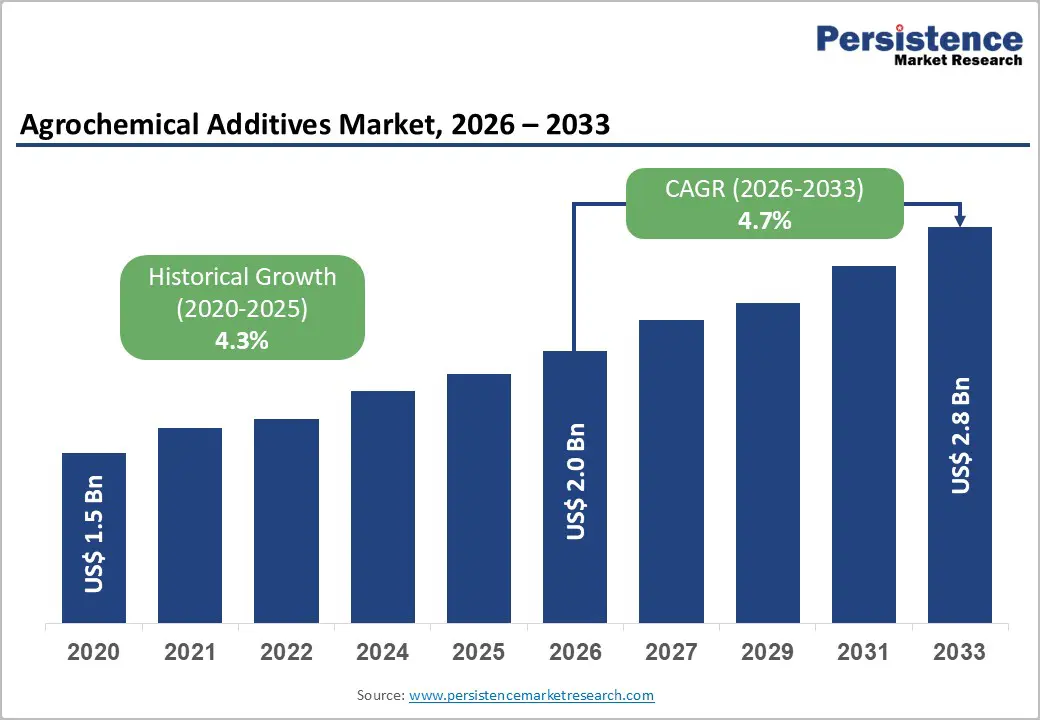
The global agrochemical additives market size is likely to be valued at US$2.0 billion in 2026 and is expected to reach US$2.8 billion by 2033, growing at a CAGR of 4.7% during the forecast period from 2026 to 2033, driven by the increasing pressure on arable land and the need to maximize agricultural productivity through improved input utilization. Agrochemical additives such as surfactants, dispersants, emulsifiers, and oil enhancers are widely used to improve spray coverage, optimize droplet retention, reduce drift, and enhance the absorption of active ingredients, thereby ensuring better efficacy of pesticides and fertilizers.
Market dynamics are closely tied to advancements in precision agriculture, where optimized application techniques and input efficiency are essential, as well as to the growing emphasis on sustainable farming practices. These additives contribute to improved nutrient-use efficiency and help minimize environmental impact by reducing chemical runoff and wastage, especially in high-intensity farming systems. The market is witnessing a gradual shift toward bio-based and environmentally friendly additives in response to regulatory pressures and increasing awareness of ecological sustainability.
Key Industry Highlights:
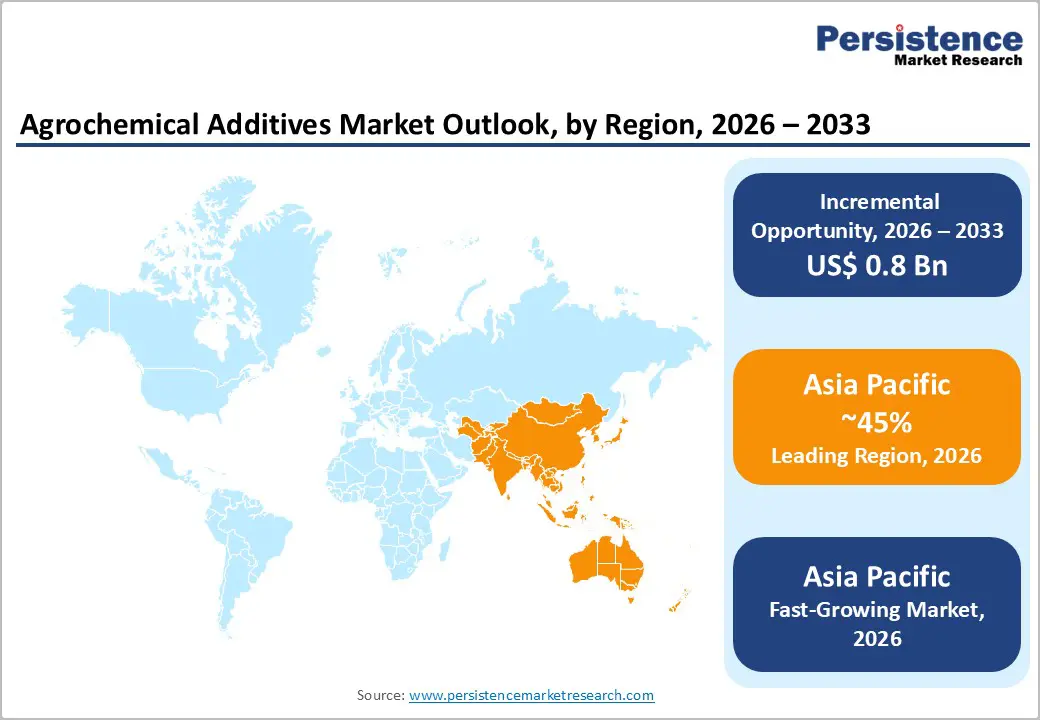
- Leading Region: Asia Pacific is anticipated to be the leading region, accounting for a market share of 45% in 2026, driven by extensive agricultural activity, large arable land availability, and rising demand for higher crop productivity.
- Fastest-growing Region: Asia Pacific is likely to be the fastest-growing region, supported by rising food demand, increasing adoption of modern farming practices, and strong manufacturing capabilities.
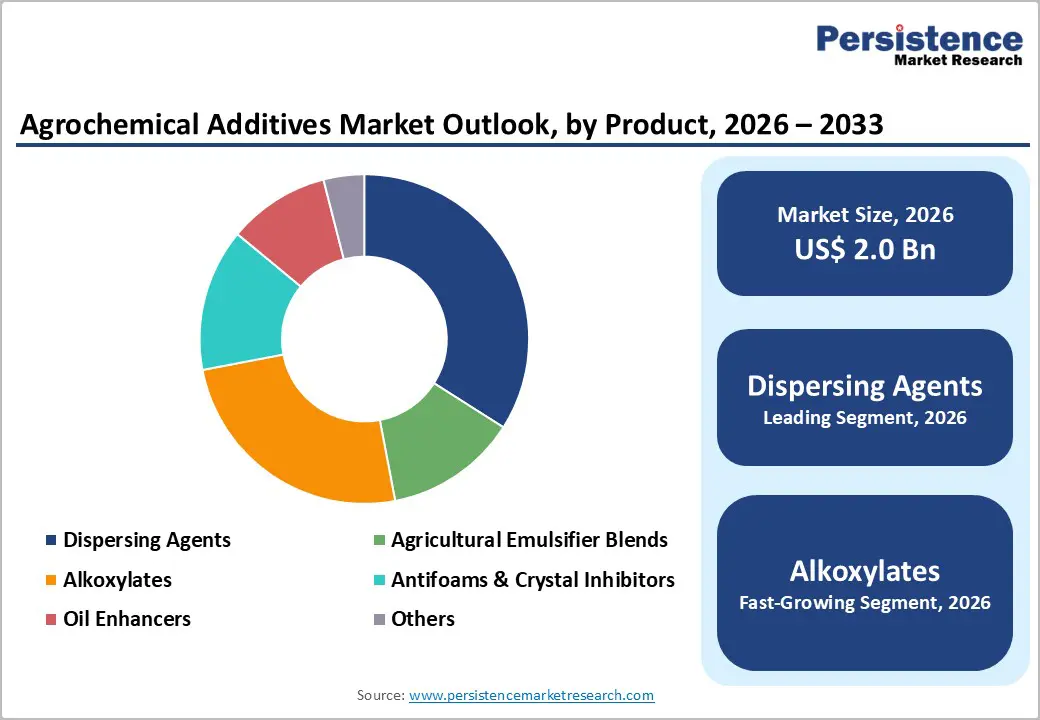
- Leading Product Type: Dispersing agents are projected to represent the leading product type in 2026, accounting for 30% of the revenue share, driven by their essential role in formulation stability and uniform application.
- Leading Additives Type: Adjuvants are anticipated to be the leading additives type, accounting for over 40% of the revenue share in 2026, supported by their widespread use in enhancing pesticide efficiency and performance.
| Key Insights | Details |
|---|---|
|
Agrochemical Additives Market Size (2026E) |
US$2.0 Bn |
|
Market Value Forecast (2033F) |
US$2.8 Bn |
|
Projected Growth (CAGR 2026 to 2033) |
4.7% |
|
Historical Market Growth (CAGR 2020 to 2025) |
4.3% |

Market Factors - Driver, Restraint, and Opportunity Analysis
Driver Analysis - Rising Demand for Improved Crop Protection and Yield Optimization
Agriculture faces mounting pressure to produce higher yields from limited arable land while combating evolving pest resistance and climate variability. Agrochemical additives play a crucial role in improving the effectiveness of pesticides and fertilizers by enhancing spray coverage, adhesion, and absorption of active ingredients. Their ability to reduce chemical wastage and improve input utilization aligns with the growing need for cost-effective and high-performance farming solutions across both developed and developing agricultural markets.
Rising population levels and shifting dietary patterns are intensifying the demand for reliable and high-quality crop output. Agrochemical additives support consistent agricultural productivity by enabling better formulation stability and performance under diverse environmental conditions. Their use ensures uniform distribution of crop protection products, leading to improved pest and disease control. As precision agriculture gains traction, these additives become even more critical in optimizing input application rates.
Advancements in Formulation Technology and Precision Agriculture
Technological advancements in agrochemical formulations are significantly enhancing the functionality and efficiency of additives. Innovations in surfactant chemistry, nano-formulations, and controlled release systems are enabling better delivery and targeted action of crop protection products. Agrochemical additives are increasingly designed to perform under specific environmental conditions, improving compatibility and reducing degradation. These developments support higher precision in application, ensuring that active ingredients reach intended targets effectively.
The adoption of precision agriculture practices is accelerating the demand for high-performance additives. Technologies such as GPS-guided spraying, variable rate application, and data-driven farming require formulations that can perform consistently under controlled conditions. Additives enhance the efficiency of these systems by improving droplet behavior, minimizing drift, and ensuring optimal coverage. This integration of digital agriculture with advanced formulation science is transforming input management strategies.
Restraint Analysis - Environmental and Health Scrutiny
Increasing environmental and health concerns are placing significant pressure on the use of chemical-based agricultural inputs, including agrochemical additives. Regulatory authorities across major agricultural regions are tightening standards related to toxicity, biodegradability, and environmental impact. Additives that contribute to chemical persistence or runoff are facing stricter evaluations, leading to reformulation requirements. This scrutiny affects product approvals and increases compliance costs for manufacturers.
Public concern regarding food safety and environmental protection is influencing agricultural practices. Consumers are demanding reduced chemical residues in food, prompting farmers to limit the use of certain agrochemical formulations. This shift indirectly impacts the demand for conventional additives associated with synthetic chemicals. Companies are therefore investing in research to develop eco-friendly alternatives that meet regulatory expectations. The challenge lies in balancing performance efficiency with environmental safety.
Consumer Preference for Bio Pesticides and Reduced Chemical Exposure
Growing consumer awareness regarding health and environmental sustainability is driving a shift toward biopesticides and reduced chemical usage in agriculture. This trend is influencing farmers to adopt safer and more natural crop protection solutions. The demand for traditional agrochemical additives linked to synthetic formulations is experiencing gradual pressure. Regulatory support for organic farming and residue-free food production is reinforcing this transition. Manufacturers are facing the challenge of aligning their product portfolios with evolving consumer expectations while maintaining effectiveness and cost efficiency.
In response, the industry is witnessing increased interest in bio-based and compatible additive solutions that can be used alongside biopesticides. These alternatives aim to deliver similar performance benefits, such as improved adhesion and absorption, without adverse environmental impact. However, developing such solutions requires significant research and innovation. The transition toward biologically derived inputs is reshaping market dynamics and encouraging sustainable product development. While this trend presents challenges for conventional additives, it also opens pathways for innovation in eco-friendly formulations.
Opportunity Analysis - Convergence with Seed-Treatment and Soil-Health Solutions
The integration of agrochemical additives with seed treatment and soil health solutions is creating new avenues for agricultural efficiency. Additives are increasingly being incorporated into seed coatings to enhance germination, protect against early-stage pests, and improve nutrient uptake. This convergence allows for targeted delivery of active ingredients at the earliest stages of plant growth, reducing the need for excessive chemical application later. It also supports uniform crop establishment and improved resilience against environmental stress, making it a valuable strategy in modern farming systems.
The focus on soil health management is driving demand for additives that enhance nutrient availability and microbial activity. These solutions contribute to long-term soil fertility and sustainable crop production. By improving the interaction between fertilizers and soil, additives help reduce nutrient losses and increase efficiency. This integrated approach aligns with efforts toward regenerative agriculture and resource conservation. As farmers seek holistic solutions that combine productivity with sustainability, the role of agrochemical additives in seed and soil applications continues to expand significantly.
Expansion into High-Growth Developing-Agricultural Economies
Developing agricultural economies are emerging as key growth areas due to increasing investments in modern farming practices and infrastructure. Countries with large agrarian populations are focusing on improving crop productivity to meet rising domestic and export demands. Agrochemical additives are gaining traction in these regions as farmers adopt advanced inputs to enhance efficiency and reduce losses. Government initiatives supporting agricultural modernization and access to better farming technologies are accelerating market penetration and adoption of additive-based solutions.
Expanding commercial farming and agribusiness activities in these regions are creating sustained demand for high-performance agrochemical formulations. Local manufacturing capabilities and favorable cost structures are also encouraging companies to establish a presence in these markets. The need for improved crop protection under diverse climatic conditions strengthens the demand for effective additives. As awareness and accessibility increase, these economies present significant opportunities for market expansion, innovation, and long-term growth in agrochemical additive applications.
Category-wise Analysis
Product Type Insights
Dispersing agents are expected to lead the agrochemical additives market, accounting for approximately 30% of revenue in 2026, driven by their essential role in maintaining formulation stability and preventing sedimentation in liquid crop protection products. These additives ensure uniform distribution of active ingredients, which is critical for achieving consistent application and efficacy across large agricultural fields. For example, in large-scale herbicide applications, dispersing agents help maintain homogeneity in spray solutions, ensuring even weed control and minimizing product loss, thereby supporting both economic and agronomic outcomes.
Alkoxylates are likely to represent the fastest-growing segment in 2026, supported by their superior performance as surfactants and emulsifiers, particularly in enhancing wetting, spreading, and penetration of agrochemicals. These properties are increasingly important in precision agriculture, where efficient coverage and reduced application volumes are critical. For example, in insecticide sprays, alkoxylates improve leaf coverage and adhesion, resulting in more effective pest control with lower chemical usage, aligning with sustainability and efficiency goals.
Application Insights
Adjuvants are projected to lead the market, capturing around 40% of the revenue share in 2026, supported by their broad functionality in enhancing the performance of crop protection products. They improve adhesion, spreading, and penetration of pesticides, ensuring that active ingredients are effectively delivered to target surfaces. Adjuvants are widely used across herbicides, fungicides, and insecticides, making them a core component in modern agricultural practices. For example, in herbicide applications, adjuvants help sprays stick to weed surfaces and resist wash-off, ensuring better absorption and long-lasting effectiveness in diverse field conditions.
Fertilizer additives are likely to be the fastest-growing application, driven by increasing emphasis on nutrient-use efficiency and sustainable agriculture practices. These additives enhance nutrient availability, reduce losses from volatilization or leaching, and improve overall fertilizer performance. With stricter environmental regulations and rising input costs, farmers are adopting enhanced-efficiency fertilizers supported by advanced additive technologies. For example, nitrogen stabilizers used as fertilizer additives help retain nutrients in the soil for longer periods, improving plant uptake and reducing environmental impact, thereby supporting both productivity and sustainability objectives.
Regional Insights
North America Agrochemical Additives Market Trends
North America is likely to be a significant market for agrochemical additives in 2026, driven by the strong adoption of precision agriculture and sustainable farming practices. The region benefits from advanced agricultural infrastructure, large-scale commercial farming, and increasing demand for high-efficiency crop protection inputs. Farmers are increasingly integrating additives that improve spray performance, reduce drift, and enhance nutrient uptake, aligning with environmental compliance requirements. There is a notable shift toward bio-based and low-toxicity additives due to regulatory pressures and consumer demand for sustainable food production.
A key trend shaping the region is strong investment in research and development by major agrochemical companies focused on innovative and sustainable additive solutions. For example, FMC Corporation has been actively developing advanced crop protection formulations that incorporate performance-enhancing additives to improve application efficiency and environmental safety. Such initiatives reflect the region’s emphasis on technological innovation and regulatory compliance. The market also benefits from well-established distribution networks and strong collaboration between agritech firms and farmers, enabling rapid adoption of next-generation additives designed for precision agriculture systems.
Europe Agrochemical Additives Market Trends
Europe is likely to be a significant market for agrochemical additives, due to stringent environmental regulations and a strong focus on sustainable agriculture. Regulatory frameworks across the region encourage reduced chemical usage and promote eco-friendly formulations, driving demand for biodegradable and low-impact additives. Farmers increasingly adopt additives that enhance efficiency while minimizing environmental footprint, particularly in crop protection and fertilizer applications. The region is also witnessing a shift toward integrated pest management and organic farming practices, which influences the development of innovative additive solutions compatible with sustainable systems.
Another significant trend is the emphasis on sustainable supply chains and innovation by key industry players operating in the region. For example, Bayer Crop Science continues to invest in environmentally advanced formulations and digital farming solutions that incorporate high-performance additives to improve crop protection efficiency. The increasing entry of regional manufacturers is intensifying competition, encouraging companies to focus on value-added products and customer-centric solutions.
Asia Pacific Agrochemical Additives Market Trends
The Asia Pacific region is anticipated to be the leading region, accounting for a market share of 45% in 2026, driven by large agricultural economies and rising food demand. The region benefits from extensive arable land, increasing population pressure, and government initiatives focused on improving agricultural productivity. Farmers are increasingly adopting modern agrochemical formulations supported by additives that enhance efficiency, reduce input costs, and improve crop yields. Expanding commercial farming and growing awareness of advanced agricultural practices are fueling demand for performance-enhancing additives across countries such as China and India.
A notable trend in the region is the expansion of multinational companies and investments in local manufacturing and technology transfer. For example, UPL Limited has been strengthening its presence across Asia by developing innovative agrochemical solutions integrated with advanced additives to improve crop productivity and sustainability. The region also benefits from cost-effective production capabilities and strong supply chains, making it a key hub for agrochemical manufacturing.
Competitive Landscape
The global agrochemical additives market exhibits a moderately fragmented structure, driven by the presence of large multinational chemical companies alongside numerous regional and niche formulation specialists. The market is shaped by increasing demand for high-performance and sustainable agricultural inputs, encouraging both leaders and local players to strengthen their portfolios. Leading companies benefit from strong research and development capabilities, integrated supply chains, and distribution networks, enabling them to deliver advanced additive solutions across diverse agricultural systems.
With key leaders including BASF SE, Bayer Crop Science, Syngenta AG, FMC Corporation, and UPL Limited, the competitive environment reflects a balance between innovation leadership and regional adaptability. These players compete through continuous product innovation, strategic mergers and acquisitions, and expansion into emerging agricultural markets to strengthen their footprint. Companies are increasingly focusing on developing bio-based, environmentally compliant additives to align with evolving regulatory frameworks and sustainability goals.
Key Industry Developments:
- In May 2025, BASF India launched two advanced crop protection solutions, Valexio insecticide and Mibelya fungicide for rice cultivation, aimed at improving pest and disease management and enhancing crop yield and quality. These innovations target key challenges such as rice hoppers and fungal diseases, such as sheath blight, supporting farmers with effective and sustainable solutions during the critical rice growing season.
- In November 2025, Corteva Agriscience launched Pixxaro®, a broadleaf weed control herbicide for wheat in India, while Tropical Agro introduced Tag Fly Gold, a patented insecticide designed to control sucking pests and borers, strengthening crop protection solutions.
- In January 2025, Super Crop Safe launched “Super Gold WP+,” a bio-fertilizer in India designed to enhance root growth, improve nutrient uptake, and reduce dependence on chemical fertilizers for sustainable farming.
Companies Covered in Agrochemical Additives Market
- ADAMA
- BASF
- Bayer Crop Science
- Corteva
- Dow AgroSciences
- FMC
- Helm AG
- Huntsman Corporation
- Jiangsu FMC
- Lanxess
- Nufarm
- Solvay
- Sumitomo Chemical
- Syngenta Crop Protection
- UPL
Frequently Asked Questions
The global agrochemical additives market is projected to reach US$2.0 billion in 2026.
Rising food demand and the need to improve crop protection efficiency and yield optimization drive the agrochemical additives market.
The agrochemical additives market is expected to grow at a CAGR of 4.7% from 2026 to 2033.
Growing adoption of bio-based additives and increasing integration with precision agriculture and soil-health solutions present key opportunities in the agrochemical additives market.
ADAMA, BASF, Bayer Crop Science, Corteva, Dow AgroSciences, and FMC are the leading players.


