

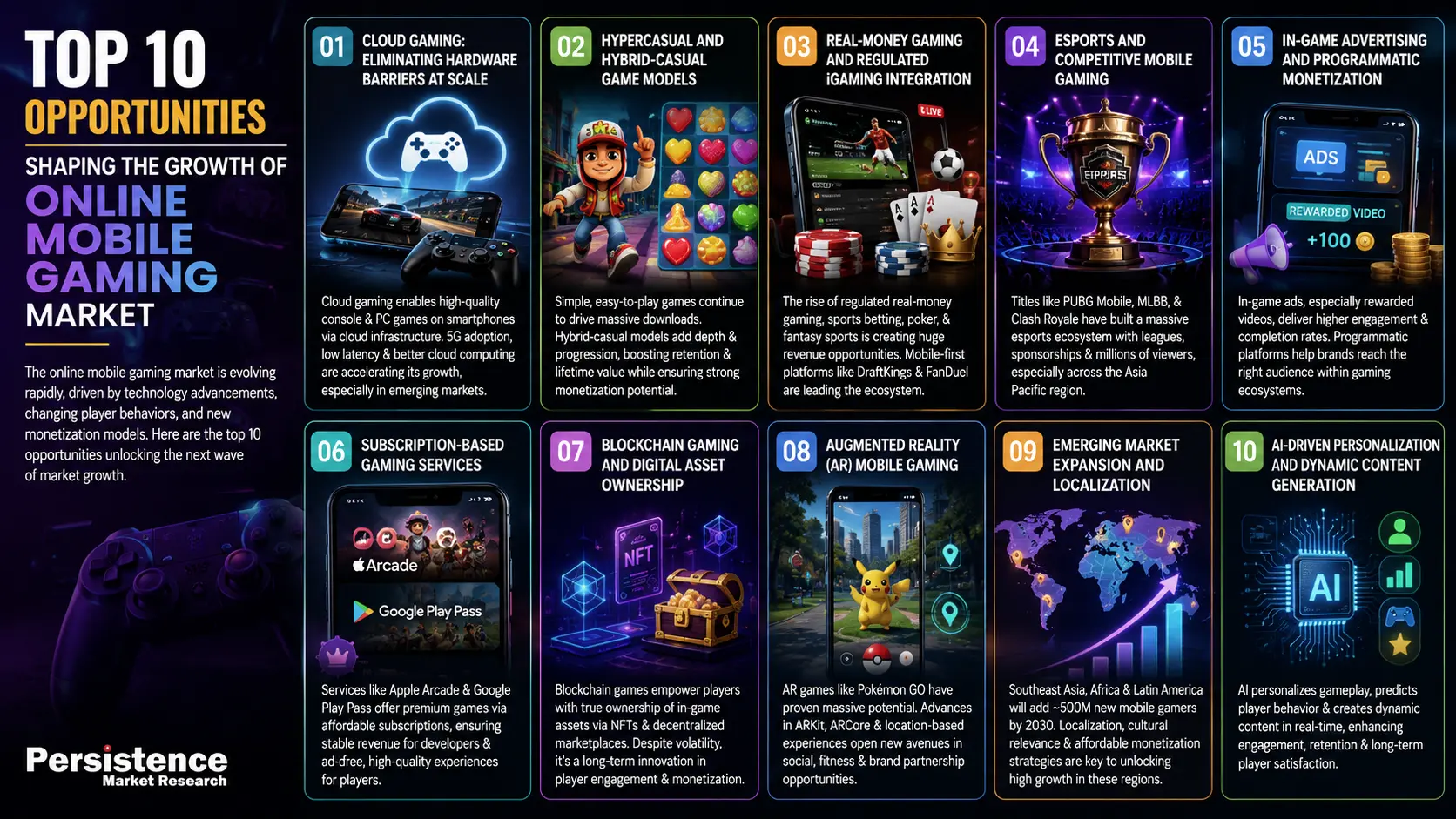
1. Cloud Gaming: Eliminating Hardware Barriers at Scale
Cloud gaming is transforming mobile gaming by enabling users to stream console- and PC-quality games directly to smartphones without expensive hardware. Platforms such as Xbox Cloud Gaming and NVIDIA GeForce NOW are expanding access to premium gaming experiences through cloud-based infrastructure. Growing 5G adoption, improved cloud computing, and lower latency are further accelerating cloud gaming adoption, especially in emerging markets with high smartphone usage.
2. Hypercasual and Hybrid-Casual Game Models
Hypercasual games characterized by extremely simple mechanics and minimal onboarding have generated billions of downloads globally, with titles such as Subway Surfers and Candy Crush Saga sustaining multi-year player retention. The evolution toward hybrid-casual designs, which layer deeper progression systems and social mechanics onto accessible core gameplay, is creating more durable engagement and substantially improved lifetime player value. This model reduces development risk while preserving strong monetization potential through in-app purchases and rewarded advertising, making it one of the most commercially efficient growth vectors in the current market.
3. Real-Money Gaming and Regulated iGaming Integration
The convergence of mobile gaming with regulated real-money gaming, including sports betting, online poker, fantasy sports, and skill-based wagering, is creating substantial new revenue streams for gaming operators and app developers. Following the repeal of PASPA in the United States, several states legalized online sports betting, accelerating the growth of mobile-first gambling platforms and increasing consumer participation through convenient smartphone access. Companies such as DraftKings and FanDuel have expanded rapidly by offering integrated ecosystems that combine betting, live sports engagement, personalized promotions, and real-time analytics to improve user retention and monetization.
4. Esports and Competitive Mobile Gaming
Popular titles such as PUBG Mobile, Mobile Legends: Bang Bang, and Clash Royale have transformed mobile esports into a major global competitive industry supported by professional leagues, sponsorships, and millions of online viewers. The strongest growth is concentrated in the Asia Pacific region, where widespread smartphone adoption, affordable mobile internet access, and advanced live-streaming infrastructure continue to drive esports participation and audience engagement.
5. In-Game Advertising and Programmatic Monetization
As privacy regulations reduce the effectiveness of traditional mobile ad targeting, in-game advertising is becoming a highly engaging and brand-safe alternative for advertisers. Rewarded video ads offer strong user participation and significantly higher completion rates compared to conventional display ads. Platforms such as Unity Ads and Digital Turbine are enabling advanced audience targeting within gaming ecosystems, creating substantial revenue opportunities for both advertisers and game developers.
6. Subscription-Based Gaming Services
Mobile game subscription services such as Apple Arcade and Google Play Pass are gaining popularity by offering premium game libraries through affordable monthly subscriptions. These platforms provide stable revenue for developers, strengthen ecosystem loyalty for platform operators, and deliver strong consumer value through high daily engagement and ad-free gaming experiences.
7. Blockchain Gaming and Digital Asset Ownership
Blockchain-based mobile games are introducing player-owned digital economies through NFTs and decentralized marketplaces, allowing users to trade and retain value from in-game assets. Platforms built on infrastructures such as Polygon and Immutable are supporting this shift toward verifiable digital ownership. Despite earlier market volatility, blockchain gaming continues to represent a long-term innovation in monetization and player engagement.
8. Augmented Reality (AR) Mobile Gaming
Augmented reality gaming which overlays interactive game elements onto the real-world environment through a smartphone camera achieved mainstream validation with Pokemon GO, which generated over US$ 6 billion in lifetime revenue since its 2016 launch. Advances in smartphone AR processing capability, Apple's ARKit, and Google's ARCore frameworks are enabling increasingly sophisticated AR game design. Location-based AR titles with social multiplayer mechanics, fitness integration, and brand partnership event frameworks represent an expanding commercial opportunity that uniquely leverages mobile devices' sensor suite capabilities in ways that no other gaming platform can replicate.
9. Emerging Market Expansion and Localization
Emerging markets across Southeast Asia, Sub-Saharan Africa, and Latin America are expected to add nearly 500 million new mobile gamers by 2030, creating major growth opportunities for publishers. Companies such as Garena and Tencent have shown that localization-focused strategies, including language adaptation, culturally relevant content, and affordable monetization models, are critical for success in these high-growth regions.
10. AI-Driven Personalization and Dynamic Content Generation
Artificial intelligence is transforming mobile game design through real-time player behavior analysis, adaptive difficulty levels, personalized content recommendations, and procedurally generated environments that improve engagement while lowering development costs. Companies such as Electronic Arts and Zynga are using AI-driven personalization to enhance monetization, player retention, and matchmaking. Advancements in generative AI are also reducing the cost of creating game art, narratives, and audio assets, enabling faster innovation and lowering entry barriers for independent developers.
Conclusion
The online mobile gaming market stands at a pivotal inflection point one defined by technological convergence, demographic expansion, and accelerating monetization sophistication. The ten opportunities outlined above collectively represent a comprehensive strategic landscape spanning infrastructure innovation, regulatory evolution, emerging market development, and AI-driven product transformation. The growth of the online gaming market is being driven by rising internet and smartphone penetration, continuous technological advancements, increasing disposable incomes, and the growing popularity of multiplayer and mobile gaming. The rapid expansion of esports and game streaming platforms has further enhanced player engagement and monetization opportunities.


