




- Industrial Machinery
- Weaving Machine Market
Weaving Machine Market Size, Share, and Growth Forecast, 2026 - 2033
Weaving Machine Market by Machine Type (Shuttle Loom, Rapier Loom, Air-Jet Loom, Water-Jet Loom, Projectile Loom) Application (Apparel & Fashion, Home Textiles & Upholstery, Automotive Textiles, Others), and Regional Analysis for 2026 - 2033

Weaving Machine Market Size and Trends Analysis
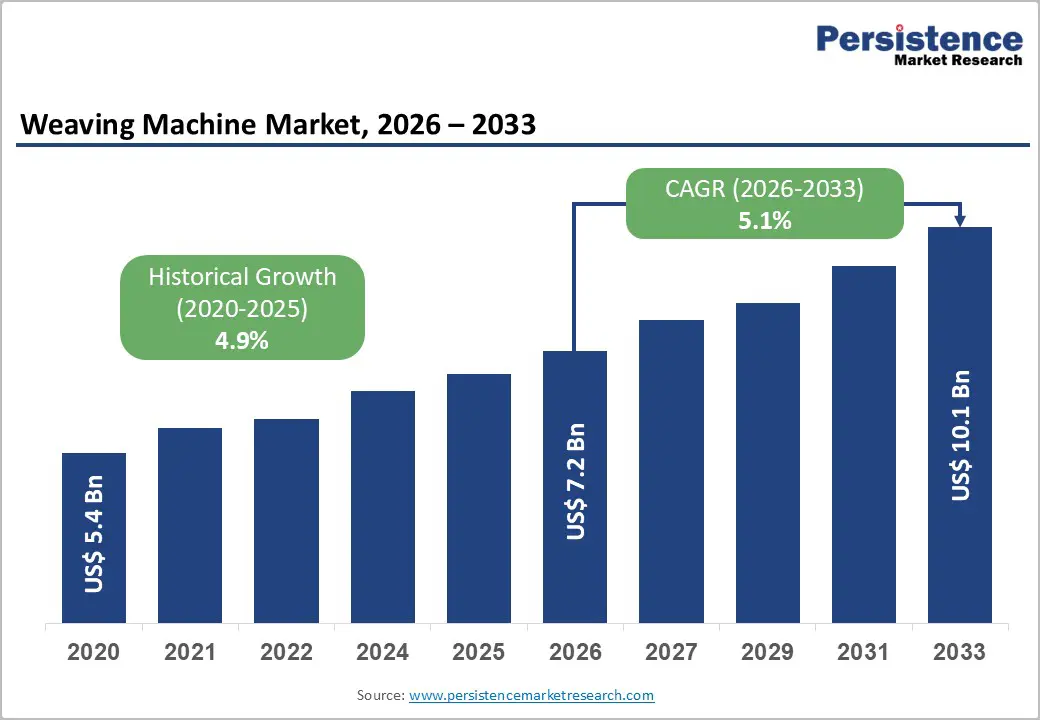
The global weaving machine market size is likely to be valued at US$7.2 billion in 2026 and is expected to reach US$10.1 billion by 2033, growing at a CAGR of 5.1% during the forecast period from 2026 to 2033, driven by rapid automation in textile manufacturing, increasing demand for technical textiles, and modernization of weaving facilities across Asia-Pacific and Europe.
According to the International Textile Manufacturers Federation (ITMF), global shipments of shuttle-less looms increased by 32% in 2025, with air-jet and water-jet loom deliveries rising by 10% and 56%, respectively, highlighting strong adoption of high-speed and energy-efficient weaving technologies. ITMF reported global textile capacity utilization at 72% in May 2025, reflecting sustained investment in advanced weaving infrastructure and smart textile production systems.
Key Industry Highlights:
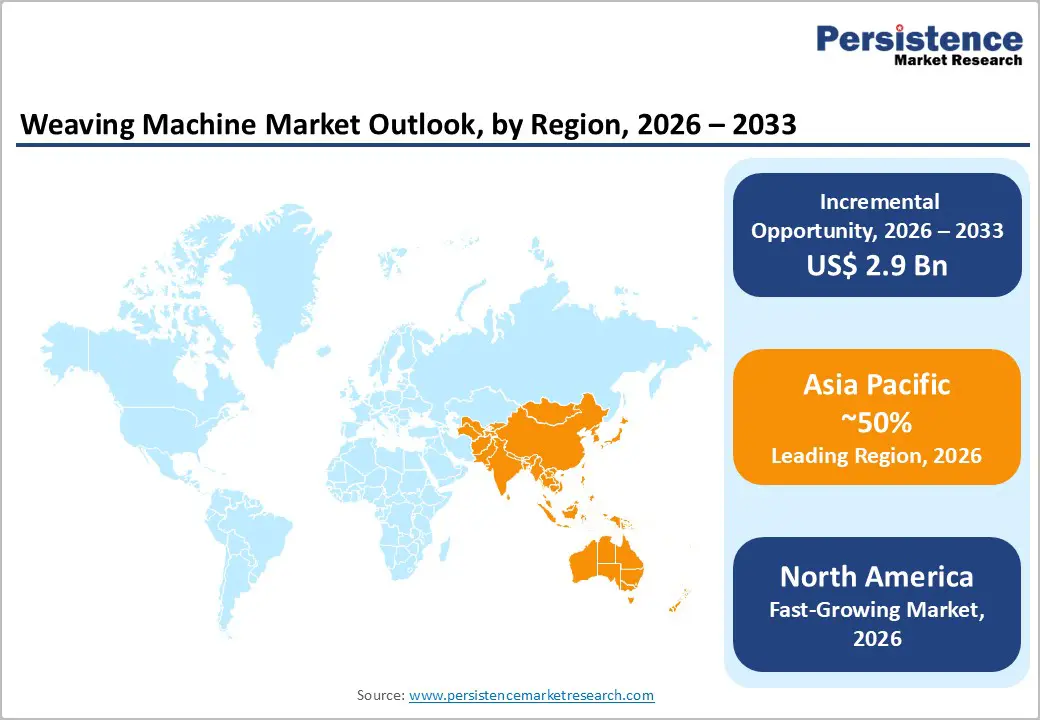
- Leading Region: Asia Pacific is anticipated to be the leading region, accounting for 50% market share in 2026, driven by strong textile manufacturing capacity, rapid adoption of automation, and expanding apparel and technical textile production across countries.
- Fastest-growing Region: North America is likely to be the fastest-growing region, supported by advanced automation, reshoring initiatives, and rising demand for high-performance technical textiles.
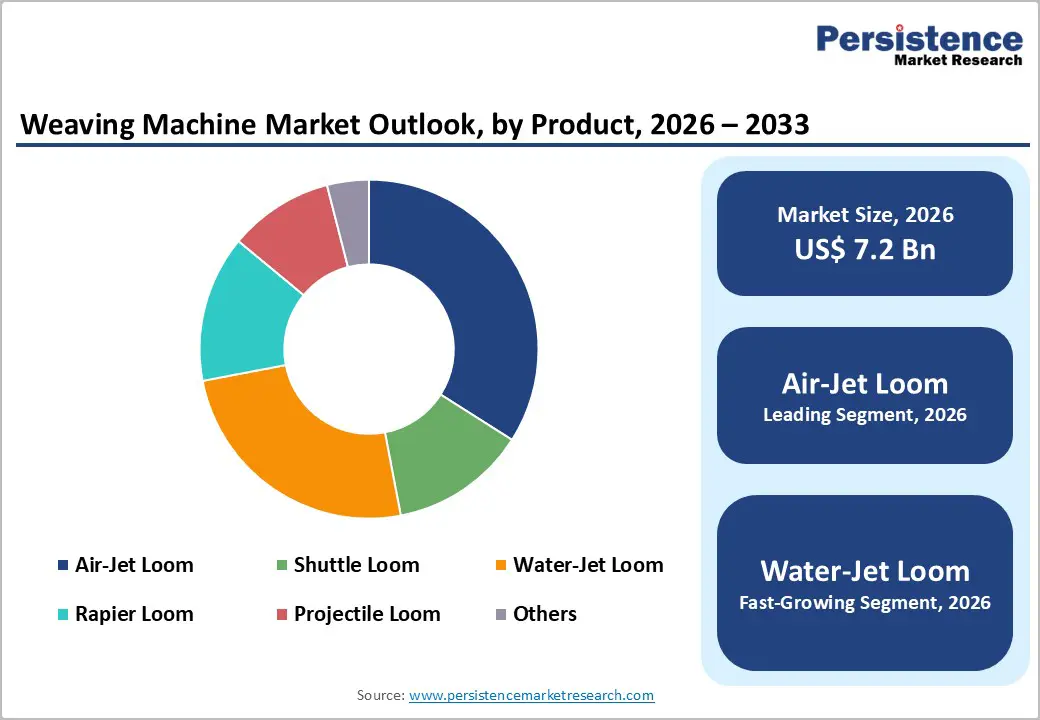
- Leading Machine Type: Air-jet looms are projected to represent the leading machine type in 2026, accounting for 39% of the revenue share, driven by their high-speed and efficient fabric production capabilities.
- Leading Application: The apparel & fashion segment is anticipated to be the leading application, accounting for over 48% of the revenue share in 2026, supported by rising garment production and fashion demand.
- Key Opportunity: The growing shift toward automated, sustainable, and high-performance textile manufacturing is creating significant opportunities for advanced weaving machines in technical textiles, smart factories, and eco-friendly fabric production worldwide.
DRO Analysis
Driver - Rising Demand for Technical and Industrial Textiles
The weaving machine market is experiencing strong growth driven by increasing demand for technical and industrial textiles across the automotive, healthcare, aerospace, filtration, and construction industries. According to the International Textile Manufacturers Federation (ITMF), global shipments of shuttleless looms increased significantly in 2025, reflecting rising investments in advanced weaving technologies for high-performance fabrics.
Demand for lightweight and durable textiles used in electric vehicles, protective clothing, and industrial filtration systems is accelerating the adoption of air-jet and rapier weaving machines worldwide. The technical textile sector is expanding rapidly as manufacturers focus on sustainable, heat-resistant, and performance-oriented fabric solutions for industrial applications.
ITMF reported that Asia & Oceania accounted for nearly 97% of global loom deliveries in 2025, highlighting the region’s strong investment in automated weaving infrastructure. Increasing production of geotextiles, medical fabrics, filtration materials, and smart textiles is encouraging textile producers to replace traditional shuttle looms with energy-efficient shuttle-less systems.
Restraint - Skilled Labor Shortage and Technological Complexity
Modern weaving machines require technical expertise in software programming, machine calibration, predictive maintenance, and computerized process control, creating operational difficulties for small and medium textile manufacturers. Many developing textile-producing regions continue to experience limited access to workforce training and technical education, slowing modernization efforts.
The technological complexity of smart weaving machinery also impedes broader market adoption, particularly among cost-sensitive textile manufacturers. Integration of IoT-enabled controls, automated defect-detection systems, and digital monitoring platforms requires substantial investment in infrastructure, software interoperability, and workforce training programs. Smaller textile companies often struggle to manage sophisticated equipment and maintain consistent operational performance.
Opportunity - Smart and Automated Textile Manufacturing Integration
Textile manufacturers are increasingly investing in automated weaving systems integrated with IoT sensors, AI-based quality monitoring, predictive maintenance, and real-time production analytics to improve operational efficiency and reduce downtime. Advanced digital weaving technologies help manufacturers achieve higher fabric precision, lower defect rates, and optimized energy utilization, making them highly attractive for large-scale textile production facilities.
Increasing labor costs and workforce shortages in major textile-producing countries are accelerating demand for automated weaving solutions capable of supporting continuous and high-speed production environments.
Rising investments in smart textile factories across China and India are creating long-term growth prospects for weaving machine manufacturers offering digitally connected and energy-efficient systems. Textile producers are modernizing existing production lines with automated controls, robotic material handling, and cloud-based monitoring platforms to strengthen productivity and sustainability performance.
Category-wise Analysis
Machine Type Insights
Air-jet looms are expected to lead the weaving machine market, accounting for approximately 39% of revenue in 2026, driven by their superior production speed, operational efficiency, and suitability for large-scale apparel fabric manufacturing. These machines are widely utilized for weaving polyester, nylon, blended fabrics, and lightweight industrial textiles because they deliver high productivity with lower maintenance requirements compared to conventional shuttle systems. A notable example is Toyota Industries, which offers advanced air-jet weaving machines designed for energy efficiency, automated monitoring, and high-speed textile production.
Water-jet looms are likely to be the fastest-growing segment, supported by rising synthetic fiber production and demand for lightweight textile materials. These machines are highly efficient for weaving filament yarns such as polyester and nylon, making them particularly suitable for sportswear, lining fabrics, industrial textiles, and technical applications. For example, Tsudakoma Corp., which provides technologically advanced water-jet weaving machines featuring automated controls, low-energy consumption systems, and optimized weaving performance for synthetic textile production.
Application Insights
The apparel and fashion segment is projected to lead the market, capturing around 48% of the revenue share in 2026, supported by rising clothing demand, fast-fashion trends, and expanding textile exports from Asia Pacific manufacturing economies. Textile manufacturers are increasingly investing in high-speed weaving technologies that enable the production of large volumes of fabric with superior consistency, design flexibility, and production efficiency. A significant example is Picanol, which supplies advanced weaving machines extensively used in high-speed apparel textile manufacturing.
Technical and filtration textiles are likely to be the fastest-growing application, driven by increasing demand from automotive, aerospace, healthcare, construction, and industrial filtration industries. Manufacturers are rapidly adopting advanced weaving technologies to produce durable, lightweight, heat-resistant, and high-performance fabrics required for specialized industrial applications. For instance, Staubli Group provides advanced weaving preparation and automation solutions, supporting high-performance technical textile manufacturing across filtration and aerospace.
Regional Insights
North America Weaving Machine Market Trends
North America is likely to be the fastest-growing region, driven by rising investments in advanced textile manufacturing, reshoring initiatives, and increasing demand for technical textiles across automotive, aerospace, healthcare, and defense sectors. A notable example includes Itema S.p.A., which provides advanced rapier weaving technologies and automated textile manufacturing solutions supporting high-performance fabric production.
U.S. Weaving Machine Market Trends
The U.S. dominates the regional market, driven by strong demand for technical textiles and advanced manufacturing technologies. Textile manufacturers are increasingly investing in automated weaving systems to improve efficiency and reduce labor dependency. Growth in electric vehicles, aerospace production, and industrial filtration applications is driving demand for engineered fabrics and advanced weaving equipment.
Canada Weaving Machine Market Trends
Canada is a significant market for weaving machines, supported by increasing demand for industrial and technical textiles across healthcare, construction, and automotive sectors. Textile manufacturers are investing in energy-efficient and automated weaving machinery to improve productivity and reduce operational waste. Sustainability initiatives and environmental regulations are encouraging the modernization of textile production facilities throughout the country.
Europe Weaving Machine Market Trends
Europe is likely to be a significant market for weaving machines, due to sustainability regulations, smart manufacturing adoption, and strong demand for premium textile production systems. Automation, robotics, and real-time production monitoring are becoming standard across textile manufacturing facilities. For example, Dornier GmbH, which provides advanced rapier and air-jet weaving technologies supporting high-performance textile manufacturing.
U.K. Weaving Machine Market Trends
The U.K. is a significant market for weaving machines, supported by demand for technical textiles, medical fabrics, and sustainable textile production technologies. Textile manufacturers are modernizing facilities with automated weaving systems to improve efficiency and reduce production costs. Increasing interest in smart textiles and performance fabrics is driving investments in advanced weaving technologies nationwide.
Germany Weaving Machine Market Trends
Germany dominates the regional market, driven by strong engineering capabilities and high adoption of automated textile production systems. German textile manufacturers are increasingly investing in energy-efficient weaving machines and smart factory technologies to improve sustainability and production accuracy. Demand for technical textiles used in automotive, aerospace, filtration, and industrial applications continues to drive market growth.
Asia Pacific Weaving Machine Market Trends
The Asia Pacific region is anticipated to be the leading region, accounting for 50% market share in 2026, driven by large-scale textile manufacturing, rising apparel exports, rapid industrialization, and the increasing adoption of automated weaving technologies. For example, Tsudakoma Corp., which supplies technologically advanced weaving machines supporting high-speed textile production, synthetic fabric manufacturing, and automated weaving operations.
China Weaving Machine Market Trends
China dominates the regional market, driven by its massive textile manufacturing base and strong export-oriented apparel industry. Textile producers are rapidly adopting automated weaving technologies to improve production speed and reduce labor dependency. The country is investing heavily in smart textile factories and digitally connected manufacturing systems.
India Weaving Machine Market Trends
India is a significant market for weaving machines, supported by expanding textile exports, rising domestic apparel demand, and strong government support for textile modernization. Initiatives such as the production-linked incentive scheme and technical textile promotion programs are encouraging investments in advanced weaving technologies. Textile manufacturers are increasingly upgrading from conventional looms to automated shuttle-less systems to improve productivity and export competitiveness.
Competitive Landscape
The global weaving machine market exhibits a moderately fragmented structure, driven by rapid technological advancements, increasing automation adoption, and rising demand for high-performance textile manufacturing systems across apparel, industrial, and technical textile sectors. The market is characterized by the presence of established international manufacturers alongside regional suppliers competing through product innovation, energy efficiency, digital integration, and after-sales service capabilities.
With key leaders including Picanol, Itema S.p.A., Toyota Industries, Dornier GmbH, Tsudakoma Corp., and Staubli Group, competition remains focused on technological differentiation and operational efficiency. These players compete through advanced automation technologies, IoT-enabled weaving solutions, sustainable machine designs, strategic acquisitions, regional expansion, and enhanced digital service platforms.
Key Industry Developments:
- In April 2026, Zhejiang Wanli Textile Machinery launched the WL680 Series Ultra-Start Rapier Weaving Machine, featuring intelligent automation, variable-speed weaving control, energy-efficient drive systems, and high-speed production capabilities for apparel, industrial, and technical textile applications.
- In October 2025, Staubli launched the SAFIR PRO S37 automatic drawing-in machine at ITMA Asia Singapore 2025, introducing advanced high-speed weaving automation solutions for filament yarns, technical textiles, and energy-efficient fabric production across Southeast Asia.
Companies Covered in Weaving Machine Market
- Picanol
- Itema S.p.A.
- Toyota Industries
- Dornier GmbH
- Tsudakoma Corp.
- Staubli Group
- SMIT Textile Machinery
- Van de Wiele
- Bonas
- Rieter
- Trützschler
- Oerlikon
- J P Extrusiontech
- Jingwei
Frequently Asked Questions
The global weaving machine market is projected to reach US$7.2 billion in 2026.
The weaving machine market is driven by rising demand for automated, high-speed, and energy-efficient textile manufacturing systems across apparel, technical textile, automotive, and industrial fabric industries.
The weaving machine market is expected to grow at a CAGR of 5.1% from 2026 to 2033.
Key market opportunities in the weaving machine market lie in smart textile manufacturing, sustainable weaving technologies, and growing demand for technical and recycled textile production.
Picanol, Itema S.p.A, Toyota Industries, Dornier GmbH, Tsudakoma Corp., and Staubli Group are the leading players.


