




- Automotive
- Roll Trailer Market
Roll Trailer Market Size, Share, and Growth Forecast, 2026 - 2033
Roll Trailer Market by Load Capacity (Below 30 Tons, 30-50 Tons, 50-100 Tons, And Above 100 Tons), Attachment (Fixed Gooseneck, Detachable Gooseneck), and Regional Analysis for 2026 - 2033

Roll Trailer Market Size and Trends Analysis
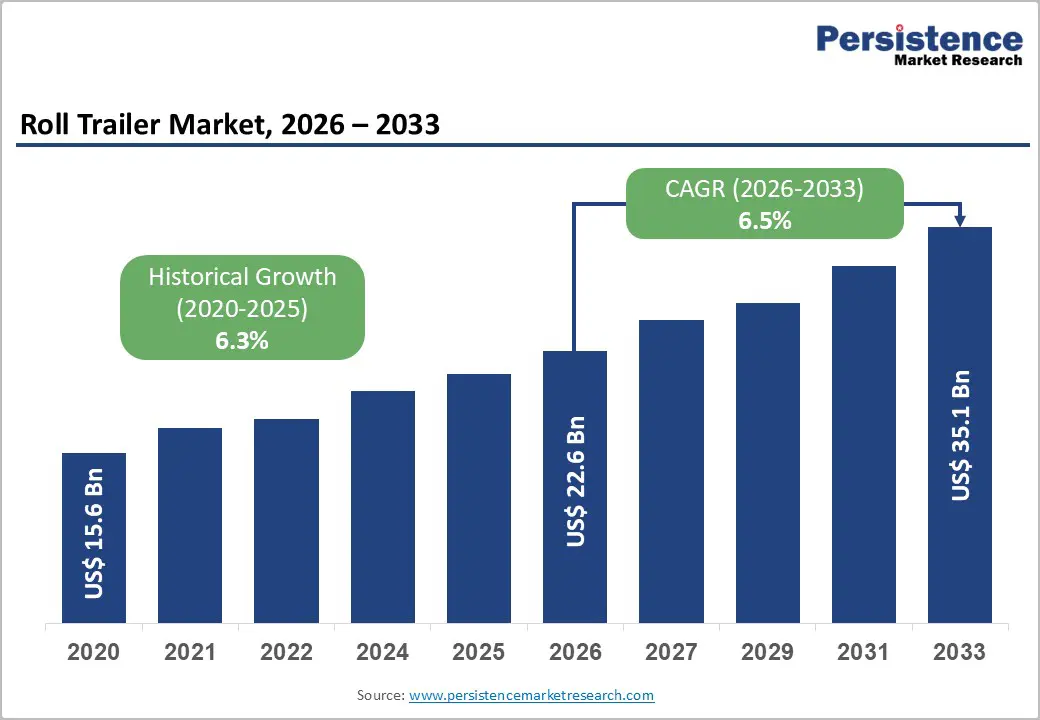
The global roll trailer market size is likely to be valued at US$22.6 billion in 2026 and is expected to reach US$35.1 billion by 2033, growing at a CAGR of 6.5% during the forecast period from 2026 to 2033, driven by the rapid expansion of offshore wind energy installations, surging cross-border heavy equipment trade enabled by infrastructure investment programs, and fleet modernization across major port operators.
Rising port automation and increasing heavy cargo handling requirements across maritime logistics networks are further supporting market growth. Infrastructure modernization programs and growth in offshore energy logistics are accelerating adoption. Regulatory emphasis on safe, efficient intermodal transport is strengthening market growth.
Key Industry Highlights:
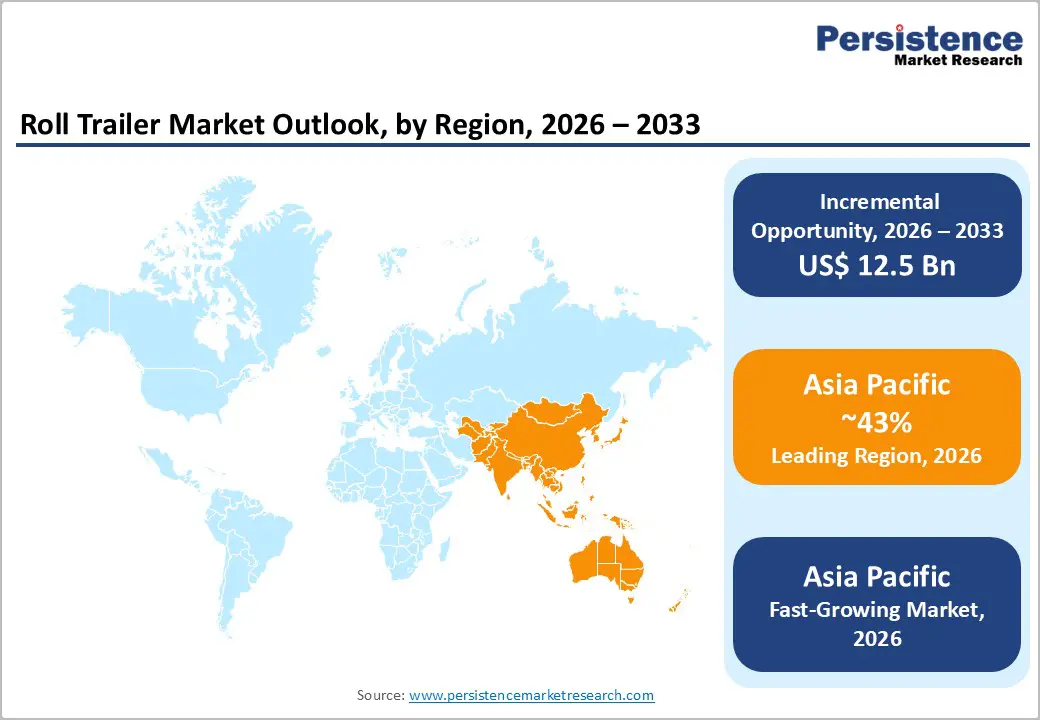
- Leading Region: Asia Pacific is anticipated to be the leading region, accounting for a market share of 43% in 2026, driven by large-scale manufacturing hubs, expanding port infrastructure, and strong export-oriented trade activities.
- Fastest-growing Region: Asia Pacific is likely to be the fastest-growing region, supported by rapid industrialization, urbanization, and major infrastructure investments across countries.
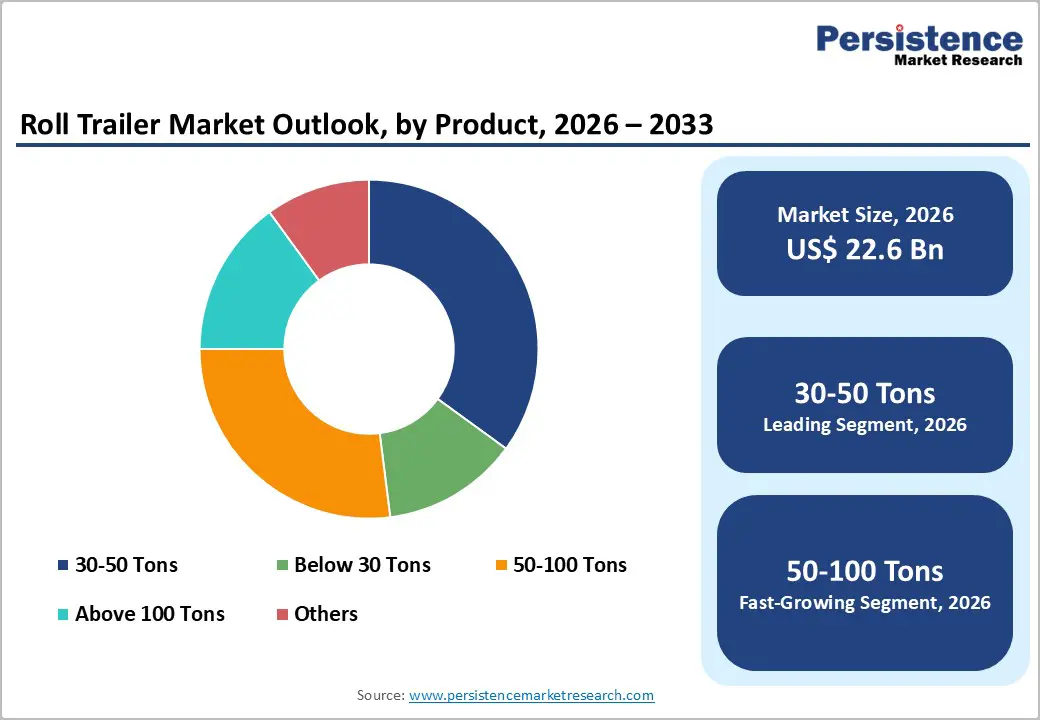
- Leading Load Capacity: 30-50 tons are projected to represent the leading load capacity in 2026, accounting for 38% of the revenue share, driven by its widespread use in standard port operations and light industrial cargo handling.
- Leading Attachment: Fixed gooseneck is anticipated to be the leading attachment, accounting for over 40% of the revenue share in 2026, supported by its operational stability and suitability for dedicated logistics applications.
- Key Opportunity: The key market opportunity lies in the growing shift toward automated, high-capacity, and smart port logistics systems supported by rising offshore energy projects, infrastructure expansion, and increasing demand for efficient heavy and oversized cargo transportation across international trade networks.

DRO Analysis
Driver - Expansion of Offshore Renewable Energy Infrastructure
The expansion of offshore renewable energy infrastructure is a major driver for the roll trailer market, as wind farm installations require efficient transport of heavy and oversized components such as turbine blades, nacelles, and tower sections. Ports are increasingly upgrading RoRo (Roll-on/Roll-off) systems and heavy-duty handling equipment to support offshore project logistics.
Growing investments in offshore wind projects across Europe, Asia Pacific, and North America are increasing demand for specialized roll trailers. Increased collaboration between port operators and energy developers is improving cargo handling efficiency, reducing turnaround time, and strengthening the adoption of high-capacity roll trailer solutions in complex offshore supply chains.
Ports are adopting advanced RoRo terminals and mechanized cargo handling systems to improve efficiency in moving heavy and oversized freight. Growth in trade volumes and increasing deployment of large cargo vessels are enhancing demand for robust transport solutions such as roll trailers.
Restraint - Skilled Operator Shortage for Heavy-Duty RoRo Equipment
Operating advanced roll trailers demands specialized training, technical expertise, and practical experience in port logistics and heavy cargo handling. Many emerging economies face a shortage of skilled personnel, which restricts the efficient use of modern handling equipment. According to engineering standards such as ISO 3834, the complex nature of roll trailer operations, particularly for multi-axle configurations exceeding 100 tons, requires certified heavy transport operators, whose availability remains limited globally.
To address the skilled operator shortage, companies often need to invest heavily in training programs and certification systems, which increases operational costs for port and logistics operators. The lack of standardized training frameworks for heavy-duty RoRo equipment complicates workforce development across regions.
Opportunity - Digitalization and IoT-Enabled Smart Trailer Solutions
The integration of sensors, GPS tracking, and real-time monitoring systems allows operators to optimize load management, improve safety, and reduce downtime in port and terminal activities. Smart roll trailers enable predictive maintenance, reducing unexpected equipment failures and extending asset life cycles.
According to McKinsey & Company (2024), digitally enabled port operations reduce cargo handling cycle times by up to 25% and improve asset utilization by 15-20%. Demand for automated and connected port infrastructure is encouraging investments in intelligent roll trailer systems across global supply chains.
The growing adoption of digital technologies in maritime logistics is supporting the shift toward smart cargo handling solutions. Ports and terminal operators are increasingly focusing on IoT-enabled equipment to enhance real-time decision-making and operational transparency. Advanced roll trailers integrated with smart monitoring systems help reduce fuel usage, improve load safety, and optimize fleet performance.
Category-wise Analysis
Load Capacity Insights
30-50 tons are expected to lead the roll trailer market, accounting for approximately 38% of revenue in 2026, driven by its widely used mid-capacity range for port and industrial logistics operations, balancing payload efficiency with operational flexibility. It is commonly deployed for handling medium-weight cargo such as construction materials, machinery components, and packaged industrial goods that require stable and frequent movement within terminals. For example, mid-range RoRo and terminal handling equipment in major ports like the Port of Antwerp-Bruges is broadly used for general cargo and equipment movement within terminal areas.
50-100 tons are likely to represent the fastest-growing segment, supported by rising demand for heavy project cargo, wind turbine components, and large industrial equipment transportation. Expansion of offshore energy projects and large-scale infrastructure development is significantly increasing the adoption of high-capacity roll trailers. For instance, modern RoRo and heavy-lift terminal operations in major industrial ports such as the Port of Rotterdam and Port of Antwerp-Bruges commonly handle large industrial and project cargo using high-capacity transport systems.
Attachment Insights
Fixed gooseneck is projected to lead the market, capturing around 40% of the revenue share in 2026, supported by its structural stability, lower maintenance requirements, and suitability for dedicated and repetitive port operations. It is widely preferred in controlled logistics environments where consistent cargo types are handled. A notable example includes busy terminals in Japan that utilize fixed gooseneck roll trailers for regular RoRo cargo movement, as they provide reliable performance and simplified operational handling in high-frequency shipping activities, ensuring efficiency in standardized port workflows.
Detachable gooseneck is likely to be the fastest-growing attachment, driven by its flexibility, modular design, and ability to support multiple cargo types and operational scenarios. It allows easier coupling and decoupling, making it ideal for dynamic logistics environments and multimodal transport systems. For instance, European logistics providers increasingly deploy detachable gooseneck roll trailers for handling mixed cargo such as heavy machinery and oversized construction modules, as they improve operational adaptability and reduce equipment idle time, driving strong adoption across modernized port and transport networks.
Regional Insights
North America Roll Trailer Market Trends
North America is likely to be a significant market for roll trailers in 2026, driven by strong port modernization, rising offshore energy logistics, and increasing heavy cargo movement across major maritime hubs. Growth is supported by automation in terminal operations, expansion of RoRo infrastructure, and rising demand for efficient intermodal transport systems. For example, Triton International Limited plays a key role in providing intermodal and marine equipment leasing solutions that support container and heavy cargo logistics across North American ports.
U.S. Roll Trailer Market Trends
The U.S. dominates the regional market, driven by the expansion of offshore wind logistics on the East Coast, which is increasing demand for heavy cargo handling systems. Recent federal investments in port infrastructure modernization under clean energy and supply chain resilience programs are supporting growth. Rising container traffic and industrial shipments are increasing RoRo equipment utilization.
Canada Roll Trailer Market Trends
Canada is a significant market for roll trailers, supported by its rising Asia Pacific trade routes and increasing export of natural resources and industrial goods. Government investments in trade corridor development and port expansion projects are strengthening logistics capacity. Recent developments in green port initiatives are encouraging the adoption of efficient cargo handling systems.
Europe Roll Trailer Market Trends
Europe is likely to be a significant market for roll trailers, due to strong maritime trade, advanced port infrastructure, and increasing offshore wind energy projects. The region is highly focused on sustainability, digitalization, and automation in port operations, improving efficiency in heavy cargo handling. Growth is also driven by strong shipbuilding and industrial export activities. A notable example is MAFI Transport-Systeme GmbH, a leading European manufacturer of terminal tractors and heavy-duty transport systems widely used in RoRo and port logistics operations.
U.K. Roll Trailer Market Trends
The U.K. is a significant market for roll trailers, driven by increasing offshore wind projects in the North Sea and rising container trade activity. Recent investments in port modernization and digital logistics systems are enhancing cargo handling efficiency. Expansion of renewable energy infrastructure is increasing the demand for heavy-duty transport equipment.
Germany Roll Trailer Market Trends
Germany dominates the regional market, driven by major ports such as Hamburg, Bremerhaven, and Wilhelmshaven. Growth is supported by strong automotive exports, industrial machinery movement, and offshore wind logistics. Recent developments include the expansion of green hydrogen and offshore energy infrastructure, increasing demand for heavy cargo handling equipment. Automation in German ports is improving efficiency and reducing turnaround time.
Asia Pacific Roll Trailer Market Trends
The Asia Pacific region is anticipated to be the leading region, accounting for a market share of 43% in 2026, driven by strong manufacturing hubs, expanding port infrastructure, and high export volumes. The region benefits from rapid industrialization, infrastructure development, and increasing adoption of smart port technologies. For instance, Qingdao CIMC Special Vehicles Co. Ltd. is a major Chinese manufacturer supplying specialized port trailers and heavy transport equipment, widely used in Asian logistics and port operations.
China Roll Trailer Market Trends
China dominates the regional market, driven by strong export manufacturing, Belt and Road Initiative projects, and increasing port automation. Recent investments in smart port infrastructure and green logistics are enhancing efficiency. Expansion of offshore wind and industrial projects is increasing demand for heavy-duty roll trailers.
India Roll Trailer Market Trends
India is a significant market for roll trailers, supported by port modernization initiatives under the Sagarmala program and increasing container trade. Major ports such as Mundra, Nhava Sheva, and Chennai are witnessing capacity expansion and automation upgrades. Growth is supported by rising industrialization, infrastructure development, and renewable energy projects. The recent government focus on improving logistics efficiency and reducing cargo handling time is increasing demand.
Competitive Landscape
The global roll trailer market exhibits a moderately fragmented structure, driven by the presence of OEMs, regional manufacturers, and specialized port equipment providers competing on durability, payload capacity, and digital integration. Market competition is shaped by rising demand for heavy cargo handling solutions in ports, offshore logistics, and industrial transport applications, along with increasing focus on automation and lifecycle efficiency.
With key leaders including MAFI Transport-Systeme GmbH, Schmitz Cargobull AG, CIMC Special Vehicles, Triton International Limited, Novatech, Seacom Trailer Systems, Buiscar Cargo Solutions, and Ace Brothers Equipment, the market shows strong participation across Europe, Asia Pacific, and North America. These players compete through product innovation, strategic partnerships with port operators, expansion of manufacturing capacities, and integration of IoT-enabled fleet monitoring solutions.
Key Industry Developments:
- In February 2026, Schmitz Cargobull expanded its product portfolio by launching the S.BO MULTI dry freight semi-trailer, designed for flexible cargo handling and improved load efficiency across logistics and port operations, strengthening its position in the European heavy transport and trailer market.
- In March 2026, Utility Trailer Manufacturing Company, in collaboration with Schmitz Cargobull, introduced next-generation hybrid transport refrigeration technology, highlighting the growing integration of advanced, energy-efficient systems in trailer and logistics solutions, particularly targeting North American fleet modernization and sustainability goals.
- In April 2025, Triton International announced a strategic long-term partnership with Sumitomo Mitsui Finance and Leasing Company (SMFL), under which SMFL acquired a minority stake in Triton’s container leasing portfolio and secured the option to invest in additional assets in the future, strengthening collaboration in the container leasing and intermodal logistics sector.
Companies Covered in Roll Trailer Market
- Triton International Limited
- Novatech
- Seacom Trailer Systems GmbH
- MAFI Transport-Systeme GmbH
- Ace Brothers Equipment
- Qingdao CIMC Special Vehicles Co., Ltd.
- Qingdao Phillaya International Trading Co., Ltd.
- Buiscar Cargo Solutions BV
- Schmitz Cargobull
Frequently Asked Questions
The global roll trailer market is projected to reach US$22.6 billion in 2026.
The roll trailer market is driven by increasing demand for efficient heavy cargo handling in ports, offshore energy projects, and expanding trade and industrial logistics.
The roll trailer market is expected to grow at a CAGR of 6.5% from 2026 to 2033.
Key opportunities in the roll trailer market include rising adoption of smart port automation, growth in offshore renewable energy logistics, and increasing demand for high-capacity modular heavy cargo transport solutions.
Triton International Limited, Novatech, Seacom Trailer Systems GmbH, and Ace Brothers Equipment are the leading players.


