




- Processed Food
- Liquid Breakfast Market
Liquid Breakfast Market Size, Share, and Growth Forecast, 2026 - 2033
Liquid Breakfast Market by Product Type (Smoothies, Protein Shakes, Meal Replacement Drinks), Application (Health & Wellness, Convenience Foods), End-user (Retail, Food Service), and Regional Analysis for 2026 - 2033

Liquid Breakfast Market Size and Trends Analysis
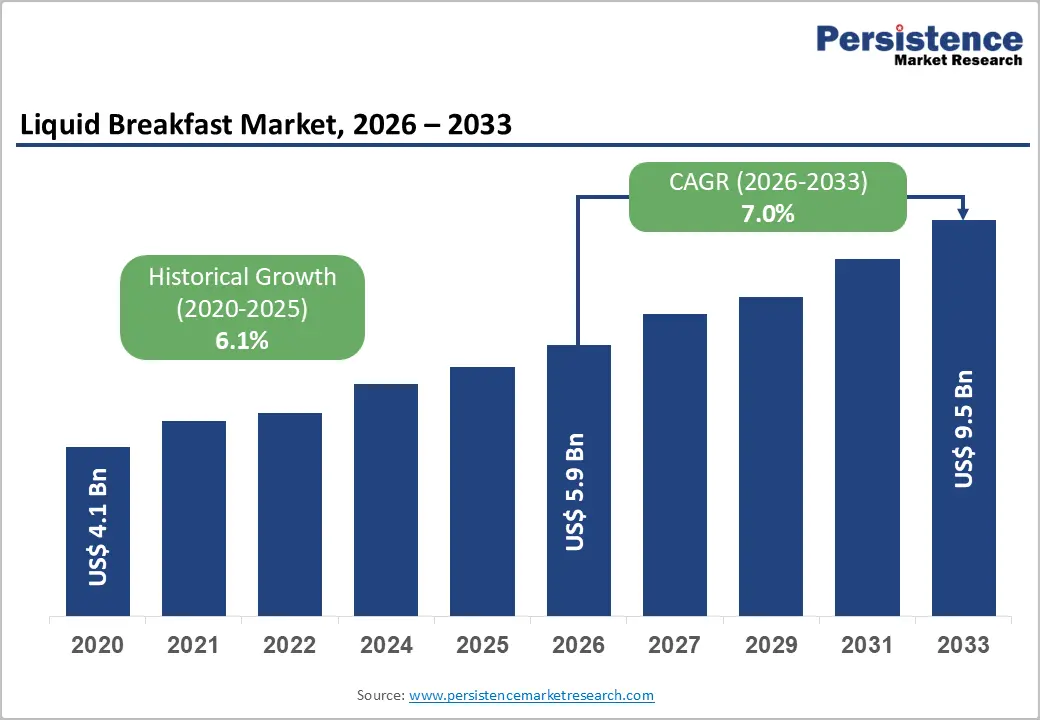
The global liquid breakfast market size is likely to be valued at US$5.9 billion in 2026, and is expected to reach US$9.5 billion by 2033, growing at a CAGR of 7.0% during the forecast period from 2026 to 2033, driven by increasing consumer preference for convenient and nutritious meal options.
Liquid breakfast products, such as ready-to-drink smoothies, protein shakes, and meal replacement beverages, provide balanced nutrition, including vitamins, protein, and fiber, in portable formats. The rising demand for on-the-go, health-oriented food solutions continues to support strong market expansion.
Key Industry Highlights
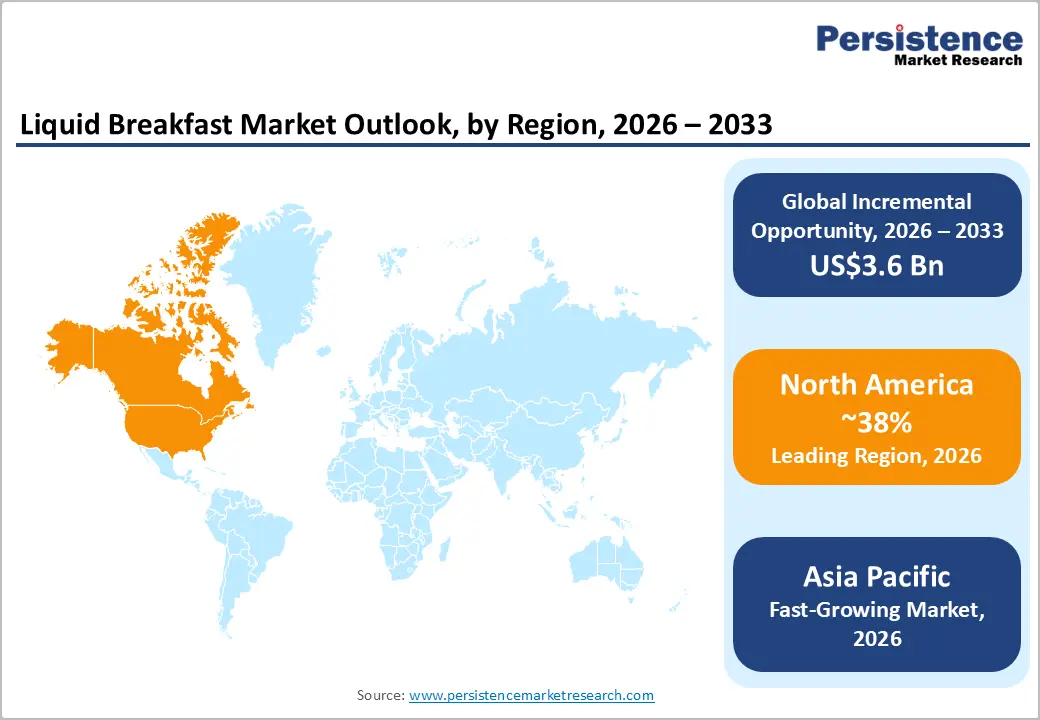
- Dominant Region: North America is projected to dominate with 38% revenue share in 2026, supported by busy lifestyles and strong demand for convenient nutrition.
- Fastest-growing Region: Asia Pacific is the fastest-growing region with a projected CAGR of 8.2% (2026 - 2033), driven by urbanization and rising health awareness in China and India.
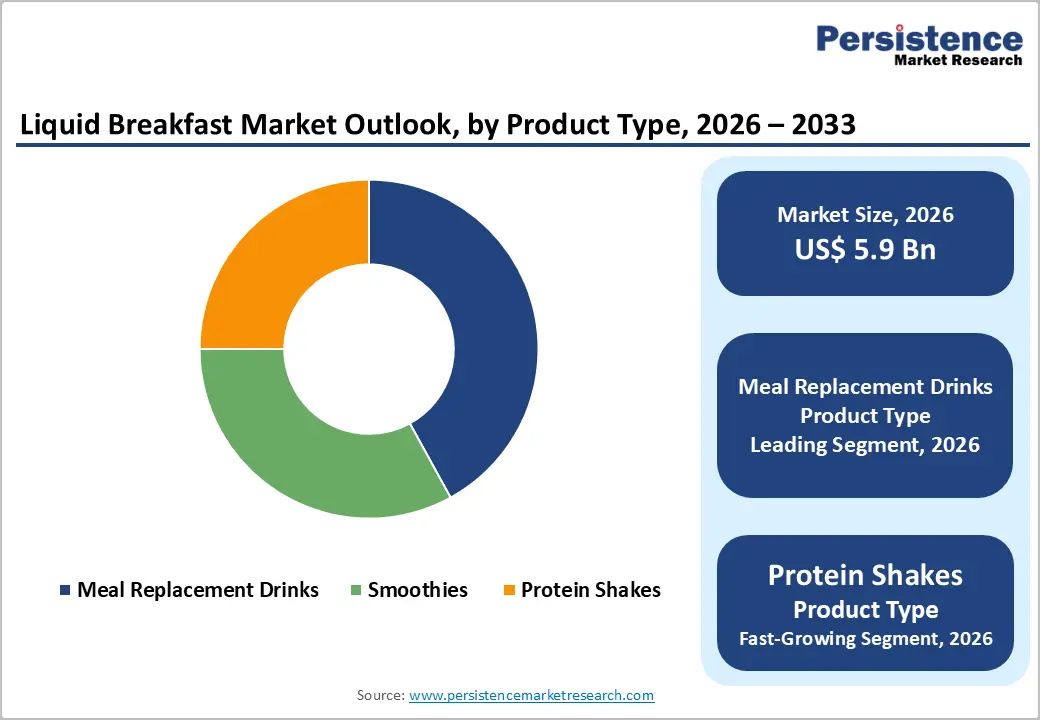
- Dominant Product Type: Meal replacement drinks are expected to dominate with 42% share in 2026 due to high protein demand among fitness enthusiasts.
- Leading Application: The health & wellness segment is projected to lead the application segment with the 60% share, owing to a focus on nutritional benefits.

DRO Analysis
Driver - Expanding Health, Wellness, and Weight Management Consumer Awareness Driving Functional Nutrition Premiumization
The global health and wellness movement represents the second major structural growth driver for the liquid breakfast market, as consumers increasingly evaluate breakfast choices through nutritional lenses, prioritizing protein content, micronutrient completeness, glycemic index management, and caloric precision over taste convenience alone. The World Health Organization (WHO) estimates that globally, over 1.9 billion adults are overweight and 650 million are clinically obese, with weight management motivation driving significant consumer spending on structured meal replacement and controlled-calorie breakfast solutions.
Liquid breakfast products, particularly clinically formulated meal replacement drinks and high-protein shakes, directly address weight management consumption occasions by offering portion-controlled, protein-rich, fiber-supplemented nutrition profiles that support satiety, metabolic health, and dietary compliance. The clinical nutrition segment within liquid breakfast, anchored by brands including Abbott's Ensure, Nestlé's Boost, and Danone's Fortimel, has experienced consistent growth, driven by the expanding aging global population with elevated protein requirements, oncology patient support nutrition, and post-surgical recovery nutrition protocols.
Restraint - Taste, Texture, and Satiety Perception Gaps Limiting Repeat Purchase and Category Retention
Despite significant formulation advances, taste and texture satisfaction gaps remain a persistent challenge for the liquid breakfast category, particularly in the meal replacement drink segment, where engineering complete nutritional profiles within palatable sensory parameters represents an ongoing technical challenge. Taste is the primary purchase driver for food and beverage products, strongly influencing trial and repeat buying. Many liquid breakfast users do not repurchase due to poor flavor intensity, protein aftertaste (especially from soy and pea), chalky texture, and low satiety compared to solid options.
The satiety perception gap, where consumers acknowledge the nutritional completeness of liquid breakfast products but do not feel as full or satisfied as after consuming a conventional breakfast, represents a specific barrier to establishing liquid breakfast as a primary daily meal occasion rather than an occasional convenience solution.
Opportunity - Personalized Nutrition Technology and Subscription Commerce Enabling High-Value Consumer Relationships
The convergence of personalized nutrition technology with direct-to-consumer subscription commerce models represents a high-value emerging opportunity for liquid breakfast market participants. Advances in consumer-facing nutrition assessment tools, including smartphone-based dietary tracking, DNA-based nutritional profiling, microbiome analysis, and wearable metabolic monitoring, are creating the technological infrastructure for genuinely personalized liquid breakfast formulations tailored to individual macronutrient requirements, food sensitivities, fitness goals, and health biomarkers.
DTC subscription platforms operated by brands including Huel, Soylent, and emerging personalized nutrition startups are demonstrating that subscription commerce models generate significantly higher customer lifetime values than single-transaction retail, with recurring delivery subscriptions reducing churn, increasing purchase frequency, and enabling data-driven formulation refinement based on consumer feedback.
Category-wise Analysis
Product Type Insights
Meal replacement drinks are expected to dominate the product type segment, accounting for around 42% of the liquid breakfast market revenue in 2026. This leadership is driven by their positioning as the most nutritionally comprehensive and functionally advanced option within the category, offering complete macro- and micronutrient profiles comparable to a balanced breakfast in a single, convenient serving. Products such as Abbott Laboratories’ Ensure COMPLETE illustrate this trend, delivering 350 calories, 30g of protein, and over 25 essential vitamins and minerals per serving, highlighting how these beverages are designed to provide balanced nutrition in a portable format.
Protein shakes are expected to be the fastest-growing product type, driven by the explosive growth of fitness culture, sports nutrition mainstreaming, and the broader consumer adoption of high-protein dietary strategies for body composition, metabolic health, and satiety management. Optimum Nutrition (Glanbia) offers ready-to-drink high-protein shakes formulated with fast-absorbing whey protein to support muscle recovery and active lifestyles, reflecting the mainstream adoption of sports nutrition products and high-protein dietary trends.
Application Insights
The health & wellness segment is the dominant application segment in the liquid breakfast market, accounting for approximately 60% of total revenue in 2026. This segment's commanding share reflects the fundamental consumer motivation architecture of the liquid breakfast category. The vast majority of liquid breakfast purchases are driven by health optimization goals, including weight management, fitness performance support, nutritional completeness assurance, and chronic disease risk management. Abbott Laboratories’ Ensure Complete Nutrition Shake delivers 30g of protein and 25 essential nutrients, supporting muscle, immune, bone, and heart health while addressing weight management and overall nutritional needs.
The convenience food segment represents the fastest-growing application segment, reflecting the accelerating adoption of liquid breakfast products by consumer cohorts whose primary purchase motivation is time efficiency and meal simplicity rather than explicit health optimization. Nestlé’s Carnation Breakfast Essentials provides ready-to-drink breakfast shakes designed for busy consumers, offering a quick, no-preparation meal solution that highlights the growing importance of convenience and time efficiency in liquid breakfast adoption.
End-user Insights
The retail segment is expected to dominate, capturing the 40% revenue share in 2026. The retail channel encompasses supermarkets and hypermarkets, health food and specialty nutrition retailers, pharmacy and drugstore chains, club stores, and e-commerce platforms, collectively representing the primary consumer access point for liquid breakfast products globally. Nestlé distributes Carnation Breakfast Essentials Ready-to-Drink shakes across supermarkets, pharmacies, and e-commerce platforms, with its grab-and-go positioning and wide retail availability underscoring the dominance of retail channels as the primary consumer access point for liquid breakfast products.
The food service segment is expected to represent the fastest-growing end-user channel in the liquid breakfast market, driven by the expansion of liquid breakfast product placements across corporate workplace nutrition programs, healthcare institutional catering, fitness center and gym refreshment services, quick-service restaurant breakfast menus, and airport and travel catering formats. Tropical Smoothie Cafe operates over 1,400 quick-service locations offering ready-to-consume smoothies and liquid breakfast options, illustrating how foodservice channels ranging from QSRs to workplace catering are increasingly integrating liquid breakfast formats to meet on-the-go consumption demand.
Regional Insights
North America Liquid Breakfast Market Trends
North America is projected to lead the liquid breakfast market, accounting for approximately 38% of total revenue in 2026 and growing at a CAGR of approximately 6.5% through 2033. The region's market leadership reflects its combination of high per-capita health and wellness spending, a deeply established functional nutrition culture, strong retail infrastructure across mass, specialty, and e-commerce channels, and a competitive brand landscape that includes the global headquarters of several of the category's most influential companies.
The U. S. is the dominant national market, driven by a large and economically active consumer base with high health consciousness, the world's most developed sports and fitness nutrition retail sector, and a clinical nutrition market anchored by Abbott and Nestlé's established medical nutrition brands.
Canada represents an important and consistently growing secondary market within the region, with a health-conscious consumer base, strong natural and organic food retail infrastructure, and a growing multicultural food culture that is receptive to diverse liquid breakfast formulations. Canadian market demand is particularly strong in British Columbia, Ontario, and Quebec, where urban lifestyle patterns and high health food retail density support above-average per-capita liquid breakfast consumption.
Europe Liquid Breakfast Market Trends
Europe is the second-largest regional market for liquid breakfast, projected to account for approximately 29% of global revenue in 2026 and growing at a CAGR of approximately 6.2% through 2033. The region benefits from a strong health and wellness consumer culture, sophisticated food labeling regulation that supports clean-label product development, a well-developed clinical nutrition market, and the global headquarters of Danone, one of the category's most significant competitors, alongside strong consumer acceptance of meal replacement and functional nutrition concepts in Northern and Western European markets.
Germany represents Europe's largest liquid breakfast market, driven by a consumer culture with strong health and fitness orientation, a large and well-funded private health insurance sector that supports clinical nutrition adoption, and premium retail infrastructure, including an exceptionally developed health food and organic product retail sector. The U.K. maintains a large and innovation-driven market, with London functioning as a key global launch market for premium liquid breakfast brands, including Huel, a British company that has achieved significant global scale from its U.K. origin base.
France benefits from Danone's domestic leadership position and a growing consumer openness to functional meal solutions despite historically strong traditional meal culture preferences. French CAGR is estimated at approximately 5.8% through 2033.
Asia Pacific Liquid Breakfast Market Trends
Asia Pacific is expected to be the fastest-growing regional market for liquid breakfast, projected to expand at a CAGR of approximately 8.5% through 2033 from an estimated 22% revenue share in 2026. The region's growth trajectory is driven by rapidly rising disposable incomes, urban lifestyle changes, increasing time pressure on morning routines, growing health and wellness consumer awareness, and the influence of global digital food culture through social media platforms, introducing international nutrition concepts to younger Asian consumers.
China represents the largest and fastest-growing national market in the region, with a CAGR estimated at approximately 9.0% through 2033. Rising urban middle-class health consciousness, the explosive growth of China's fitness and wellness industry, and the rapid expansion of premium health food e-commerce through platforms including Tmall, JD.com, and Douyin are driving strong liquid breakfast adoption.
India is an emerging high-growth market with a CAGR estimated above 9.5% through 2033, driven by a rapidly growing urban professional population, rising disposable incomes, and a large and health-motivated young adult demographic actively adopting international nutrition formats. The Indian liquid breakfast market is at an early stage of development but growing rapidly, with Nestlé's Milo, Herbalife's protein shakes, and emerging domestic brands competing for share in a consumer base that blends traditional dairy-based morning beverage habits with growing openness to engineered nutritional products.
Competitive Landscape
The global liquid breakfast market features a dual-tier competitive structure comprising large multinational food and beverage corporations with established mass-market brand portfolios and extensive distribution networks alongside a growing cohort of specialized, digitally native premium nutrition brands competing for share in high-value consumer segments. Nestlé S.A. and Abbott Laboratories anchor the clinical and mainstream functional nutrition tier, with Nestlé's Boost range and Abbott's Ensure franchise representing the world's most recognized and clinically established liquid meal replacement brands, generating significant volume across retail pharmacies, healthcare food service, and mainstream grocery channels globally.
The premium and digitally-led tier of the market is represented by Huel Ltd., Orgain, Inc., Soylent Nutrition, Inc., Garden of Life, LLC, and Herbalife Nutrition Ltd. Huel has achieved remarkable global scale from its direct-to-consumer subscription model, becoming one of the world's largest complete nutrition brands with a strong millennial consumer following built through digital marketing, sustainability positioning, and science-led formulation credibility.
Key Industry Developments:
- In November 2025, Abbott, the global healthcare company, announced the launch of a new and advanced formulation of Ensure Diabetes Care. Building on over 30 years of pioneering scientific nutrition and supported by more than 60 clinical trials, this innovation empowers people with diabetes to live a better life.
Companies Covered in Liquid Breakfast Market
- Nestlé S.A.
- The Coca-Cola Company
- PepsiCo, Inc.
- Danone S.A.
- Abbott Laboratories
- Herbalife Nutrition Ltd.
- Orgain, Inc.
- Huel Ltd.
- Soylent Nutrition, Inc.
- Garden of Life, LLC
Frequently Asked Questions
The global liquid breakfast market is projected to reach US$5.9 billion in 2026.
The liquid breakfast market is primarily driven by busy lifestyles, rising demand for protein-rich and functional beverages, and growing consumer focus on health and wellness.
The liquid breakfast market is poised to witness a CAGR of 7.0% from 2026 to 2033.
Key opportunities in the liquid breakfast market include innovation in clean-label and plant-based products, expansion in food service channels, and penetration into emerging markets with urbanizing populations.
Key players in the liquid breakfast market include Nestlé S.A., The Coca-Cola Company, PepsiCo, Inc., Danone S.A., Abbott Laboratories, Herbalife Nutrition Ltd., Orgain, Inc., Huel Ltd., Soylent Nutrition, Inc., and Garden of Life, LLC.


