




- Sporting Goods & Equipment
- Jigsaw Puzzles Market
Jigsaw Puzzles Market Size, Share, and Growth Forecast, 2026 – 2033
Jigsaw Puzzles Market by Material (Paperboard & Cardboard, Wood, Metal, Plastic, Others), Number of Pieces (500 Pieces or Less, 500-1000 Pieces, 1000-1500 Pieces, 1500-2000 Pieces, More than 2000 Pieces), End-User (Children, Adults), and Regional Analysis for 2026-2033

Jigsaw Puzzles Market Share and Trends Analysis
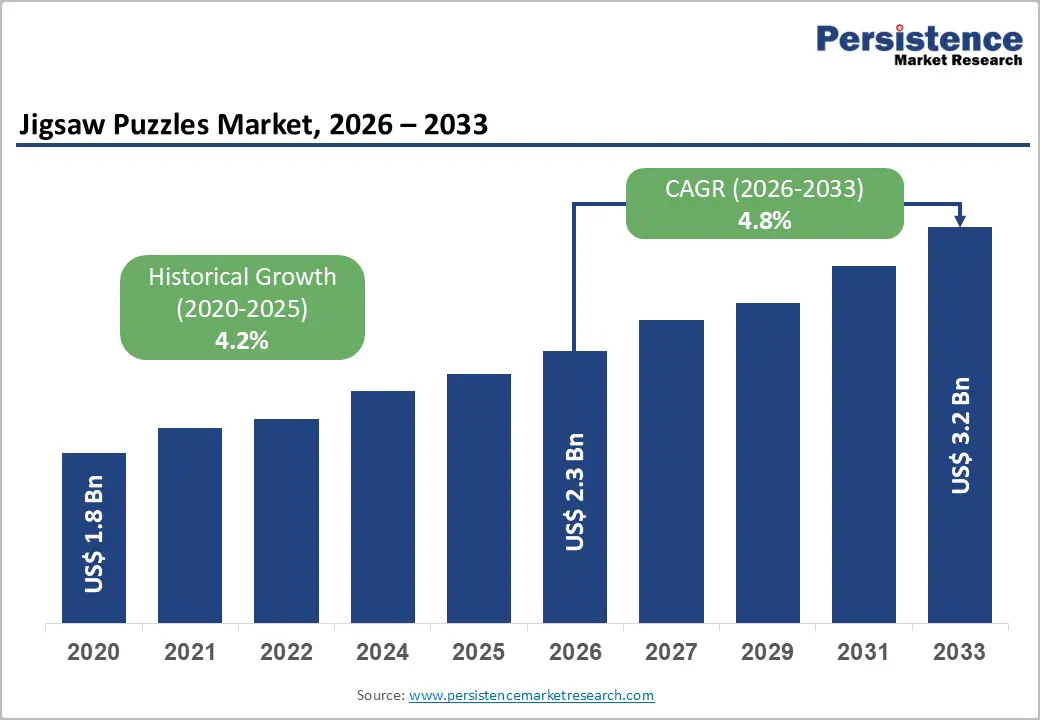
The global jigsaw puzzles market size is likely to be valued at US$ 2.3 billion in 2026, and is projected to reach US$ 3.2 billion by 2033, growing at a CAGR of 4.8% during the forecast period 2026−2033.
Market expansion is driven by increasing adult interest in cognitive stimulation activities, which fuels the adoption of recreational puzzles. Growth in children's educational products further contributes to demand through structured learning interventions. Technological integration in puzzle design and e-commerce distribution enhances accessibility, promoting broader market penetration. Awareness of mental wellness and cognitive development benefits reinforces adoption across diverse age groups. Rising disposable income and leisure time encourage investment in premium and diversified puzzle formats. Improvements in global distribution infrastructure support efficient supply-chain operations, enabling timely delivery and extending market reach. Digital platforms for community engagement and puzzle sharing create supplementary engagement channels, fostering repeat purchases and sustained market activity.
Key Industry Highlights
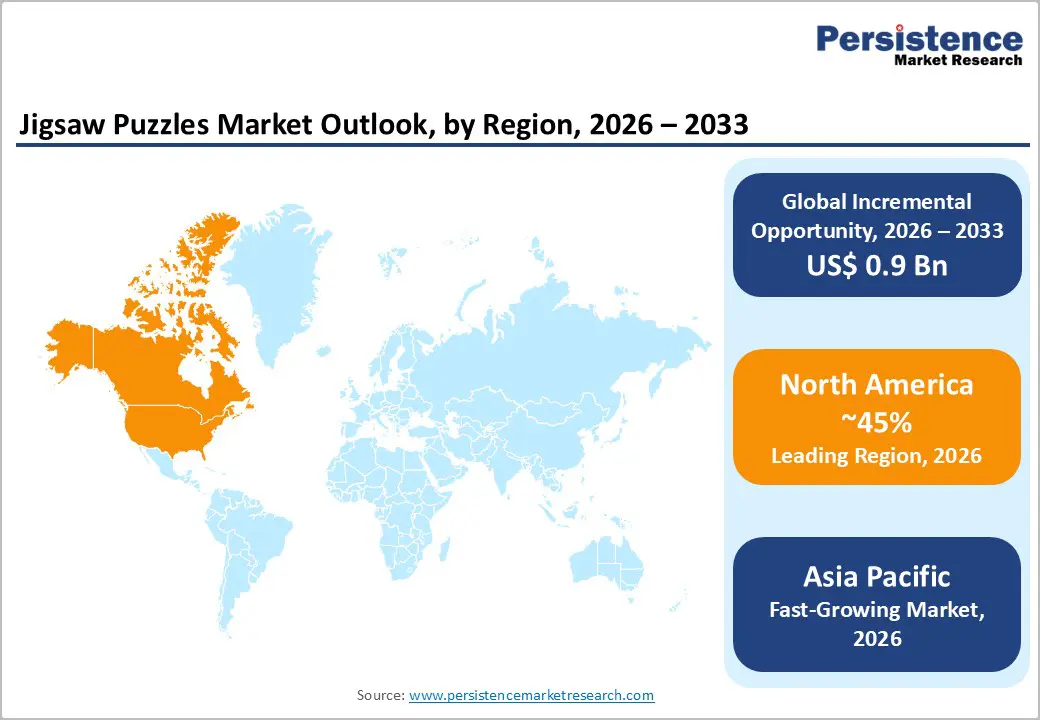
- Dominant Region: North America is expected to lead the jigsaw puzzles market in 2026 with 45% revenue share, driven by educational integration and advanced e-commerce distribution.
- Fastest-growing Regional Market: Asia Pacific is projected as the fastest-growing market from 2026 to 2033, supported by rising cognitive and recreational interest and e-commerce expansion.
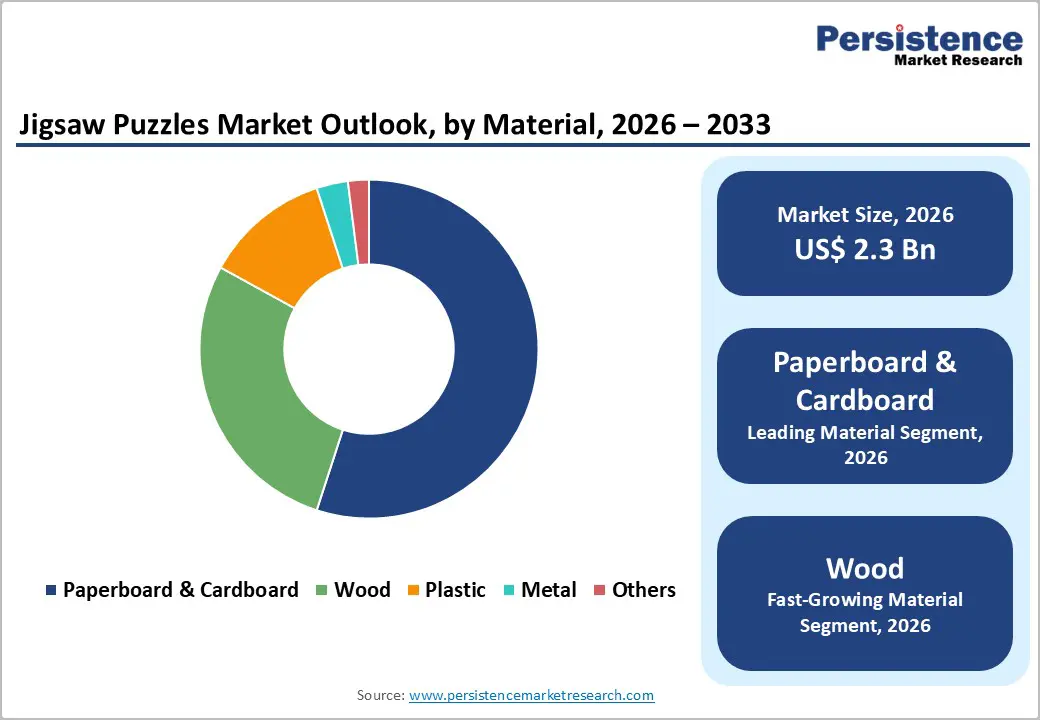
- Leading Material: Paperboard and cardboard are expected to lead with 55% revenue share in 2026, propelled by low-cost production, recyclability, safety, and visual appeal.
- Fastest-growing Material: Wood-based puzzles are projected as the fastest-growing segment from 2026 to 2033, stimulated by sustainability trends and premium consumer demand.
- March 2025: Buffalo Games acquired Boogie Board, the innovator of reusable writing and drawing tablets, leveraging patented liquid crystal technology for creative play and learning.
| Report Attribute | Details |
|---|---|
|
Jigsaw Puzzles Market Size (2026E) |
US$ 2.3 Bn |
|
Market Value Forecast (2033F) |
US$ 3.2 Bn |
|
Projected Growth (CAGR 2026 to 2033) |
4.8% |
|
Historical Market Growth (CAGR 2020 to 2025) |
4.2% |
Market Factors – Growth, Barriers, and Opportunity Analysis
Demographic Shift toward Cognitive Recreation
Increasing preference among adults and older populations for activities that engage mental faculties and enhance cognitive resilience is a prime factor fueling the jigsaw puzzles market growth. Improved awareness about brain health and preventive cognitive care has led consumers to seek leisure options that combine entertainment with intellectual challenge. Puzzles provide structured problem-solving experiences that support memory retention, spatial reasoning, and concentration skills. This behavioral trend aligns with a broader lifestyle shift toward purposeful recreation, where consumers prioritize activities offering measurable cognitive benefits alongside relaxation. Changing work patterns and urban lifestyles have created demand for accessible, home-based intellectual engagement, positioning puzzles as a favored medium for sustained mental stimulation.
The appeal extends to younger demographics as educational frameworks emphasize critical thinking, logic development, and skill acquisition through interactive learning tools. Cognitive recreation supports early developmental milestones and complements formal education, making structured puzzle engagement a preferred choice for households. Rising disposable incomes and the willingness to invest in high-quality, diversified formats amplify adoption across age segments. Digital integration and interactive platforms enhance appeal by facilitating social interaction, skill tracking, and community engagement. The convergence of wellness consciousness, educational priorities, and leisure time allocation establishes cognitive recreation as a strategic driver, influencing consumption patterns and shaping preferences toward mentally engaging activities.
Competitive Saturation from Digital Alternatives
The proliferation of mobile application, online games, and virtual puzzle platforms that offer instant engagement and interactive experiences poses a major restraint on the market. Consumers increasingly prefer digital formats that provide adjustable difficulty levels, real-time feedback, and multimedia integration, creating a high substitution effect. These platforms deliver convenience, portability, and social connectivity, allowing users to compete, collaborate, and share progress globally, which traditional physical formats struggle to replicate. The ease of access and frequent content updates on digital channels capture attention spans and discretionary time, limiting consumer inclination toward physical alternatives.
Growing investments in interactive and gamified digital experiences by technology providers amplifies competitive pressure. Development of advanced features such as augmented reality, artificial intelligence-driven challenges, and cross-platform integration enhances user engagement, making digital alternatives more compelling. Consumer preference trends indicate a shift toward immersive experiences that combine entertainment with cognitive stimulation, eroding demand for conventional formats. Supply-chain efficiencies and production scalability of digital offerings further reinforce market penetration, as distribution costs remain minimal compared with physical products.
Expansion into Emerging Markets
Emerging markets present significant growth potential due to shifting consumer lifestyles and rising disposable income. Urbanization trends and increasing awareness of educational and recreational products drive demand among families and young professionals. Consumers in these markets are seeking activities that combine leisure with cognitive development, creating a favorable environment for diversified puzzle offerings. Distribution channels are improving rapidly, enabling faster product availability across tier-2 and tier-3 cities, while e-commerce adoption supports wider reach and convenient purchasing. This combination of evolving consumer behavior and expanding retail infrastructure positions these markets as high-potential targets for growth initiatives.
Local manufacturers and international companies can leverage cultural customization to appeal to regional preferences, including thematic puzzles and age-specific designs. For example, Pazleum blends digital jigsaw puzzles with high-resolution historic artworks from collections such as the Louvre and Uffizi, letting players assemble masterpieces while uncovering art facts and stories. Developed by Crystal Vision Games, the relaxing Epic Games Store title features over 100 images, custom piece cuts, progressive difficulty, and a peaceful soundtrack for immersive, educational puzzling. Partnerships with educational institutions and community programs can further enhance visibility and adoption. Cost-efficient production and scalable supply chains allow competitive pricing, making premium and mid-range products accessible to a broader audience. The convergence of consumer readiness, infrastructure improvements, and innovative engagement strategies creates an environment where market penetration can accelerate, driving long-term value creation.
Category-wise Analysis
Material Insights
Paperboard and cardboard are likely to be the leading segment with 55% of the jigsaw puzzles market revenue share in 2026, due to their low-cost production, high recyclability, and broad accessibility. Educational institutions and household consumers prefer paper-based puzzles for safe, non-toxic use, supporting strong adoption across age groups. The ease of printing complex images enhances visual appeal, making puzzles suitable for both entertainment and learning purposes. Standardization in board thickness and cut quality reinforces consumer trust, encouraging repeat purchases. Retail channels, including e-commerce platforms, favor paperboard puzzles due to lightweight shipping, efficient storage, and simple inventory management. Seasonal product variations and thematic designs further stimulate demand.
Wood-based puzzles are expected to witness the fastest growth between 2026 and 2033, as sustainability and premium consumer preferences increase. Wood supports intricate cut patterns and long-term durability, appealing to adult and collector markets. Rising interest in eco-friendly materials and regulatory encouragement for sustainable production amplify adoption. Wood puzzles integrate effectively with digital learning overlays, magnetic components, and interactive educational tools, enhancing engagement. Laser-cutting technology improves design precision, allowing higher price points and differentiation. Marketing initiatives highlighting craftsmanship and sustainability, combined with improved accessibility, contribute to sustained growth and long-term segment value.
Number of Pieces Insights
500 pieces or fewer are poised to lead with a forecasted 40% market share in 2026, owing to ease of assembly and broad appeal across children and adults. Small-piece puzzles serve as entry points for new consumers, encouraging repeated purchases. Retail distribution focuses on compact packaging, reducing shipping costs and increasing product placement efficiency. The segment aligns with cultural acceptance of recreational puzzles as leisure activities and cognitive exercises. Integration in educational curricula further reinforces adoption. Online commerce channels also facilitate accessibility, supporting consistent demand across diverse consumer segments.
1000–1500 pieces are anticipated to be the fastest-growing segment between 2026 and 2033, driven by adult consumer engagement and collector interest. Complex puzzles offer higher cognitive challenge, supporting mental wellness objectives. Social trends toward hobbyist communities, group activities, and gamified experiences elevate demand. Retail and digital distribution models accommodate premium packaging and enhanced visual designs, increasing appeal. Integration with augmented reality and personalized imagery further strengthens adoption. Consumer willingness to invest in higher-priced, intricate puzzles accelerates growth within this mid-sized piece category.
End-User Insights
Children are positioned as the leading segment with nearly 60% market share in 2026, supported by educational institutions and household adoption. Puzzles support developmental objectives such as problem-solving, hand-eye coordination, and spatial awareness. Safety standards and regulatory compliance favor child-targeted designs, enhancing accessibility. Retailers prioritize packaging and promotional strategies for children, increasing visibility and adoption. Digital learning integration, such as companion apps and augmented reality (AR) overlays, reinforces usage in educational contexts. Cost-effective production and distribution of child-oriented puzzles ensure affordability and broad reach.
Adults are expected to emerge as the fastest-growing segment between 2026 and 2033, driven by rising awareness of mental wellness and stress-reduction benefits. Adult puzzles target cognitive stimulation, leisure engagement, and collector markets. Integration with technology, including AR applications and online puzzle communities, enhances interaction and repeat engagement. Premium materials, complex designs, and customizable features increase perceived value. Workplace wellness programs and hobbyist communities provide additional adoption pathways. Cost efficiency of digital and physical distribution supports scalable growth within the adult consumer segment.
Regional Insights
North America Jigsaw Puzzles Market Trends
North America is expected to dominate the jigsaw puzzles landscape, with an estimated 45% revenue share in 2026. Leadership results from economic maturity, established retail infrastructure, and sophisticated consumer behavior. High disposable income enables discretionary spending on premium and specialty puzzle formats. Adult consumers increasingly pursue cognitive stimulation and stress-relief activities, driving demand beyond traditional child-focused products. Educational institutions and hobbyist communities integrate puzzles into learning and recreational programs, strengthening penetration. Advanced e-commerce ecosystems facilitate rapid distribution and access to diverse formats, from standard paperboard designs to premium wood and three-dimensional variants. The combination of affordability, accessibility, and lifestyle-driven consumption reinforces market dominance.
Strategic product innovation and technology integration further support leadership. Manufacturers employ AR overlays, app-based interactions, and online communities to enhance engagement and stimulate repeat purchases. Licensing partnerships with entertainment franchises and cultural icons increase brand visibility and appeal, particularly among collectors and adult enthusiasts. Standardized quality in board thickness, cut precision, and material safety fosters consumer trust and loyalty. Corporate wellness programs and community initiatives encourage adoption, positioning puzzles as educational tools and lifestyle activities. Environmentally responsible production and regulatory alignment enhance reputation and long-term sustainability.
Europe Jigsaw Puzzles Market Trends
Europe is anticipated hold a considerable portion of the jigsaw puzzles market share through 2033, supported by high consumer awareness of cognitive wellness and recreational activities. Mature retail networks, combined with advanced e-commerce platforms, facilitate broad access to diverse puzzle formats, from paperboard designs for children to premium wooden and three-dimensional offerings for collectors. Rising interest in educational and skill-development products drives adoption among families and institutions. Urban households increasingly prioritize leisure activities that combine learning, engagement, and stress relief, strengthening market penetration. Partnerships with schools, community centers, and hobbyist associations enhance visibility and encourage repeated purchases.
Innovation and sustainability trends further reinforce market growth. Integration of interactive features, including augmented reality overlays and online puzzle communities, enhances engagement and repeat usage. Premium products leveraging laser-cut technology, high-quality materials, and sustainable sourcing attract adult enthusiasts and collectors, aligning with lifestyle and environmental preferences. Scalable production and optimized distribution enable cost efficiency and timely delivery, supporting access across multiple consumer segments. Marketing initiatives emphasizing cognitive development, relaxation, and family-oriented leisure promote brand loyalty and differentiation.
Asia Pacific Jigsaw Puzzles Market Trends
Asia Pacific is forecasted to be the fastest-growing market for jigsaw puzzles between 2026 and 2033, stimulated by rising consumer interest in cognitive development, recreational activities, and educational engagement. Expanding urban populations and increasing disposable income drive adoption among adults and children seeking activities that combine learning, leisure, and stress relief. Growth in e-commerce platforms and digital payment infrastructure allows wider access to diverse puzzle formats, ranging from affordable paperboard designs to premium wood and three-dimensional products. Educational institutions, hobbyist communities, and online learning platforms integrate puzzles into structured programs, strengthening market penetration. Localized customization, including culturally relevant themes and age-specific designs, enhances engagement and repeat purchase potential.
Technological innovation and supply-chain efficiency further accelerate expansion. AR overlays, app-based interactive features, and online puzzle communities increase user engagement and promote repeat interaction. Scalable manufacturing and distribution models support competitive pricing while maintaining quality standards, enabling access across income tiers. Premium offerings featuring laser-cut precision, sustainable materials, and intricate designs appeal to adult enthusiasts and collectors, aligning with evolving preferences for high-value and environmentally responsible products. Strategic marketing highlighting cognitive benefits, stress reduction, and family-oriented leisure drives brand visibility and loyalty.
Competitive Landscape
The global jigsaw puzzles market exhibits a moderately fragmented structure, with leading players capturing approximately 35% of total market revenue. Competition combines established international brands such as Ravensburger, Ceaco, Wrebbit, Cobble Hill, Educa Borras, Artifact Puzzles, and CubicFun with specialized regional producers, creating a landscape where differentiation is critical for market positioning. Material quality, design complexity, and distribution efficiency serve as key levers for competitive advantage. Companies focus on offering a diverse portfolio, including paperboard, wooden, and three-dimensional puzzles, catering to children, adults, and collectors. Educational integration, such as puzzles designed for cognitive development and skill-building, enhances product relevance across age groups.
Strategic initiatives by market participants reinforce competitiveness and market share. Licensing partnerships with entertainment franchises, premium and customizable puzzle designs, and collaborations with educational institutions strengthen brand presence and consumer appeal. Efficient supply-chain management and e-commerce distribution improve reach and accessibility, supporting both cost-effective and high-value product lines. Marketing strategies emphasizing cognitive benefits, stress reduction, and family-oriented leisure further reinforce brand loyalty.
Key Industry Developments
- In August 2025, Clementoni rolled out the Metamorphic Art Collection – Stranger Things, featuring a 520-piece jigsaw puzzle with RGB LED technology and heptachrome printing that reveals three distinct images (Demogorgon, Upside Down, and Vecna) under colored lights.
The kidult-focused range expands with a "Friends Don’t Lie" cooperative board game covering Seasons 1-4 and 1,000-piece Premium Puzzles of iconic posters, building on their 2019 Netflix partnership. - In August 2025, All Jigsaw Puzzles launched a 1,000-piece exclusive collaboration with London's Natural History Museum, featuring British artist Tim Bulmer's whimsical illustration touring iconic exhibits from dinosaurs to marine life. This vibrant, quirky design blends science, wonder, and humor to immerse puzzlers in the museum's treasures.
- In April 2025, Ravensburger debuted exclusive secret puzzles – Time for Tea by Georgia Breeze and No. 1 Crazy Street – The Harbour by Stuart Matthews – at the UK Jigsaw Puzzle Nationals in Bradford. These 500-piece championship designs for singles and pairs competitions highlight Ravensburger's sponsorship of the UK Jigsaw Puzzle Association (UKJPA) event, blending artistry with speed-puzzling challenges.
Companies Covered in Jigsaw Puzzles Market
- Ravensburger
- Ceaco
- Wrebbit
- Cobble Hill
- Educa Borras
- Artifact Puzzles
- CubicFun
- Buffalo Games
- Gibsons Games Ltd.
Frequently Asked Questions
The global jigsaw puzzles market is projected to reach US$ 2.3 billion in 2026.
The market is driven by growing demand for cognitive recreation, educational engagement, and technological integration in interactive and premium puzzle formats.
The market is poised to witness a CAGR of 4.8% from 2026 to 2033.
Key market opportunities lie in expansion into emerging markets and integration with digital learning and augmented reality experiences.
Some of the key market players include Ravensburger, Ceaco, Wrebbit, Cobble Hill, Educa Borras, Artifact Puzzles and CubicFun.


