




- HVAC
- Industrial Heaters Market
Industrial Heaters Market Size, Share, and Growth Forecast, 2026 - 2033
Industrial Heaters Market by Product Type (Pipe Heater, Duct Heater, Others), Application (Oil & Gas, Chemical, Food & Beverage, Manufacturing, Automotive), Technology (Electric, Oil, Solid, Gas), and Regional Analysis for 2026 - 2033

Industrial Heaters Market Size and Trends Analysis
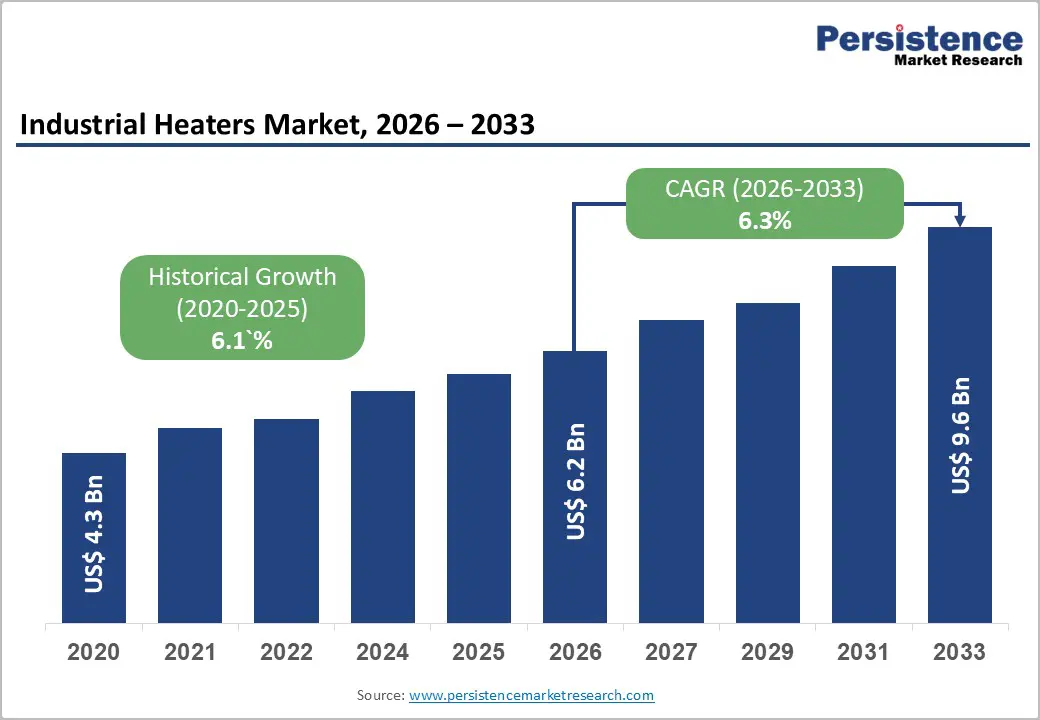
The global industrial heaters market size is likely to be valued at US$6.2 billion in 2026 and is expected to reach US$9.6 billion by 2033, growing at a CAGR of 6.3% during the forecast period from 2026 to 2033, driven by expanding industrial output and the accelerating shift toward energy-efficient thermal solutions.
According to the International Energy Agency (2024), industry accounts for nearly 37% of global energy consumption, with process heating representing a major share, reinforcing demand for efficient heating systems. The U.S. Department of Energy (2024) highlights that advanced electric heating technologies can significantly improve energy efficiency in industrial processes. Increasing adoption of electrification, automation, and smart monitoring across manufacturing and process industries continues to drive modernization and long-term demand for industrial heaters.
Key Industry Highlights:
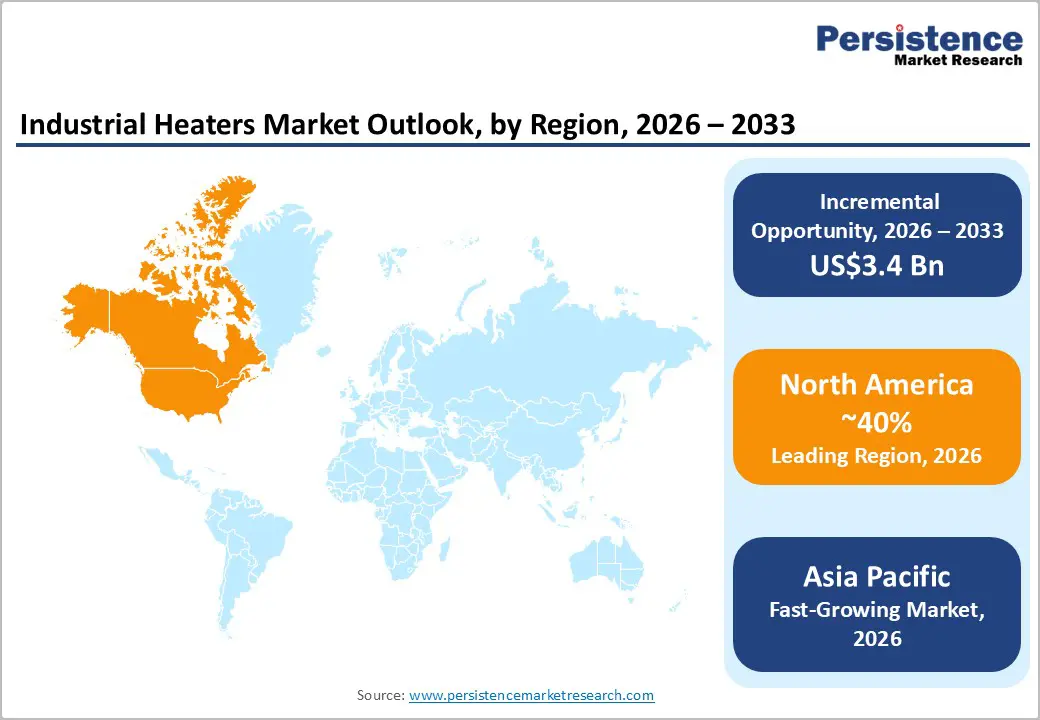
- Leading Region: North America is anticipated to be the leading region, accounting for a market share of 40% in 2026, driven by strong U.S. industrial leadership, stringent energy-efficiency regulations, and advanced innovation in electric and smart heating technologies.
- Fastest-growing Region: Asia Pacific is likely to be the fastest-growing region, supported by rapid industrialization, expanding manufacturing hubs, and strong regional demand for cost-efficient heating solutions.
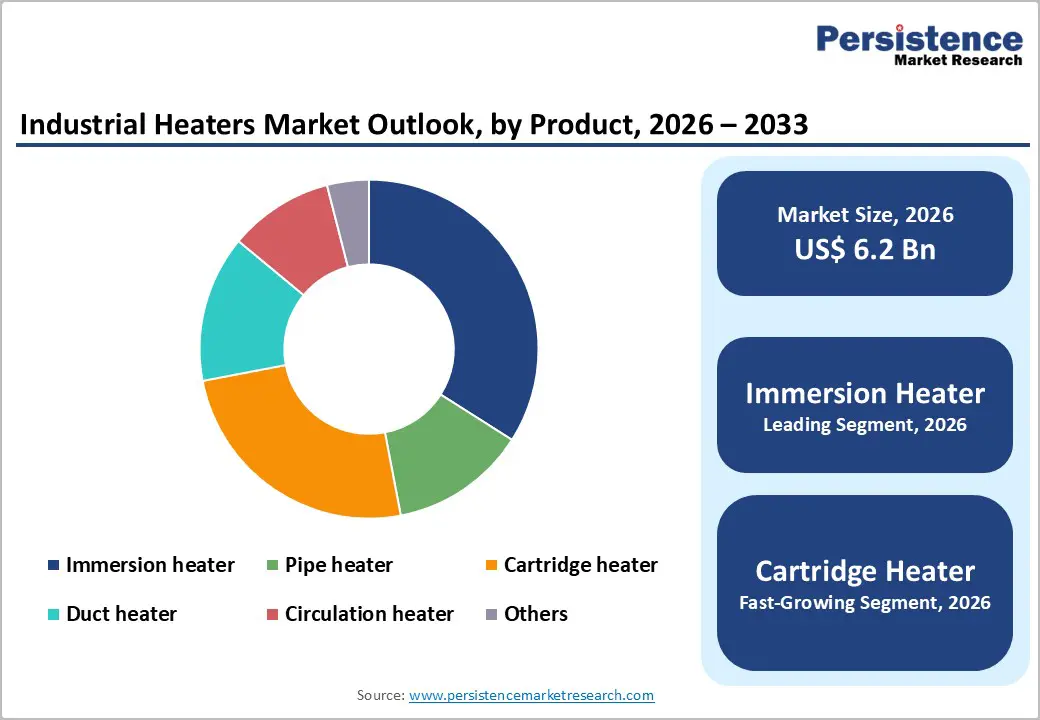
- Leading Product Type: Immersion heaters are projected to represent the leading product type in 2026, accounting for 33% of the revenue share, driven by their widespread use in direct liquid heating across key industries.
- Leading Application: The oil & gas segment is anticipated to be the leading application, accounting for over 40% of the revenue share in 2026, supported by extensive process heating requirements.
- Key Opportunity: The biggest market opportunity lies in the accelerating shift toward electrified, energy-efficient, and smart heating solutions that enable industries to decarbonize operations while enhancing precision, productivity, and long-term cost efficiency.
DRO Analysis
Driver - Expansion of Energy-Intensive Process Industries
The expansion of energy-intensive industries such as oil & gas, chemicals, petrochemicals, and heavy manufacturing is a primary driver for the industrial heaters market. These sectors rely heavily on controlled heating for processes such as distillation, cracking, drying, and fluid temperature maintenance. Increasing demand for fuels, specialty chemicals, and processed materials is pushing companies to expand production capacities and upgrade thermal systems.
Industrial heaters play a critical role in ensuring operational efficiency, product quality, and process stability, making them indispensable in both greenfield and brownfield industrial projects across emerging and developed economies.
The rise of industrialization in emerging markets such as India, China, and Southeast Asia is significantly contributing to demand growth. Governments are promoting domestic manufacturing through policy support, leading to the establishment of new industrial plants requiring advanced heating solutions. Industries are shifting toward energy-efficient and low-emission systems to meet sustainability goals, increasing the adoption of modern industrial heaters.
Restraint - Long Asset Replacement Cycles and Lock-in to Legacy Systems
One of the major restraints in the industrial heaters market is the long lifecycle of existing heating equipment, which delays replacement demand. Industrial heaters are typically designed for durability and can operate efficiently for decades with proper maintenance, reducing the frequency of new installations. Many industries continue to rely on legacy systems such as steam-based or fuel-fired heaters due to their established infrastructure and high initial replacement costs.
The cost and complexity associated with upgrading or replacing existing systems act as significant barriers for end users. Retrofitting industrial heaters often requires downtime, capital investment, and compatibility adjustments with existing pipelines and control systems. Small and medium enterprises, in particular, hesitate to invest in advanced heating technologies due to budget constraints and uncertain return on investment.
Opportunity - Digitalization and Smart Risk-Free Heating Systems
Digitalization presents a strong growth opportunity in the industrial heaters market, as industries increasingly adopt smart and connected technologies. Modern industrial heaters are being integrated with sensors, IoT platforms, and advanced control systems that enable real-time monitoring, predictive maintenance, and precise temperature management.
These smart heating solutions reduce operational risks, improve energy efficiency, and enhance process reliability. As industries move toward automation and data-driven operations, the demand for intelligent heating systems capable of minimizing human intervention and ensuring consistent performance is rapidly increasing across sectors.
The development of risk-free and energy-optimized heating technologies aligns with sustainability and safety standards. Digital twins and simulation tools allow industries to optimize heating processes before implementation, reducing errors and improving system design. Smart heaters also support remote diagnostics and fault detection, minimizing downtime and maintenance costs.
Category-wise Analysis
Product Type Insights
Immersion heaters are expected to lead the industrial heaters market, accounting for approximately 33% of revenue in 2026, driven by their efficiency in direct liquid heating across critical industrial processes. These heaters are extensively used in reactors, storage tanks, and pipelines where maintaining precise temperatures is essential for viscosity control, freeze protection, and chemical stability. For example, in petrochemical refineries, immersion heaters are widely deployed to maintain fluid temperatures in storage tanks, preventing solidification and ensuring smooth downstream processing operations.
Cartridge heaters are likely to represent the fastest-growing segment, supported by increasing automation and precision requirements in manufacturing industries. These heaters provide localized, high-intensity heating by being inserted into drilled holes in metal components, enabling faster heating cycles and improved production efficiency. For instance, in automotive component manufacturing, cartridge heaters are used in mold systems to ensure uniform heating, resulting in better surface finish and reduced cycle times in high-volume production environments.
Application Insights
The oil & gas segment is projected to lead the market, capturing around 40% of the revenue share in 2026, supported by its extensive reliance on continuous and high-capacity process heating. These industries require industrial heaters for complex operations such as distillation, cracking, and fluid transportation over long distances. A key example can be seen in oil refineries, where circulation and immersion heaters are employed to maintain crude oil at optimal temperatures during pipeline transport. This helps prevent viscosity-related flow disruptions and ensures smooth, continuous processing throughout refining operations.
The food & beverage segment is likely to be the fastest-growing application, driven by rising consumption trends and technological advancements in production processes. In the food industry, industrial heaters are essential for pasteurization, sterilization, and cleaning processes that require strict temperature control and hygiene standards. For instance, in food processing plants, duct and circulation heaters are used in sterilization systems to ensure microbial safety and product consistency.
Technology Insights
Electric heaters are expected to lead the industrial heaters market, accounting for approximately 35% of revenue in 2026, driven by their superior efficiency, precision, and compatibility with modern industrial systems. These heaters offer rapid heating response and accurate temperature control, making them ideal for applications requiring consistent and clean heating. For example, in pharmaceutical manufacturing, electric heaters are used in cleanroom environments to maintain strict temperature conditions, ensuring product integrity and compliance with stringent regulatory standards.
Electric heaters are also likely to represent the fastest-growing segment, supported by increasing environmental regulations and the need for energy-efficient solutions. These systems combine electric heating with traditional fuel sources to optimize energy consumption and reduce emissions. For instance, in metal processing industries, electric heaters are widely used in drying and curing applications to enhance efficiency and minimize emissions.
Regional Insights
North America Industrial Heaters Market Trends
North America is anticipated to be the leading region, accounting for a market share of 40% in 2026, driven by strong decarbonization policies, electrification of process heating, and rapid adoption of smart, connected heating systems. Industries are increasingly replacing legacy fuel-based systems with electric and hybrid technologies to meet emissions targets and improve operational efficiency. A notable example is Chromalox, which continues to advance electric thermal solutions and digital control systems, helping industries improve efficiency and reduce emissions through intelligent heating technologies.
U.S. Industrial Heaters Market Trends
The U.S. dominates the regional market, driven by investments in refinery upgrades, petrochemical expansion, and electrification initiatives under clean energy policies. The country is also witnessing strong demand from data centers and semiconductor manufacturing, requiring precise heating systems.
Canada Industrial Heaters Market Trends
Canada is a significant market for industrial heaters supported by oil sands operations and an increasing focus on reducing carbon emissions through energy-efficient industrial equipment. Canada is also investing in cleaner industrial technologies and electrified heating systems to align with national climate goals, driving market demand.
Europe Industrial Heaters Market Trends
Europe is likely to be a significant market, due to stringent environmental regulations, carbon neutrality goals, and strong emphasis on energy-efficient technologies. Industries are rapidly transitioning toward electric and low-emission heating systems to comply with EU directives and reduce carbon footprints. For instance, Durex Industries provides customized electric heating solutions widely used across European industries to improve efficiency and meet strict environmental standards.
U.K. Industrial Heaters Market Trends
The U.K. is a significant market for industrial heaters, supported by growth in food processing, pharmaceuticals, and clean energy initiatives. The U.K. is focusing on reducing industrial emissions and promoting sustainable manufacturing, which is increasing demand for advanced industrial heaters.
Germany Industrial Heaters Market Trends
Germany dominates the regional market, driven by its strong industrial base, particularly in automotive and chemical manufacturing, along with increasing adoption of Industry 4.0 technologies. The country is investing heavily in energy-efficient production systems and electrified heating solutions.
Asia Pacific Industrial Heaters Market Trends
The Asia Pacific region is likely to be the fastest-growing region in the industrial heaters market in 2026, driven by rapid industrialization, expanding manufacturing activities, and strong government support for domestic production. The region is witnessing high demand from sectors such as chemicals, food processing, electronics, and automotive manufacturing. For instance, Indeeco is expanding its presence by offering customized heating solutions tailored to industrial applications in emerging Asian markets.
China Industrial Heaters Market Trends
China dominates the regional market, driven by its massive manufacturing base, strong presence in chemicals, electronics, and heavy industries, and continuous investments in industrial infrastructure. The country is increasingly adopting electric and energy-efficient heating systems to meet environmental regulations and reduce emissions.
India Industrial Heaters Market Trends
India is a significant market for industrial heaters, supported by rapid industrialization, expansion of food processing, automotive, and chemical sectors, and strong government initiatives such as Make in India. The country is witnessing the rising adoption of modern heating technologies in new manufacturing facilities. Increasing investments in infrastructure and energy-efficient industrial equipment are driving demand for industrial heaters.
Competitive Landscape
The global industrial heaters market exhibits a moderately fragmented structure, driven by the presence of both established manufacturers and numerous regional and niche players offering customized thermal solutions. While a few leading companies hold a notable portion of the market, a large number of small and medium enterprises contribute to competition across specialized applications and local markets.
With key leaders including Chromalox, Durex Industries, Backer Hotwatt, Elmic, and Indeeco, the competitive environment is shaped by strong engineering capabilities and distribution networks. These players compete through product innovation, customization, and integration of digital technologies such as IoT-enabled monitoring and predictive maintenance systems.
Key Industry Developments:
- In February 2026, Honeywell launched a hybrid heating solution that integrates natural gas and electric energy, enabling real-time switching to reduce industrial carbon emissions, optimize energy costs, and support decarbonization without disrupting operations.
- In May 2025, Lennox and Ariston Group announced a joint venture to launch residential water heaters in North America, combining Lennox’s strong distribution network with Ariston’s advanced water heating technology to expand product offerings and strengthen market presence across the U.S. and Canada.
- In November 2025, Adani Cement partnered with Coolbrook to deploy the world’s first commercial RotoDynamic Heater at its Andhra Pradesh plant, enabling fully electrified, renewable-powered industrial heat and significantly reducing carbon emissions in cement production.
Companies Covered in Industrial Heaters Market
- Accutherm
- Backer Hotwatt
- Chromalox
- Durex Industries
- Elmec Heaters
- Elmatic
- ExcelHeaters
- Friedr Freek
- Heatcon Sensors
- Heatrex
- Heatco
- Indeeco
- Marathon Heater
Frequently Asked Questions
The global industrial heaters market is projected to reach US$6.2 billion in 2026.
The industrial heaters market is driven by rising demand from energy-intensive industries, increasing focus on energy efficiency, and the shift toward low-emission and electrified heating solutions.
The industrial heaters market is expected to grow at a CAGR of 6.3% from 2026 to 2033.
Key market opportunities lie in the growing adoption of electric and smart industrial heating systems driven by decarbonization goals, energy efficiency needs, and increasing industrial automation.
Accutherm, Backer Hotwatt, Chromalox, Durex Industries, Elmec Heaters, Elmatic, and ExcelHeaters are the leading players.


