




- Industrial Goods & Service
- Industrial Gas Stove Market
Industrial Gas Stove Market Size, Share, and Growth Forecast 2026 -2033
Industrial Gas Stove Market by Product Type (Single Burner Industrial Gas Stoves, Double Burner Industrial Gas Stoves, Multi-Burner Industrial Gas Stoves, Stock Pot / Heavy-Duty Burners, Range with Oven, Modular Industrial Cooking Ranges), Fuel Type (LPG Stoves, Natural Gas Stoves, Coal Gas Stoves, Oil-Based Stoves, Dual-Fuel Stoves), Automation Level, Installation Type, End-user, and Regional Analysis, 2026 - 2033

Industrial Gas Stove Market Size and Trend Analysis
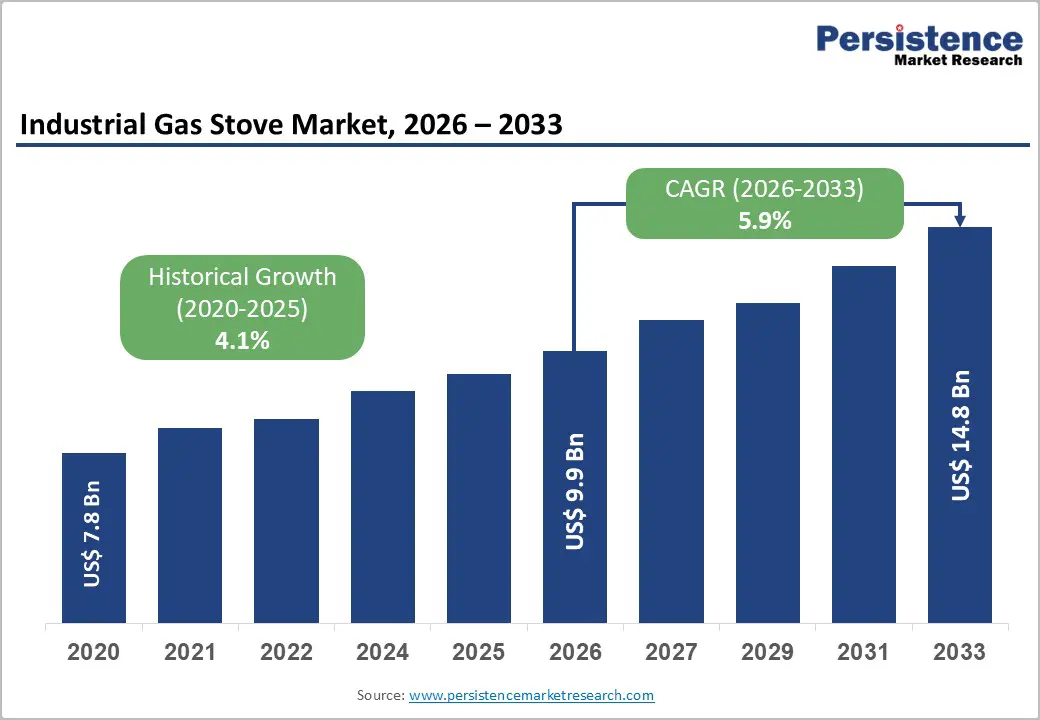
The global industrial gas stove market size is likely to be valued at US$ 9.9 billion in 2026 and is expected to reach US$ 14.8 billion by 2033, growing at a CAGR of 5.9% during the forecast period from 2026 to 2033.
The market is advancing on the back of rapid expansion in the global foodservice and hospitality industry, surging proliferation of cloud kitchens, and sustained investment in commercial kitchen infrastructure across emerging economies.
Key Market Highlights
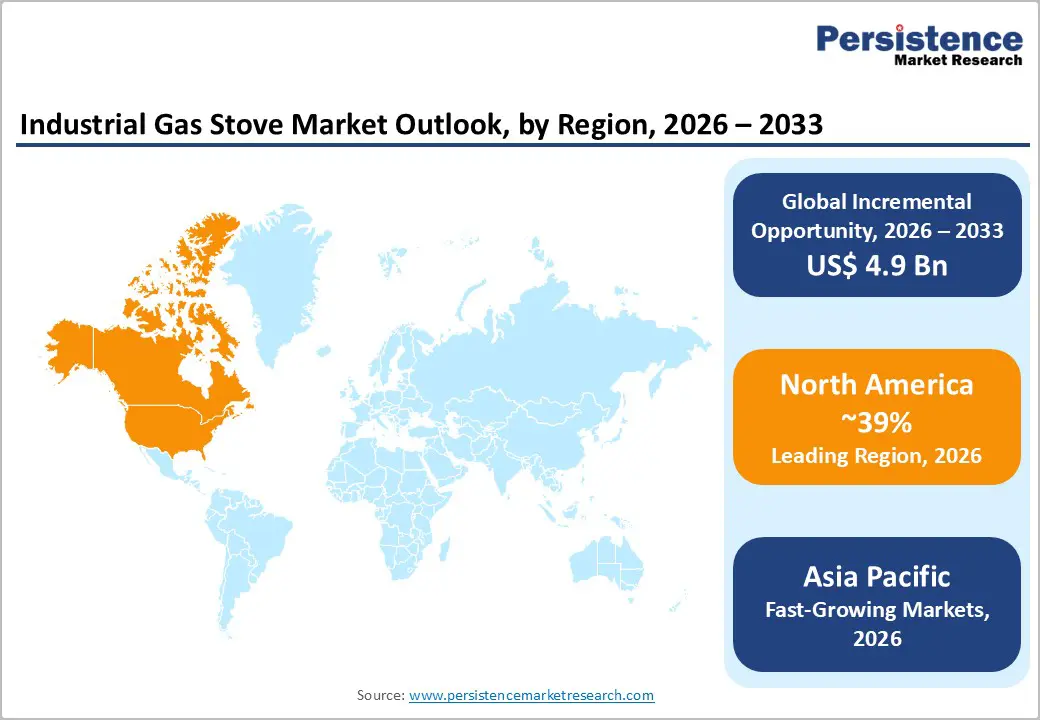
- Leading Region: North America leads the market holding 39% share, led by the United States, dominates the global Industrial Gas Stove Market, supported by approximately 1 Million restaurant locations, a mature hospitality sector, and robust capital investment in commercial kitchen upgrades driven by the National Restaurant Association (NRA).
- Fastest Growing Region: Asia Pacific is the fastest-growing regional market with rising CAGR of 7.2%, driven by over 10 Million restaurant establishments in China, rapid foodservice sector expansion in India under the NRAI, and booming hotel and resort construction across Southeast Asia.
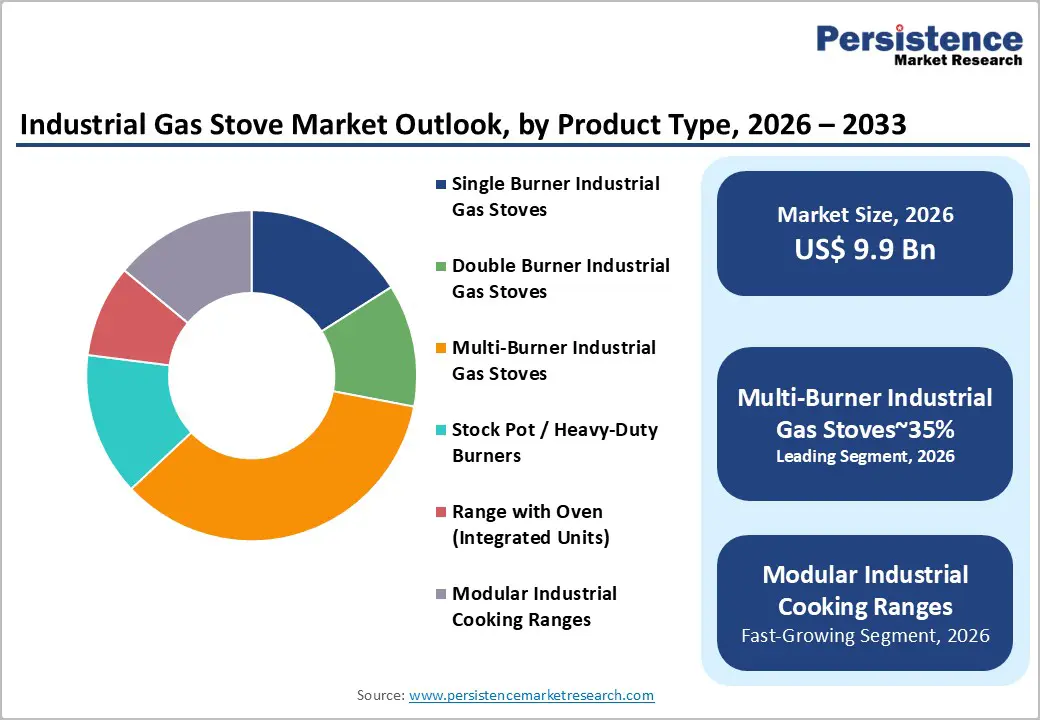
- Dominant Segment: Multi-Burner Industrial Gas Stoves lead the Product Type category with approximately 35% market share, favored for high-volume simultaneous multi-dish cooking in full-service restaurants, hotel kitchens, and large-scale institutional catering facilities globally.
- Fastest Growing Segment: Cloud Kitchens and QSR Chains represent the fastest-growing end-user segment, propelled by the global expansion of food delivery platforms including Uber Eats, DoorDash, and Zomato, and the associated demand for compact, high-performance industrial cooking equipment.
- Key Opportunity: Institutional kitchen modernization in emerging markets presents a high-growth opportunity, with India's Mid-Day Meal Scheme serving over 120 Million children daily and Saudi Vision 2030 driving large-scale hospitality infrastructure investment, creating scalable procurement demand for industrial gas stoves.
| Key Insights | Details |
|---|---|
| Industrial Gas Stove Market Size (2026E) | US$ 9.9 Billion |
| Market Value Forecast (2033F) | US$ 14.8 Billion |
| Projected Growth CAGR (2026 - 2033) | 5.9% |
| Historical Market Growth (2020 - 2025) | 4.1% |

Market Dynamics
Drivers - Strong Growth in Global Foodservice and Hospitality Industry Driving Demand for Industrial Gas Stoves Worldwide
The global foodservice industry is expanding rapidly, creating steady and scalable demand for industrial gas stoves across restaurants, hotels, catering services, and institutional kitchens. According to the World Travel and Tourism Council (WTTC), the sector contributed nearly US$ 9.9 trillion to the global economy in 2023, accounting for 9.1% of global GDP, with strong hospitality investments driving upgrades in kitchen infrastructure worldwide.
The International Food and Agribusiness Management Association (IFAMA) projects the global foodservice market to exceed US$ 5.5 trillion by 2030. As restaurants and hotels increasingly focus on preparing large volumes of food quickly and precisely, industrial gas stoves remain a preferred choice for their instant flame control, high heat output, and cost efficiency compared to electric alternatives. This consistent growth in the foodservice sector continues to act as a strong long-term driver for the industrial gas stove market.
Rising Cloud Kitchens and Expanding QSR Chains Accelerating Demand for Efficient Industrial Gas Cooking Solutions
The rapid growth of cloud kitchens, also known as ghost or dark kitchens, is becoming a key factor driving demand for industrial gas stoves. According to Euromonitor International, the global cloud kitchen market was valued at approximately US$ 43 billion in 2023 and is expected to grow significantly in the coming years, supported by the rising use of food delivery platforms such as Uber Eats, DoorDash, and Zomato.
These kitchens operate exclusively for delivery and require compact, efficient, and high-performance cooking equipment to handle large order volumes within limited spaces. Industrial gas stoves, especially single- and double-burner models, are well-suited for such environments. At the same time, QSR chains like McDonald's, Yum! Brands and Restaurant Brands International are expanding globally, increasing the need for standardized, high-capacity kitchen equipment. This trend is significantly boosting demand across both emerging and developed markets.
Restraints - Strict Environmental Regulations and Shift toward Electrification Limiting Adoption of Industrial Gas Stoves Globally
Increasing environmental regulations aimed at reducing carbon emissions from commercial kitchens are creating challenges for the industrial gas stove market. Regulatory bodies such as the U.S. Environmental Protection Agency (EPA) and the European Commission, through its Fit for 55 initiative, are introducing stricter energy efficiency and emission standards for cooking equipment. In addition, cities like New York and San Francisco have proposed or implemented restrictions on natural gas installations in new commercial buildings. These developments are encouraging foodservice operators to consider electric and induction-based alternatives. As a result, equipment buyers, designers, and developers are becoming cautious in their investment decisions, especially in regions with strict environmental policies. This regulatory shift is creating uncertainty and may slow down the adoption of gas-based cooking equipment in certain urban markets, thereby impacting overall market growth.
Volatile Natural Gas and LPG Prices Impacting Operating Costs and Slowing Equipment Investment Decisions
Fluctuations in natural gas and LPG prices have a direct impact on the operating costs of commercial kitchens that rely on gas stoves. This price instability can influence purchasing decisions, often delaying equipment upgrades or new installations. For example, after the Russia-Ukraine conflict in 2022, natural gas and LPG prices in Europe surged by more than 200% in some regions.
This forced many foodservice operators to reduce kitchen operations or consider switching to electric alternatives. According to the International Energy Agency (IEA), natural gas price volatility is expected to remain high due to ongoing geopolitical uncertainties. As a result, businesses are becoming more cautious with capital investments in gas-based equipment. This ongoing unpredictability in fuel costs continues to act as a key restraint, particularly for cost-sensitive operators in both developed and emerging markets.
Opportunities - Growing Demand for Fully Automatic and Smart Industrial Gas Stoves
The adoption of advanced technologies such as automation, IoT integration, and programmable cooking systems is creating strong growth opportunities in the industrial gas stove market. Modern gas stoves equipped with digital flame control, automatic ignition, temperature monitoring, and safety shutdown features are gaining popularity among large hotels, institutional kitchens, and food production facilities. Increasing focus on food safety and regulatory compliance is also encouraging the use of such smart equipment.
Organizations like the Food and Drug Administration (FDA) emphasize stricter safety standards, pushing operators toward solutions with built-in monitoring and control systems. Leading companies are investing in connected kitchen platforms to offer better efficiency and performance. As a result, the smart kitchen equipment segment is expected to grow faster than the overall market, making it a key area of investment for manufacturers looking to differentiate their products.
Institutional Kitchen Modernization in Emerging Markets
Government initiatives aimed at upgrading institutional kitchens in schools, hospitals, military units, and correctional facilities across emerging economies present a major growth opportunity for industrial gas stove manufacturers. In India, for example, the Mid-Day Meal Scheme serves meals to over 120 million school children daily, creating continuous demand for large-scale cooking equipment.
China is expanding its healthcare infrastructure, with plans to add more than 500,000 hospital beds by 2025, increasing the need for modern kitchen facilities. In the Middle East, initiatives such as Saudi Vision 2030 and tourism development programs in the UAE are driving investments in hospitality and institutional infrastructure. These large-scale projects require reliable and high-capacity cooking solutions. Such long-term and high-volume procurement opportunities provide strong growth potential for manufacturers and suppliers targeting emerging markets.
Category-wise Analysis
Product Type Insights
Multi-burner industrial gas stoves dominate the product segment, accounting for around 35% of total market revenue. Their strong demand is driven by the need for high-volume cooking and the ability to prepare multiple dishes simultaneously in commercial kitchens. These stoves typically feature 4 to 8 burners, allowing chefs to maintain efficiency during peak service hours without compromising on cooking quality or control.
According to the National Restaurant Association (NRA), most full-service restaurants rely on multi-burner gas ranges as their primary cooking equipment. In addition, these units offer better cost efficiency, as the cost per burner is lower compared to single-burner systems. Their ability to support diverse cooking requirements in busy environments makes them an essential component of restaurant and hotel kitchens, reinforcing their leading position in the market.
Fuel Type Insights
Natural gas stoves hold the largest share in the fuel type segment, contributing approximately 42% of total market revenue. They are widely preferred in large commercial kitchens due to their continuous fuel supply through pipeline networks, eliminating the need for cylinder storage and handling. Additionally, natural gas is generally more cost-effective per unit of energy compared to LPG in regions with established infrastructure.
According to the U.S. Energy Information Administration (EIA), natural gas is the most commonly used fuel for commercial cooking equipment in North America and Europe. Its reliability and lower operational costs make it ideal for large-scale operations such as hotels and institutional kitchens. Meanwhile, dual-fuel stoves are gaining popularity as they offer flexibility to switch between natural gas and LPG, helping operators manage fuel availability and costs more effectively.
Automation Level Insights
Manual gas stoves continue to lead the automation segment, accounting for around 52% of the total market revenue. These stoves are widely used in small and mid-sized foodservice establishments due to their affordability, ease of maintenance, and operational flexibility. Chefs often prefer manual control as it allows precise flame adjustment during cooking.
According to World Bank data on small and medium enterprises (SMEs), a large number of foodservice businesses globally operate with limited budgets, making manual equipment a practical choice. However, fully automatic gas stoves are gaining traction, especially in large hotels and institutional kitchens. These advanced systems help reduce labor dependency, improve consistency, and enhance food safety compliance. As labor costs rise and operational efficiency becomes more critical, the demand for automated solutions is expected to grow steadily.
Installation Type Insights
Freestanding industrial gas stoves lead the installation segment, accounting for approximately 48% of the total market revenue. Their popularity is mainly due to their flexibility and ease of installation, as they do not require fixed infrastructure or custom kitchen designs. This makes them suitable for a wide range of applications, including restaurants, catering services, and institutional kitchens. These units can be easily moved, serviced, or replaced, reducing downtime and operational disruptions.
According to industry surveys by Foodservice Equipment Reports (FER), freestanding gas stoves consistently rank among the most commonly used cooking equipment in commercial kitchens. Although built-in and integrated systems are gaining popularity in premium hotels and large-scale facilities for better workflow and aesthetics, freestanding models continue to dominate due to their practicality and cost efficiency.
End-user Insights
Restaurants are the largest end-user segment, contributing around 33% of total market revenue in the industrial gas stove market. The global restaurant industry's vast scale and continuous expansion make it a major driver of equipment demand. According to the National Restaurant Association (NRA), there are about 1 million restaurant locations in the United States alone, each requiring regular equipment upgrades and replacements.
In emerging markets, increasing urbanization and rising disposable incomes are encouraging people to dine out more frequently, further boosting restaurant growth. Premium casual dining and fine dining segments, in particular, require advanced multi-burner gas stoves for complex cooking processes. Meanwhile, cloud kitchens and QSR chains are emerging as the fastest-growing sub-segment, driven by the increasing shift toward online food delivery services and changing consumer preferences.
Regional Insights
North America Industrial Gas Stove Market Trends
The United States leads the North American industrial gas stove market, supported by a well-established restaurant and hospitality sector. According to the U.S. Bureau of Labor Statistics (BLS), the foodservice and accommodation industry employed around 16 million people in 2023, highlighting the scale of demand for commercial kitchen equipment.
The National Restaurant Association (NRA) also reports strong investment trends, with many operators prioritizing kitchen upgrades and expansions. In addition, compliance with safety and certification standards such as NSF and ANSI/UL plays a key role in equipment selection. Canada, although smaller in market size, is witnessing steady growth, especially in major cities such as Toronto and Vancouver. Labor shortages in the foodservice sector are pushing operators to adopt semi-automatic and fully automatic gas stoves, improving efficiency and reducing dependence on manual labor.
Europe Industrial Gas Stove Market Trends
The European industrial gas stove market is shaped by a strong hospitality sector, strict environmental regulations, and a well-established culinary culture. Major countries such as Germany, France, Italy, and the United Kingdom contribute significantly to market demand. According to Eurostat, the EU’s foodservice sector generated around €600 billion in revenue in 2023. Regulations such as the Ecodesign Directive are encouraging the adoption of energy-efficient and low-emission cooking equipment. Countries like France and Italy, known for their fine dining culture, drive demand for high-quality professional cooking equipment. Spain is experiencing strong growth due to its thriving tourism industry. Harmonized regulations across the EU also make it easier for manufacturers to expand their presence across multiple countries, supporting overall market growth.
Asia Pacific Industrial Gas Stove Market Trends
Asia Pacific is the fastest-growing market for industrial gas stoves, driven by rapid expansion in the foodservice and hospitality sectors across countries such as China, India, Japan, and Southeast Asia. China leads both in production and consumption, with over 10 million restaurant establishments creating a large demand base. India is also witnessing strong growth due to rising incomes, urbanization, and the expansion of organized foodservice chains.
According to the National Restaurant Association of India (NRAI), the sector is growing at a significant pace. Southeast Asian countries like Thailand and Vietnam are benefiting from increased tourism and hotel development. In Japan, demand is driven by a focus on precision, quality, and energy efficiency. These factors collectively make the Asia Pacific a key growth region for the industrial gas stove market.
Competitive Landscape
The global industrial gas stove market is moderately fragmented, with a mix of multinational companies, specialized manufacturers, and regional players. Leading companies differentiate themselves through wide product portfolios, global distribution networks, and integrated kitchen solutions. Key strategies include investing in smart kitchen technologies, developing energy-efficient burner systems, and expanding through acquisitions.
Companies are also introducing innovative business models such as equipment-as-a-service (EaaS) and predictive maintenance to enhance customer value. At the same time, regional manufacturers, particularly in Asia, compete aggressively on pricing to attract cost-sensitive customers. This competitive environment encourages continuous innovation and product development, helping the market evolve to meet changing customer needs and regulatory requirements.
Key Developments:
- March 2024: RATIONAL AG launched its next-generation iCombi Pro series with enhanced AI-assisted cooking intelligence and integrated gas and electric cooking capability, targeting large-scale hotel and institutional kitchen segments across North America and Europe.
- January 2024: The Middleby Corporation announced the acquisition of a European commercial kitchen equipment manufacturer to expand its product portfolio in the modular industrial cooking range segment, strengthening its competitive position in the European HORECA sector.
- November 2023: Welbilt, Inc. unveiled its KitchenConnect digital platform upgrade, integrating real-time gas stove performance monitoring, predictive maintenance alerts, and energy consumption analytics for connected commercial kitchen operators globally.
Companies Covered in Industrial Gas Stove Market
- RATIONAL AG
- The Middleby Corporation
- Welbilt, Inc.
- Garland Commercial Industries LLC
- Blue Star Limited
- AB Electrolux
- Electrolux Professional AB
- Ali Group S.r.l.
- Henny Penny Corporation
- ITW Food Equipment Group LLC
- Vulcan Equipment
- Southbend
- Imperial Commercial Cooking Equipment
- Falcon Foodservice Equipment
- Fagor Professional
- Hobart Corporation
- Bakers Pride
- Lang Manufacturing
Frequently Asked Questions
The global Industrial Gas Stove Market is projected to reach US$ 14.8 Billion by 2033, expanding at a CAGR of 5.9% during the forecast period 2026-2033, from an estimated US$ 9.9 Billion in 2026. The market recorded a historical CAGR of 4.1% between 2020 and 2025, driven by sustained growth in the global foodservice and hospitality industry.
The principal growth drivers are the global expansion of the foodservice and hospitality industry, with the U.S. restaurant industry projected to exceed US$ 1.1 Trillion in 2024 revenues per the National Restaurant Association (NRA), and the rapid proliferation of cloud kitchens and QSR chains worldwide, fueled by the growth of food delivery platforms such as Uber Eats, DoorDash, and Zomato.
Multi-Burner Industrial Gas Stoves dominate the product type segment with approximately 35% of total market revenue. Their leadership is driven by their capacity for high-volume, simultaneous multi-dish cooking, an operational requirement in full-service restaurants, hotel kitchens, catering operations, and institutional cafeterias across North America, Europe, and Asia Pacific.
North America, led by the United States, is the dominant regional market for industrial gas stoves. The region benefits from approximately 1 Million operating restaurant locations, a mature commercial kitchen equipment distribution network, and robust industry investment guided by organizations including the National Restaurant Association (NRA) and supported by NSF International and ANSI/UL equipment certification frameworks.
Institutional kitchen modernization in high-growth emerging markets represents a compelling opportunity. India's government-backed Mid-Day Meal Scheme serving over 120 Million children daily, combined with healthcare infrastructure expansion in China and large-scale hospitality investment under Saudi Vision 2030, creates scalable, long-cycle procurement demand for industrial gas stoves across institutional, hotel, and healthcare kitchen segments.
Key companies operating in the global Industrial Gas Stove Market include RATIONAL AG, The Middleby Corporation, Welbilt, Inc., Garland Commercial Industries LLC, Blue Star Limited, AB Electrolux, Electrolux Professional AB, Ali Group S.r.l., Henny Penny Corporation, ITW Food Equipment Group LLC, Vulcan Equipment, Southbend, Imperial Commercial Cooking Equipment, Falcon Foodservice Equipment, and Fagor Professional, among others.


