




- Smart Packaging
- High Visible Packaging Market
High Visible Packaging Market Size, Share, and Growth Forecast, 2026 - 2033
High Visible Packaging Market by Product Type (Clamshell Packaging, Others), Material (Plastic, Others), Packaging Technology (Thermoforming, Vacuum Sealing, Others), End-user (Food & Beverage, Others), and Regional Analysis for 2026 – 2033

High Visible Packaging Market Size and Trends Analysis
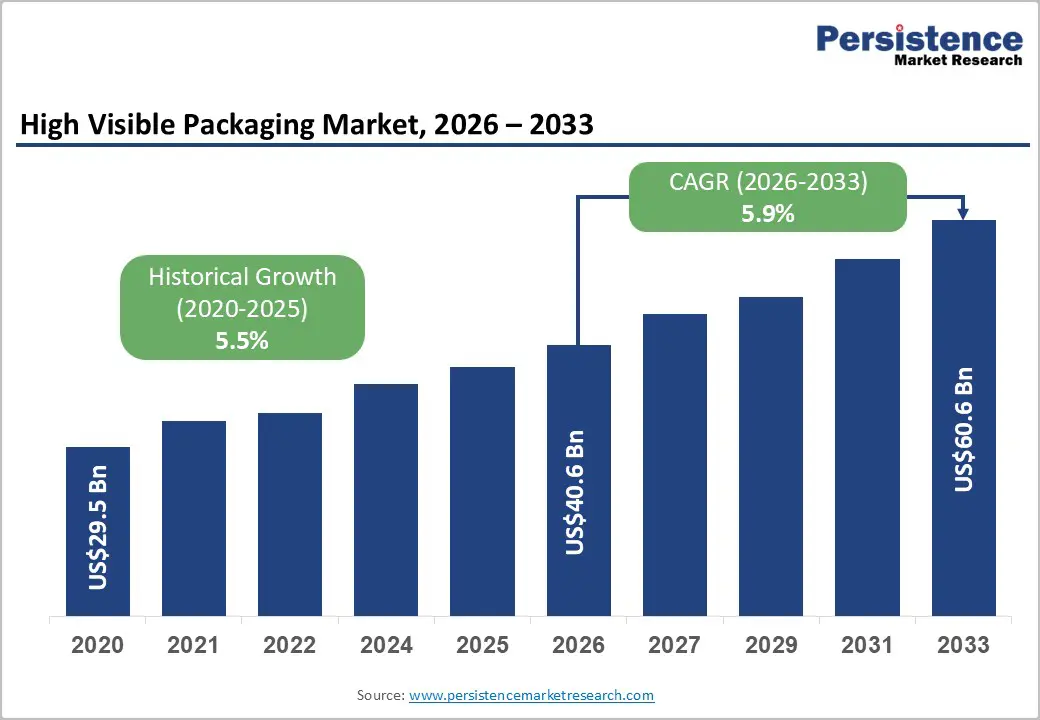
The global high visible packaging market size is likely to be valued at US$40.6 billion in 2026, and is expected to reach US$60.6 billion by 2033, growing at a CAGR of 5.9% during the forecast period from 2026 to 2033, driven by the increasing prevalence of impulse buying behavior, rising demand for product visibility on crowded retail shelves, and growing adoption of transparent and windowed packaging in food & beverage and healthcare sectors. Growing demand for high visible packaging solutions, especially clamshell and blister packs for retail security and shelf appeal, is accelerating adoption across end-user industries.
Key Industry Highlights:
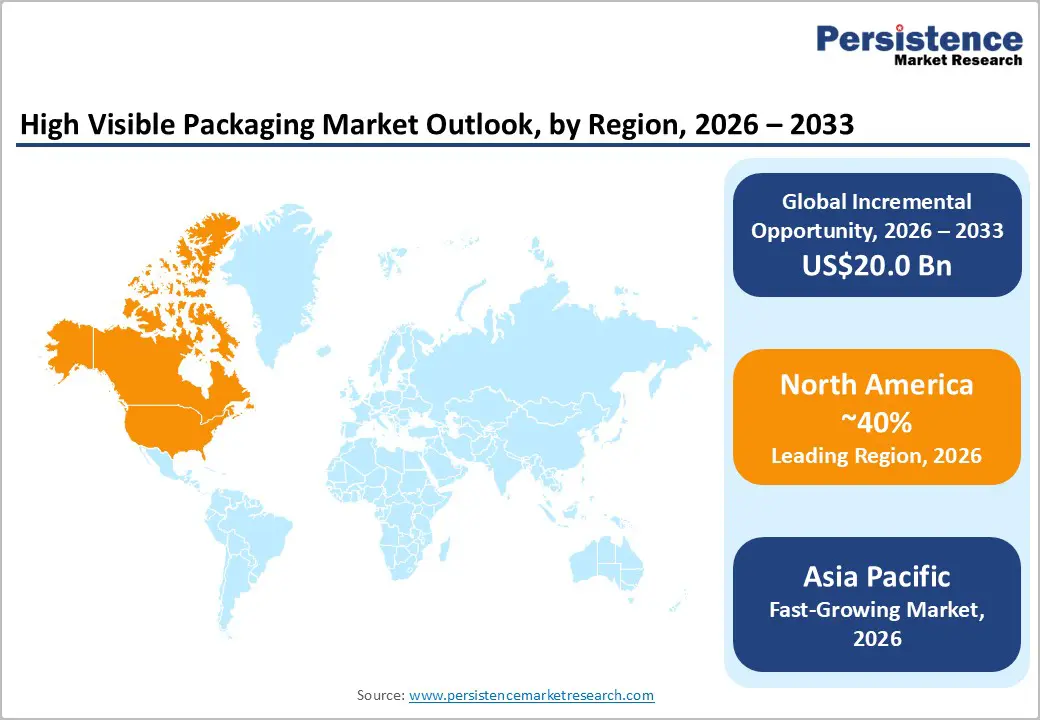
- Leading Region: North America, anticipated to account for a 40% market share in 2026, driven by advanced retail infrastructure, strong brand focus, and high demand for theft-resistant packaging in the U.S.
- Fastest-growing Region: Asia Pacific, fueled by rapid modern retail expansion, rising organized trade, and growing FMCG consumption in China and India.
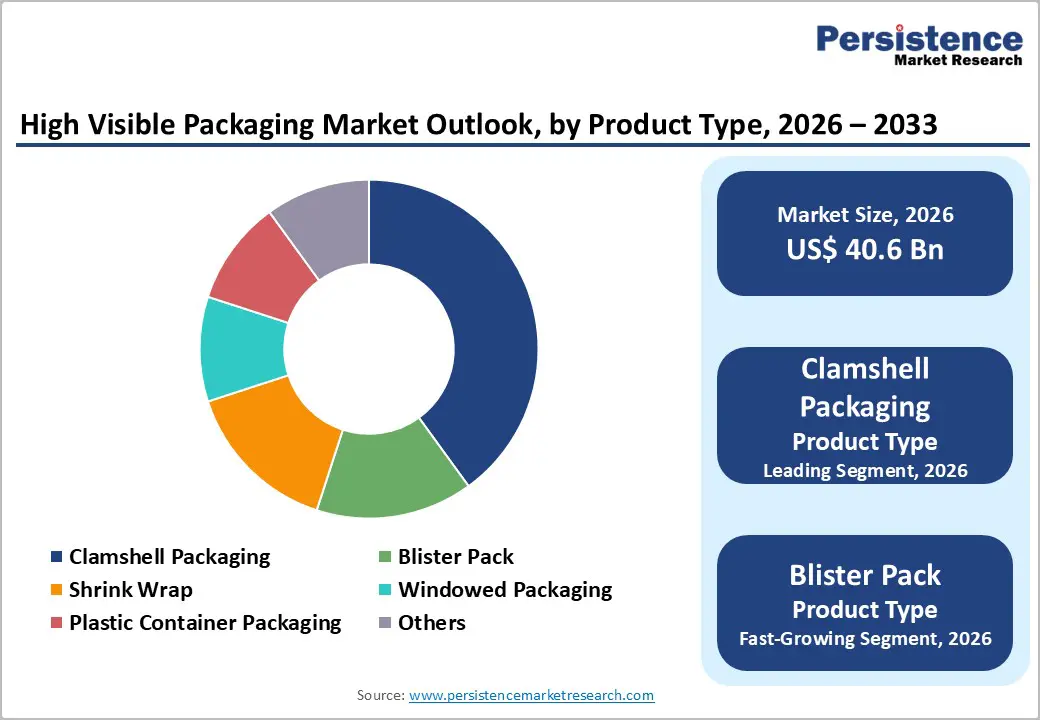
- Dominant Product Type: Clamshell packaging, to hold approximately 38% of the market share, as it remains the preferred format for high-visibility retail security.
- Leading Material: Plastic, contributing nearly 68% of the market revenue, due to superior clarity, formability, and cost-effectiveness.
- The EU’s Packaging and Packaging Waste Regulation (PPWR) mandates that all packaging be recyclable by 2030, enforcing design standards and harmonized labeling, accelerating the shift toward compliant and sustainable high-visibility packaging formats.
| Report Attribute | Details |
|---|---|
|
High Visible Packaging Market Size (2026E) |
US$40.6 Bn |
|
Market Value Forecast (2033F) |
US$60.6 Bn |
|
Projected Growth CAGR (2026-2033) |
5.9% |
|
Historical Market Growth (2020-2025) |
5.5% |
Market Factors – Growth, Barriers, and Opportunity Analysis
Growth Analysis – Rising Impulse Purchase Behavior and Organized Retail Expansion
Consumer buying patterns are shifting as households have more disposable income and access to a broader range of products, prompting more unplanned purchases at retail outlets and online stores. Official government data show that non-food consumption which includes discretionary goods such as apparel, cosmetics, and personal care increased to 53.6% of total rural household spending in 2022–23, up from 47% in 2011–12, indicating a shift towards higher spending on non-essentials that often triggers impulse buys. This changing consumption profile reflects deeper engagement with retail environments where visual merchandising, promotions, and product variety can prompt spontaneous purchases.
India’s organized retail sector is growing rapidly, expanding retail space and modern store networks that enhance the shopping experience and encourage unplanned purchases. Government-linked industry projections show that organized retail is expected to reach over 5,148,000 crore (US$600 billion) by 2030, capturing more than 35% of India’s total retail market as consumer demand for structured retail formats rises. This expansion of branded stores, supermarkets, and modern retail channels increases touchpoints where consumers are exposed to product displays and promotions, reinforcing impulse purchase behavior and supporting market growth.
Increasing Focus on Theft Deterrence and Product Security
Retailers and manufacturers are intensifying efforts on theft deterrence and product security as crime rates and loss of goods impact profitability and consumer trust. Official data from India’s National Crime Records Bureau (NCRB) shows that theft cases reached 689,580 incidents in 2023, highlighting the scale of property loss and the importance of security measures to protect merchandise and inventory. Delhi reported property thefts with losses totaling 688.6 crore (US$$82.63 million) in 2023, underscoring vulnerabilities in both public and commercial environments and the need for stronger theft prevention systems. Strengthening tags, alarms, surveillance systems, and access controls not only reduces shrinkage but also reinforces customer confidence and deters repeat offenders.
To counter these challenges, businesses and local authorities are investing in advanced loss prevention technologies, collaborating with law enforcement, and training for staff to identify suspicious behavior. Integration of smart CCTV, RFID tagging, and real-time monitoring helps detect and deter theft, while clear policies and visible security reduce opportunities for crime. Emphasis on product security also supports safer shopping environments and protects brand reputation, enabling retailers to focus on growth without disproportionate losses from theft and pilferage.
Barrier Analysis – Sustainability Pressure and Single-use Plastic Regulations
Retailers and manufacturers are under increasing pressure to adopt sustainable practices as governments impose stricter regulations on plastic use and waste management. For instance, India’s Plastic Waste Management Amendment Rules, 2021, banned the production, import, and sale of certain single-use plastics from July 2022, resulting in 861,740 inspections, the seizure of 1,985 tonnes of banned plastics, and fines totaling Rs 19.82 crore. Such policies reflect growing regulatory expectations for companies to reduce plastic dependence and adopt sustainable packaging alternatives, driving up costs in product design, supply chains, and logistics. India’s plastic waste generation, estimated at 26,000 tonnes per day, exacerbates this challenge, with many single-use items being difficult to recycle. Businesses are therefore compelled to invest in eco-friendly materials, enhance recycling efforts, and implement circular economy practices. These environmental and regulatory pressures require significant strategic shifts, which may impact short-term profitability and operations.
Raw Material Price Volatility and Supply Chain Disruptions
Raw material price volatility and supply chain disruptions significantly hinder the inbound medical tourism market by increasing operational costs and creating uncertainty in service delivery. Healthcare providers rely on a consistent supply of medical equipment, pharmaceuticals, and specialized technology, all vulnerable to price fluctuations in materials such as plastics, metals, and semiconductors. Sharp cost increases in these inputs can lead hospitals to raise treatment prices or absorb higher costs, diminishing their competitiveness for international patients. Unpredictable price swings complicate budgeting and long-term planning for facility upgrades and service expansion.
Supply chain disruptions, caused by factors such as natural disasters, geopolitical tensions, or logistics bottlenecks, further constrain the market by delaying crucial inventory deliveries. These delays can lengthen procedure wait times, interrupt surgeries, and reduce patient trust. For inbound patients, such uncertainties undermine confidence in destination reliability and quality assurance. Ongoing supply challenges shift hospital focus from patient care to inventory management, affecting service quality and impeding market growth.
Opportunity Analysis – Expansion in Recyclable and Bioplastic High-Visible Formats
Efforts to expand recyclable and bioplastic packaging formats present a significant opportunity by aligning industry practices with government sustainability goals and enhancing material circularity. Increasingly stringent public policy frameworks are mandating higher recycling rates and the use of recycled content in packaging, driving innovation in recyclable and compostable alternatives to conventional plastics. In the European Union, several countries have already exceeded 70% recycling rates per inhabitant, moving closer to the 2030 target under EU regulations. This push for material recovery and reuse is boosting demand for recyclable and biodegradable packaging solutions in consumer-facing industries.
National initiatives are also gaining momentum. For example, Canada has committed to requiring plastic packaging to contain at least 50% recycled content by 2030, spurring investment in recycling technologies and creating new markets for secondary materials. Packaging made from recyclable or bioplastic materials reduces environmental impact while enhancing a brand’s sustainability image. This shift helps companies attract eco-conscious consumers, comply with extended producer responsibility (EPR) regulations, and differentiate their products, contributing to reduced lifecycle impacts and advancing circular economy practices.
Developments in E-commerce Ready and Anti-Theft Visible Packaging
Developments in e-commerce-ready and anti-theft visible packaging present a strong opportunity for the retail and logistics segments of the packaging industry by enhancing both customer experience and product protection. With the rapid growth of online shopping, packaging that is designed to withstand transit stress, provide tamper evidence, and allow easy unpacking adds value for both sellers and buyers. E-commerce environments place unique demands on packaging: products must be protected from rough handling, moisture, and prolonged journeys, all while minimizing weight and waste to control shipping costs. Anti-theft visible features such as tamper-evident seals, security tapes, and transparent windows help reassure customers that products have not been opened or altered in transit, boosting trust and repeat purchases.
Packaging engineered specifically for e-commerce can also integrate branding and information directly on the shipping carton, offering opportunities for marketing and improved user engagement when the product arrives. Clear, robust packaging reduces returns due to damage and allows fulfilment centers to handle products more efficiently. As online retail continues to grow, companies that adopt innovative, e-commerce-ready packaging solutions will be better positioned to reduce loss, enhance customer satisfaction, and streamline supply chain operations.
Category-wise Analysis
Product Type Insights
Clamshell packaging is expected to hold the largest market share, approximately 38%, by 2026. Its dominance is driven by its robust protective structure, product visibility, and compatibility with retail display needs. The hinged, transparent design allows consumers to clearly view the product, encouraging impulse purchases while maintaining tamper resistance. Retailers prefer clamshell formats for a wide range of products, including electronics, food items, personal care products, and hardware accessories, as they provide durability and stability on shelves. The packaging also incorporates anti-theft features, such as sealed edges and reinforced locking mechanisms, making it a preferred choice for high-traffic retail environments. Apple Inc., for example, has widely adopted clear thermoformed clamshell packaging for accessories such as EarPods, charging cables, and small electronics, offering high visibility while preventing theft.
Blister packs represent the fastest-growing packaging type, due to their excellent product protection, tamper evidence, and consumer convenience. Their sealed cavities securely hold individual items, reducing damage, contamination, and theft, while extending shelf life—particularly important for pharmaceuticals, electronics, and small consumer goods. Blister packaging’s transparency increases product visibility, fostering buyer confidence. Blister packs are compatible with automated packaging systems and can be customized for unit-dose requirements, making them efficient for high-volume production. Dr. Reddy’s Laboratories, for example, uses blister packs in its “Purple Health” initiative, providing clear product information, expiry dates, and dosage guidance to ensure correct medication usage.
Packaging Technology Insights
Thermoforming is expected to dominate the market, contributing nearly 55% of revenue by 2026, due to its cost efficiency, design flexibility, and suitability for high-volume production. This process involves heating plastic sheets and molding them into precise shapes, making it ideal for applications such as clamshells, blisters, trays, and food containers. Manufacturers prefer thermoforming because of its faster production cycles and lower tooling costs compared to injection molding. It enables lightweight yet durable packaging formats that enhance product visibility and shelf appeal. Sealed Air Corporation, for instance, uses thermoforming to create custom-molded trays and protective packaging for electronics, medical devices, and consumer goods, offering durability, lightweight protection, and material savings over traditional methods.
3D forming and over-molding are expected to be the fastest-growing packaging technologies, driven by their ability to create complex, custom shapes that enhance product protection and consumer appeal. 3D forming allows packaging to be tailored to the exact contours of a product, improving fit and reducing material waste. Over-molding combines multiple materials into a single package, adding strength, tactile features, or integrated seals. These technologies are particularly valuable for premium products such as electronics accessories and medical devices, where structural integrity, aesthetics, and user experience are critical. DuPont Mitsui Polychemicals (MDP) has developed advanced over-molding techniques for cosmetic and fragrance containers, creating intricate shapes with enhanced durability and aesthetics.
Regional Insights
North America High Visible Packaging Market Trends
North America is projected to dominate, account for nearly 40% of the share in 2026, driven by the region’s advanced retail infrastructure, strong brand security focus, and high public awareness of impulse-buy benefits. Distribution systems in the United States and Canada provide extensive support for high visible packaging programs, ensuring wide accessibility across clamshell, plastic, and food & beverage populations. Increasing demand for secure, convenient, and easy-to-merchandise forms is further accelerating adoption, as these formats improve sell-through and reduce barriers associated with shrinkage.
Innovation in high visible packaging technology, including stable bioplastics, improved 3D forming delivery, and targeted healthcare enhancement, is attracting significant investment from both public and private sectors. Government initiatives and FTC campaigns continue to promote use against theft risks, sustainability concerns, and emerging e-commerce threats, creating sustained market demand. The growing focus on large-size grades and specialty uses, particularly for food & beverage and others, is expanding the target applications for high visible packaging.
Europe High Visible Packaging Market Trends
Europe is increasing awareness of sustainability and visibility benefits, strong regulatory systems, and government-led circular economy programs. Countries such as Germany, France, the U.K., and Italy have well-established retail and packaging frameworks that support routine high visible packaging use and encourage adoption of innovative material delivery methods, including bioplastic and recyclable PET solutions. These high-performance formulations are particularly appealing for food & beverage populations, regulation-conscious retailers, and healthcare users, improving shelf impact and coverage rates.
Technological advancements in high visible packaging development, such as enhanced recyclability, application-targeted delivery, and improved thermoforming grades, are further boosting market potential. European authorities are increasingly supporting research and trials for packaging against both routine and specialized needs, strengthening market confidence. The growing emphasis on convenient, eco-friendly options is aligned with the region’s focus on preventive plastic reduction and retail modernization. Public awareness campaigns and promotion drives are expanding reach in both food & beverage and healthcare segments, while suppliers are investing in sustainable substrates and novel variants to increase efficacy.
Asia Pacific High Visible Packaging Market Trends
Asia Pacific is likely to be the fastest-growing market for high visible packaging in 2026, driven by rising modern retail awareness, increasing government initiatives, and expanding application programs across the region. Countries such as China, India, Indonesia, and Thailand are actively promoting packaging campaigns to address retail growth and emerging visibility needs. High visible packaging is particularly attractive in these regions due to its cost-effective administration, ease of adoption, and suitability for large-scale food & beverage and electronics drives in both urban and semi-urban populations.
Technological advancements are supporting the development of stable, effective, and easy-to-deploy high visible packaging, which can withstand challenging retail conditions and minimize shrinkage dependence. These innovations are critical for reaching domestic retailers and improving overall shelf coverage. Growing demand for clamshell, plastic, and food & beverage applications is contributing to market expansion. Public-private partnerships, increased retail expenditure, and rising investment in packaging research and production capacity are further accelerating growth. The convenience of packaging delivery, combined with improved visibility and reduced risk of theft, positions it as a preferred choice.
Competitive Landscape
The global high visible packaging market is highly competitive, with established multinational leaders and emerging sustainability-driven manufacturers vying for market share. In North America and Europe, companies such as Amcor Plc and Mondi Plc leverage advanced R&D, extensive distribution networks, and strong retail relationships. Their focus on innovative clamshell formats, recyclable materials, and bioplastics enhances shelf appeal while meeting environmental standards.
Companies such as Sonoco Products, Sealed Air, Pactiv Evergreen, and Anchor Packaging expand their portfolios through innovation and strategic collaborations, emphasizing tamper-evident, thermoformed, and sustainable packaging solutions. In the Asia Pacific region, manufacturers compete on cost-efficiency and scalable solutions, supporting accessibility in emerging retail markets, while strategic partnerships and acquisitions drive further growth and sustainability in packaging.
Key Industry Developments:
- In September 2025, CelluForce, a leader in cellulose nanocrystals (CNC), launched CelluShield™, a high-performance, bio-based barrier coating. Designed for recyclable flexible packaging, it maintained shelf life and product protection while enhancing barrier performance. This expansion of their bio-based portfolio reinforced the company's commitment to environmentally responsible packaging technologies.
- In February 2025, EP Group's RePapaPac® bag was chosen as the official visitor bag for the 2025 event, underscoring the company's environmental commitment. Made from high-strength biodegradable paper in the U.K., the bag supports up to 20kg, with durability tested for up to 50 uses, all while maintaining a low carbon footprint.
Companies Covered in High Visible Packaging Market
- Amcor Plc
- Mondi Plc
- Sonoco Products Company
- Sealed Air Corporation
- Pactiv Evergreen Inc.
- Anchor Packaging Inc.
- Visipak – Sinclair and Rush Inc.
- Reynolds Consumer Products Inc.
- Rohrer Corporation
- Bemis Company LLC
- Huhtamaki Oyj
- International Paper Company
- Plastipak Packaging Inc.
- Dordan Manufacturing Company
- Drug Package Inc.
- Imex Packaging Corp.
Frequently Asked Questions
The global high visible packaging market is projected to reach US$40.6 billion in 2026.
Growing adoption of recyclable, biodegradable, and fiber-based packaging solutions, driven by environmental regulations and corporate ESG goals, is accelerating demand for eco-friendly high-visible packaging.
The high visible packaging market is poised to witness a CAGR of 5.9% from 2026 to 2033.
Rising online retail and shrinkage concerns create opportunities for durable, transparent, and anti-theft packaging designs that enhance product protection while maintaining shelf visibility.
Amcor Plc, Mondi Plc, Sonoco Products Company, Sealed Air Corporation, and Pactiv Evergreen Inc. are the key players.


