ID: PMRREP13021| 199 Pages | 12 Dec 2025 | Format: PDF, Excel, PPT* | Food and Beverages
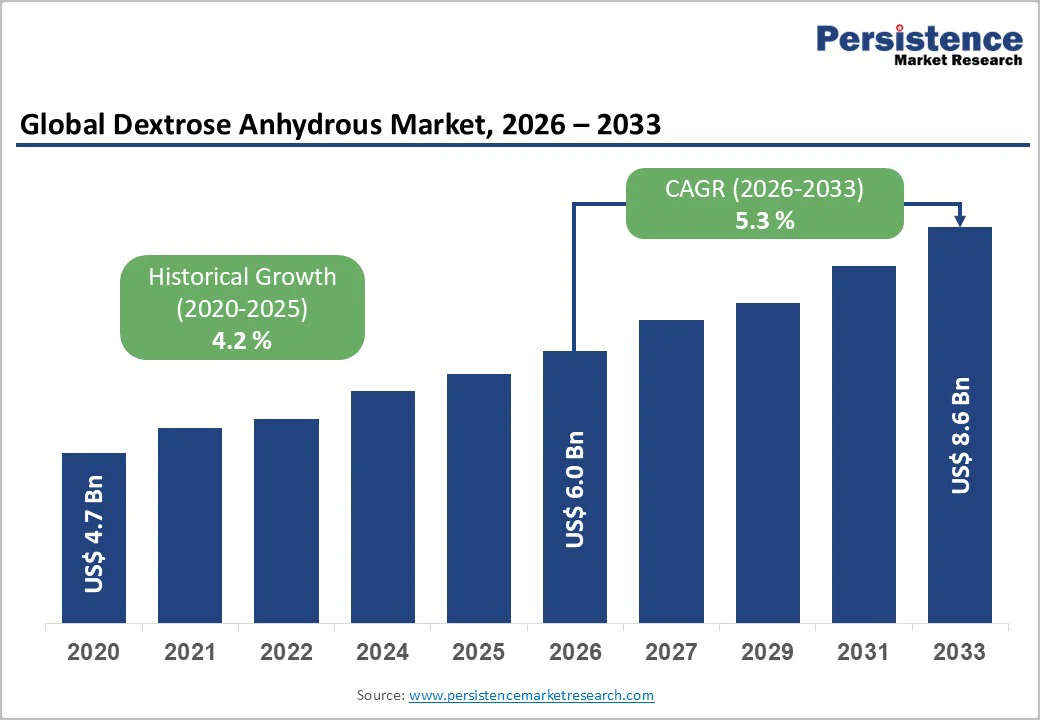
The global dextrose anhydrous market size is likely to be valued at US$6.0 billion in 2026, and is projected to reach US$8.6 billion by 2033, growing at a CAGR of 5.3% during the forecast period 2026-2033. The market is driven by the increasing use of the ingredient in food and beverage formulations as a food additive, in pharmaceutical applications, and in industrial processes.
Market growth is also supported by stricter global food safety regulations, rising demand for high-purity functional sweeteners, and expanding utilization in parenteral solutions and oral rehydration therapies. Regulatory approvals and standardized purity guidelines from international bodies continue to reinforce market confidence.
| Key Insights | Details |
|---|---|
|
Dextrose Anhydrous Market Size (2026E) |
US$6.0 Bn |
|
Market Value Forecast (2033F) |
US$ 8.6 Bn |
|
Projected Growth (CAGR 2025 to 2032) |
5.2 % |
|
Historical Market Growth (CAGR 2020 to 2025) |
5.3 % |
Dextrose anhydrous is expected to see strong demand across food, beverage, and pharmaceutical applications due to its versatility, stability, and functional properties. In food, it acts as a sweetener, humectant, and bulking agent, while in pharmaceuticals, it is widely used in intravenous solutions, oral rehydration therapies, and drug formulations requiring high purity. Consumer preference for clean-label ingredients and expanding processed food and healthcare sectors in emerging markets further drive adoption. Its compatibility across multiple product types ensures steady integration in formulations.
Regulatory standardization and supply chain efficiency are also strengthening market stability. Safety, purity, and labeling standards reduce compliance risks and facilitate international trade. Advances in raw material processing and starch-derived extraction improve yields and lower production bottlenecks. A well-integrated supply chain ensures consistent availability for food, pharmaceutical, and industrial applications. These factors collectively support continuous market expansion while maintaining reliability and quality, reinforcing the dextrose anhydrous market's long-term growth trajectory globally.
The production of dextrose anhydrous relies heavily on agricultural feedstocks such as corn and maize, making it sensitive to commodity price fluctuations driven by weather patterns, trade dynamics, and biofuel policies. Regional supply disruptions can temporarily increase costs, while energy-intensive processing adds further expense during periods of high energy prices. These factors create margin pressure for manufacturers, potentially limiting their production flexibility and constraining growth in the dextrose anhydrous market. Maintaining consistent output and cost efficiency remains a critical challenge, particularly for producers serving multiple applications across food, pharmaceutical, and industrial sectors.
Compliance with stringent regulatory standards adds another layer of constraint. Food and pharmaceutical-grade dextrose must meet strict safety, quality, and labeling requirements, including Good Manufacturing Practice (GMP) protocols, sterile processing, and pharmacopeia monographs. The associated testing, quality control, and documentation costs can be substantial, especially for smaller manufacturers. These compliance burdens may slow market entry, reduce competitiveness, and limit the ability to scale operations efficiently, particularly in emerging economies where regulatory infrastructure is evolving.
Unprecedented urbanization, growing middle-class populations, and increasing packaged food and healthcare consumption in Asia, the Middle East, Africa, and Latin America present significant growth opportunities for dextrose anhydrous. The expansion of healthcare infrastructure in these regions drives demand for intravenous fluids, oral rehydration solutions, and pharmaceutical formulations that require high-purity carbohydrate sources.
The global shift toward clean-label and multifunctional ingredients in personal care products, including skincare, haircare, and cosmetics, further supports adoption as a humectant and skin-conditioning agent. These trends collectively expand the potential market across food, pharmaceutical, and personal care segments, enabling suppliers to capture meaningful share through local production and strategic distribution partnerships.
Major players are actively expanding local manufacturing and distribution capabilities to meet rising domestic demand and strengthen supply chains. In September 2022, for example, Cargill established a new corn wet mill in Southeast Asia to support demand across Asia and Africa. Dextrose anhydrous is also benefiting from increased use in the bioprocessing and fermentation industries, serving as a carbon source for enzymes, organic acids, vitamins, and bio-based chemicals. Suppliers providing consistent, high-purity feedstock can capitalize on growth across industrial, food, and healthcare sectors, reinforcing a strong long-term growth trajectory.
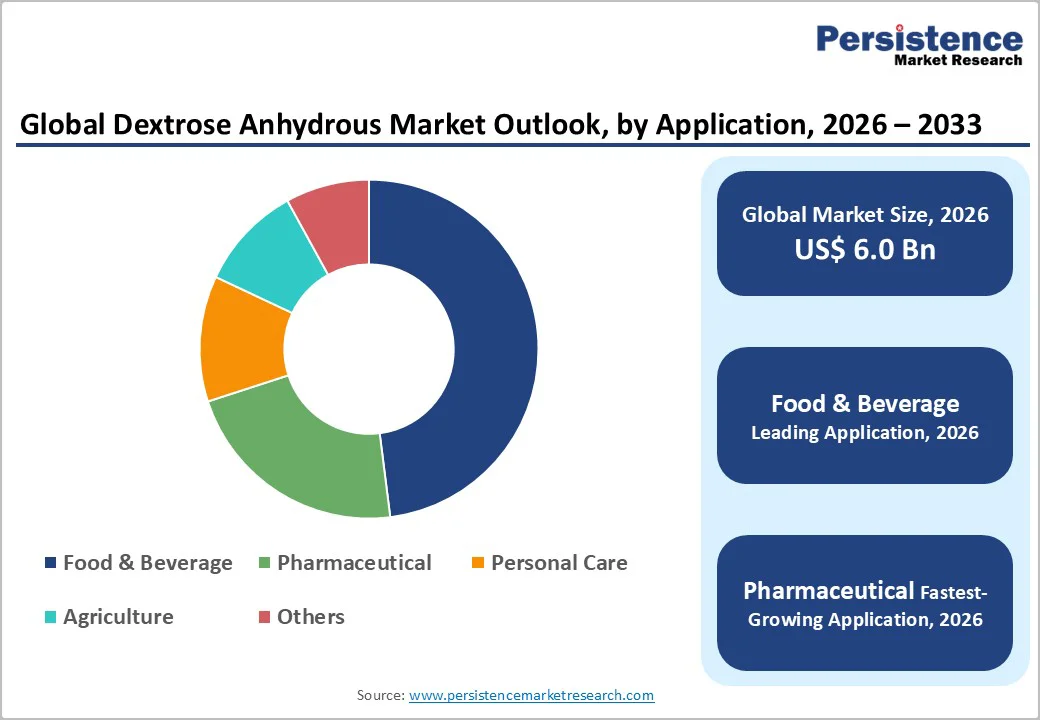
The powdered form is expected to dominate in 2026 with an estimated 47% of the dextrose anhydrous market revenue share, driven by its versatility and wide use across food, beverage, and pharmaceutical formulations. Its ease of handling, stability, and compatibility with multiple product types make it a preferred choice for manufacturers seeking consistency and reliable performance in production processes. Powdered dextrose is widely adopted in bakery, confectionery, dairy, and processed beverage applications due to its predictable sweetness profile, solubility, and functional properties. Its ability to support clean-label formulations and calorie-controlled products reinforces steady demand. Continued growth in both developed and emerging markets ensures that powdered dextrose maintains a strong market presence through 2033.
Crystalline dextrose is projected to grow at a CAGR of 5.8% through 2033, driven by its increasing use in confectionery and pharmaceutical tableting applications. Its high purity, low moisture content, and reliable performance under thermal processing make it ideal for specialized manufacturing needs. The segment benefits from rising demand in niche sectors requiring precise ingredient functionality, such as calorie-controlled confectionery and high-performance pharmaceutical formulations. Its solubility, sweetness, and compatibility with various matrices position crystalline dextrose for sustained high growth, particularly as manufacturers adopt more automated and efficiency-driven production methods.
The food & beverages segment is anticipated to lead in 2026 with an estimated 48% market share, driven by rising consumption of processed, packaged, and convenience foods worldwide. Dextrose’s functional properties as a sweetener, bulking agent, and fermentation substrate make it essential across bakery, confectionery, dairy, and ready-to-drink beverage products. Consumer preference for familiar, clean-label ingredients further strengthens adoption. The ingredient’s ability to stabilize moisture, enhance flavor, and support browning reactions ensures its continued relevance across global food categories. Growth in emerging markets and expanding processed food sectors sustains the segment’s leadership position through 2033.
Pharmaceutical applications are projected to grow at a CAGR of 6% from 2026 to 2033, fueled by expanding use in intravenous solutions, oral rehydration therapies, and parenteral nutrition. High-purity dextrose meets pharmacopeia standards, enabling standardized use across clinical and hospital settings. Rising chronic disease prevalence, aging populations, and growing healthcare access in developing markets further drive demand. Increased investment in healthcare infrastructure and pharmaceutical manufacturing capacity supports the adoption of dextrose as a reliable carbohydrate source, establishing pharmaceuticals as the fastest-expanding application segment globally.
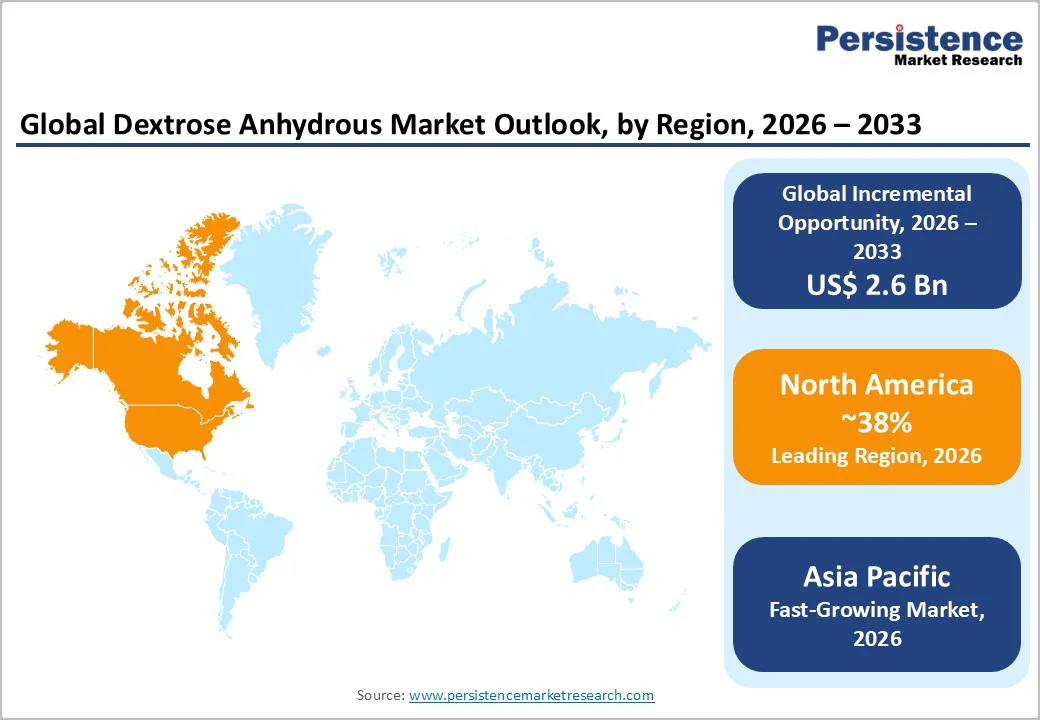
North America is expected to dominate with approximately 38% of the dextrose anhydrous market share in 2026. The growth is supported by a mature food and beverage industry, advanced pharmaceutical manufacturing, and well-defined regulatory frameworks. The United States dominates regional demand due to strong utilization in packaged foods, clinical nutrition, IV fluids, and high-purity pharmaceutical formulations. The recognition of dextrose as a Generally Recognized as Safe (GRAS) ingredient by the U.S. Food and Drug Administration (FDA) has enabled its widespread use, while stringent pharmaceutical standards have ensured consistent adoption in hospital and therapeutic applications. Growing demand for parenteral nutrition, rising chronic disease prevalence, and a robust biotechnology ecosystem further reinforce the market leadership of the region.
Multinational ingredient manufacturers with integrated supply chains lead the competitive landscape, enabled by investments in biotechnology, process automation, and digitalized production systems. Canada’s regulatory alignment with the U.S., along with its expanding food innovation sector, supports steady regional growth. Commitment to sustainability, labeling transparency, and rigorous compliance frameworks strengthens long-term market stability. North America’s established industrial base, strong regulatory oversight, and high consumption of high-purity ingredients are set to ensure its continued dominance through 2033.
Europe is projected to hold around 28% of the dextrose anhydrous market share in 2026. The regional market benefits from a strong demand for the ingredient across food, beverage, and pharmaceutical sectors, supported by mature consumption patterns in Germany, the U.K., France, and Spain. Regulatory harmonization under the European Food Safety Authority (EFSA) and the European Commission (EC) provides clear guidelines for safety, quality, and labeling, enabling manufacturers to maintain consistent formulations. High adoption is observed in processed foods, bakery, confectionery, dairy, and pharmaceutical-grade products. The combination of established industrial infrastructure and regulatory clarity strengthens investor confidence and ensures steady growth in high-purity dextrose consumption across Europe.
Germany remains the leading market for industrial food processing and pharmaceutical-grade sourcing, while the U.K. shows increasing adoption of clean-label and personal care ingredients. France’s bakery and confectionery sectors continue to drive consumption, and Spain benefits from expanding beverage production and functional food applications. European manufacturers emphasize sustainability, traceability, and ISO-certified food safety practices, while investments focus on environmentally efficient production, bio-based processes, and advanced automation. The mature market structure, combined with clear regulatory frameworks, supports long-term stability and sustained regional leadership in dextrose anhydrous applications.
The Asia Pacific market is expected to register the fastest growth with an estimated CAGR of 6.2% through 2033, driven by rapid urbanization, rising disposable incomes, and accelerated growth in processed food, beverage, and pharmaceutical manufacturing. China accounts for the largest regional share due to its extensive ingredient production capacity and growing domestic consumption of packaged foods and clinical nutrition products. Economies in India and ASEAN, including Indonesia, Thailand, and Vietnam, are experiencing increased adoption as healthcare systems modernize and food processing infrastructure expands. The region’s surge in beverage manufacturing, nutritional products, and fermentation-based industries further strengthens demand for high-purity dextrose.
The market in Asia Pacific also benefits from abundant raw materials, cost-efficient manufacturing environments, and improved logistical and industrial capabilities. Investments in biotechnology and large-scale fermentation processes, where dextrose serves as a key carbon source, are accelerating regional consumption. Regulatory frameworks across major markets are increasingly aligned with global standards, ensuring predictable product quality and market reliability. With structural manufacturing advantages, rising consumer markets, and strong expansion in pharmaceuticals and food processing, the Asia Pacific is positioned to act as the primary engine of global market growth during the forecast period 2026-2033.
The global dextrose anhydrous market structure is moderately consolidated, led by established ingredient manufacturers such as ADM, Cargill, Ingredion, Roquette, Tereos, Tate & Lyle, and Foodchem International, all of which maintain strong control over production capacity, quality consistency, and cross-regional distribution. These companies leverage large-scale starch processing infrastructure, advanced purification technologies, and strict compliance with global food and pharmaceutical standards to supply multiple high-purity grades. Their ability to serve diverse sectors, including food and beverages, clinical nutrition, fermentation, and personal care, reinforces their dominant position. Ongoing investments in process automation, sustainability-focused milling operations, and high-purity ingredient innovation further strengthen their global competitiveness.
Competing with these established giants are regional and emerging players such as Zhucheng Dongxiao Biotechnology, Gulshan Polyols, Sinosweet, and Qingdao Bright Moon that are rapidly expanding their presence, particularly across the Asia Pacific and Latin America. These companies are focusing on cost-efficient production, localized supply chains, and flexible product customization, enabling them to meet rising demand from bakery, confectionery, beverage, fermentation, and pharmaceutical manufacturers. As processed food consumption, biotechnology applications, and clinical nutrition requirements continue to grow globally, market competition is expected to intensify, with a stronger emphasis on purity optimization, energy-efficient production methods, and enhanced compatibility with clean-label formulations.
The global dextrose anhydrous market is projected to reach US$ 6.0 billion in 2026.
Key drivers include rising demand for high-purity sweeteners, growing use of dextrose in parenteral solutions, expanding fermentation-based ingredient production, and increasing adoption in processed foods and beverages.
The market is poised to witness a CAGR of 5.3 % from 2026 to 2033.
Major opportunities lie in bio-fermentation industries, clean-label food formulations, expansion of IV-grade dextrose manufacturing, and emerging usage in biotechnology and chemical synthesis.
Prominent market players include Roquette, Ingredion, Cargill, ADM, Tate & Lyle, Avebe, and Tereos.
| Report Attribute | Details |
|---|---|
|
Historical Data/Actuals |
2020 - 2025 |
|
Forecast Period |
2026 - 2033 |
|
Market Analysis |
Value: US$ Bn/Mn, Volume: As Applicable |
|
Geographical Coverage |
|
|
Segmental Coverage |
|
|
Competitive Analysis |
|
|
Report Highlights |
|
By Product Form
By Application
By Region
Delivery Timelines
For more information on this report and its delivery timelines please get in touch with our sales team.
About Author