




- Oil & Gas
- Casing Centralizer Market
Casing Centralizer Market Size, Share, and Growth Forecast, 2026 - 2033
Casing Centralizer Market by Product Type (Bow Spring Centralizers, Rigid Centralizers, Others), Material (Steel, Aluminum, Others), Connection Type, and Regional Analysis for 2026 - 2033

Casing Centralizer Market Size and Trends Analysis
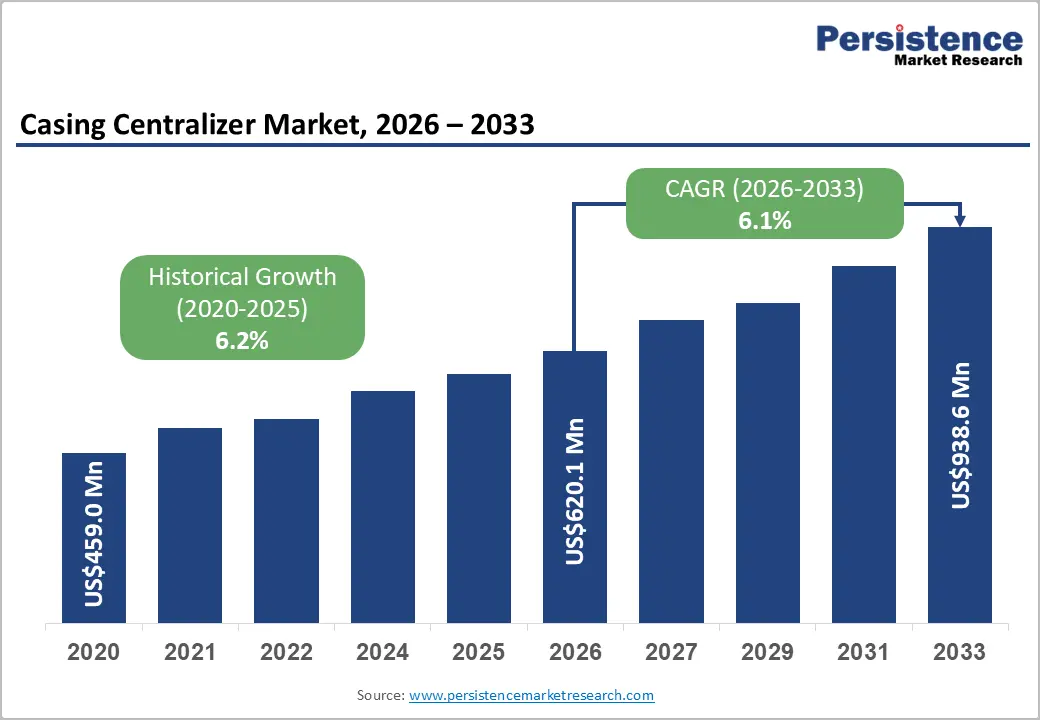
The global casing centralizer market size is likely to be valued at US$620.1 million in 2026 and is expected to reach US$938.6 million by 2033, growing at a CAGR of 6.1% between 2026 and 2033, driven by increasing offshore drilling activities, rising focus on well integrity, and growing adoption of advanced cementing technologies in complex well environments.
Demand for casing centralizers is also strengthening due to higher investments in deepwater exploration, horizontal drilling operations, and stringent standards for zonal isolation. Manufacturers are increasingly developing engineered and application-specific centralizers to improve casing placement, reduce cementing failures, and support operational efficiency across onshore and offshore projects.
Key Industry Highlights:
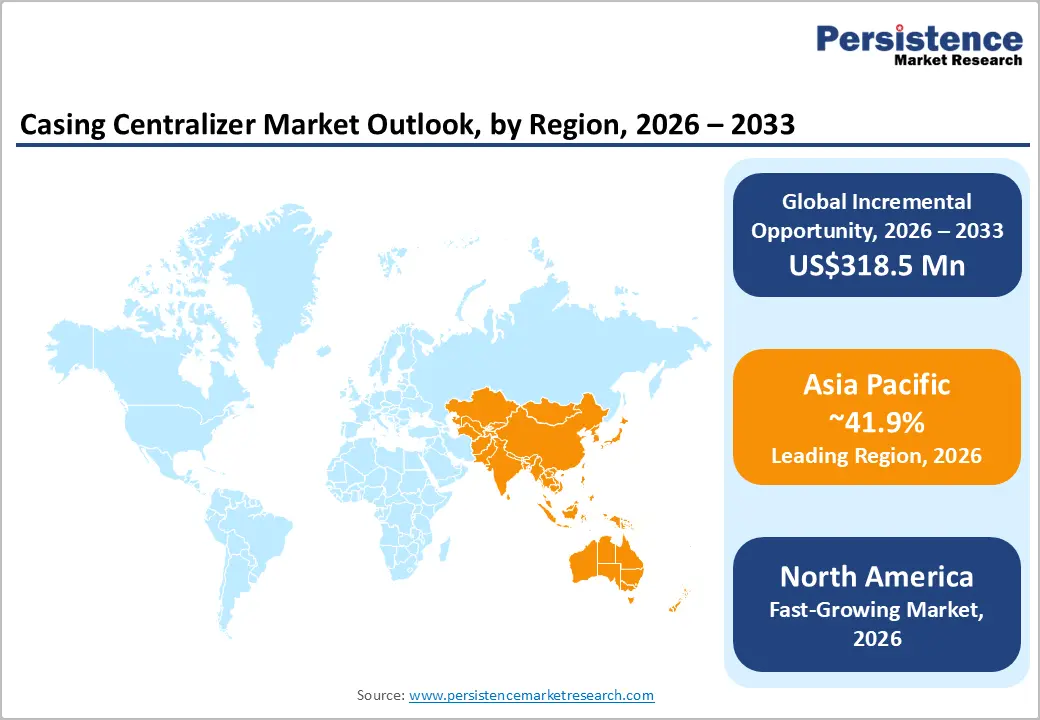
- Leading Region: Asia Pacific is projected to account for 41.9% of market share in 2026, driven by expanding offshore exploration, rising energy demand, and increasing upstream investments across China, India, Indonesia, and Australia.
- Fastest-growing Region: North America is anticipated to register the fastest growth due to increasing horizontal drilling activity, Gulf of Mexico offshore developments, and strong adoption of automated drilling and digital well-construction technologies.
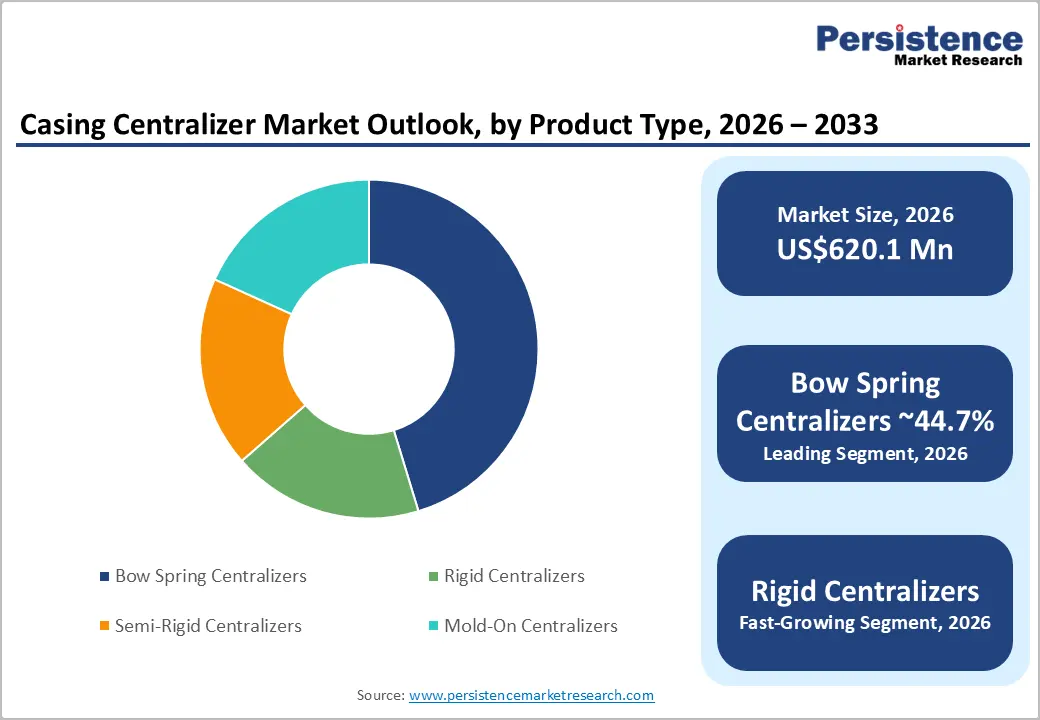
- Dominant Product Type: Bow spring centralizers are anticipated to account for 44.7% market share in 2026, supported by versatility across vertical, directional, and horizontal drilling applications.
- Leading Material: Steel centralizers are expected to hold 47.5% market share in 2026 due to superior durability, mechanical strength, and reliability in harsh downhole environments.
DRO Analysis
Driver - Rising Drilling Activity in Offshore and Deepwater Projects
The increasing number of offshore and deepwater drilling operations is one of the primary factors supporting demand for casing centralizers. Deepwater wells require precise casing positioning and effective cement placement to maintain well integrity under high-pressure and high-temperature conditions. As energy companies continue expanding exploration activities in the Gulf of Mexico, the North Sea, Brazil, West Africa, and Southeast Asia, demand for advanced well construction equipment is rising steadily.
Operators are increasingly focusing on minimizing nonproductive time and reducing cementing failures, which has increased the use of premium centralizers in deviated and horizontal wells. Offshore drilling projects typically involve higher operational risks and costs, making reliable casing centralization critical for maintaining zonal isolation and preventing gas migration. The growing complexity of extended-reach wells and multilayer reservoirs is also encouraging adoption of rigid and high-performance bow-spring centralizers capable of operating in challenging downhole environments.
Growing Focus on Well Integrity and Cementing Efficiency
The market is benefiting from stricter well-integrity standards and increasing emphasis on cementing efficiency across drilling operations. Industry standards related to casing placement and cementing performance have encouraged operators to deploy engineered centralizers that provide improved standoff and better cement distribution. In modern drilling programs, centralizers are no longer treated as simple accessories; instead, they are integrated into broader well-construction and cementing strategies.
Oilfield service companies are increasingly utilizing digital well-planning software, simulation tools, and automated cementing technologies to optimize casing placement. This trend is encouraging demand for customized centralizer solutions designed for specific well geometries and operating conditions. The adoption of automated drilling systems and digital well monitoring is further supporting the market because operators require high-performance centralizers capable of delivering repeatable results in complex wells. Companies offering API-compliant and application-specific products are expected to gain competitive advantages as operators prioritize reliability and long-term well performance.
Restraint - Volatility in Upstream Capital Spending and Cost Pressures
The casing centralizer market remains highly dependent on upstream oil and gas investments, making it vulnerable to fluctuations in crude oil prices and drilling budgets. During periods of reduced exploration spending, operators often delay drilling programs and reduce procurement of premium well-construction tools. This creates pricing pressure across the supply chain and intensifies competition among manufacturers.
Procurement teams are increasingly focused on reducing cost per well, which limits the adoption of higher-priced engineered centralizers unless clear operational benefits can be demonstrated. Smaller manufacturers also face challenges associated with raw material cost fluctuations, transportation expenses, and inventory management. In highly competitive drilling markets, buyers frequently prioritize pricing over product differentiation, resulting in margin pressure for suppliers. These cost-related challenges may slow replacement cycles and reduce the pace of technological adoption in price-sensitive regions.
Opportunity - Expansion of Offshore Exploration across Asia Pacific
Asia Pacific represents the largest long-term growth opportunity for casing centralizer manufacturers due to rising energy demand and expanding offshore exploration programs. Countries such as China, India, Indonesia, Malaysia, and Australia continue investing in oil and gas production to strengthen energy security and reduce import dependency. Offshore projects across the South China Sea, Indian offshore basins, and Southeast Asian waters are creating strong demand for high-performance centralization systems.
The region’s growing manufacturing capabilities also support market expansion. Local production facilities allow suppliers to reduce delivery times, improve customization capabilities, and address region-specific drilling requirements. Demand is expected to remain strong for centralizers designed for deepwater wells, extended-reach drilling, and corrosive offshore environments. Suppliers with regional manufacturing networks and application engineering expertise are likely to benefit significantly from upcoming offshore development projects across APAC.
Increasing Demand for Lightweight and Corrosion-Resistant Materials
Growing use of lightweight and corrosion-resistant materials is creating new growth opportunities for manufacturers. Operators are increasingly adopting aluminum and composite-material centralizers in applications where reduced weight, easier handling, and corrosion protection provide operational advantages. These materials are particularly attractive in offshore wells, geothermal drilling projects, and corrosive downhole environments.
Composite and thermoplastic centralizers are gaining attention as they reduce casing wear and improve compatibility with non-metallic casing systems. Lightweight designs also simplify installation procedures and reduce logistical costs during transportation and rig handling. As drilling programs continue expanding into harsher operating environments, demand for engineered materials capable of improving durability and reducing maintenance requirements is expected to increase steadily. This trend is encouraging manufacturers to invest in advanced material development and customized product solutions.
Category-wise Analysis
Product Type Insights
Bow spring centralizers are anticipated to account for 44.7% of the market share in 2026, supported by their versatility across vertical, directional, and horizontal wells. These centralizers provide a reliable restoring force and effective standoff while reducing drag during casing operations, improving cement distribution and zonal isolation. Their broad compatibility with different casing sizes and well profiles has made them the preferred choice in large onshore drilling programs across the U.S. Permian Basin and Middle Eastern oilfields.
Oilfield service providers continue to favor bow-spring designs because they are cost-efficient and easy to standardize across multiple drilling environments. Companies such as Weatherford and Halliburton offer advanced bow-spring systems with enhanced durability and high-temperature resistance for deeper wells and challenging drilling conditions. Growing shale drilling activity and increasing horizontal well deployment are expected to sustain segment dominance throughout the forecast period.
Rigid centralizers are anticipated to witness the fastest CAGR during the forecast period, due to rising offshore exploration and deepwater drilling investments. These centralizers provide superior structural strength and maintain consistent casing positioning in highly deviated and extended-reach wells where cementing precision is critical. Offshore operators in regions such as Brazil, the Gulf of Mexico, and Southeast Asia increasingly prefer rigid centralizers because they deliver stable standoff performance under high-pressure and high-temperature conditions.
Manufacturers, including NOV and Centek, are developing premium rigid designs for under-reamed and large-diameter wellbores to support complex offshore projects. Rising investments in deepwater exploration and technically demanding wells are expected to accelerate the adoption of rigid systems over the coming years.
Material Insights
Steel centralizers are anticipated to hold 47.5% of the market share in 2026, due to their high durability, mechanical strength, and resistance to harsh downhole environments. Steel remains the preferred material for most oilfield applications because it performs effectively under high pressure and elevated temperatures encountered in offshore and unconventional wells. Steel-based systems are widely used across North America and the Middle East, particularly in shale and offshore drilling operations requiring long operational life and a reliable restoring force.
Companies such as Weatherford and Drinol continue to develop corrosion-resistant coatings and high-strength steel designs to improve operational lifespan and reduce maintenance requirements. Strong operator familiarity and broad application compatibility continue to support the segment’s market leadership.
Aluminum centralizers are anticipated to register the fastest growth during the forecast period, owing to their lightweight properties and improved corrosion resistance. Operators increasingly prefer aluminum-based systems in offshore and remote drilling projects where reducing transportation costs and simplifying rig-site handling are important operational priorities. The material is gaining traction in offshore fields across Asia Pacific and the North Sea, where corrosive drilling environments can affect conventional steel systems.
Aluminum centralizers also improve installation efficiency and reduce manual handling risks during well construction. Manufacturers are increasingly introducing hybrid aluminum designs with enhanced strength and corrosion protection to support specialized offshore and geothermal drilling applications.
Regional Insights
North America Casing Centralizer Market Trends
North America is expected to be the fastest-growing region, supported by advanced drilling infrastructure, strong shale production activity, and the presence of leading oilfield service providers. The region continues to witness stable demand for premium casing centralizers due to increasing horizontal drilling operations, deepwell exploration, and growing focus on cementing efficiency in unconventional wells.
U.S. Casing Centralizer Market Trends
The U.S. dominates regional demand due to high drilling intensity across the Permian Basin, Eagle Ford, Bakken, and Gulf of Mexico. Operators increasingly utilize advanced bow-spring and rigid centralizers in extended-reach and horizontal wells to improve cement placement and maintain zonal isolation. Offshore drilling projects in the Gulf of Mexico are generating strong demand for weld-on and rigid centralizers capable of operating under high-pressure and high-temperature conditions.
The U.S. market also benefits from the presence of major manufacturers and technology providers such as Halliburton, SLB, Weatherford, and NOV. These companies continue investing in engineered products, automated manufacturing systems, and digital drilling technologies to support complex well environments.
Canada Casing Centralizer Market Trends
Canada remains an important contributor to regional growth due to expanding oil sands production and unconventional drilling activity in Alberta and British Columbia. Operators are increasingly focusing on reducing drilling downtime and improving cement integrity in long horizontal wells, which is driving demand for high-performance casing centralizers. The country’s harsh operating environments and deep drilling conditions support adoption of durable steel and corrosion-resistant centralizer systems. Growing investments in operational efficiency and environmental safety standards are also encouraging wider deployment of engineered cementing solutions across Canadian drilling projects.
Europe Casing Centralizer Market Trends
Market growth in Europe is driven primarily by offshore drilling activity in the North Sea and ongoing investments in mature field redevelopment. The region maintains strong demand for premium well-construction equipment due to strict operational standards, advanced offshore infrastructure, and increasing emphasis on well integrity and environmental compliance.
U.K. Casing Centralizer Market Trends
The U.K. remains one of the largest markets in Europe due to extensive offshore oil and gas operations in the North Sea. Operators increasingly require advanced rigid and weld-on centralizers capable of supporting high-pressure offshore wells and extended-reach drilling environments.
Growing investment in mature field optimization and offshore asset life extension is supporting demand for high-specification centralization systems. Companies operating in the U.K. offshore sector also prioritize products with strong traceability and certified performance standards to comply with strict regulatory requirements.
Norway Casing Centralizer Market Trends
Norway continues to play a significant role in the European market due to its technologically advanced offshore drilling sector. Deepwater exploration activities and complex subsea projects are increasing demand for premium casing centralizers designed for harsh offshore conditions.
Norwegian operators focus heavily on operational safety, environmental protection, and drilling efficiency, encouraging adoption of corrosion-resistant materials and engineered rigid systems. Increasing digital integration in offshore well planning is also contributing to demand for advanced centralization technologies.
Asia Pacific Casing Centralizer Market Trends
Asia Pacific is the largest regional market, accounting for 41.9% of the global casing centralizer market share, supported by rising energy demand, expanding offshore exploration, and increasing upstream investments across major economies. The region benefits from rapid industrialization, growing domestic energy consumption, and strong government support for oil and gas production activities.
China Casing Centralizer Market Trends
China remains the leading market in the region due to substantial investments in offshore and unconventional oil and gas production. The country continues expanding exploration activities in offshore basins and shale formations to strengthen domestic energy security and reduce dependence on imports.
Chinese operators increasingly require rigid and high-performance centralizers for deepwater drilling and high-pressure wells. Growth in automated drilling technologies and large-scale offshore projects is further supporting demand for engineered centralization systems.
India Casing Centralizer Market Trends
India is emerging as one of the fastest-growing markets due to rising offshore exploration activities in the Krishna-Godavari Basin, Mumbai High, and eastern offshore regions. Increasing investments in deepwater drilling and energy infrastructure are accelerating demand for premium casing centralizers. Government initiatives to expand domestic hydrocarbon production and reduce energy imports are encouraging exploration in technically challenging offshore areas. Demand for corrosion-resistant and lightweight centralizers is also increasing as operators focus on operational efficiency and long-term well integrity.
Asia Pacific’s strong manufacturing base and cost-efficient production capabilities provide a major competitive advantage for the regional market. Local suppliers increasingly compete through customization, shorter delivery timelines, and application-specific engineering support.
Competitive Landscape
The global casing centralizer market is moderately fragmented, with competition shared between large integrated oilfield service providers and specialized well-construction equipment manufacturers. Major participants compete through technological innovation, product reliability, manufacturing scale, and global distribution capabilities. Integrated service providers focus on bundled drilling and cementing solutions, while specialist manufacturers emphasize customized engineering, rapid delivery, and application-specific designs.
Leading companies are prioritizing innovation, customization, and regional expansion strategies to strengthen market presence. Manufacturers are investing in lightweight materials, automated manufacturing, and engineered product designs to improve operational efficiency and reliability. Strategic focus areas also include offshore market expansion, rapid product delivery, and integration of digital well-planning technologies into drilling workflows.
Key Industry Developments:
- In April 2025, Halliburton and Nabors Industries achieved the first fully automated surface and subsurface rotary drilling execution in Oman using integrated LOGIX™ and SmartROS® systems, strengthening automation capabilities for complex drilling operations.
- In March 2025, NOV launched the ReedHycalog™ Evolve performance drill bit product line designed to improve drilling efficiency, extend lateral reach, and reduce operational costs in harsh and abrasive drilling environments.
Companies Covered in Casing Centralizer Market
- Halliburton
- SLB
- Baker Hughes
- Weatherford International
- NOV Inc.
- Centek Group
- Antelope Oil Tool & Manufacturing Company
- Summit Casing Equipment
- TAM International
- NCS Multistage Holdings
- Innovex International
- Dril-Quip
- NeOz Energy
- Maxwell Oil Tools
- kwik-ZIP
- DIC Oil Tools
Frequently Asked Questions
The global casing centralizer market is anticipated to reach US$620.1 million in 2026.
The market is projected to reach approximately US$938.6 million by 2033.
Key market trends include rising offshore and deepwater drilling investments, increasing adoption of rigid and lightweight centralizers, growing use of corrosion-resistant materials, and integration of digital well-construction technologies to improve cement placement accuracy.
Bow spring centralizers represent the leading product segment with an anticipated 44.7% market share in 2026, owing to their versatility across vertical, directional, and horizontal drilling applications.
The market is projected to grow at a CAGR of 6.1% between 2026 and 2033.
Major companies operating in the market include SLB, Halliburton, Baker Hughes, Weatherford, and NOV.


