




- Inks, Coatings, Adhesives & Sealants (ICAS)
- Biodegradable Electronics Market
Biodegradable Electronics Market Size, Share, and Growth Forecast, 2026 - 2033
Biodegradable Electronics Market by Product Type (Biodegradable Sensors, Biodegradable Circuit Boards, Others), Material (Biopolymers, Compostable Materials, Natural Fiber Composites), Application, End-user, and Regional Analysis for 2026 - 2033

Biodegradable Electronics Market Size and Trends Analysis
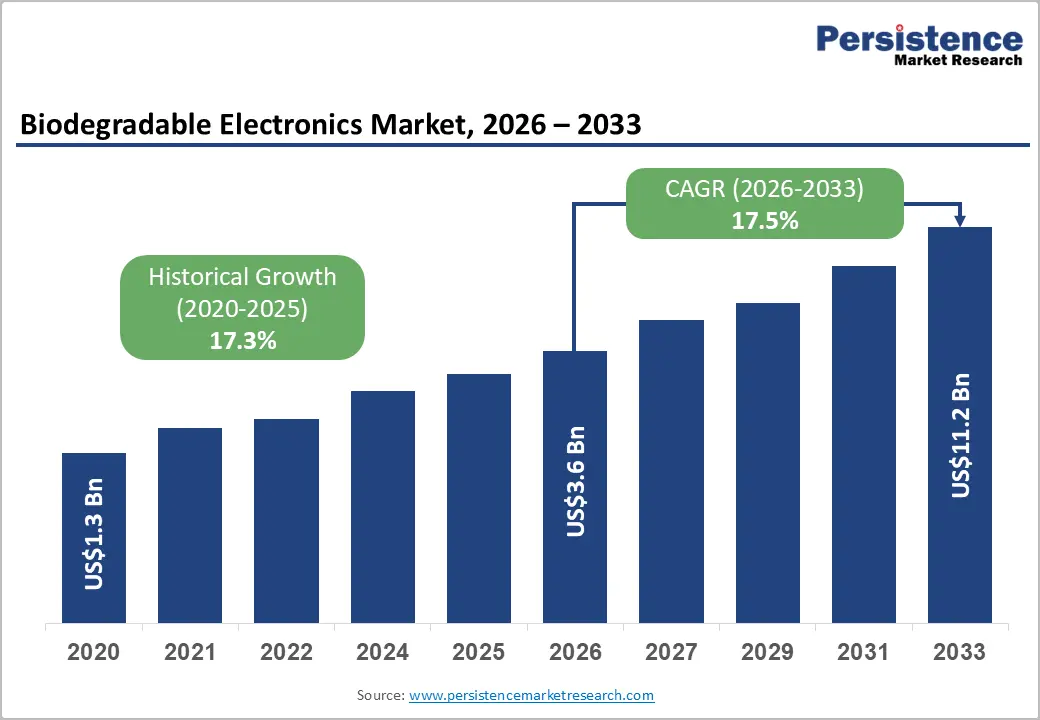
The global biodegradable electronics market size is likely to be valued at US$3.6 billion in 2026 and is expected to reach US$11.2 billion by 2033, growing at a CAGR of 17.5% during the forecast period from 2026 to 2033, driven by strong momentum as industries increasingly shift toward sustainable and eco-friendly technologies to address the escalating issue of electronic waste.
Biodegradable electronics, also known as transient electronics, are designed with materials that naturally decompose after their functional lifecycle, significantly reducing long-term environmental impact. With e-waste levels continuing to rise and recycling systems struggling to keep pace, there is a growing need for innovative solutions that minimize waste generation at the source.
Advancements in material science, especially in biopolymers, compostable substrates, and natural fiber composites, are enhancing the performance, flexibility, and durability of biodegradable electronic devices, making them more commercially viable. Increasing demand from healthcare applications is also a major contributor, as biodegradable implants and diagnostic devices eliminate the need for surgical removal, improving patient outcomes and reducing medical waste.
Key Industry Highlights:
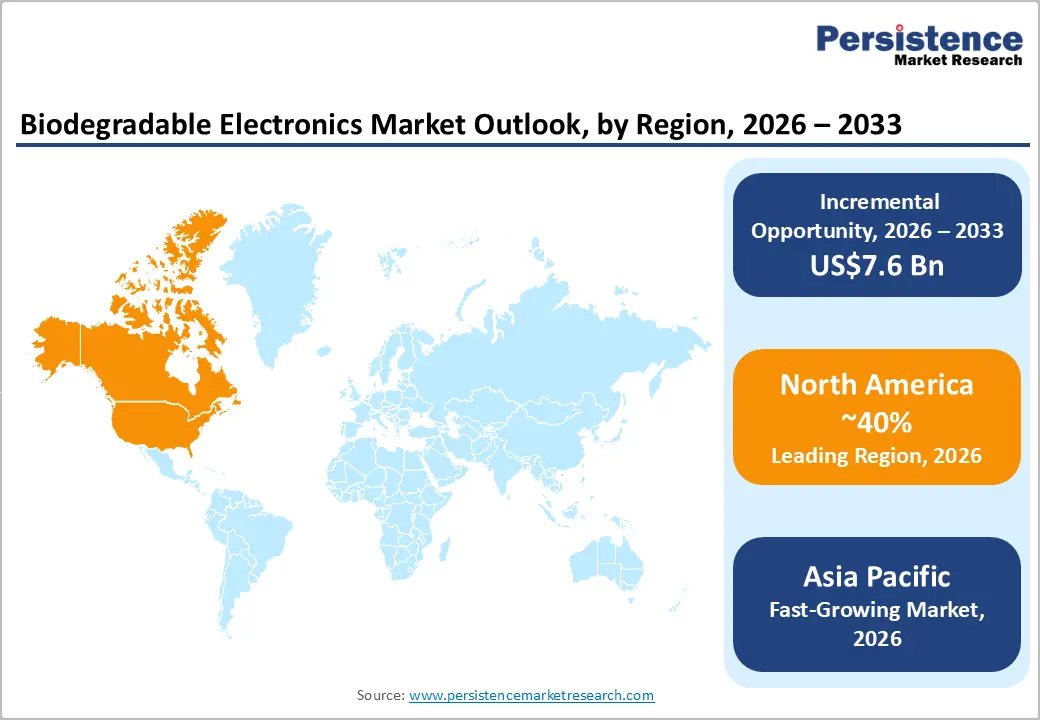
- Leading Region: North America is anticipated to be the leading region, accounting for 40% market share in 2026, driven by strong innovation ecosystems, stringent environmental regulations, and high adoption across healthcare, defense, and advanced technology sectors.
- Fastest-growing Region: Asia Pacific is likely to be the fastest-growing region, supported by strong manufacturing capabilities, rapid industrialization, and increasing adoption of sustainable electronics across key economies.
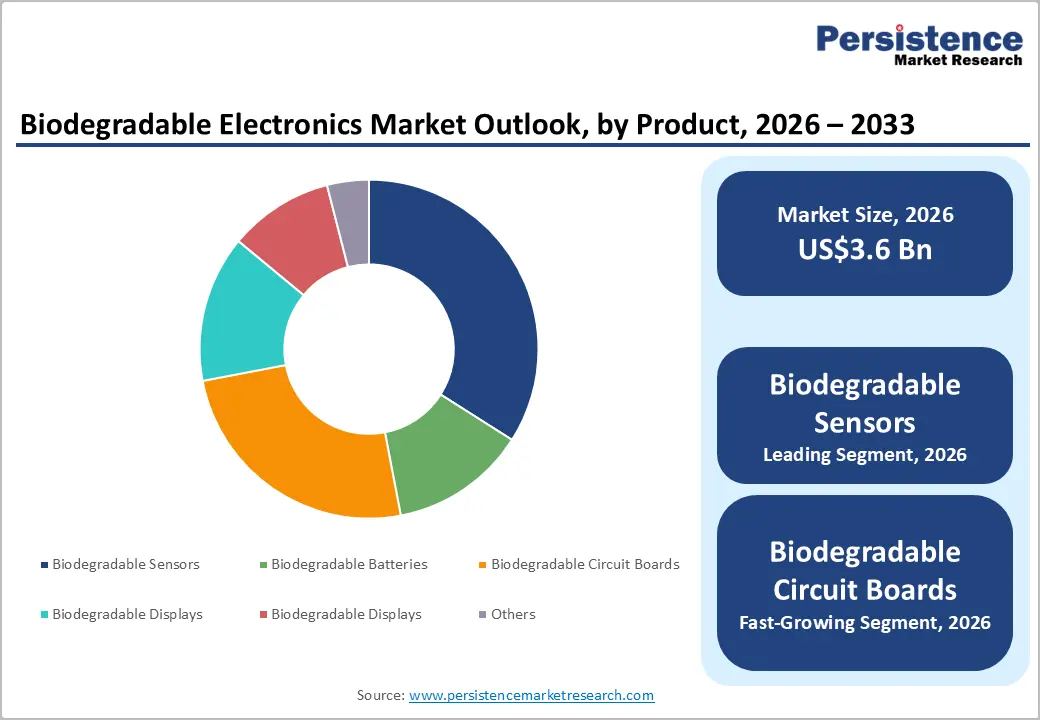
- Leading Product Type: Biodegradable sensors are projected to represent the leading product type in 2026, accounting for 45% of the revenue share, driven by increasing demand in medical diagnostics, environmental monitoring, and smart packaging applications.
- Leading Material Type: Biopolymers are anticipated to be the leading material type, accounting for over 50% of revenue in 2026, supported by strong scalability, broad material versatility, and increasing integration into flexible and printed electronic systems.
| Key Insights | Details |
|---|---|
| Biodegradable Electronics Market Size (2026E) | US$3.6 Bn |
| Market Value Forecast (2033F) | US$11.2 Bn |
| Projected Growth (CAGR 2026 to 2033) | 17.5% |
| Historical Market Growth (CAGR 2020 to 2025) | 17.3% |
DRO Analysis
Driver - Rising Regulatory Pressure on E-Waste Management
Governments and environmental agencies are implementing stricter policies to reduce electronic waste accumulation, improve recycling efficiency, and limit the use of hazardous substances in electronic products. These regulations are encouraging manufacturers to redesign electronic devices using sustainable and decomposable materials. Extended producer responsibility requirements compel companies to manage the environmental impact of products throughout their lifecycles. This regulatory shift is driving innovation in transient electronics, especially in short-life devices such as sensors and disposable circuits.
Along with regulatory enforcement, sustainability commitments, and circular-economy initiatives, these initiatives are reinforcing the transition toward biodegradable electronic systems. Industries are being pushed to minimize landfill contribution and adopt materials that safely degrade after use without harming ecosystems. This is particularly important in sectors that generate large volumes of short-lived electronic devices. Companies are investing in research into eco-friendly materials and redesigning products to align with evolving environmental standards. The growing pressure from both government bodies and consumers is encouraging faster commercialization of biodegradable components.
Technological Advancements in Biodegradable Materials
Innovations in biopolymers, compostable substrates, and natural fiber composites are enhancing electrical performance, flexibility, and integration potential with modern electronic systems. These developments are enabling biodegradable components to move beyond experimental stages into practical applications across multiple industries. Improvements in conductive bio-inks and printed electronics are allowing the production of lightweight and flexible circuits. Such progress is enabling the design of transient devices that meet functional requirements while maintaining environmental sustainability.
Continuous research in material science and nanotechnology is strengthening the performance and adaptability of biodegradable electronic systems. Enhanced material formulations are improving conductivity, stability, and controlled degradation rates, making devices more reliable for short-term applications. This is enabling wider adoption in healthcare monitoring, environmental sensing, and wearable technologies. Integration of advanced fabrication techniques is also reducing production complexity and improving design precision. As material innovation continues, biodegradable electronics are becoming more scalable and efficient.
Restraint - Performance and Durability Limitations
These materials often struggle to match the electrical conductivity, mechanical strength, and long-term stability of conventional electronic components. Exposure to environmental factors such as humidity, heat, and moisture can accelerate degradation and reduce device reliability. This makes biodegradable electronics less suitable for applications requiring continuous performance or high operational precision. Industries such as automotive, aerospace, and industrial automation often require long-lasting, highly stable components, and biodegradable alternatives still face functional constraints.
Ongoing research efforts are focused on improving the structural integrity and functional reliability of biodegradable materials, but achieving consistent performance remains challenging. Variations in material composition and degradation behavior can lead to unpredictable device lifespans, which complicates product design and deployment. Balancing biodegradability with performance efficiency creates engineering trade-offs that slow commercialization. While hybrid material approaches are being explored, they often increase complexity and cost.
Scalability and Manufacturing Infrastructure Constraints
Scalability and manufacturing infrastructure constraints significantly limit the mass production of biodegradable electronics. Unlike traditional semiconductor manufacturing, biodegradable electronic components require specialized processes and bio-based raw materials that are not yet widely integrated into existing production systems. Limited availability of large-scale fabrication facilities and standardized manufacturing techniques restricts output capacity. Production costs remain relatively high due to small-scale operations and the need for specialized equipment.
Another key challenge is the inconsistency in raw material supply chains and the lack of mature industrial ecosystems for biodegradable electronics. Variability in bio-based material quality can affect product uniformity and manufacturing efficiency. Integration of biodegradable components into existing electronic assembly lines is also complex, requiring redesign of processes and equipment. Limited industry-wide standardization creates barriers to scalability and trade.
Opportunity - Expansion in Medical and Healthcare Applications
Expansion into medical and healthcare applications offers strong growth potential for biodegradable electronics, particularly in temporary implants, diagnostic sensors, and drug-delivery systems. These devices offer the advantage of safely degrading inside the body after completing their function, eliminating the need for surgical removal. This reduces patient risk, medical costs, and recovery time. Biodegradable sensors can monitor internal conditions such as temperature, pressure, or biochemical signals, making them highly suitable for post-operative care and short-term diagnostics.
Advancements in biocompatible materials and implantable electronic systems are expanding the use of biodegradable electronics in personalized healthcare. These technologies are increasingly being integrated into smart medical devices that support real-time monitoring and targeted therapy. Hospitals and research institutions are actively exploring transient electronics for applications in wound healing, cardiovascular monitoring, and drug release systems. The ability to eliminate device retrieval procedures makes them highly attractive for both patients and healthcare providers.
Growth in Environmental Monitoring and Smart Agriculture
Disposable sensors are increasingly being used to monitor soil quality, water pollution, temperature, and humidity without generating long-term electronic waste. These devices are particularly useful in remote or hard-to-reach environments where retrieval is impractical. Their biodegradable nature ensures minimal environmental impact after use. This is driving adoption in environmental conservation projects and climate monitoring systems, where large networks of temporary sensors are required for data collection.
In smart agriculture, biodegradable electronics are supporting precision farming techniques that improve productivity and resource efficiency. These sensors help farmers monitor crop health, irrigation levels, and soil nutrients in real time, enabling data-driven agricultural decisions. Their temporary deployment nature makes them ideal for seasonal farming cycles and large agricultural fields. Increasing focus on sustainable agriculture and food security is driving demand for eco-friendly monitoring solutions.
Category-wise Analysis
Product Type Insights
Biodegradable sensors are expected to lead the biodegradable electronics market, accounting for approximately 45% of revenue in 2026, driven by their extensive adoption in healthcare diagnostics, environmental monitoring, and smart packaging systems. Their dominance is supported by high compatibility with flexible substrates, printed electronics technology, and scalable manufacturing processes that allow integration into compact and disposable devices. These sensors are widely used in applications that require temporary data collection without generating electronic waste. For example, in medical diagnostics, biodegradable biosensors are used for short-term internal health monitoring, such as wound healing and glucose tracking, where they safely degrade after completing their function.
Biodegradable circuit boards are likely to represent the fastest-growing segment, supported by increasing demand for sustainable alternatives to conventional printed circuit boards used in disposable and short-life electronic devices. Their growth is supported by advancements in bio-composite substrates, flexible printed electronics, and eco-friendly conductive materials that enable reliable circuit performance while ensuring controlled decomposition after use. For example, biodegradable circuit boards are increasingly used in single-use medical diagnostic kits, where the electronic components perform short-term monitoring tasks and then safely degrade, eliminating the need for disposal and reducing environmental impact.
Material Type Insights
Biopolymers are projected to lead the market, capturing around 50% of the revenue share, supported by their strong scalability, material versatility, and compatibility with electronic manufacturing processes. Materials such as PLA and PHA derivatives are widely used in biodegradable electronic substrates, insulating layers, and flexible circuit components. Their established production infrastructure and support for printing and molding technologies make them highly suitable for large-scale applications. For example, in disposable healthcare devices, biopolymer-based substrates are used in temporary diagnostic patches that monitor patient vitals and safely decompose after use.
Natural fiber composites are likely to be the fastest-growing material type, driven by increasing demand for fully renewable and environmentally safe electronic components. These materials offer superior biodegradation properties and are gaining traction in eco-sensitive applications such as agriculture and environmental monitoring systems.
Growth is supported by rising sustainability certifications and the push toward reducing plastic-based electronic waste. For example, natural fiber composite-based agricultural sensors are deployed in smart farming to monitor soil moisture and nutrient levels during a single crop cycle, then naturally decompose into the soil.
Regional Insights
North America Biodegradable Electronics Market Trends
North America is anticipated to be the leading region, accounting for a market share of 40% in 2026, driven by increasing regulatory pressure on electronic waste management and high investments in sustainable technologies. The region benefits from a strong research and development ecosystem supported by universities, innovation labs, and government-backed sustainability programs. The rising adoption of eco-friendly materials in healthcare devices, consumer electronics, and environmental monitoring systems is driving market expansion. For example, IBM is actively investing in advanced materials research and sustainable electronics solutions to support next-generation eco-friendly computing and sensor technologies.
The region is also experiencing rapid commercialization of biodegradable components driven by growing demand from the healthcare and defense sectors. Increasing focus on circular economy practices and corporate sustainability goals is encouraging manufacturers to replace traditional electronic materials with biodegradable alternatives. Advanced manufacturing capabilities and early adoption of emerging technologies such as IoT-enabled disposable sensors are accelerating market penetration. Consumer and industry environmental awareness is driving strong demand for sustainable electronic solutions.
Europe Biodegradable Electronics Market Trends
Europe is likely to be a significant market for biodegradable electronics, due to strict environmental regulations such as the European Green Deal and a strong emphasis on reducing electronic waste. Increasing investments in green electronics research and material innovation are supporting the development of biodegradable sensors, circuits, and packaging solutions. For example, Stora Enso Oyj is actively developing renewable and bio-based material solutions to support sustainable packaging and electronic substrate development, aligning with Europe’s green transition goals.
Strong participation from universities and innovation centers is accelerating breakthroughs in biopolymers, compostable substrates, and flexible electronics. The growing demand for sustainable consumer electronics and smart packaging is driving market expansion. Companies are increasingly aligning their strategies with EU sustainability targets, promoting eco-design and low-impact manufacturing processes. This structured regulatory environment, combined with strong innovation capability, is positioning Europe as a key region for the long-term development and adoption of biodegradable electronics technologies.
Asia Pacific Biodegradable Electronics Market Trends
The Asia Pacific region is likely to be the fastest-growing region, driven by strong manufacturing capabilities, rapid industrialization, and increasing government support for sustainable technologies. The region benefits from cost-effective production infrastructure and large-scale electronics manufacturing ecosystems, which support the rapid commercialization of biodegradable components. Increasing demand for consumer electronics, wearable devices, and IoT-based applications is driving adoption.
The region is also witnessing significant innovation in material science and flexible electronics, supported by both domestic companies and international collaborations. For example, Panasonic Holdings Corporation is actively developing sustainable electronic components and energy-efficient technologies aligned with environmental goals. Expanding applications in smart agriculture, environmental monitoring, and healthcare are increasing market growth. Rising focus on scalable production and low-cost biodegradable materials is making Asia Pacific a hub for manufacturing and export of transient electronics.
Competitive Landscape
The global biodegradable electronics market exhibits a moderately fragmented structure, driven by increasing demand for sustainable electronic materials, rapid advancements in biodegradable polymers, and rising regulatory pressure on e-waste reduction. The market is characterized by a mix of large chemical conglomerates, electronics manufacturers, and specialized startups focusing on transient electronics, biodegradable sensors, and flexible circuit technologies.
With key leaders including BASF SE, Evonik Industries AG, Merck KGaA, PragmatIC Semiconductor Ltd., and Stora Enso Oyj, along with emerging innovators such as bio-electronics startups and printed electronics firms, the market shows strong participation from both materials and device manufacturers. These players compete through continuous innovation in bio-based polymers, development of transient circuits and sensors, strategic collaborations with research institutions, and expansion into high-growth applications such as medical implants, IoT-enabled disposable devices, and environmental sensing systems.
Key Industry Developments:
- In January 2026, PragmatIC Semiconductor Ltd. announced the expansion of its next-generation flexible and ultra-thin semiconductor platform, focused on low-cost disposable electronics for smart packaging and IoT applications. The development emphasizes reduced material usage and improved scalability for transient electronic systems, supporting the shift toward sustainable and low-waste electronic manufacturing.
- In May 2025, BASF SE advanced its bio-based polymer solutions portfolio aimed at electronic-grade sustainable materials. The company introduced enhanced biodegradable polymer formulations designed for use in flexible circuit substrates and eco-friendly electronic packaging materials.
Companies Covered in Biodegradable Electronics Market
- Samsung Electronics Co. Ltd.
- BASF SE
- Merck KGaA
- Xerox Corporation
- Fujifilm Holdings Corporation
- Agfa-Gevaert Group
- Evonik Industries AG
- Stora Enso Oyj
- PragmatIC Semiconductor Ltd.
- Nano Dimension Ltd.
- Imprint Energy, Inc.
- BeFC (Bioenzymatic Fuel Cells)
- Avery Dennison Corporation
- Enfucell Oy
Frequently Asked Questions
The global biodegradable electronics market is projected to reach US$3.6 billion in 2026.
The biodegradable electronics market is driven by rising e-waste concerns, strict environmental regulations, and growing demand for sustainable and transient electronic devices.
The biodegradable electronics market is expected to grow at a CAGR of 17.5% from 2026 to 2033.
Key market opportunities in biodegradable electronics include expansion in medical implants, environmental monitoring systems, smart agriculture, and sustainable IoT-based disposable devices.
Samsung Electronics Co. Ltd., BASF SE, Merck KGaA, Xerox Corporation, Fujifilm Holdings Corporation, and Agfa-Gevaert Group are the leading players.


