




- Automotive Components & Materials
- Automotive Maintenance Tools Market
Automotive Maintenance Tools Market Size, Share, and Growth Forecast, 2026 - 2033
Automotive Maintenance Tools Market by Product Type (Hand Tools, Power Tools, Diagnostic Tools, Mechanical Tools, Cutting Tools), Vehicle Type (Motorcycle, Passenger Cars, Others), End-user, and Regional Analysis for 2026 - 2033

Automotive Maintenance Tools Market Size and Trends Analysis
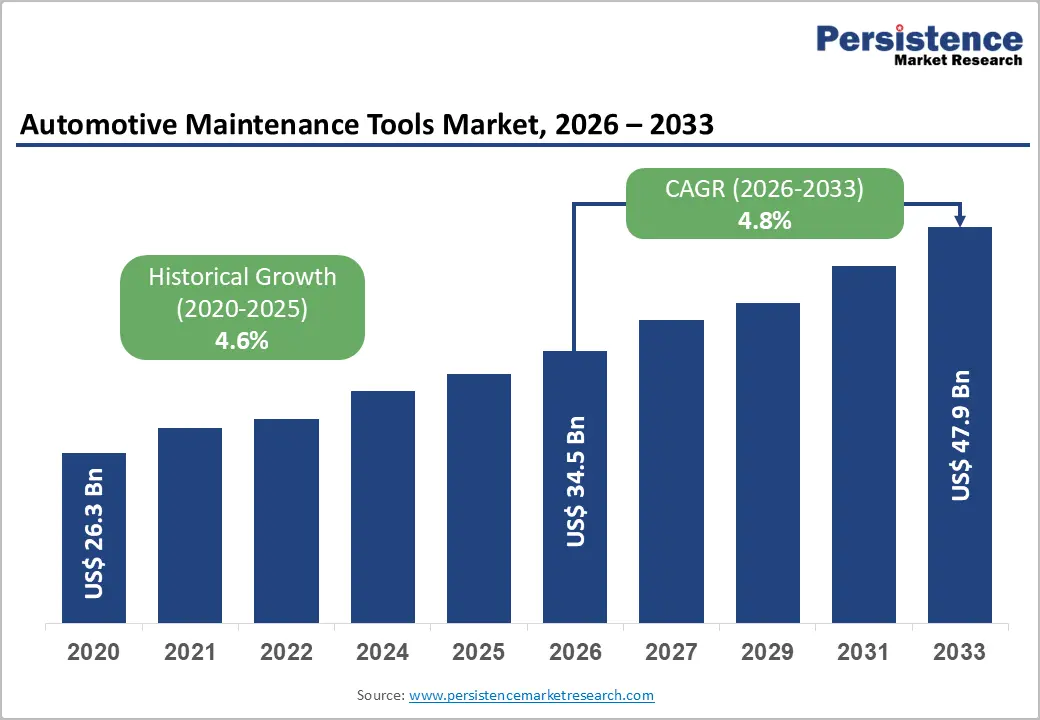
The global automotive maintenance tools market size is likely to be valued at US$34.5 billion in 2026 and is expected to reach US$47.9 billion by 2033, growing at a CAGR of 4.8% during the forecast period from 2026 to 2033, driven by the expanding vehicle parc, increasing vehicle complexity, and the shift toward technologically advanced mobility solutions.
Modern vehicles equipped with electronics, connectivity, and advanced driver-assistance systems are accelerating demand for precision diagnostic and calibration tools. The rapid adoption of electric vehicles is reshaping tool requirements, emphasizing insulated tools, battery servicing equipment, and software-based diagnostics.
Key Industry Highlights:
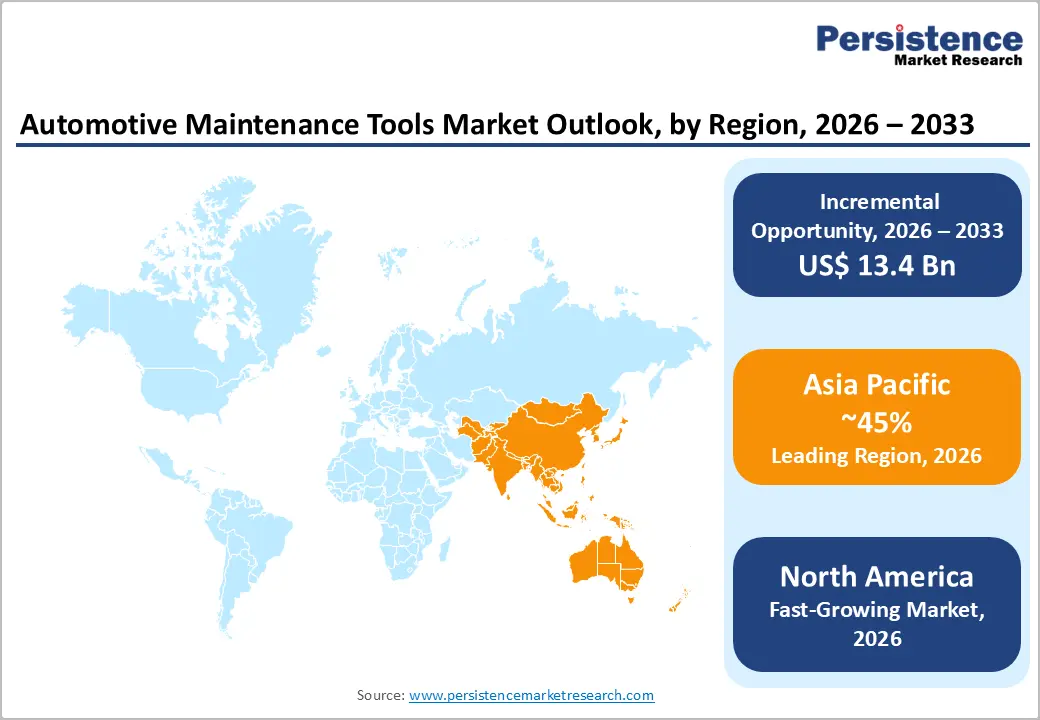
- Leading Region: Asia Pacific is anticipated to be the leading region, accounting for a market share of 45% in 2026, driven by rising vehicle parc, aging vehicles, expanding aftermarket demand, and increasing adoption of advanced and EV-specific maintenance tools.
- Fastest-growing Region: North America is likely to be the fastest-growing region, supported by advanced service infrastructure, high vehicle ownership, strong aftermarket demand, and rapid adoption of diagnostic and EV servicing technologies.
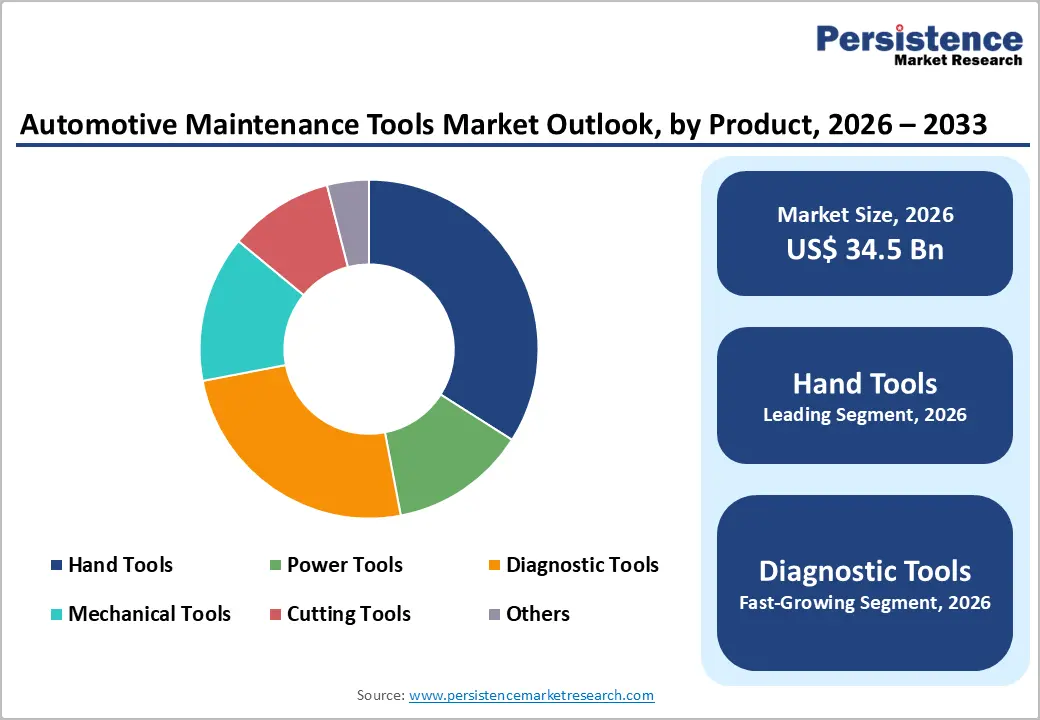
- Leading Product Type: Hand tools are projected to represent the leading product type in 2026, accounting for 40% of the revenue share, driven by their essential use in routine maintenance and broad applicability across users.
- Leading Vehicle Type: Passenger cars are anticipated to be the leading vehicle type, accounting for over 55% of the revenue share in 2026, supported by the largest vehicle parc and frequent servicing needs.
- Key Opportunity: The automotive maintenance tools market is witnessing a major shift toward EV-first, software-driven smart diagnostic ecosystems, where tools are evolving into connected platforms that replace traditional mechanical servicing with real-time, data-powered vehicle intelligence.

DRO Analysis
Driver - Proliferation of Electric and Hybrid Vehicles
The surge in electric and hybrid vehicle adoption is reshaping the automotive maintenance tools market. According to the International Energy Agency Global EV Outlook 2024, global EV registrations surpassed 14 million in 2023, with over 40 million electric vehicles on the road, significantly accelerating demand for specialized automotive maintenance tools such as insulated torque wrenches, high-voltage disconnect tools, and EV-specific diagnostic systems.
This rapid electrification is driving workshops to adopt advanced battery-handling equipment, software-enabled diagnostics, and safety-focused tools designed for high-voltage systems, while hybrid vehicles increase complexity, creating strong demand for versatile, precision-driven, and technologically advanced maintenance tool solutions across evolving automotive service ecosystems.
Restraint - Fragmentation of End-user Base and Skill Gaps
The automotive maintenance tools market faces a significant challenge due to the highly fragmented end-user base, which includes independent garages, authorized service centers, fleet operators, and individual consumers. This fragmentation creates inconsistencies in tool adoption, purchasing capacity, and technology integration, limiting the uniform growth of advanced tools across the market. Smaller workshops often operate with budget constraints, restricting their ability to invest in high-cost diagnostic equipment or EV-specific tools.
The growing skill gap among technicians presents another critical barrier, particularly as vehicles become more electronically sophisticated. Many service providers lack adequately trained personnel capable of handling advanced diagnostics, ADAS calibration, and high-voltage systems safely and efficiently. This shortage of skilled labor reduces the effective utilization of modern tools, impacting service quality and operational efficiency.
Opportunity - Technological Convergence with Smart and EV-Specific Tools
Modern automotive tools now feature digital interfaces, wireless connectivity, and real-time data analytics, enabling faster, more accurate diagnostics and predictive maintenance across increasingly complex vehicle systems. The rise of connected vehicles is strengthening this shift by increasing demand for tools that can interface with onboard systems, support software updates, and interpret complex data streams.
The automotive maintenance tools market is entering a high-value transformation phase as Tier-1 brands accelerate development of EV-specific toolkits integrated with smart diagnostics and connected servicing capabilities. Companies are also aligning with OEM certification programs and expanding training ecosystems to build EV-focused technician expertise, enabling broader access to franchise-independent workshops and enhancing advanced service capabilities.
Category-wise Analysis
Product Type Insights
Hand tools are expected to lead the automotive maintenance tools market, accounting for approximately 40% of revenue in 2026, driven by their universal applicability, low cost, and essential role in routine vehicle servicing across workshops, OEM service centers, and DIY users. These tools, including wrenches, sockets, and pliers, are widely preferred due to their durability, ease of use, and consistent demand across all vehicle categories. For example, socket wrench sets are widely used in passenger and heavy vehicle servicing for quick adjustments, making them essential in repair operations.
Diagnostic tools are likely to represent the fastest-growing segment, supported by increasing vehicle electronic complexity, EV adoption, and ADAS integration, requiring precise fault detection and calibration. Modern vehicles rely heavily on onboard electronics, increasing the need for advanced scanning and software-based tools for accurate servicing. For instance, OBD scanners are widely used in EV workshops to detect battery faults and software errors, improving repair efficiency.
Vehicle Type Insights
Passenger cars are projected to lead the market, capturing around 55% of the revenue share in 2026, supported by the largest vehicle parc and frequent maintenance cycles driven by daily usage patterns. High vehicle ownership in developed and emerging economies ensures steady demand for maintenance tools across workshops and service centers. For example, hatchback and sedan servicing relies heavily on hand and diagnostic tools for engine, brake, and electrical checks, reinforcing passenger car dominance.
Light commercial vehicles (LCVs) are likely to be the fastest-growing application, driven by the rapid expansion of e-commerce, logistics, and last-mile delivery services, which significantly increase vehicle utilization and maintenance frequency. These vehicles require frequent servicing to ensure operational uptime, driving demand for efficient and durable maintenance tools. For instance, delivery vans in logistics fleets require frequent brake and suspension servicing, increasing the use of power and diagnostic tools.
Regional Insights
North America Automotive Maintenance Tools Market Trends
North America is expected to be the fastest-growing region in the automotive maintenance tools market in 2026, driven by a large vehicle parc, an aging vehicle fleet, and a well-established aftermarket service ecosystem. The U.S. dominates the regional market, accounting for nearly 78% of the share, supported by advanced automotive infrastructure and high vehicle ownership rates. Companies such as Snap-on play a significant role, with their precision hand and diagnostic tools widely used across professional workshops, enhancing repair efficiency across both OEM and independent service networks.
The region is strengthened by structured markets in Canada and Mexico, where aging vehicle fleets, seasonal operating conditions, and growing logistics activity are increasing maintenance frequency and tool usage. Canada shows stable demand driven by harsh climate-related wear and compliance-based servicing, while Mexico is emerging as a fast-expanding hub due to rising vehicle ownership and commercial fleet growth.
Europe Automotive Maintenance Tools Market Trends
Europe is likely to be a significant market for automotive maintenance tools, due to increasing vehicle complexity, strong regulatory frameworks, and rapid electrification across the region. A key driver is the rising adoption of ADAS, EVs, and software-defined vehicles, increasing demand for advanced diagnostic and calibration tools. For example, Bosch diagnostic tools are widely used in European garages for multi-brand and EV servicing, supporting the shift toward digital repair systems.
The rapid adoption of electric vehicle servicing tools and smart diagnostic systems is driven by accelerating EV penetration and strong policy support for green mobility. The expansion of EV infrastructure is creating demand for specialized tools such as high-voltage safety equipment, battery servicing kits, and connected diagnostic platforms capable of real-time system analysis. Independent workshops are upgrading to handle EV and hybrid models, supported by OEM collaborations and training programs.
Asia Pacific Automotive Maintenance Tools Market Trends
The Asia Pacific region is anticipated to be the leading region, accounting for a market share of 45% in 2026, driven by rapid vehicle electrification, expanding automotive production hubs, and rising adoption of advanced diagnostic and EV servicing tools. A key driver is the accelerating adoption of EVs and hybrid vehicles, which is increasing demand for smart, connected, and high-voltage maintenance tools. For example, Autel provides diagnostic scanners in Asia Pacific workshops for multi-brand servicing, ECU programming, and EV battery diagnostics, supporting digital repair systems.
The integration of AI-enabled, wireless, and cloud-connected diagnostic tools that support real-time monitoring and predictive maintenance. Workshops are increasingly transitioning from conventional mechanical tools to advanced systems capable of ADAS calibration, EV battery servicing, and complex electronic fault detection. Government support for EV adoption and smart mobility infrastructure is accelerating this shift.
Competitive Landscape
The global automotive maintenance tools market is moderately fragmented, driven by rising vehicle complexity, increasing EV adoption, and strong demand from both professional workshops and DIY users. The competitive environment is shaped by continuous innovation in diagnostic systems, cordless tools, and EV-specific servicing equipment, along with growing emphasis on digital integration and smart workshop solutions.
With key leaders including Snap-on, Bosch, Stanley Black & Decker, Makita Corporation, and Apex Tool Group, the market is highly innovation-driven and globally competitive. These players compete through product innovation, expansion of EV-compatible tool portfolios, strategic partnerships with automotive service networks, and distribution channels. Increasing R&D, digital diagnostics, and ergonomic designs are intensifying competition, while regional players compete on pricing and customization in emerging markets.
Key Industry Developments:
- In April 2026, the Auto Care Association launched the “Tools for Tomorrow’s Technicians” high school vocational grant program, aimed at supporting workforce development in the automotive aftermarket. The initiative, backed by the Tool and Equipment community, focuses on addressing the growing skills gap by encouraging technical education and preparing future technicians for advanced vehicle technologies, including modern diagnostic systems and EV servicing tools.
- In February 2025, Snap-on joined the Tekion Strategic Partner Program, integrating its EPC system with Tekion’s Automotive Retail Cloud platform. This partnership enables dealers to directly access Snap-on’s parts lookup and ordering tools within a unified digital workflow, automatically syncing VIN and customer data to improve accuracy and speed in repair order processing.
- In March 2025, Bosch Power Tools launched a new range of hand tools in India, expanding its portfolio with over 100 products, including wrenches, pliers, screwdrivers, and ratchet sets, designed for professional and industrial applications.
Companies Covered in Automotive Maintenance Tools Market
- Snap-on
- Bosch
- Husky Corporation
- Matco Tools
- Craftsman
- DeWalt
- K Tool International
- Lisle Corporation
- Astro Pneumatic Tool
Frequently Asked Questions
The global automotive maintenance tools market is projected to reach US$34.5 billion in 2026.
The automotive maintenance tools market is driven by rising vehicle parc, increasing vehicle complexity, EV adoption, and growing demand for efficient repair and diagnostic solutions.
The automotive maintenance tools market is expected to grow at a CAGR of 4.8% from 2026 to 2033.
Key market opportunities include the rising demand for EV-specific tools, smart diagnostic technologies, and the expansion of advanced aftermarket service networks.
Snap-on, Bosch, Husky Corporation, Matco Tools, Craftsman, DeWalt, K Tool International, and Lisle Corporation are the leading players.


