ID: PMRREP12172| 199 Pages | 7 Nov 2025 | Format: PDF, Excel, PPT* | Chemicals and Materials
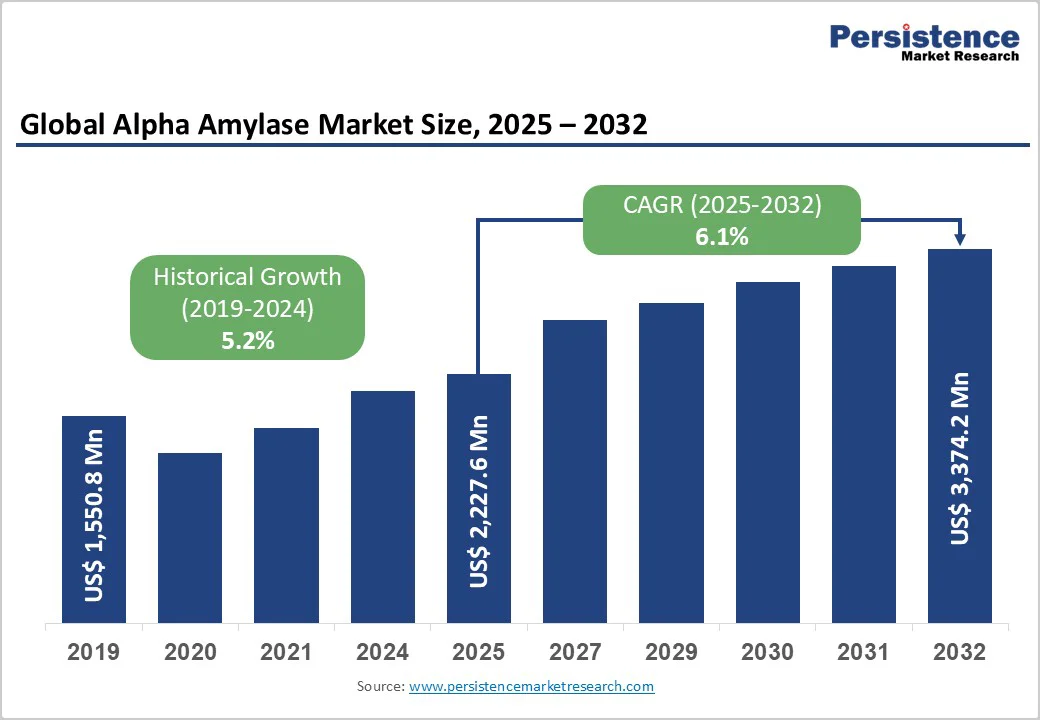
The global alpha amylase market size is likely to be valued at US$2.2 billion in 2025, and is projected to reach US$3.4 billion by 2032, growing at a CAGR of 6.1% during the forecast period 2025-2032. The market is primarily driven by an escalating demand from the food and beverage industry, particularly in baking and brewing applications, where alpha amylase enhances product quality and shelf life.
Rising consumer awareness regarding health and wellness, coupled with the growing preference for natural and clean-label ingredients, continues to fuel market expansion across multiple end-use industries, including pharmaceuticals, animal feed, and emerging biofuel applications. The enzyme's proven ability to support digestive health, immune function, and provide energy optimization positions it as an increasingly critical component in functional food formulations and pharmaceutical preparations.
| Key Insights | Details |
|---|---|
|
Alpha Amylase Market Size (2025E) |
US$ 2.2 Bn |
|
Market Value Forecast (2032F) |
US$ 3.4 Bn |
|
Projected Growth (CAGR 2025 to 2032) |
6.1% |
|
Historical Market Growth (CAGR 2019 to 2024) |
5.2% |
Consumer consciousness of health and nutrition has fundamentally shifted global food consumption patterns, creating substantial demand for products with demonstrable health benefits. Alpha amylase, scientifically proven to enhance digestion, support immune system function, and normalize blood sugar levels, has become increasingly sought after as a functional ingredient. This health-conscious consumer shift directly correlates with the enzyme's expanded adoption across food and beverage formulations. With sedentary lifestyles and unhealthy dietary patterns contributing to rising prevalence of digestive disorders, manufacturers across both food and pharmaceutical sectors are responding by incorporating alpha amylase into health-focused product lines.
The bio-preservation movement represents an unprecedented transformation in food manufacturing practices as artificial preservatives increasingly face consumer rejection. Alpha amylase plays a critical role in this transition by extending shelf life through natural enzymatic processes while maintaining food safety standards and sensory qualities. As consumers demand clean-label products with minimal chemical additives, food producers across dairy, beverage, and bakery sectors actively integrate alpha amylase into preservation protocols. This trend is particularly pronounced in developed markets where regulatory scrutiny of synthetic additives is intensifying.
The regulatory landscape for food enzymes poses significant compliance challenges, particularly across geographically diverse markets with varying regulatory frameworks. For example, the European Food Safety Authority (EFSA) operates a comprehensive authorization process requiring extensive safety documentation and efficacy data for each enzyme application and source strain. Unlike the United States, where regulatory pathways are more streamlined, the European Union (EU) maintains distinct regulations governing food enzymes and processing aids, creating market fragmentation and compliance costs.
Different national regulatory standards across Asia Pacific, Latin America, and Middle East necessitate localized product registration and documentation, extending market entry timelines and increasing costs for manufacturers. These regulatory complexities particularly disadvantage smaller regional players while favoring multinational corporations with established regulatory and quality infrastructure.
The pharmaceutical and nutraceutical sectors present expanding opportunities for alpha amylase applications beyond traditional food processing. Alpha amylase's scientifically validated properties in supporting immune system function, managing inflammatory conditions, and normalizing blood glucose levels align with growing pharmaceutical industry demand for enzyme-based therapeutic solutions.
The prevalence of digestive disorders and metabolic diseases has been consistently rising globally, creating a dire need for innovative drug delivery systems and therapeutic agents to be developed by pharmaceutical manufacturers that alpha amylase can facilitate. This segment is experiencing faster growth rates than traditional food applications, with estimated market expansion in pharmaceutical applications outpacing overall market growth rates. Research institutions and pharmaceutical companies increasingly invest in enzyme engineering and protein modification technologies to develop alpha amylase variants with enhanced bioavailability and therapeutic efficacy.
The powder & granules segment dominates the alpha amylase market revenue share, due to their superior stability, ease of handling, and compatibility with established food processing systems. Powder formulations offer operational advantages such as longer shelf life, simplified dosing, and broad adaptability across bakery, brewery, and starch processing applications. Their leadership is supported by decades of industry standardization, well-developed supply chains, and economies of scale that enable cost-effective production. These formulations often include both single-enzyme and multi-enzyme blends optimized for specific industrial uses.
In contrast, liquid alpha amylase formulations represent the fastest-growing market segment, gaining traction in specialized applications that demand precise dosing and flexible integration. Liquids enable direct injection into production streams and rapid dispersion, enhancing efficiency and bioavailability. Their expansion is fueled by advances in enzyme stabilization, improved formulation chemistry, and rising adoption in pharmaceuticals and next-generation food processing, where flexibility and dosing accuracy justify premium pricing.
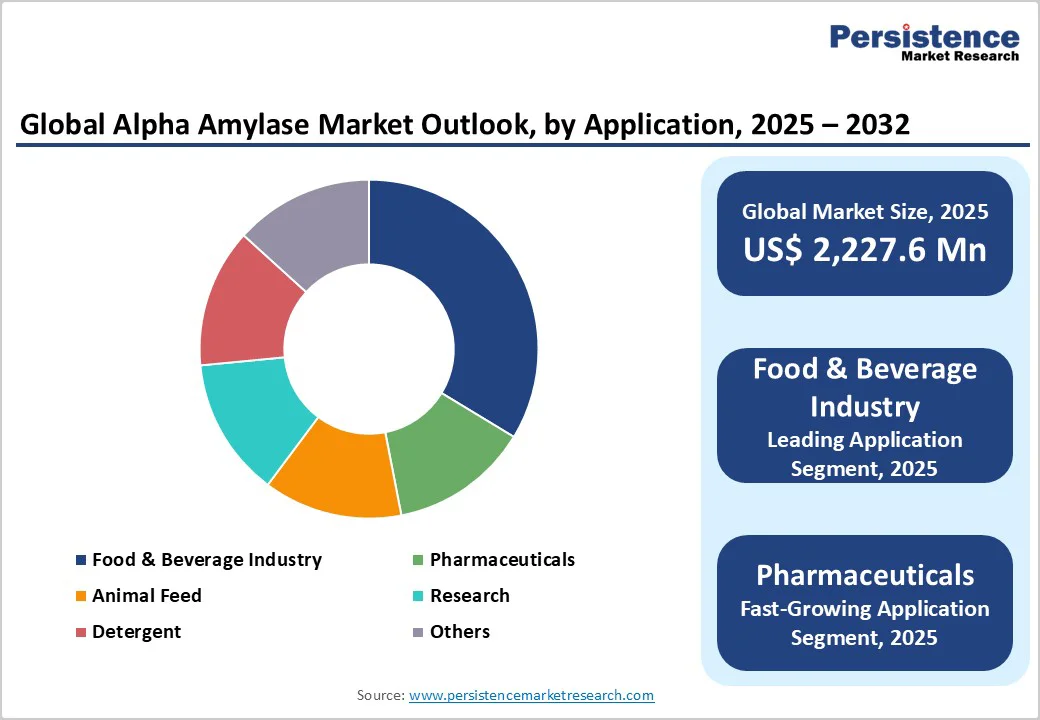
The alpha amylase market growth is primarily driven by the food and beverage industry, which accounts for more than half of total demand due to the enzyme’s essential role in diverse processing applications. Within this sector, bakery products represent the dominant sub-segment, where alpha amylase improves dough handling, enhances loaf volume, and extends shelf life while supporting the clean-label trend by reducing reliance on chemical improvers. Brewing applications rank as the second-largest use area, as alpha amylase optimizes sugar conversion, fermentation efficiency, and beer stability.
The pharmaceutical and nutraceutical sectors are emerging as the fastest-growing application areas. Expanding research into enzyme-based formulations highlights alpha amylase’s therapeutic benefits in digestive health, inflammation control, and metabolic regulation. With the rising demand for natural and functional healthcare solutions, this segment’s growth is outpacing traditional food applications, signaling a strategic industry shift toward high-value, biologically active enzyme products.
Bacterial alpha amylase, accounting for the majority of production, is expected to continue to lead the market due to its superior efficiency, scalability, and cost-effectiveness. Produced primarily using Bacillus and Aspergillus strains, bacterial enzymes exhibit exceptional thermostability, rapid fermentation cycles, and high yields, ensuring consistent large-scale output. The use of solid-state fermentation (SSF) with agricultural waste as a substrate has further enhanced cost efficiency and sustainability, reducing dependency on synthetic media. Decades of process standardization, regulatory familiarity, and well-established supply chains have solidified the bacterial segment’s position as the market incumbent.
On the other hand, fungal-derived alpha amylase is emerging as the fastest-growing segment, supported by innovations in fermentation technology and expanding industrial applications. Strains such as Aspergillus oryzae offer broader pH tolerance, improved substrate compatibility, and enhanced thermostability. Regulatory approvals and adoption of eco-friendly SSF technologies using renewable feedstock are accelerating commercialization, positioning fungal enzymes as vital contributors to sustainable and diversified enzyme production growth.
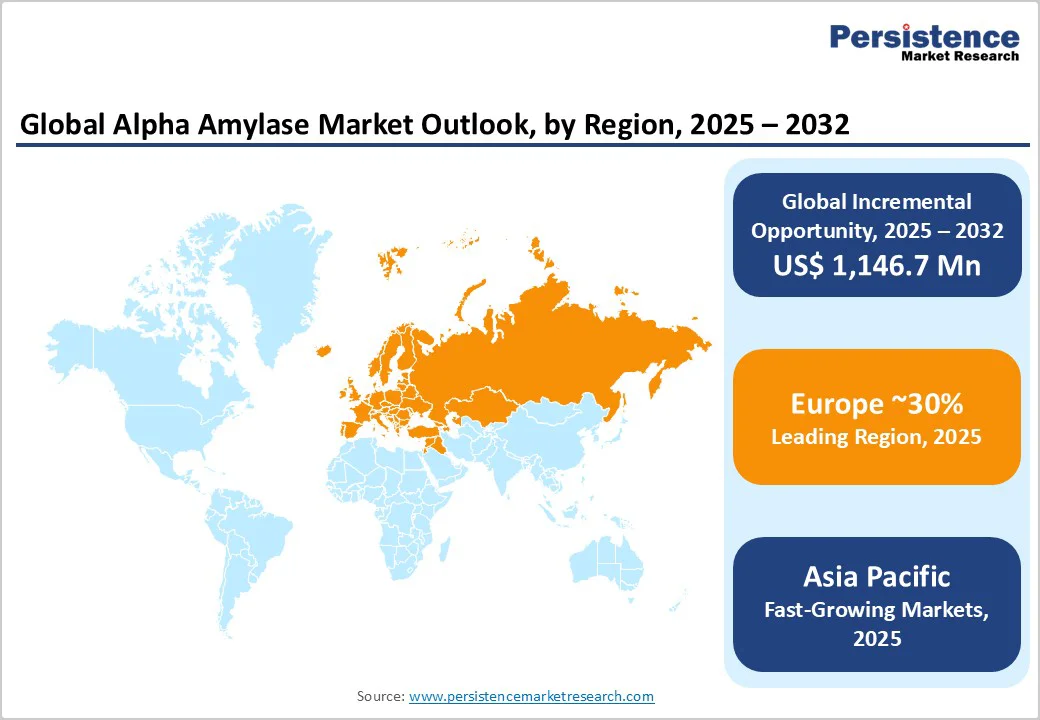
Europe is slated to dominate the market with the highest volume share of around 28% in 2025, attributable to the region's extensive biotechnology infrastructure, well-established food processing industries, and advanced regulatory frameworks supporting enzyme innovation. Germany, the United Kingdom, France, and Spain represent key markets within the European landscape, each supporting distinct application profiles. Germany's position as a biotechnology hub hosts major enzyme manufacturers including AB Enzymes, headquartered in Germany with production facilities in Finland, supporting regional innovation and market leadership.
The EU’s strict food safety regulations and EFSA oversight have established compliance frameworks that, while challenging for market entry, ultimately support product quality standards and consumer confidence. Bio-preservation trends and clean-label ingredient preferences are particularly pronounced in European consumer markets, driving alpha amylase adoption across bakery, dairy, and beverage sectors. Geographic proximity to major enzyme suppliers and established distribution networks support competitive pricing and rapid product availability.
North America is anticipated to maintain a substantial regional market share, driven by robust baking and food processing industries, advanced biotechnology infrastructure, and stringent regulatory frameworks supporting enzyme adoption. The United States represents the dominant market within the region, supported by significant ethanol production capacity and robust pharmaceutical research sectors, creating alpha amylase demand across multiple applications. The region holds approximately 39% of the global food enzymes market, reflecting mature industry development and high enzyme adoption rates across commercial food manufacturing.
Government incentives promoting renewable energy and bio-based industries support bioethanol production growth, incrementally increasing alpha amylase demand for fuel ethanol applications. Regulatory frameworks, while more streamlined than European systems, maintain rigorous safety and efficacy standards supported by U.S. Food and Drug Administration (FDA) oversight and established enzyme registration protocols. Investment trends reflect strong R&D spending by multinational corporations seeking novel applications and enhanced enzyme performance characteristics
The global alpha amylase market exhibits a moderately consolidated structure with significant concentration among multinational enzyme manufacturers and growing competition from regional and specialized producers. Major players including Novozymes A/S, DuPont (through IFF Nutrition & Biosciences), DSM, AB Enzymes, Amano Enzyme, and International Flavors & Fragrances (IFF) collectively maintain substantial market share, estimated at over 50% globally, reflecting established technological capabilities, regulatory expertise, and global distribution infrastructure.
The competitive landscape is further characterized by distinct regional dynamics, with European dominance among established manufacturers and emerging competition from Asian producers gaining market presence through cost-competitive production and expanding application portfolios. Smaller specialized enzyme producers and regional manufacturers continue gaining market share through niche application focus, customized formulation capabilities, and localized customer support.
The global alpha amylase market is estimated to reach US$ 2.2 billion in 2025.
The key market driver is the rising demand from the global food and beverage industry, particularly in bakery, brewing, and processed food applications.
The alpha amylase market is poised to witness a CAGR of 6.1% from 2025 to 2032.
Growing demand from the healthcare industry for enzyme-based therapeutic solutions and increasing investment in enzyme engineering and protein modification technologies by pharmaceutical companies are key market opportunities.
Novozymes A/S, DuPont, DSM, Puratos N.V., and Infinita Biotech are a few leading players in the market.
| Report Attribute | Details |
|---|---|
|
Historical Data/Actuals |
2019 - 2024 |
|
Forecast Period |
2025 - 2032 |
|
Market Analysis Units |
Value: US$ Bn/Mn, Volume: As Applicable |
|
Geographical Coverage |
|
|
Segmental Coverage |
|
|
Competitive Analysis |
|
|
Report Highlights |
|
By Form
By Application
By Source
By Region
Delivery Timelines
For more information on this report and its delivery timelines please get in touch with our sales team.
About Author