




- Media & Entertainment
- AI in Social Media Market
AI in Social Media Market Size, Share, and Growth Forecast 2026 - 2033
AI in Social Media Market by Functionality (Content Creation & Management, Campaign & Community Management), Deployment (On-premises, Cloud), Application (Customer Service, Sales), End-user, and Regional Analysis, 2026 - 2033

AI in Social Media Market Size and Trends Analysis
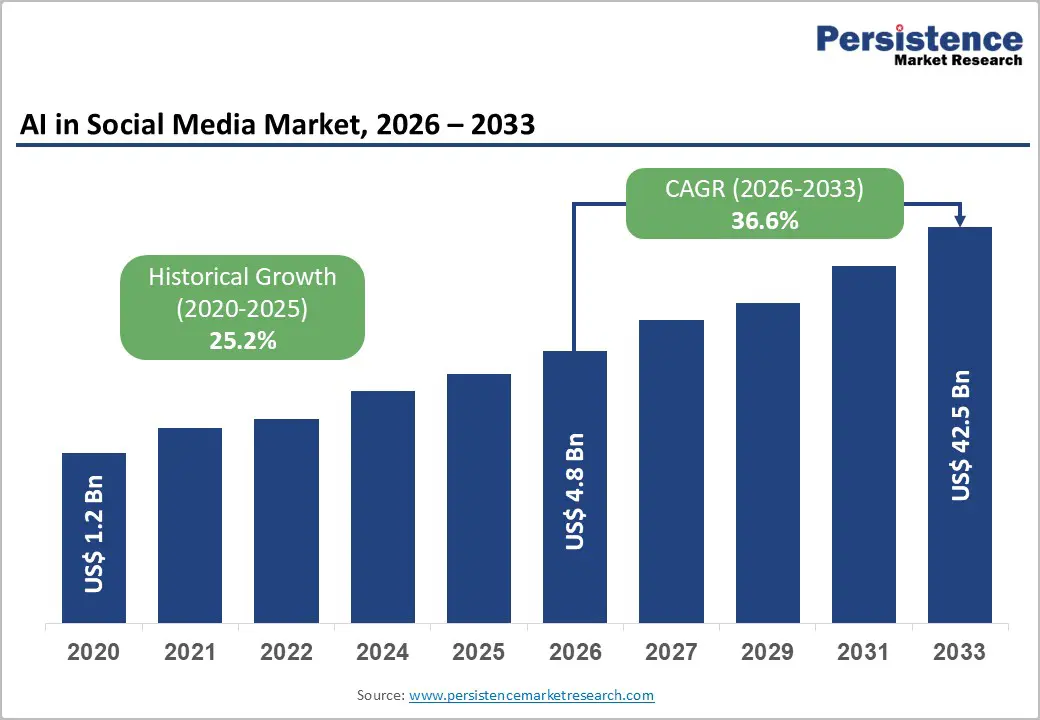
The global AI in social media market size is likely to be valued at US$4.8 billion in 2026 and is expected to reach US$42.5 billion by 2033, growing at a CAGR of 36.6% during the forecast period from 2026 to 2033, driven by the requirement for speedy content production, strong engagement, and measurable marketing outcomes. Another important driver is efficiency, as AI enables creators and brands to produce content at scale.
Key Industry Highlights:
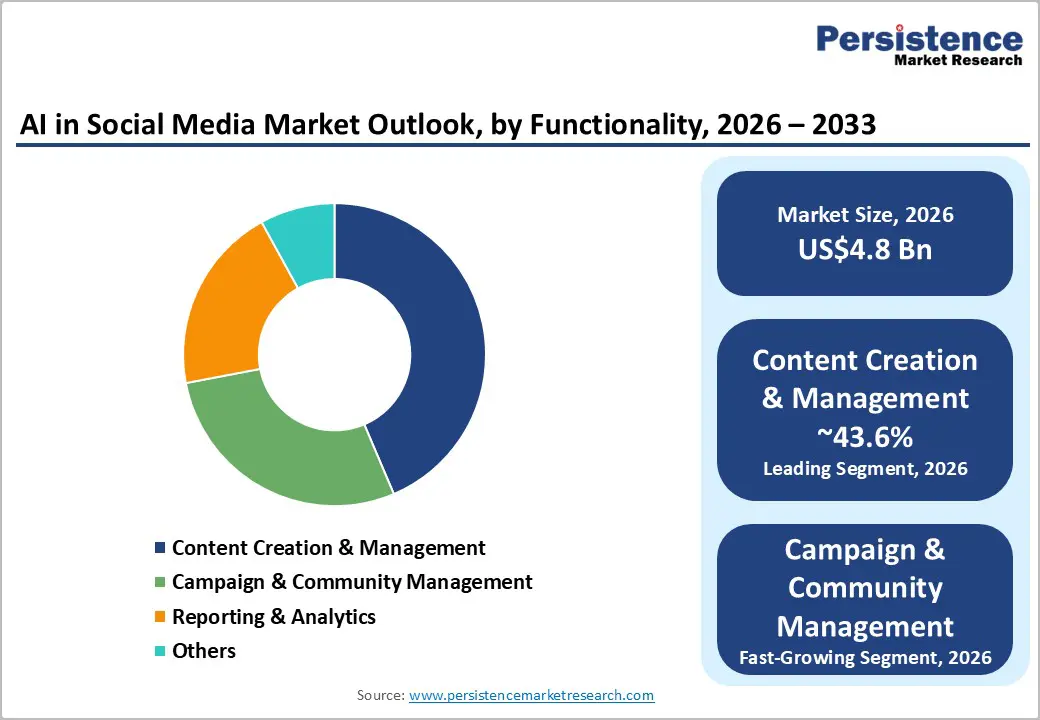
- Leading Functionality: Content creation and management segment, approximately 43.6% of share in 2026, as AI removes production bottlenecks by enabling instant generation, editing, and optimization of high-performing content.
- Dominant Application: Marketing, with a nearly 40.3% of share in 2026, as AI directly improves targeting, personalization, and campaign performance, leading to superior engagement and measurable outcomes.
- Roll Out of New Feature: Instagram recently introduced a feature that lets creators label themselves as AI creators if they regularly use AI to create or edit content. The main goal is transparency, as AI-generated images and videos are becoming harder to distinguish from real content.
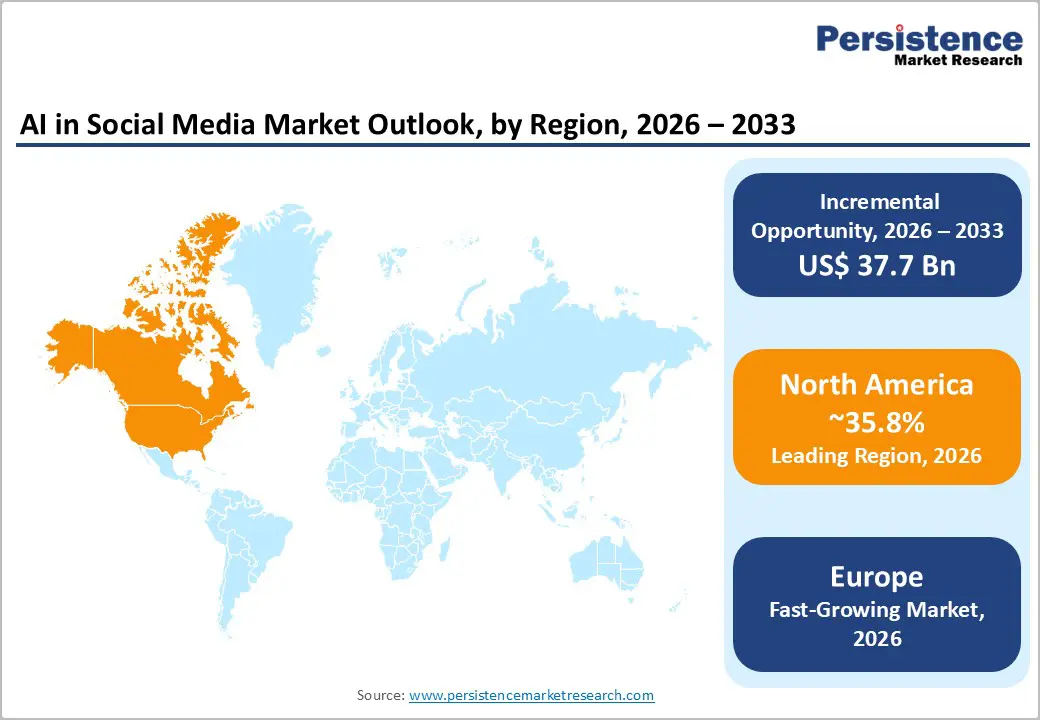
- Leading Region: North America, with about 35.8% of share in 2026, owing to early adoption, presence of various tech giants, and continuous investment in AI-led social media innovation.
- Fast-growing Region: Europe, spurred by the implementation of strict regulations that are pushing platforms to adopt transparent AI tools, thereby boosting structured and compliant deployment.
DRO Analysis
Driver - Surging Need to Improve Ad Performance Outcomes
AI is constantly improving how social media ads are targeted, optimized, and measured, leading to strong returns from the same budgets. Instead of broad audience targeting, AI analyzes behavioral signals, purchase intent, and engagement patterns in real time, reducing wasted impressions. Studies show campaigns created with AI can deliver up to 41% higher conversion rates and improve Return on Investment (ROI) by nearly 40% compared to manual campaigns.
Recent platform-level evidence supports this shift. AI-led ad tools have boosted high advertiser adoption and performance. Companies have reported superior campaign outcomes and rising advertiser activity due to automation and creative optimization. This efficiency is a key growth driver because brands are reallocating budgets toward AI-supported campaigns that produce measurable business results rather than vanity metrics.
Requirement for Large-scale and Real-time Individualized Content Delivery
AI is enabling social media platforms to move beyond basic segmentation to continuous, real-time personalization for every user. Instead of showing the same content to large groups, algorithms now adjust feeds based on micro-signals such as watch time, scrolling speed, and interaction history. This shift is increasing engagement, as AI-optimized content can generate 15% higher engagement rates and drastically improve click-through performance.
On large platforms, this has translated into visible changes in user behavior. For instance, AI-supported recommendations have increased time spent and content consumption across social media apps. This ability to deliver near-1:1 content experiences at scale is driving growth, as users stay longer and interact more. It thus directly improves both platform monetization and creator visibility.
Restraint - Increasing Concerns over Data Security and User Privacy Risks
AI in social media depends heavily on continuous data collection, including user behavior, preferences, and interactions. This creates a significant restraint as users are becoming more cautious about how their data is stored and used. High-profile data leaks and misuse of personal information have already eroded trust in AI-based features, especially those that require deep tracking.
Recent studies indicate that a large share of users now actively limit app permissions or avoid personalized features due to privacy fears. For platforms and marketers, this directly affects the effectiveness of AI models, as reduced data access weakens targeting accuracy and personalization capabilities.
Opportunity - Development of AI Assistants to Allow Constant Brand Interaction
AI-based conversational tools are creating new opportunities by allowing brands to stay active on social media around the clock without human intervention. These systems now go beyond basic replies. They can handle product queries, recommend items, and even complete purchases within chat interfaces.
Platforms such as WhatsApp and Instagram are already integrating AI chat features for businesses, where response times have dropped from hours to seconds, thereby improving user satisfaction. Recent adoption trends show that a growing share of users prefer interacting with AI for quick resolutions, especially in e-commerce and service-based interactions. This creates a strong opportunity for brands to broaden customer engagement without expanding support teams.
Data-driven Influencer Selection to Improve Campaign Precision
AI is transforming influencer marketing by replacing guesswork with data-backed decision-making. Novel algorithms now evaluate audience authenticity, engagement behavior, and content relevance to identify the right creators for specific campaigns. This reduces risks such as fake followers and mismatched audiences, which were common earlier.
Tools integrated within platforms, including TikTok and Meta Platforms, help brands discover creators whose followers are more likely to convert. Hence, campaigns are becoming more targeted and outcome-driven. These further encourage high investments in influencer collaborations and the extension of AI's role in social media marketing strategies.
Category-wise Analysis
Functionality Insights
The content creation and management segment is predicted to dominate with approximately 43.6% of the market share in 2026, driven by AI’s ability to address one of the biggest challenges in social media by enabling the consistent generation of high-quality content efficiently. AI tools now generate captions, videos, and visuals in seconds, allowing creators and brands to broaden output without increasing resources. Around 82% of marketers already use AI for content generation, and many report saving several hours every week on content tasks. Also, AI-created content is not just faster but performs better, which, in turn, propels demand.
The campaign and community management segment is projected to be the fastest-growing, as brands are shifting from static posting to continuous engagement. Modern AI tools help manage comments, detect sentiment, and adjust campaigns in real time, which was not possible earlier. For example, AI-based systems can also identify engagement drops instantly and modify content or targeting within hours, improving campaign responsiveness. AI also helps handle large volumes of conversations simultaneously, which is why even tasks such as comment moderation and audience segmentation are increasingly automated.
Application Insights
The marketing segment is expected to lead with a share of about 40.3% in 2026, supported by the growing use of AI to enhance audience targeting, personalization, and performance tracking, all of which play a critical role in improving campaign effectiveness. AI can analyze user behavior and deliver highly relevant content, increasing engagement and improving campaign efficiency. Studies show AI-based personalization significantly boosts user engagement and perceived relevance of content, making marketing efforts more effective. AI also allows brands to test multiple variations of content and optimize them automatically, something that manual marketing cannot achieve.
The sales segment is projected to grow at a decent pace as AI turns social media from a discovery platform into a conversion channel. Features, including AI chat assistants, product recommendations, and predictive targeting, are enabling users to move from browsing to purchasing without leaving the platform. AI can further identify high-intent users and serve them targeted offers at the right moment, improving conversion efficiency. This ability to connect engagement with actual sales outcomes is making sales a strategically important and fast-evolving application area.
Regional Insights
North America AI in Social Media Market Trends
In 2026, North America is estimated to account for nearly 35.8% of the share. It represents one of the most advanced regions, where AI in social media is deeply embedded across advertising, content, and user engagement. The region benefits from superior tech infrastructure and early adoption of generative AI tools, which have accelerated platform-level innovation. Social media is also a key discovery channel here. Approximately 44% of online users use social platforms to research brands, making AI-backed recommendations important for business outcomes.
U.S. AI in Social Media Market Trends
The U.S. dominates due to the presence of leading AI and social media companies, which continuously push new AI features into platforms. The country follows a low-regulation, innovation-first model, enabling fast deployment of generative AI and automation tools.
This rapid growth has, however, created uneven outcomes. AI adoption is boosting productivity and platform revenues, but concerns around job displacement and data usage are increasing. The U.S. also stands out for its strong creator economy. AI tools for video, voice, and content generation are attracting heavy investments and changing how content is produced and monetized.
Europe AI in Social Media Market Trends
Europe is a significant market not because of speed, but because it sets global standards for responsible AI use. The region emphasizes data privacy, ethical AI, and transparency, which directly affects how social media platforms deploy AI features.
Regulations such as strict age controls and AI content guidelines are influencing platform behavior and compelling companies to redesign algorithms and data practices. This makes Europe a compliance-driven market, where growth is slow but more structured. In this region, global companies often test privacy-focused AI models before expanding elsewhere.
U.K. AI in Social Media Market Trends
The U.K. sits between the U.S. and Europe in terms of AI adoption. It encourages development in AI-based marketing and social media analytics while still complying with the broad data protection principles of Europe. Social media plays a key role in consumer decision-making, and AI is widely used for targeted advertising and content personalization. The U.K. is also actively influencing AI governance frameworks to avoid risks related to misinformation and deepfakes. This creates a balanced environment, where companies can innovate but must remain accountable.
Germany AI in Social Media Market Trends
Germany stands out in Europe for its precision-driven and privacy-first mindset. Companies and users are more selective about adopting AI in social media, prioritizing data security and reliability over constant experimentation. This results in slow but steady adoption, especially in areas such as sentiment analysis, brand monitoring, and content moderation. AI tools here are often used to ensure compliance and maintain brand trust rather than drive engagement. Germany’s approach highlights a key contrast. AI is used as a control and optimization tool, not just a growth engine.
Asia Pacific AI in Social Media Market Trends
Asia Pacific is experiencing decent growth due to high social media usage, mobile-first populations, and constant government support for AI. The region follows an expansion-based model, where platforms integrate AI into every layer, including content, commerce, and communication.
Adoption, however, is uneven as some countries are highly advanced, while others are still catching up. Globally, AI adoption is rising, but the gap between developed and developing regions remains visible, with speedy growth seen in advanced economies. What makes Asia Pacific unique is the integration of social media with e-commerce, where AI directly influences purchasing behavior.
China AI in Social Media Market Trends
China represents one of the most technologically developed countries, where AI is fully integrated into social media, e-commerce, and entertainment. Platforms use AI extensively for content recommendation, live streaming, and influencer analytics. Unlike other countries, social media in China is closely tied to super-app ecosystems, where users can discover, interact, and purchase within the same platform. Government support and prominent domestic tech companies have accelerated development, making China a leader in AI-based social commerce and real-time personalization.
India AI in Social Media Market Trends
India is emerging as a key market because of its massive user base and increasing engagement with AI tools. It already accounts for a significant share of global AI usage, even surpassing the U.S. in some platforms. The growth is boosted by regional language content and mobile-first users, where AI helps personalize feeds for diverse audiences. Government initiatives such as Digital India and rising start-up activity are also accelerating adoption. AI in social media here is focused on accessibility, including voice-based search, local content recommendations, and automated moderation for regional languages.
Competitive Landscape
The global AI in social media market is moderately consolidated with emerging fragmentation at the innovation layer. A few dominant platforms still control the majority of user attention and data. However, the entry of AI-based tools and start-ups is creating pockets of competition across different parts of the value chain. At the platform level, the market remains concentrated, led by players such as Meta Platforms and ByteDance. These companies have a structural advantage as their AI models are trained on massive volumes of real-time user data. These enable them to continuously improve recommendation engines and ad targeting systems.
The market, however, becomes fragmented when looking at AI content creation tools and supporting technologies. Multiple start-ups and independent platforms are providing AI-based video generation, caption writing, influencer analytics, and trend prediction tools. These players do not compete with Meta or TikTok directly but instead compete to become the backend layer for creators and brands. This has lowered entry barriers for content creation, which is evident from the rising share of AI-assisted viral content across platforms.
Key Industry Developments:
- In April 2026, Meta Platforms began testing advanced ‘agentic AI’ assistants across its apps. These enabled automated interactions, task execution, and improved user engagement without manual input.
- In November 2025, the European Union introduced new AI transparency guidelines requiring social media platforms to label AI-generated content and disclose algorithmic decision-making processes to users.
- In September 2025, Snap Inc. improved its AI chatbot, My AI, on Snapchat with multimodal capabilities. The new version enables users to generate visual content and receive contextual recommendations within chats.
Companies Covered in AI in Social Media Market
- Salesforce, Inc.
- Snap Inc. (Snapchat)
- IBM Corporation
- Microsoft Corporation
- Adobe
- Hootsuite Inc.
- Google LLC (Alphabet)
- Amazon Web Services, Inc.
- Baidu
- Clarabridge
- Sprout Social
- Buffer
- Canva
Frequently Asked Questions
The global AI in social media market is projected to be valued at US$ 4.8 billion in 2026.
The market is expected to reach US$ 42.5 billion by 2033.
Development of AI-based content generation tools, recommendation engines, and autonomous agents are a few key market trends.
Marketing application, with about 40.3% of share in 2026, as AI is automating content creation and providing real-time customer engagement through chatbots.
The market is expected to grow at a CAGR of 36.6% from 2026 to 2033.
Salesforce, Inc., Snap Inc. (Snapchat), IBM Corporation, and Microsoft Corporation are a few key market players.


