

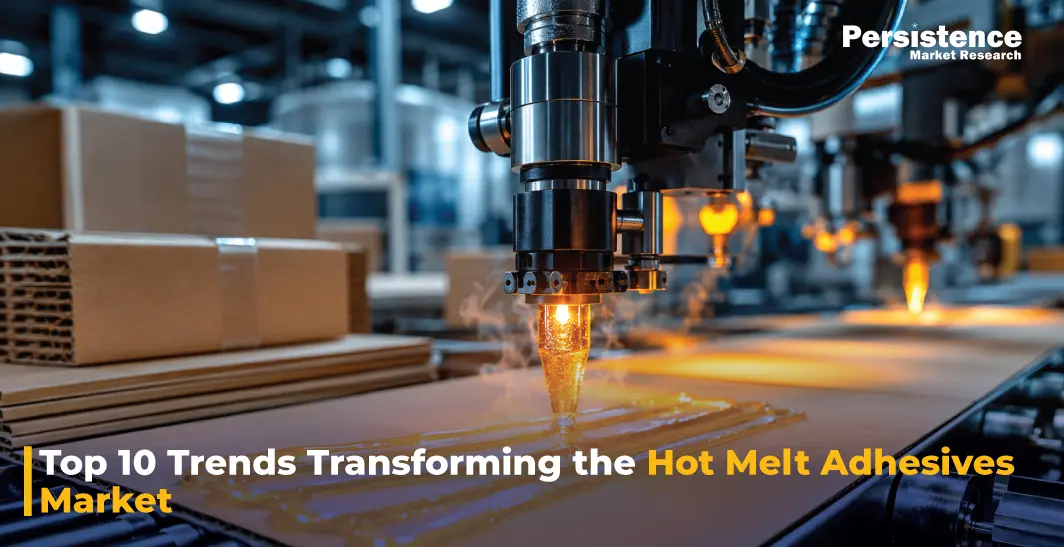
The following trends are expected to significantly influence market growth and strategic developments in the coming years.
1. Rising Demand for Sustainable and Eco-Friendly Adhesives
Sustainability has emerged as one of the strongest forces influencing the hot melt adhesives market. Manufacturers are increasingly developing bio-based and recyclable adhesive formulations to align with environmental regulations and corporate sustainability goals.
Conventional solvent-based adhesives are gradually being replaced by HMAs because they produce lower volatile organic compound (VOC) emissions and reduce environmental impact. Packaging companies, particularly in food and consumer goods sectors, are accelerating the adoption of recyclable adhesive systems that support circular economy initiatives.
2. Rapid Growth of E-Commerce Packaging Applications
The continued expansion of e-commerce is significantly boosting demand for hot melt adhesives in packaging applications. Corrugated box sealing, carton closing, labeling, and flexible packaging rely heavily on high-speed adhesive solutions capable of withstanding transportation stress and varying environmental conditions.
Online retail growth has increased the need for durable packaging that can maintain product integrity during shipping. Packaging manufacturers are investing in advanced hot melt technologies that improve bonding strength while enabling faster packaging line operations. This trend is expected to remain a major revenue driver for adhesive suppliers globally.
3. Increasing Adoption in Automotive Lightweighting
Automotive manufacturers are increasingly using hot melt adhesives to support vehicle lightweighting initiatives and electric vehicle (EV) production. HMAs are being applied in interior assembly, wire harnessing, seating systems, insulation, and electronic component bonding.
The transition toward lightweight materials such as composites and engineered plastics has increased the importance of advanced adhesive technologies that can replace traditional mechanical fasteners. Hot melt adhesives provide strong adhesion while reducing vehicle weight, improving fuel efficiency, and supporting EV battery system integration.
4. Technological Advancements in Reactive Hot Melt Adhesives
Reactive hot melt adhesives are gaining traction due to their superior bonding strength, heat resistance, and chemical durability. Unlike conventional HMAs, reactive formulations undergo additional chemical curing after application, enabling enhanced long-term performance. Industries such as construction, automotive, and electronics are increasingly adopting reactive polyurethane hot melt adhesives for demanding applications requiring structural bonding and environmental resistance. Continuous innovation in reactive adhesive chemistry is expanding the application range of HMAs and increasing competition among technology providers.
5. Expansion of Electronics and Miniaturization Applications
The growing electronics industry is generating substantial demand for precision adhesive solutions. Hot melt adhesives are increasingly used in consumer electronics, wearable devices, semiconductors, and appliance manufacturing due to their fast curing and compatibility with automated assembly processes.
As electronic products become more sophisticated, adhesive manufacturers are developing specialty formulations with enhanced conductivity, flexibility, and temperature resistance.
6. Automation and Smart Manufacturing Integration
The integration of automation and Industry 4.0 technologies is reshaping adhesive application processes across manufacturing industries. Automated dispensing systems, robotic adhesive applicators, and real-time monitoring technologies are improving precision, reducing waste, and enhancing operational efficiency.
Manufacturers are increasingly seeking hot melt adhesive systems compatible with high-speed automated production lines. This trend is driving investment in smart adhesive equipment capable of predictive maintenance, temperature optimization, and digital process control.
7. Volatility in Raw Material Supply Chains
Raw material price fluctuations remain a major challenge impacting the hot melt adhesives market. Key raw materials such as ethylene-vinyl acetate (EVA), polyurethane, polyolefins, and tackifying resins are closely linked to petrochemical supply chains, making the market vulnerable to geopolitical tensions and energy price instability.
Manufacturers are responding by diversifying sourcing strategies, investing in regional supply networks, and increasing focus on bio-based alternatives. Supply chain resilience has become a critical competitive factor, particularly for global adhesive producers seeking stable production capabilities and pricing consistency.
8. Growing Demand in Hygiene and Healthcare Products
Hot melt adhesives are witnessing rising adoption in hygiene and medical applications, particularly in disposable products such as diapers, sanitary napkins, surgical drapes, and medical tapes. The healthcare sector values HMAs for their skin-friendly properties, strong adhesion, and efficient manufacturing compatibility.
An aging population, increasing healthcare expenditure, and growing awareness of personal hygiene are driving sustained demand for adhesive-intensive hygiene products. This trend is encouraging innovation in low-odor, hypoallergenic, and pressure-sensitive hot melt formulations tailored for healthcare applications.
9. Shift Toward Customized and Application-Specific Formulations
Industries are increasingly demanding tailored adhesive solutions designed for specific performance requirements. This has accelerated the development of customized formulations based on factors such as temperature resistance, bonding substrates, curing speed, and environmental exposure.
Specialized HMAs are now being developed for applications ranging from bookbinding and woodworking to advanced aerospace components. Customization capabilities are becoming an important differentiator for adhesive manufacturers, enabling stronger customer relationships and premium product positioning.
10. Regulatory Pressure and Compliance Requirements
Regulatory compliance continues to influence product development and market access within the hot melt adhesives industry. Governments and regulatory bodies are implementing stricter standards related to chemical safety, packaging sustainability, food-contact materials, and workplace emissions. Manufacturers are increasingly investing in compliant formulations that meet evolving international standards while maintaining performance efficiency.
Conclusion
The hot melt adhesives market is evolving rapidly as industries seek faster, more sustainable, and technologically advanced bonding solutions. Trends to watch out for include the rising adoption of reactive PUR and metallocene-based hot melt adhesives, growing demand for adhesives compatible with high-speed automated packaging lines, increasing use in disposable hygiene products and nonwoven applications, and development of low-odor thin-coating formulations. The strong growth of the hot melt adhesives market is also driven by rising demand from packaging, automotive, hygiene, and electronics industries, where these adhesives provide faster application, strong bonding performance, and improved environmental compliance compared to solvent-based alternatives.


