

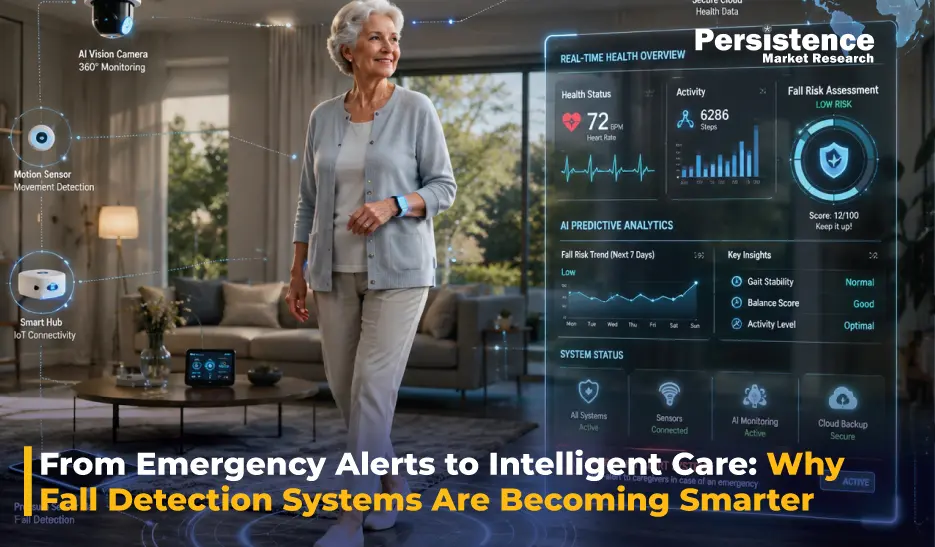
Fall detection systems have hence become an integral part of modern elderly care, giving way for technological innovation. What was once a market dominated by emergency pendants and wearable alert buttons is evolving into a sophisticated ecosystem powered by Artificial Intelligence (AI), computer vision, connected sensors, and remote healthcare platforms. Today's fall detection systems are not just designed to react after an accident occurs; they are increasingly being built to monitor, predict, and support safe independent living.
Why Traditional Solutions Are No Longer Enough
For years, wearable emergency response devices have served as the primary line of defense against falls. While these devices have helped countless users summon assistance during emergencies, they come with a common limitation: they rely on people remembering to wear them. This is where AI is beginning to change the conversation.
Modern fall detection systems can now analyze body movements, posture changes, and activity patterns in real time. Instead of waiting for a user to press a button, intelligent systems can automatically recognize a fall and send alerts to caregivers or emergency contacts. Researchers have reported fall detection accuracy rates exceeding 90% for advanced AI-based systems, highlighting how far the technology has progressed.
The shift from reactive alerts to automated monitoring is already moving beyond pilot stages. In May 2026, the Netherlands introduced its first AI-powered fall detection homes in the municipality of Waalre, which is designed by Kepler Vision Technologies to support older adults living independently. The initiative uses intelligent monitoring technology to detect falls and trigger rapid intervention when assistance is needed. The project reflects a broad trend across Europe, where healthcare systems are increasingly exploring technology-enabled aging-in-place solutions.
Innovation is Coming from Unexpected Places
One of the most fascinating aspects of the fall detection market is the diversity of innovators entering the space. In 2025, 13-year-old California student Kevin Tang was named America's Top Young Scientist for creating FallGuard, an AI-supported home safety system inspired by a deeply personal experience. After witnessing the challenges his grandmother faced following a fall at home, Tang developed a computer vision-based system capable of detecting falls and automatically notifying caregivers, even in low-light conditions.
While Tang's invention is remarkable in its own right, it also highlights a large industry shift. Advances in AI, machine learning, and sensor technology are making sophisticated monitoring solutions more accessible than ever before. What once required specialized healthcare infrastructure can increasingly be deployed in everyday homes, expanding access to intelligent monitoring solutions. As development costs decline and technology becomes easier to implement, the next generation of fall detection systems is expected to reach a much broader population, accelerating innovation across the market.
The Bigger Opportunity: Connected Care
Perhaps the most exciting development is how fall detection is becoming part of a larger connected healthcare ecosystem. Healthcare providers increasingly recognize that a fall is rarely an isolated event. Changes in mobility, sleep patterns, heart rate, or daily activity often provide early warning signs of declining health. As a result, modern fall detection platforms are being integrated with remote patient monitoring systems and smart-home technologies to create a more complete picture of patient well-being.
A good initiative comes from the U.K., where Forest Care deployed the AI-assisted Silver Shield monitoring system across its care homes in 2026. Beyond detecting falls, the platform monitors respiratory rate, heart rate, bed-exit activity, and mobility patterns while providing real-time alerts to caregivers. The deployment demonstrates how fall detection is evolving into a broader health-monitoring capability rather than a standalone emergency response tool.
This trend also aligns closely with the principles behind the "5 Ps of Nursing"- Purpose, People, Process, Performance, and Professionalism. By enabling faster interventions and providing continuous patient insights, intelligent monitoring technologies are helping caregivers deliver more proactive and patient-centered care.
Looking Beyond Detection: The Future of Fall Prevention
The future of fall detection systems is anticipated to extend beyond emergency response to proactive fall prevention. Advances in AI, predictive analytics, and connected healthcare platforms are enabling solutions that can identify early signs of fall risk and support timely intervention before accidents occur.
As fall detection systems evolve toward proactive prevention, their increasing integration into healthcare networks is driving market growth. According to Persistence Market Research, the global fall detection system market is projected to grow from US$ 531.7 million in 2026 to US$ 728.4 million by 2033, supported by rising adoption of home healthcare services, high demand for independent living solutions, and continued advancements in intelligent monitoring technologies.
From AI-powered homes in the Netherlands to young innovative solutions like FallGuard and connected care platforms such as Silver Shield, the industry is rapidly evolving toward smarter, more preventive care models. As healthcare increasingly shifts toward remote and home-based settings, fall detection systems are poised to play a vital role in supporting safer and healthier aging.


