




- Metals & Minerals
- Pyrite Market
Pyrite Market Size, Share, and Growth Forecast, 2026 - 2033
Pyrite Market by Product Type (Pyrite Sun, Dollar, Pyrite Cube, Others), Grade (Low Purity, Medium Purity, High Purity), Application (Jewelry Industry, Sulfur Compounds Industry, Grinding Industry, Others), and Regional Analysis for 2026 - 2033

Pyrite Market Size and Trends Analysis
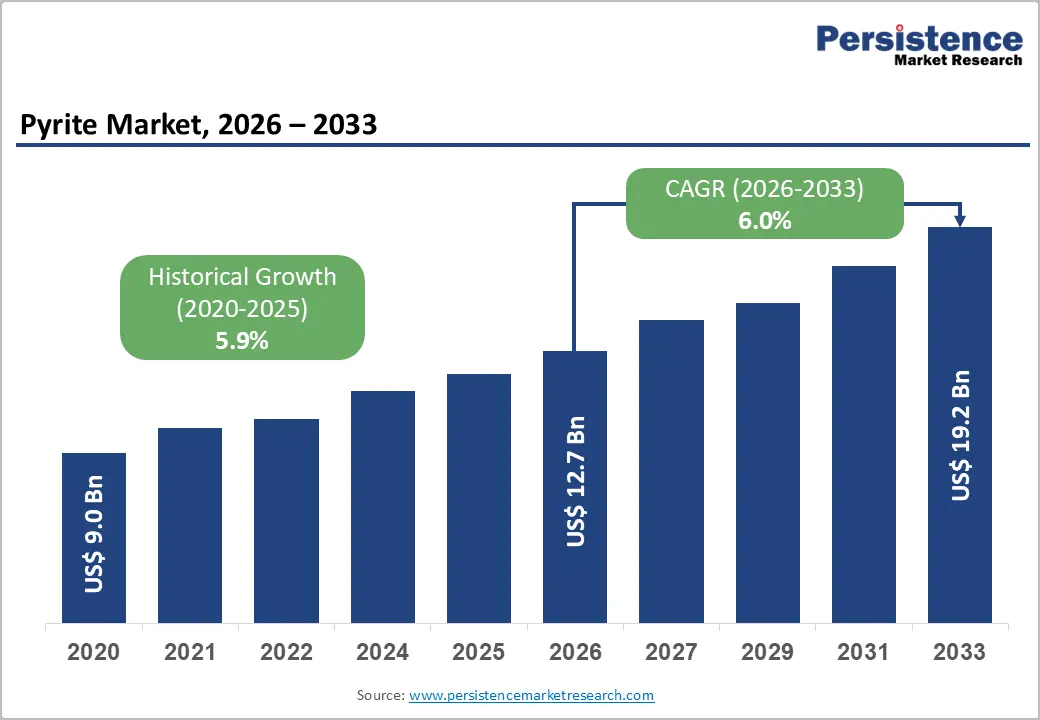
The global pyrite market size is likely to be valued at US$12.7 billion in 2026 and is expected to reach US$19.2 billion by 2033, growing at a CAGR of 6.0% during the forecast period from 2026 to 2033, driven by robust demand from the sulfur compounds sector, growing adoption in electronics manufacturing, and expanding decorative applications across emerging economies.
Pyrite (FeS2), commonly known as fool's gold, has evolved from a decorative mineral to a strategically important industrial raw material. The compound's unique physicochemical properties, high sulfur content, semiconducting behavior, and distinct crystalline aesthetics position it across multiple end-use industries. From gemstone-quality specimens in high-end jewelry to raw ore in chemical processing, pyrite occupies a uniquely diverse market space.
Key Industry Highlights:
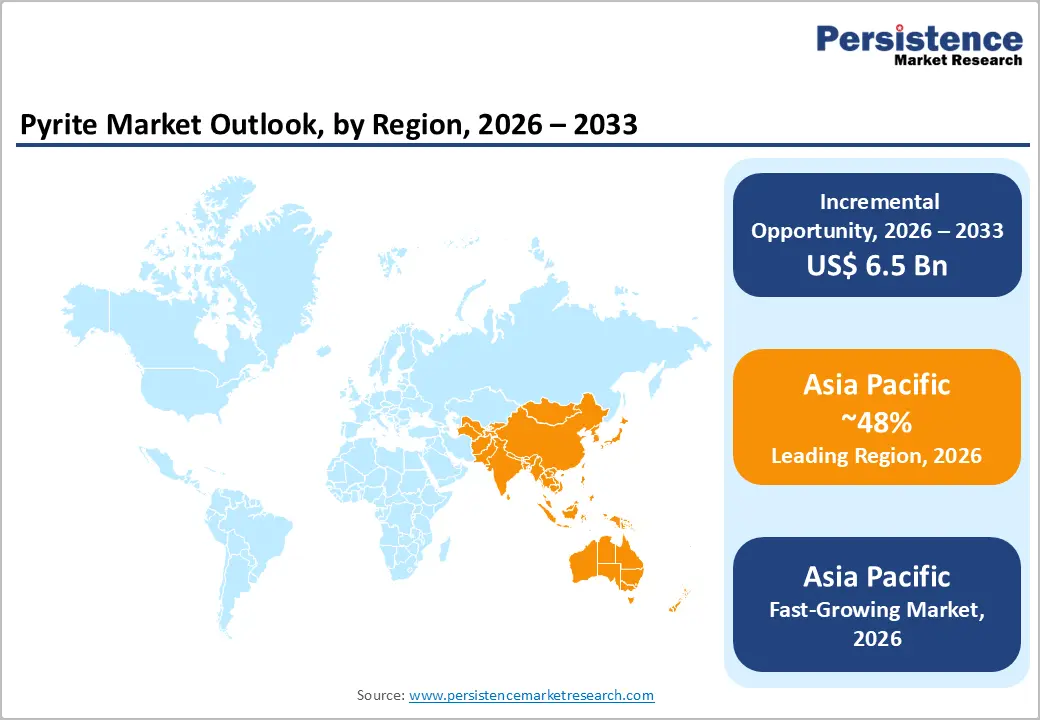
- Leading Region: Asia Pacific is anticipated to be the leading region, accounting for a market share of 48% in 2026, driven by strong demand from sulfur-based fertilizers, chemicals, and expanding electronics manufacturing in China and India.
- Fastest-growing Region: North America is likely to be the fastest-growing region, supported by strong demand from electronics, chemical applications, and innovation-driven industrial uses in the U.S.
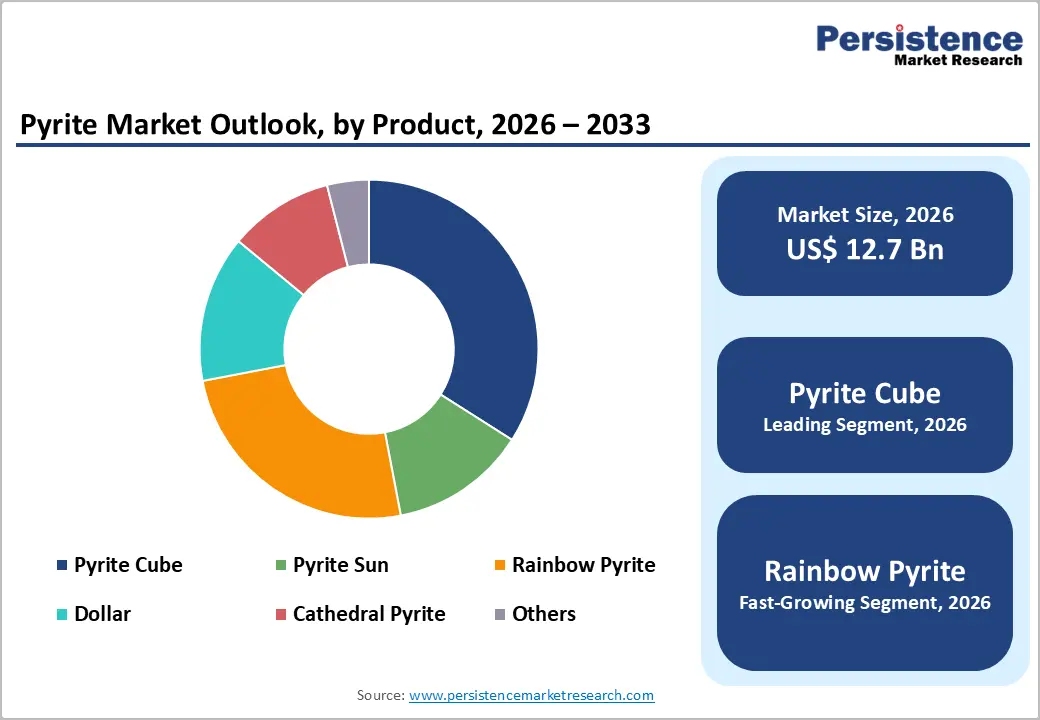
- Leading Product Type: Pyrite cube is projected to represent the leading product type in 2026, accounting for 35% of the revenue share, driven by its high structural uniformity and suitability for industrial and decorative applications.
- Leading Application: Sulfur compounds are anticipated to lead, accounting for over 50% of the revenue share in 2026, supported by their critical role in fertilizer and chemical production.
- Key Opportunity: Expanding integration of pyrite across sulfur-based industrial value chains, alongside rising adoption in jewelry, wellness, and emerging energy applications, is creating a broad-based growth opportunity across the market.

DRO Analysis
Driver - Rising Sulfur Demand in Fertilizers and Chemicals
Growing demand for fertilizers is a primary driver for the pyrite market, as pyrite serves as a key feedstock for sulfuric acid production. Sulfuric acid remains essential in phosphate fertilizer manufacturing, supporting agricultural productivity amid rising food demand. Expanding chemical industries amplify demand, as sulfur derivatives are widely used in detergents, explosives, and petroleum refining.
The U.S. Geological Survey (USGS) notes that global sulfur cycle dependencies reinforce pyrite's indispensable position in the sulfur chemicals supply chain, creating a structurally supportive demand environment for high-grade pyrite ore through the forecast period.
Sulfur-based chemicals are essential in wastewater treatment, metal processing, and battery manufacturing. As industries prioritize cost-effective and locally available raw materials, pyrite remains a viable sulfur source. This sustained demand across interconnected industries reinforces pyrite’s strategic importance in supply chains and ensures long-term market growth momentum.
Restraint - Quality Inconsistency in Natural Specimens
Pyrite deposits often differ in sulfur content, impurity levels, and mineral composition, making standardization difficult. Inconsistent quality can lead to inefficiencies in sulfur extraction and processing, increasing operational costs for manufacturers. Industries relying on precise chemical outputs, such as electronics and specialty chemicals, require uniform raw materials, limiting the use of lower-grade pyrite.
Environmental and regulatory concerns intensify this restraint, particularly regarding impurities that can cause pollution during processing. Improper handling of pyrite can lead to acid mine drainage, a well-documented issue highlighted by organizations such as the United States Environmental Protection Agency. This creates additional compliance costs for mining and processing companies.
Opportunity - Jewelry in Developing Markets
The growing popularity of affordable and aesthetically appealing jewelry presents a significant opportunity for the pyrite market, particularly in developing regions. Pyrite’s metallic luster and resemblance to gold make it an attractive, low-cost alternative for decorative purposes. Rising disposable incomes and changing fashion trends in countries such as India, Brazil, and Indonesia are driving demand for semi-precious stones and costume jewelry.
Pyrite symbolically associated with abundance, protection, and mental clarity, consumers are increasingly using pyrite in jewelry, spa therapies, and wellness brands are increasingly incorporating high-quality pyrite specimens into product lines, with premium cathedral pyrite and rainbow pyrite products.
E-commerce growth and fashion influence accelerate this trend by increasing accessibility to pyrite-based jewelry products. Online platforms enable small businesses to reach international markets, increasing exports from emerging economies. The expanding middle-class population and evolving consumer preferences create strong demand potential. This shift toward lifestyle and fashion applications diversifies the pyrite market, opening new revenue streams and reducing dependence on traditional industrial consumption sectors.
Category-wise Analysis
Product Type Insights
The pyrite cube is expected to lead the pyrite market, accounting for approximately 35% of revenue in 2026, driven by its highly uniform crystalline structure that supports efficient industrial processing. Its consistent geometry makes it particularly suitable for sulfur extraction and chemical applications, where predictable behavior during crushing and processing is essential. For instance, large-scale sulfuric acid manufacturers utilize pyrite cubes for consistent feedstock quality, ensuring stable production outputs and minimizing operational variability across industrial processes.
Rainbow pyrite is likely to represent the fastest-growing segment, supported by its unique iridescent appearance and increasing demand in decorative and jewelry markets. Its vibrant coloration, caused by natural oxidation patterns, makes it highly attractive for ornamental use. A notable example includes jewelry exporters in the Asia Pacific region who increasingly incorporate rainbow pyrite into fashion accessories, responding to trends in sustainable and visually striking materials.
Grade Insights
High purity is projected to lead the market, capturing around 42% of the revenue share in 2026, supported by its superior sulfur content and minimal impurities, making it ideal for high-performance industrial applications. Industries such as electronics, specialty chemicals, and advanced metallurgy require consistent and high-quality raw materials to ensure efficiency and precision. For example, semiconductor manufacturers prefer high-purity pyrite for specific chemical processes where contamination control is critical, ensuring optimal performance and product quality in advanced technological applications.
Medium-purity pyrite is likely to be the fastest-growing grade, driven by its balance between cost-effectiveness and functional performance across a wide range of applications. It is widely used in general industrial processes, including grinding, basic chemical production, and intermediate sulfur extraction, where extremely high purity is not mandatory. For instance, regional manufacturers use medium-purity pyrite for sulfur compounds due to its cost efficiency and adequate performance.
Application Insights
The sulfur compounds industry is expected to lead the pyrite market, accounting for approximately 50% of revenue in 2026, as pyrite remains a key raw material for producing sulfuric acid and related chemicals. Sulfuric acid is widely used in fertilizer production, chemical synthesis, and industrial processing, making this segment highly dependent on consistent sulfur sources. For example, fertilizer producers rely on pyrite-derived sulfuric acid to manufacture phosphate fertilizers, supporting food production systems.
The electronics industry is likely to represent the fastest-growing segment, supported by increasing demand for advanced materials in semiconductor and electronic component manufacturing. Pyrite is gaining attention for its potential use in polishing, grinding, and even emerging photovoltaic technologies due to its semiconductor-like properties. A notable example includes electronics manufacturers exploring pyrite-based materials for use in thin-film solar cells, leveraging its abundance and cost advantages.
Regional Insights
North America Pyrite Market Trends
North America is likely to be the fastest-growing region, driven by advanced industrial applications, particularly in sulfur-based chemicals, metallurgy, and emerging renewable energy technologies. The growing focus on electric vehicles and energy storage systems is creating new opportunities for pyrite in battery-related applications. Companies such as Freeport-McMoRan Inc. process sulfide ores, generating sulfur streams that support downstream chemical production linked to pyrite demand.
U.S. Pyrite Market Trends
The U.S. is expected to dominate the regional market, driven by strong sulfuric acid production and advancements in renewable energy and mining technologies. The country is also focusing on sustainable mining and improved processing technologies to enhance efficiency. Strict environmental regulations are encouraging cleaner extraction and sulfur recovery practices.
Canada Pyrite Market Trends
Canada is experiencing steady growth in the pyrite market, supported by expanding mining activities and resource development. Provinces such as Ontario and British Columbia are witnessing increased exploration and sulfide ore processing projects. Recent government-backed critical mineral strategies are promoting sustainable mining and increasing sulfur recovery initiatives.
Europe Pyrite Market Trends
Europe is likely to be a significant market for pyrite, due to chemical processing, metallurgy, and increasing focus on sustainable industrial practices. Technological advancements in extraction and circular economy initiatives are enhancing efficiency and resource utilization. For example, TotalEnergies SE is advancing low-carbon chemical processes, supporting sulfur-based value chains linked to pyrite demand.
U.K. Pyrite Market Trends
The U.K. is experiencing steady growth in the pyrite market, supported by growth in specialty chemicals and industrial recycling initiatives. Recent policy developments are supporting low-carbon manufacturing and sustainable resource use. Increased focus on recovering sulfur from industrial waste streams is enhancing efficiency and reducing dependency on primary raw materials.
Germany Pyrite Market Trends
Germany dominates the regional market, driven by its well-established chemical and industrial base, which drives consistent demand for sulfur-based inputs. The country is also advancing circular economy practices, improving sulfur recovery and utilization efficiency. Strong environmental regulations encourage the use of high-purity materials and cleaner processing technologies.
Asia Pacific Pyrite Market Trends
The Asia Pacific region is anticipated to be the leading region, accounting for a market share of 48% in 2026, driven by rapid industrialization, expanding agricultural activities, and strong demand for sulfuric acid in fertilizer production. Large-scale mining automation and integrated supply chains are improving productivity and cost efficiency. A notable example includes Yunnan Copper Co., Ltd., which processes sulfide ores to produce sulfur by-products supporting sulfuric acid production linked to pyrite demand.
China Pyrite Market Trends
China dominates the regional market, driven by extensive mining operations and strong demand from the fertilizer and chemical industries. Government policies focused on resource efficiency and environmental management are improving processing standards. Large-scale industrial infrastructure supports the consistent production and supply of sulfur-based materials.
India Pyrite Market Trends
India pyrite market is witnessing steady growth, supported by rising fertilizer demand and growing chemical manufacturing capacity. Recent government initiatives are promoting domestic production and reducing reliance on imports. Sustainable mining policies and infrastructure development are improving resource utilization and supply chain efficiency.
Competitive Landscape
The global pyrite market exhibits a moderately fragmented structure, driven by the presence of both large multinational mining corporations and numerous regional producers operating across diverse geographies. The market is shaped by strong demand from sulfuric acid production, metallurgy, and emerging applications such as energy storage and semiconductors.
With key leaders including Glencore plc, BHP Group, Vale S.A., Rio Tinto, and Freeport-McMoRan Inc., the competitive landscape reflects a mix of integrated mining giants and specialized mineral suppliers. These players compete through product quality, consistent supply, cost optimization, and technological advancements in mineral processing.
Key Industry Developments:
- In April 2026, researchers led by Dr. James R. Wooten from West Virginia University reported a breakthrough discovery that lithium can be found within pyrite in ancient shale formations, highlighting a potential new source of lithium for clean energy applications.
- In January 2026, researchers led by Zhu Jianxi and Xian Haiyang from the Chinese Academy of Sciences reported a breakthrough showing that pyrite can directly facilitate gold precipitation at the pyrite–water interface, revealing a new mechanism for gold formation and enhancing potential mineral exploration techniques.
- In April 2026, QMines Ltd secured a $15 million strategic investment to accelerate development of the Mt Chalmers copper-gold project in Australia, which includes significant pyrite deposits. The funding will support feasibility studies and move the project toward production, strengthening sulfide mineral supply chains, including pyrite.
Companies Covered in Pyrite Market
- Ante-Group
- Royal Dutch Shell plc
- Exxon Mobil Corporation
- Cepsa
- GSB Chemical Co. Pty. Ltd
- Neste
- HCS Group GmbH
- DHC SOLVENT CHEMIE GMBH
- Al Sanea
- Merck KGaA
- Recochem Corporation
- Total
- Idemitsu Kosan Co., Ltd
- Bharat Petroleum Corporation Limited
- Indian Oil Corporation Ltd
- Thai Oil Public Company Limited
- NewAge Industrial Oil Pvt Ltd
- bp p.l.c.
- Pon Pure Chemicals
Frequently Asked Questions
The global pyrite market is projected to reach US$12.7 billion in 2026.
Rising demand for sulfuric acid in fertilizers and chemical industries drives the pyrite market.
The pyrite market is expected to grow at a CAGR of 6.0% from 2026 to 2033.
Growing use of pyrite in jewelry, wellness products, and emerging energy applications, such as batteries, creates key market opportunities.
Ante-Group, Royal Dutch Shell plc, Exxon Mobil Corporation, Cepsa, GSB Chemical Co. Pty. Ltd, Neste, and HCS Group GmbH are the leading players.


