


- Executive Summary
- Global Predictive Maintenance in Manufacturing Market Snapshot, 2025 and 2033
- Market Opportunity Assessment, 2025 - 2033, US$ Mn
- Key Market Trends
- Future Market Projections
- Premium Market Insights
- Industry Developments and Key Market Events
- PMR Analysis and Recommendations
- Market Overview
- Market Scope and Definition
- Market Dynamics
- Drivers
- Restraints
- Opportunity
- Key Trends
- Macro-economic Factors
- Global Sectoral Outlook
- Global GDP Growth Outlook
- COVID-19 Impact Analysis
- Forecast Factors - Relevance and Impact
- Value Added Insights
- Tool Adoption Analysis
- Regulatory Landscape
- Value Chain Analysis
- PESTLE Analysis
- Porter’s Five Force Analysis
- Price Analysis, 2025A
- Key Highlights
- Key Factors Impacting Deployment Costs
- Pricing Analysis, By Component
- Global Predictive Maintenance in Manufacturing Market Outlook
- Key Highlights
- Market Volume (Units) Projections
- Market Size (US$ Mn) and Y-o-Y Growth
- Absolute $ Opportunity
- Market Size (US$ Mn) and Volume (Units) Analysis and Forecast
- Historical Market Size (US$ Mn) Analysis, 2025-2025
- Market Size (US$ Mn) Analysis and Forecast, 2025 - 2033
- Global Predictive Maintenance in Manufacturing Market Outlook: Component
- Introduction / Key Findings
- Historical Market Size (US$ Mn) and Volume (Units) Analysis, By Component, 2025 - 2025
- Market Size (US$ Mn) and Volume (Units) Analysis and Forecast, By Component, 2025 - 2033
- Software
- Hardware
- Services
- Market Attractiveness Analysis: Component
- Global Predictive Maintenance in Manufacturing Market Outlook: Application
- Introduction / Key Findings
- Historical Market Size (US$ Mn) Analysis, By Application, 2025 - 2025
- Market Size (US$ Mn) Analysis and Forecast, By Application, 2025 - 2033
- Asset Health Monitoring
- Failure Prediction
- Maintenance Optimization
- Production Optimization
- Quality & Process Optimization
- Market Attractiveness Analysis: Application
- Global Predictive Maintenance in Manufacturing Market Outlook: Technology
- Introduction / Key Findings
- Historical Market Size (US$ Mn) Analysis, By Technology, 2025 - 2025
- Market Size (US$ Mn) Analysis and Forecast, By Technology, 2025 - 2033
- Artificial Intelligence (AI) & Machine Learning (ML)
- Industrial Internet of Things (IIoT)
- Digital Twin
- Edge Computing
- Cloud Computing
- Market Attractiveness Analysis: Technology
- Key Highlights
- Global Predictive Maintenance in Manufacturing Market Outlook: Region
- Key Highlights
- Historical Market Size (US$ Mn) and Volume (Units) Analysis, By Region, 2025 - 2025
- Market Size (US$ Mn) and Volume (Units) Analysis and Forecast, By Region, 2025 - 2033
- North America
- Europe
- East Asia
- South Asia and Oceania
- Latin America
- Middle East & Africa
- Market Attractiveness Analysis: Region
- North America Predictive Maintenance in Manufacturing Market Outlook
- Key Highlights
- Historical Market Size (US$ Mn) Analysis, By Market, 2025 - 2025
- By Country
- By Component
- By Application
- By Technology
- Market Size (US$ Mn) Analysis and Forecast, By Country, 2025 - 2033
- U.S.
- Canada
- Market Size (US$ Mn) and Volume (Units) Analysis and Forecast, By Component, 2025 - 2033
- Software
- Hardware
- Services
- Market Size (US$ Mn) Analysis and Forecast, By Application, 2025 - 2033
- Asset Health Monitoring
- Failure Prediction
- Maintenance Optimization
- Production Optimization
- Quality & Process Optimization
- Market Size (US$ Mn) Analysis and Forecast, By Technology, 2025-2033
- Artificial Intelligence (AI) & Machine Learning (ML)
- Industrial Internet of Things (IIoT)
- Digital Twin
- Edge Computing
- Cloud Computing
- Market Attractiveness Analysis
- Europe Predictive Maintenance in Manufacturing Market Outlook
- Key Highlights
- Historical Market Size (US$ Mn) Analysis, By Market, 2025 - 2025
- By Country
- By Component
- By Application
- Technology
- Market Size (US$ Mn) Analysis and Forecast, By Country, 2025 - 2033
- Germany
- France
- U.K.
- Italy
- Spain
- Russia
- Türkiye
- Rest of Europe
- Market Size (US$ Mn) and Volume (Units) Analysis and Forecast, By Component, 2025 - 2033
- Software
- Hardware
- Services
- Market Size (US$ Mn) Analysis and Forecast, By Application, 2025 - 2033
- Asset Health Monitoring
- Failure Prediction
- Maintenance Optimization
- Production Optimization
- Quality & Process Optimization es
- Market Size (US$ Mn) Analysis and Forecast, By Technology, 2025-2033
- Artificial Intelligence (AI) & Machine Learning (ML)
- Industrial Internet of Things (IIoT)
- Digital Twin
- Edge Computing
- Cloud Computing
- Market Attractiveness Analysis
- East Asia Predictive Maintenance in Manufacturing Market Outlook
- Key Highlights
- Historical Market Size (US$ Mn) Analysis, By Market, 2025 - 2025
- By Country
- By Component
- By Application
- By Technology
- Market Size (US$ Mn) Analysis and Forecast, By Country, 2025 - 2033
- China
- Japan
- South Korea
- Market Size (US$ Mn) and Volume (Units) Analysis and Forecast, By Component, 2025 - 2033
- Software
- Hardware
- Services
- Market Size (US$ Mn) Analysis and Forecast, By Application, 2025 - 2033
- Asset Health Monitoring
- Failure Prediction
- Maintenance Optimization
- Production Optimization
- Quality & Process Optimization
- Market Size (US$ Mn) Analysis and Forecast, By Technology, 2025-2033
- Artificial Intelligence (AI) & Machine Learning (ML)
- Industrial Internet of Things (IIoT)
- Digital Twin
- Edge Computing
- Cloud Computing
- Market Attractiveness Analysis
- South Asia & Oceania Predictive Maintenance in Manufacturing Market Outlook
- Key Highlights
- Historical Market Size (US$ Mn) Analysis, By Market, 2025 - 2025
- By Country
- By Component
- By Application
- By Technology
- Market Size (US$ Mn) Analysis and Forecast, By Country, 2025 - 2033
- India
- Southeast Asia
- ANZ
- Rest of South Asia & Oceania
- Market Size (US$ Mn) and Volume (Units) Analysis and Forecast, By Component, 2025 - 2033
- Software
- Hardware
- Services
- Market Size (US$ Mn) Analysis and Forecast, By Application, 2025 - 2033
- Asset Health Monitoring
- Failure Prediction
- Maintenance Optimization
- Production Optimization
- Quality & Process Optimization
- Market Size (US$ Mn) Analysis and Forecast, By Technology, 2025-2033
- Artificial Intelligence (AI) & Machine Learning (ML)
- Industrial Internet of Things (IIoT)
- Digital Twin
- Edge Computing
- Cloud Computing
- Market Attractiveness Analysis
- Latin America Predictive Maintenance in Manufacturing Market Outlook
- Key Highlights
- Historical Market Size (US$ Mn) Analysis, By Market, 2025 - 2025
- By Country
- By Component
- By Application
- By Technology
- Market Size (US$ Mn) Analysis and Forecast, By Country, 2025 - 2033
- Brazil
- Mexico
- Rest of Latin America
- Market Size (US$ Mn) and Volume (Units) Analysis and Forecast, By Component, 2025 - 2033
- Software
- Hardware
- Services
- Market Size (US$ Mn) Analysis and Forecast, By Application, 2025 - 2033
- Asset Health Monitoring
- Failure Prediction
- Maintenance Optimization
- Production Optimization
- Quality & Process Optimization
- Market Size (US$ Mn) Analysis and Forecast, By Technology, 2025-2033
- Artificial Intelligence (AI) & Machine Learning (ML)
- Industrial Internet of Things (IIoT)
- Digital Twin
- Edge Computing
- Cloud Computing
- Market Attractiveness Analysis
- Middle East & Africa Predictive Maintenance in Manufacturing Market Outlook
- Key Highlights
- Historical Market Size (US$ Mn) Analysis, By Market, 2025 - 2025
- By Country
- By Component
- By Application
- By Technology
- Market Size (US$ Mn) Analysis and Forecast, By Country, 2025 - 2033
- GCC Countries
- Egypt
- South Africa
- Northern Africa
- Rest of Middle East & Africa
- Market Size (US$ Mn) and Volume (Units) Analysis and Forecast, By Component, 2025 - 2033
- Software
- Hardware
- Services
- Market Size (US$ Mn) Analysis and Forecast, By Application, 2025 - 2033
- Asset Health Monitoring
- Failure Prediction
- Maintenance Optimization
- Production Optimization
- Quality & Process Optimization
- Market Size (US$ Mn) Analysis and Forecast, By Technology, 2025-2033
- Artificial Intelligence (AI) & Machine Learning (ML)
- Industrial Internet of Things (IIoT)
- Digital Twin
- Edge Computing
- Cloud Computing
- Market Attractiveness Analysis
- Competition Landscape
- Market Share Analysis, 2025
- Market Structure
- Competition Intensity Mapping By Market
- Competition Dashboard
- Company Profiles (Details - Overview, Financials, Strategy, Recent Developments)
- Siemens AG
- Overview
- Segments and Deployments
- Key Financials
- Market Developments
- Market Strategy
- General Electric
- IBM Corporation
- Microsoft Corporation
- SAP SE
- Schneider Electric
- ABB Ltd.
- Honeywell International Inc.
- Emerson Electric Co.
- Rockwell Automation
- Hitachi Ltd.
- Bosch Group
- Oracle Corporation
- PTC Inc.
- SAS Institute
- Siemens AG
- Appendix
- Research Methodology
- Research Assumptions
- Acronyms and Abbreviations


- Technology
- Predictive Maintenance in Manufacturing Market
Predictive Maintenance in Manufacturing Market Size, Share, and Growth Forecast, 2026 - 2033
Predictive Maintenance in Manufacturing Market by Component (Software, Hardware, Services), Application (Asset Health Monitoring, Failure Prediction, Maintenance Optimization, Production Optimization, Quality & Process Optimization), Technology (Artificial Intelligence & Machine Learning, Industrial IoT (IIoT), Digital Twin, Edge Computing, Cloud Computing), and Regional Analysis for 2026 - 2033
Key Industry Highlights
- Dominant Component: Software is set to command 45% of the revenue share in 2026, while services are likely to grow the fastest through 2033, driven by increasing demand for integration, consulting, and managed solutions.
- Leading Application: Asset health monitoring is expected to lead with 32% share in 2026, while failure prediction is projected to register the highest 2026-2033 CAGR, supported by rising adoption of AI-driven predictive analytics.
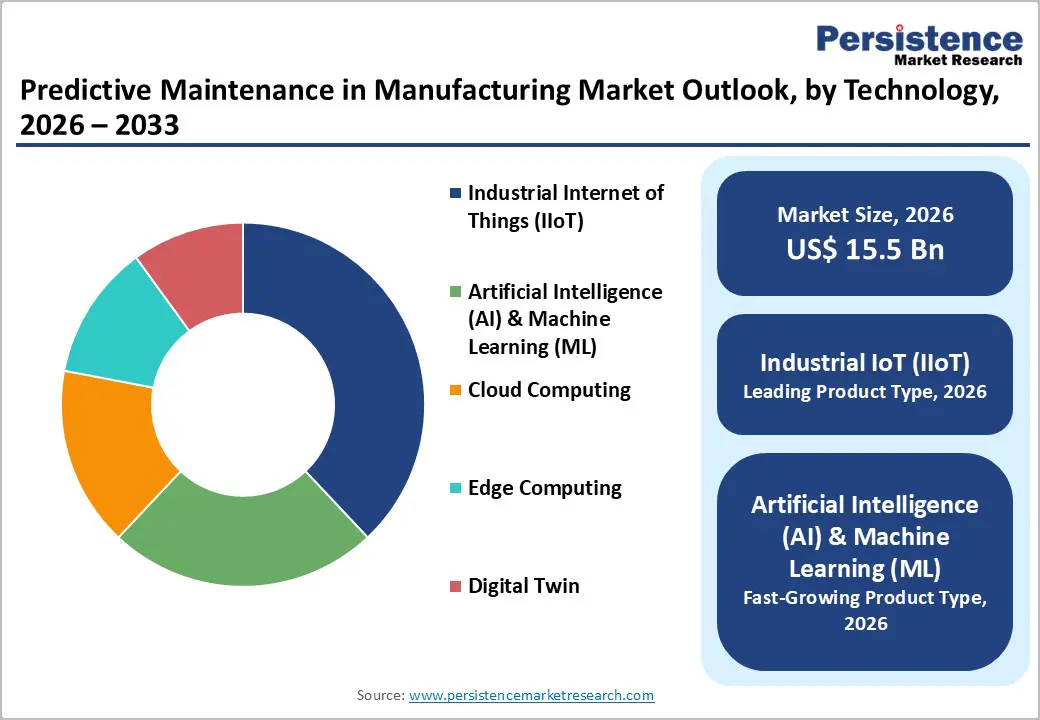
- Leading Technology: IIoT is anticipated to dominate with around 38% revenue share in 2026, while artificial intelligence (AI) & machine learning (ML) are slated to be the fastest-growing at a CAGR of 27.2% through 2033, driven by enhanced predictive accuracy and automation.
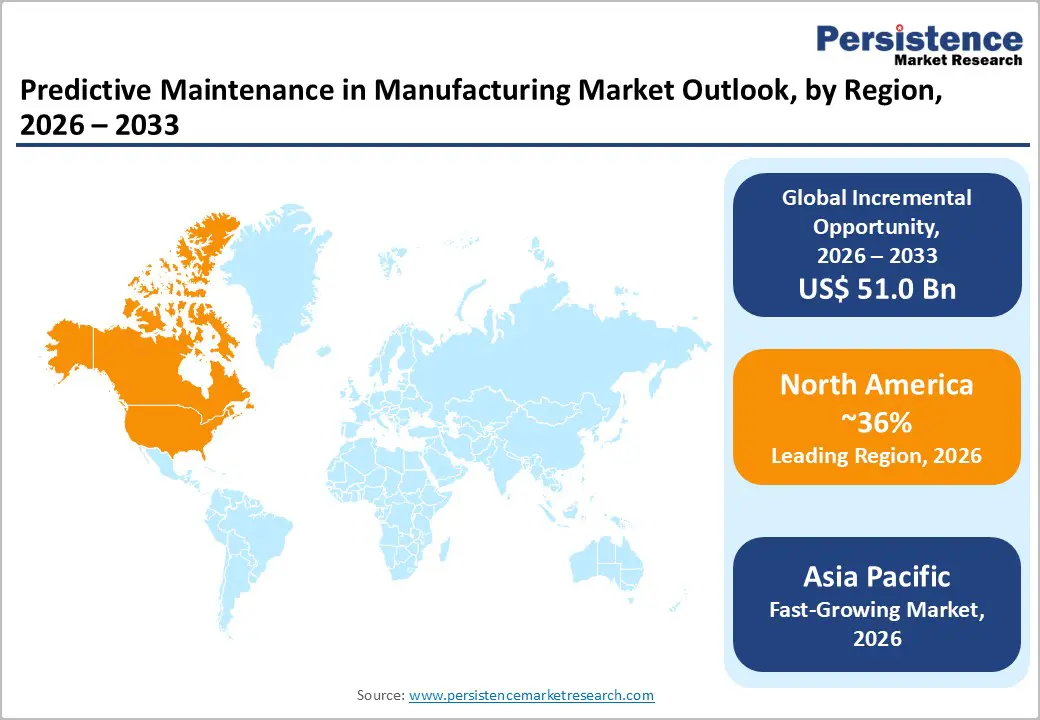
- Regional Leadership: North America is poised to lead with roughly 36% market share in 2026, while Asia Pacific is expected to register the fastest growth at a CAGR of 28.1% through 2033, fueled by digital transformation initiatives.
- Demand Drivers: Rising downtime cost pressures and sustainability priorities, including improved energy efficiency, optimized asset utilization, and extended equipment lifecycle are fueling demand.
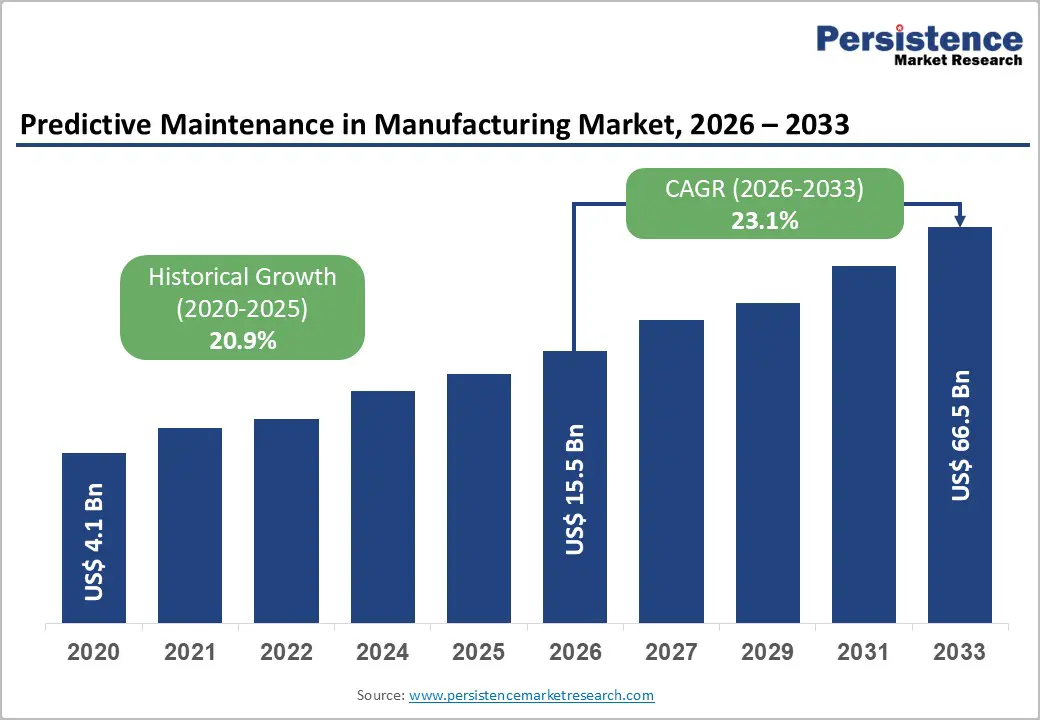
| Key Insights | Details |
|---|---|
|
Predictive Maintenance in Manufacturing Market Size (2026E) |
US$ 15.5 Bn |
|
Market Value Forecast (2033F) |
US$ 66.5 Bn |
|
Projected Growth (CAGR 2026 to 2033) |
23.1% |
|
Historical Market Growth (CAGR 2020 to 2025) |
20.9% |
DRO Analysis
Rising Cost of Equipment Downtime and Complexity of Industrial Systems
Unplanned downtime continues to impose a significant financial burden across manufacturing sectors, with industrial statistics showing that unexpected production stoppages can cost manufacturers billions annually in lost output and emergency repairs. Major industrial operations have increasingly turned to predictive maintenance as a core strategy to shift from reactive to proactive asset health management. This shift is also reflected in broader manufacturing transformation trends reported in 2025, where predictive maintenance has become a routine operational practice in leading plants as part of digitalization strategies, enabling better equipment health visibility and reduced machine failures.
The increasing complexity of industrial equipment further amplifies the need for predictive solutions that can keep pace with modern automation systems. Manufacturers implementing predictive maintenance report measurable reductions in maintenance burden and greater uptime reliability. Leadership in operational efficiency now often hinges on embedding smart technologies into maintenance regimes, especially in asset-intensive industries where even small improvements in uptime have significant business impact. These measurable outcomes strengthen the business case for predictive maintenance as a foundational component of manufacturing productivity and continuity.
Rapid Adoption of IIoT, Smart Manufacturing, and AI-Driven Analytics
The proliferation of IIoT devices and real-time data systems is reshaping manufacturing operations by creating highly interconnected smart factories. National and industrial initiatives around smart manufacturing emphasize the role of advanced connectivity, sensors, and automation in enabling real-time monitoring and predictive insights. This trend underpins the broad deployment of connected production systems that feed analytical engines for anomaly detection and failure forecasting.
Advances in AI and machine learning are accelerating this transition by turning rich sensor data into actionable predictions. Industry forums and practitioner events in late 2025 have highlighted the practical deployment of AI-enhanced analytics and prescriptive intelligence across manufacturing lines, reflecting a maturing digital ecosystem where predictive maintenance is an integral use case of smart manufacturing architectures. These developments underscore predictive maintenance’s role not just as a cost-reduction tool, but as a central enabler of digital transformation, operational resiliency, and cross-functional efficiency in modern industrial enterprises.
High Initial Implementation Costs and System Integration Challenges
Predictive maintenance systems require significant upfront investment, which can be a major barrier for many manufacturers, especially smaller firms. Costs include sensor installation, data infrastructure, software licensing, and workforce training. In 2025, implementation expenses for small and medium-sized manufacturers ranged from US$ 50,000 to US$ 500,000 per facility depending on scale and complexity. These high capital requirements often delay adoption and limit deployment to larger enterprises with deeper digital transformation budgets. Limited access to skilled technical personnel further increases implementation hurdles, particularly in emerging markets where digital expertise is still developing.
Integration with legacy equipment remains a substantial operational challenge. Many factories still operate on older machinery lacking digital interfaces, requiring retrofitting or replacement to support modern connectivity and analytics. Legacy systems also create data silos and complicate real-time workflows, slowing digital transformation efforts across production lines. Industry discussions throughout 2025 highlighted these integration obstacles as a primary reason why many manufacturers struggle to scale smart maintenance initiatives beyond pilot stages. Without standardized protocols, enterprises face higher costs and longer timelines for system-wide deployment, reducing the ROI of predictive maintenance solutions.
Cybersecurity Risks and Interoperability Challenges
The growing reliance on connected systems and cloud platforms introduces significant cybersecurity risks. The manufacturing sector has become a frequent target of cyberattacks due to the convergence of IT and operational technology (OT). In 2025, events underscored this trend when awareness sessions in Gujarat highlighted industrial OT systems being targeted by sophisticated attackers, with experts urging stricter security protocols, audits, and adherence to global standards such as IEC 62443 to protect factory operations. Cybersecurity concerns often lead companies to delay or limit digital adoption, especially when mission-critical production lines are at risk.
Interoperability issues also impede seamless adoption of predictive maintenance. Lack of standardized communication protocols across different equipment and platforms often forces manufacturers to deploy costly custom interfaces or middleware to connect disparate systems. These proprietary obstacles complicate data exchange between legacy and modern devices, increasing both development time and integration expenses. This fragmented ecosystem not only slows digital transformation but also increases vulnerability as insecure connections between systems become potential entry points for cyber threats. Organizations must invest additional resources in testing and validation, further raising implementation costs and operational complexity.
Expansion in New Manufacturing Economies and Government-Led Digital Initiatives
Emerging markets across Southeast Asia, Latin America, and parts of Eastern Europe are accelerating manufacturing digitization by combining national policies with smart factory technology adoption. In 2025, Indonesia and Vietnam hosted regional Industry 4.0 expos showcasing digital twin platforms, IIoT deployments, and predictive maintenance technologies that improve operational efficiency and reduce downtime. Such initiatives demonstrate strong government support for industrial digitalization and a growing appetite among enterprises for advanced maintenance solutions.
Education and skill development programs have expanded globally to support Industry 4.0 adoption. For instance, universities and technical institutes across Europe and Southeast Asia launched advanced smart manufacturing leadership programs in 2025, focused on IoT, AI, and predictive maintenance applications. These programs prepare a skilled workforce capable of implementing and managing predictive maintenance systems. Combined with government incentives for smart manufacturing, these developments create significant opportunities for vendors offering cost-effective, scalable predictive maintenance solutions across emerging economies.
Integration of Digital Twin, Edge Computing Technologies, and Sustainability Trends
Digital twin platforms are increasingly moving from pilot projects to full-scale industrial deployment. In 2026, major ports and manufacturing hubs in Europe and Southeast Asia implemented digital twin systems integrated with IIoT sensors and predictive analytics to optimize equipment availability, reduce downtime, and monitor energy consumption. These implementations highlight the practical benefits of real-time simulation and predictive monitoring in improving operational reliability and efficiency.
The edge computing and AI-driven manufacturing solutions are accelerating the adoption of predictive maintenance globally. Events such as Smart Factory + Automation World 2026 showcased applications where edge computing reduces latency, enables faster local decision-making, and supports real-time analytics in remote facilities. Coupled with increasing regulatory and corporate focus on sustainability, predictive maintenance systems are now positioned as both efficiency and energy-optimization tools, reducing waste, lowering energy usage, and extending equipment life across multiple industrial sectors.
Category-wise Analysis
Component Insights
Software is likely to remain the dominant component, accounting for around 45% of the predictive maintenance in manufacturing market revenue share in 2026, as predictive platforms integrate IIoT data, AI analytics, and cloud connectivity to convert machine signals into actionable maintenance insights. In 2025, major automotive manufacturers deployed plant-wide predictive platforms with IoT sensors and edge AI, reducing unplanned downtime by nearly half across robotic welding and painting lines. Beyond real-time monitoring, these solutions offer trend forecasting, anomaly alerts, and integrated dashboards for multi-facility maintenance planning. Cloud deployment enhances accessibility and coordination across global operations, making software indispensable for large-scale digital transformation initiatives.
The services segment is projected to grow at the fastest CAGR of 25.3% through 2033, driven by rising demand for consulting, implementation, and ongoing system support. As predictive maintenance systems become more complex, manufacturers increasingly rely on third-party expertise for integration, monitoring, and optimization. In 2025, several mid-tier manufacturers outsourced predictive analytics setup and performance monitoring to specialized service providers to ensure efficient deployment and maximize ROI. Services also include staff training, system updates, and continuous model tuning, allowing companies to maintain high prediction accuracy. This combination of expertise and support positions services as a critical enabler of predictive maintenance adoption.
Technology Insights
Industrial IoT is expected to command approximately 38% of the predictive maintenance in manufacturing market share in 2026, as connected sensors and devices generate the high-frequency data required for predictive analytics. In 2025, large logistics and retail operations implemented IIoT sensor networks to track equipment performance and optimize operational efficiency in real time. IIoT data supports edge and cloud processing, enabling rapid detection of anomalies and proactive maintenance decisions. Its ability to continuously monitor assets, improve reliability, and integrate with AI-driven analytics makes IIoT a foundational technology for predictive maintenance solutions across diverse manufacturing environments.
AI and ML are anticipated as the fastest-growing technologies, expanding at a CAGR of 27.2% through 2033, as they convert complex IoT and sensor data into precise predictive insights. In 2025, leading manufacturers deployed AI-enhanced vision and analytics systems on production lines to detect subtle machine anomalies, preventing quality issues and costly failures. These technologies enable real-time anomaly detection, adaptive learning, and root-cause analysis, reducing false alarms and enhancing operational efficiency. By integrating AI and ML with IIoT data, companies move from reactive to predictive maintenance, improving equipment uptime, optimizing resources, and driving strategic operational intelligence across facilities.
Regional Insights
North America Predictive Maintenance in Manufacturing Market Trends
North America is likely to be the leading region in predictive maintenance adoption, holding about 36% of global revenue in 2026. The United States drives this share due to strong digital infrastructure and widespread use of predictive analytics in manufacturing operations. In 2025, many U.S. smart factories, including facilities featured in national smart manufacturing rankings, achieved over 95% uptime by integrating AI-enabled predictive maintenance with IoT ecosystems, significantly reducing unplanned breakdowns and improving quality metrics across automotive and electronics lines.
Government and industry initiatives continue to reinforce this leadership. AI-powered predictive systems are widely used to anticipate equipment failures and optimize maintenance schedules, helping manufacturers handle labor shortages, control waste, and improve overall operational efficiency. Continuous investment in cloud platforms, connected equipment, and advanced analytics enhances real-time operational visibility. The result is a mature competitive landscape where enterprises maintain high production reliability while adopting next-generation maintenance intelligence, giving North America a clear strategic advantage.
Europe Predictive Maintenance in Manufacturing Market Trends
Europe is a key market for predictive maintenance, led by Germany, the U.K., France, and Spain, driven by strong manufacturing bases and digital transformation initiatives. In 2025, manufacturers across multiple European Union (EU) countries integrated predictive maintenance into energy-intensive sectors such as automotive and industrial machinery, aligning operational improvements with sustainability mandates and regulatory standards focused on energy efficiency. These initiatives enhance equipment reliability, reduce downtime, and support compliance with operational and environmental frameworks, making predictive maintenance a critical enabler of European industrial modernization.
Collaborations between industrial groups and automation associations have accelerated technology integration in factory floors, particularly in robotics, IIoT, and predictive diagnostics. Public-private partnerships and supportive policies continue to drive adoption, and European facilities increasingly link predictive maintenance to broader digital twin and analytics programs, enhancing performance while complying with operational standards. Investments in workforce training and AI applications also strengthen regional capabilities, ensuring predictive maintenance solutions continue to deliver measurable reductions in downtime and operational costs.
Asia Pacific Predictive Maintenance in Manufacturing Market Trends
Asia Pacific is projected to be the fastest-growing regional market for predictive maintenance in manufacturing solutions, with a CAGR exceeding 28.1% through 2033, propelled by rapid industrial expansion in China, Japan, and Southeast Asia. Manufacturers in these markets are deploying predictive maintenance to improve equipment reliability amid rising production demands. China and Japan’s strong investment in smart factory infrastructure and connected systems supports seamless integration of IoT sensors and analytics for real-time asset health monitoring.
Emerging economies in Southeast Asia are scaling digital transformation efforts through government support and industry collaborations. As manufacturing hubs adopt predictive technologies to remain globally competitive, they leverage IIoT data streams and AI analytics to maximize throughput and limit downtime. Regional manufacturers also focus on sustainability initiatives, optimizing energy consumption and resource utilization with predictive systems. Despite challenges such as uneven regulatory standards and infrastructure maturity, the region’s industrial growth trajectory and escalating adoption of connected maintenance platforms create significant long-term opportunities for predictive maintenance solution providers.
Competitive Landscape
The global predictive maintenance in manufacturing market structure is moderately consolidated, with leading players such as Siemens, Honeywell, ABB, Rockwell Automation, and Schneider Electric controlling a significant portion of the revenue. These established companies leverage extensive manufacturing industry relationships, strong R&D capabilities, and integrated hardware-software platforms to deliver end-to-end predictive maintenance solutions. They continue to invest heavily in AI-driven analytics, IIoT integration, cloud-based monitoring, and digital twin technologies to maintain technological leadership and operational excellence.
Regional and niche players such as Emerson, Mitsubishi Electric, and Hitachi Energy focus on specialized applications, smaller manufacturing segments, and geographic strongholds. While barriers such as system integration complexity and cybersecurity requirements limit new entrants, the shift toward software-centric, cloud-enabled predictive solutions is enabling technology startups to participate. The market is expected to gradually consolidate as global leaders expand through acquisitions and strategic partnerships, while collaborations with analytics and IoT firms strengthen solution portfolios and innovation capabilities.
Key Industry Developments
- In September 2025, Bausch+Lomb, Spot&Tango, and FranklinWH applied AI for predictive maintenance in non-traditional sectors such as pet food, batteries, and contact lenses, expanding adoption beyond automotive and electronics.
- In August 2025, Hyundai opened its $7.6 billion U.S. facility with digital twin and AI systems for real-time defect detection, integrating predictive maintenance to reduce downtime and improve production efficiency.
- In March 2025, Siemens launched an AI-driven predictive maintenance platform with edge computing and IoT sensors, enhancing fault detection and enabling proactive equipment management.
Companies Covered in Predictive Maintenance in Manufacturing Market
- Siemens AG
- General Electric
- IBM Corporation
- Microsoft Corporation
- SAP SE
- Schneider Electric
- ABB Ltd.
- Honeywell International Inc.
- Emerson Electric Co.
- Rockwell Automation
- Hitachi Ltd.
- Bosch Group
- Oracle Corporation
- PTC Inc.
- SAS Institute
Frequently Asked Questions
The global predictive maintenance in manufacturing market is projected to reach US$ 15.5 billion in 2026.
Rising unplanned downtime costs, adoption of Industry 4.0 technologies, and AI-driven analytics investments are key market drivers.
The market is expected to grow at a CAGR of 23.1% from 2026 to 2033.
Emerging manufacturing economies, integration with digital twin and edge technologies, and sustainability initiatives create strong opportunities.
Siemens, Honeywell, ABB, Rockwell Automation, Schneider Electric, Emerson, Mitsubishi Electric, and Hitachi Energy are some of the leading players.


