




- Hardware & Software IT Services
- IT Asset Disposition Market
IT Asset Disposition Market Size, Share, and Growth Forecast 2026 - 2033
IT Asset Disposition Market by Asset Type (Computers/Laptops, Smartphones and Tablets, Peripherals, Storages, Servers), End-user (BFSI, IT and Telecom, Government, Energy and Utilities), and Regional Analysis, 2026 - 2033

IT Asset Disposition Market Size and Trends Analysis
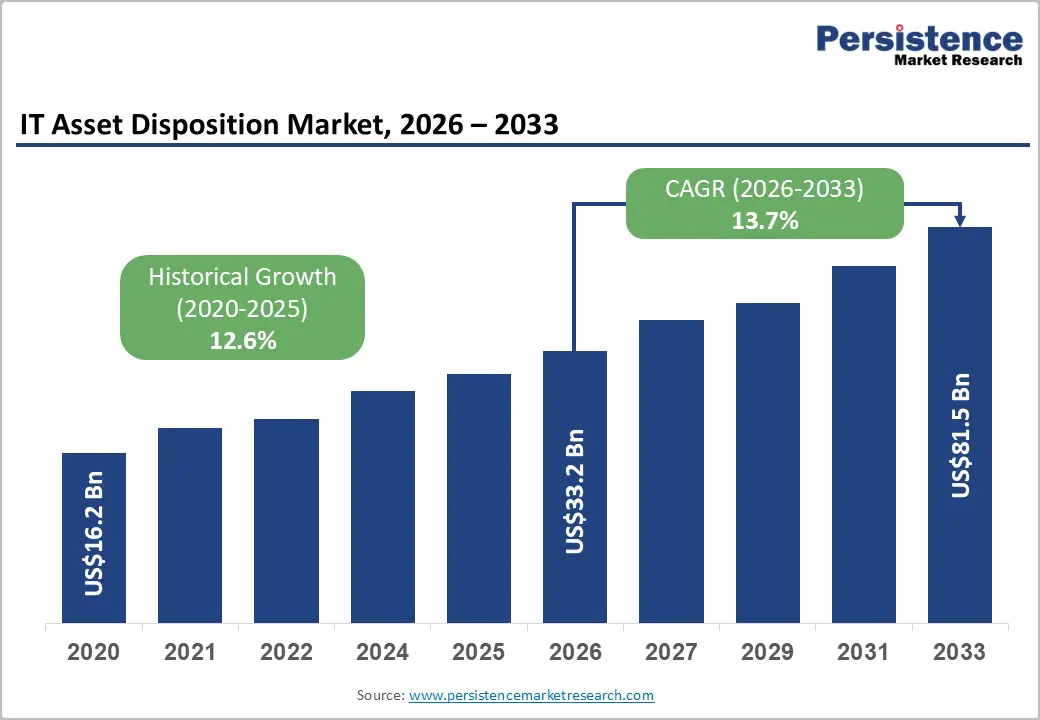
The global IT asset disposition market size is likely to be valued at US$33.2 billion in 2026 and is expected to reach US$81.5 billion by 2033, growing at a CAGR of 13.7% during the forecast period from 2026 to 2033, driven by the rising volume of retired IT equipment from frequent hardware refresh cycles across enterprises and data centers. Increased cloud adoption and AI infrastructure upgrades are further boosting the disposal of servers and storage devices.
Key Industry Highlights:
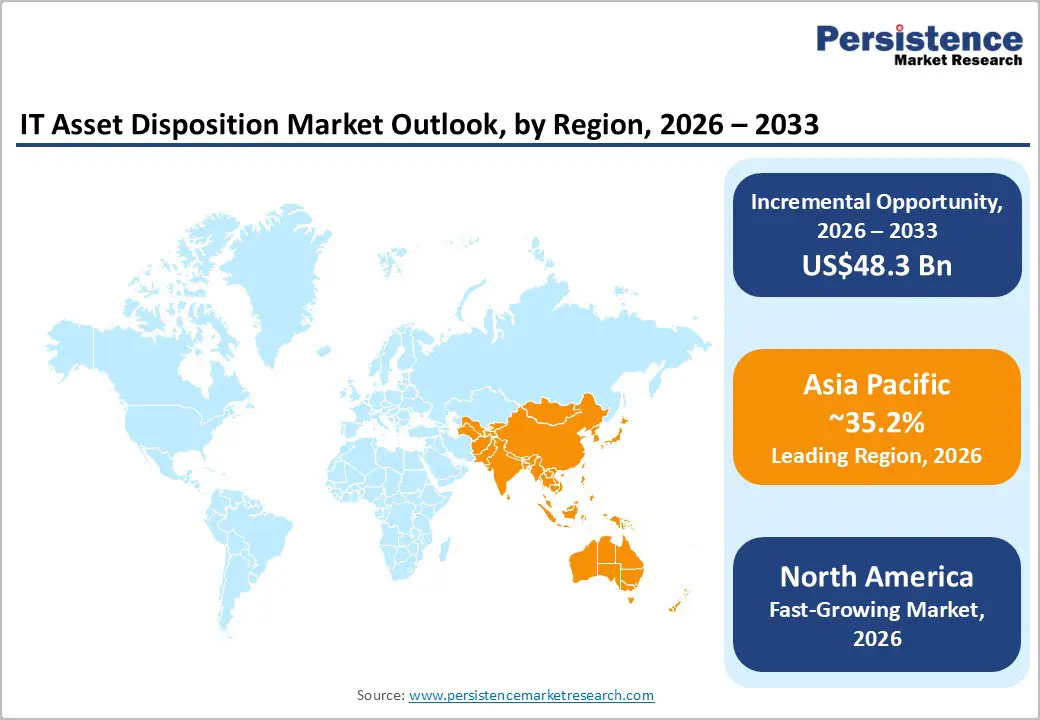
- Leading Region: Asia Pacific, with about 35.2% share in 2026, fueled by its large-scale electronics production and high e-waste generation.
- Fast-growing Region: North America, owing to ongoing data center expansion and strict data disposal standards guided by frameworks such as those from the National Institute of Standards and Technology.
- Latest Acquisition: In September 2025, Iron Mountain acquired ACT Logistics, an IT asset disposition (ITAD) and technology lifecycle services specialist in Australia. This acquisition extended Iron Mountain's booming ITAD footprint in Asia Pacific.
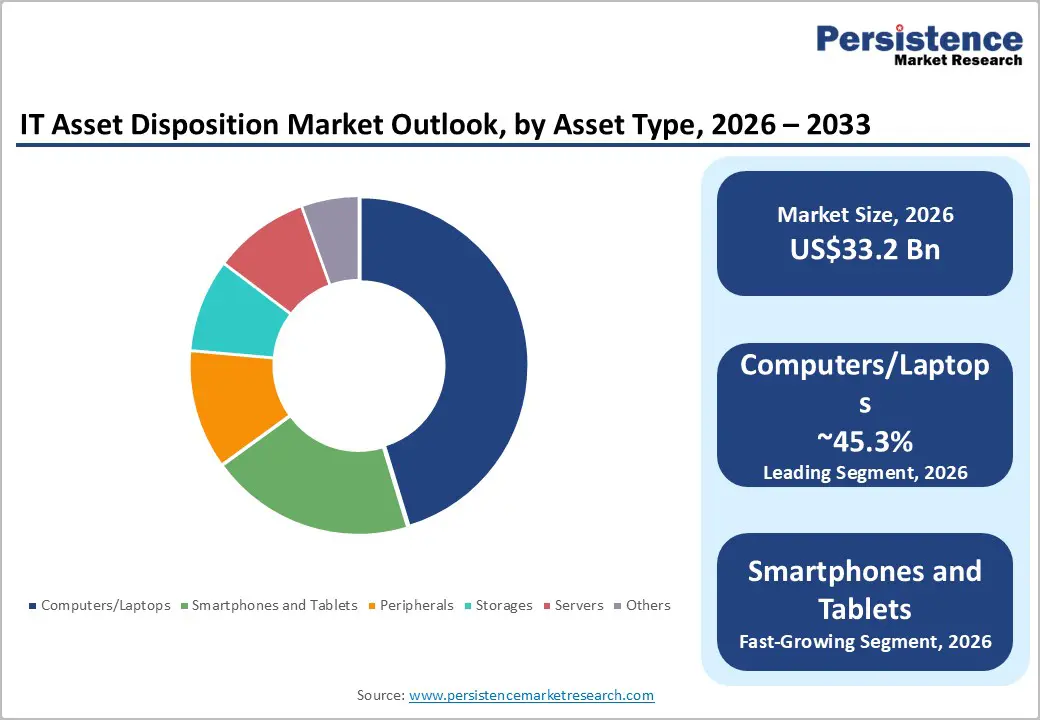
- Leading Asset Type: Computers/Laptops, approximately 45.3% share in 2026, as they are widely used across enterprises and store sensitive data that requires certified disposal at end-of-life.
- Dominant End User: IT and telecom, nearly 33.8% in 2026, as they operate large-scale infrastructure with frequent hardware upgrades, creating continuous demand for secure asset disposal.
DRO Analysis
Driver - Increasing Focus on Secure Disposal Due to Rising Cyber Risks
Frequent cyber incidents are pushing companies to adopt certified IT asset disposal practices. Old devices often store recoverable data even after basic deletion. The National Institute of Standards and Technology (NIST) states in its SP 800-88 guidelines that improper sanitization can still leave sensitive data accessible.
In 2023, the U.S. Federal Trade Commission warned businesses after multiple cases where disposed devices exposed customer records due to weak wiping methods. This has increased demand for services such as degaussing and physical destruction. Large firms now prefer ITAD vendors that provide audit trails and certificates of destruction. The rising use of remote work devices has further increased the volume of endpoints that require secure retirement.
Strict Rules Revolving around E-Waste and Data Handling
Governments are enforcing strict rules on how companies handle retired IT assets. The European Commission mandates proper e-waste handling under the WEEE Directive, making producers responsible for safe disposal and recycling. In India, the Central Pollution Control Board updated its E-Waste Management Rules in 2022, introducing extended producer responsibility with digital tracking systems.
These frameworks require documented recycling and data destruction processes. Non-compliance can lead to penalties and operational restrictions. Hence, companies are outsourcing IT asset disposal to certified vendors who understand local and global compliance requirements.
Restraint - Risk of Data Exposure from Poorly Handled Devices
One key restraint is the risk of sensitive data leaks from improperly processed assets. Even today, several devices enter secondary markets without proper wiping. A 2022 study published by the Blancco Technology Group found that a notable share of used drives still contained recoverable corporate or personal data.
The National Cyber Security Center has also warned that weak disposal practices remain a common cause of breaches. These incidents damage trust and create legal risks. Small-scale firms often avoid formal ITAD services due to cost concerns, which increases exposure. This lack of standardization in disposal practices slows broad market adoption.
Opportunity - Surging Shift toward Reuse and Recovery of IT Asset Value
Organizations are moving from disposal to reuse-focused strategies. Instead of scrapping devices, companies now refurbish and resell them. The United Nations University reported in its Global E-waste Monitor that extending device life is one of the most effective ways to reduce e-waste.
Leading firms such as Dell Technologies run take-back and refurbishment programs, recovering usable components and reselling equipment. This approach helps reduce procurement costs and supports sustainability goals. It also complies with Environmental, Social, and Governance (ESG) reporting, where companies must show measurable waste reduction efforts.
Increasing Use of AI and Automation in Asset Lifecycle Management
Advanced technologies are improving how IT assets are tracked and processed. AI tools can now assess device condition, estimate resale value, and decide the best recovery path. For instance, Microsoft has highlighted automated asset management in its circular centers, where devices are sorted and reused using data-driven systems.
Automation also improves compliance reporting by creating real-time records of asset movement and data destruction. This reduces manual errors and speeds up large-scale decommissioning projects, especially in data centers and cloud infrastructure environments.
Category-wise Analysis
Asset Type Insights
Computers/laptops are predicted to lead with a share of approximately 45.3% in 2026, as they are widely used across all industries and store large volumes of sensitive data. Enterprises replace employee laptops every three to five years due to performance, security updates, and software compatibility. The National Institute of Standards and Technology highlights that endpoints such as laptops carry high data risk and require strict sanitization under its SP 800-88 guidelines. Hybrid work has also increased device issuance.
For example, the International Labor Organization reported that remote work surged post-pandemic, pushing high laptop deployment. This creates a steady flow of retired devices requiring secure disposal, refurbishment, or resale.
Smartphones and tablets are estimated to be the fastest growing segment over the forecast period, owing to their short upgrade cycles and rising enterprise use. Smartphones are often replaced within 2 to 3 years, much faster than traditional IT hardware. The GSMA notes that billions of mobile connections exist globally, with enterprise mobility and BYOD policies increasing device turnover. Government-backed programs such as India’s e-waste rules under the Central Pollution Control Board also emphasize proper recycling of small electronics. These devices contain personal and financial data, making certified disposal important. Their compact size and resale demand further push companies to adopt ITAD services focused on recovery and reuse.
End-user Insights
The IT and telecom segment is anticipated to dominate with a share of nearly 33.8% in 2026, as it operates massive volumes of hardware across data centers, networks, and enterprise systems. Equipment, including servers, routers, and storage systems, is frequently upgraded to support cloud computing, 5G, and AI workloads. The Federal Communications Commission has highlighted ongoing network upgrades as telecom firms extend coverage and capacity. These upgrades generate large volumes of retired assets that require secure decommissioning. Companies in this sector also handle critical user data, so they rely on certified ITAD vendors for compliance, traceability, and risk reduction.
The media and entertainment segment is expected to remain in the second position in 2026, backed by speedy digital transformation. Streaming platforms, gaming studios, and production houses rely on high-performance hardware for editing, rendering, and storage. Frequent upgrades are required to handle 4K/8K content and real-time production workflows. The European Broadcasting Union has noted the shift toward IP-based production systems, which require continuous hardware refresh.
Large media firms also generate and store vast digital libraries, increasing data security concerns. This leads to high demand for ITAD services that can securely dispose of storage devices while recovering value from high-end equipment.
Regional Insights
Asia Pacific IT Asset Disposition Market Trends
Asia Pacific is anticipated to dominate in 2026 with a share of nearly 35.2%, as it is the largest producer and consumer of electronics. Countries such as China, India, and South Korea manufacture and use massive volumes of IT devices. This creates a continuous flow of retired assets. The United Nations University in its Global E-waste Monitor highlights that Asia generates the highest volume of e-waste globally. Governments are also tightening recycling rules. For example, India’s Central Pollution Control Board introduced digital tracking for e-waste flows. This combination of high device turnover and policy push drives ITAD demand.
China IT Asset Disposition Market Trends
China is growing fast due to its well-established electronics manufacturing hub and strict recycling policies. The government promotes circular economy practices through regulations and state-backed programs. The Ministry of Ecology and Environment has enforced formal e-waste collection and treatment systems. Large data center expansion is also increasing server disposal volumes. Cloud firms and telecom operators frequently upgrade infrastructure, which creates demand for professional ITAD services.
Japan IT Asset Disposition Market Trends
Japan shows stable growth due to its well-established recycling framework and disciplined corporate practices. The country follows strict laws such as the Home Appliance Recycling Law. The Ministry of the Environment of Japan promotes proper e-waste handling and resource recovery. Companies in the country further focus on refurbishment and material recovery rather than simple disposal. High awareness about data security also supports demand for certified ITAD services.
North America IT Asset Disposition Market Trends
North America is predicted to be the fastest-growing region in 2026 with a share of approximately 26.9%. Growth is attributed to superior regulatory enforcement and ongoing cloud adoption. Enterprises must follow strict data protection rules, which increases reliance on certified disposal vendors. The National Institute of Standards and Technology provides widely used data sanitization guidelines. Hyperscale data centers are also expanding across the region. Frequent hardware refresh cycles in cloud and AI infrastructure generate large volumes of retired IT assets.
U.S. IT Asset Disposition Market Trends
The U.S. remains the single largest market globally. Multiple drivers are converging to push this market forward, right from AI-backed hardware upgrades and OS end-of-life cycles to tightening state privacy laws and federal data sanitization standards. The biggest volume driver right now is the AI infrastructure boom. AI server refresh cycles have compressed from a traditional 5-to-7-year horizon to just 18 to 36 months. Successive GPU performance leaps make older accelerator fleets economically inefficient to operate at scale.
The Windows 10 end-of-life was another key catalyst. After October 14, 2025, Windows 10 stopped receiving mainstream security updates. For several enterprises, if a device could not run Windows 11 due to hardware limitations, it became a candidate for replacement rather than an upgrade. Iron Mountain noted the Windows 10 transition was predicted to surpass previous OS phaseouts such as Windows 8, owing to its sheer enterprise-scale adoption and rising focus on data security compliance.
Europe IT Asset Disposition Market Trends
Europe will likely see steady growth over the forecast period, with a share of nearly 18.3% in 2026, backed by transparent and strict regulatory frameworks. The European Commission enforces the WEEE Directive, which requires the smooth collection and recycling of electronic waste. Companies must maintain records of disposal and recycling activities. This creates consistent demand for ITAD services. The region also focuses on sustainability, pushing firms toward reuse and refurbishment instead of disposal.
U.K. IT Asset Disposition Market Trends
The U.K. is growing at a steady pace due to rising digital adoption and favorable regulatory guidelines. The Environment Agency oversees e-waste handling and enforces compliance standards. Businesses are investing in secure IT disposal due to increasing cyber risks. At the same time, growth in sectors such as fintech and media is increasing the volume of IT assets in use. This leads to more frequent replacement cycles and higher demand for ITAD services.
Germany IT Asset Disposition Market Trends
Germany shows a stable growth outlook due to its well-established industrial sector and strict environmental policies. The country has advanced recycling infrastructure and high compliance standards. The Federal Environment Agency of Germany supports circular economy initiatives and proper e-waste handling. Local companies focus on resource efficiency and often partner with ITAD vendors to recover value from used equipment.
Competitive Landscape
The global IT asset disposition market is moderately fragmented, with a handful of large multinational providers competing alongside several regional specialists. While companies such as Iron Mountain, Sims Lifecycle Services, TES, ITRenew, and Ingram Micro hold dominant positions, the leading vendors collectively account for only a limited share of global revenue, leaving significant room for regional and niche players.
Competition has shifted beyond basic e-waste recycling and data destruction. Vendors now differentiate themselves through end-to-end lifecycle management capabilities, including asset tracking, certified data sanitization, refurbishment, remarketing, reverse logistics, ESG reporting, and circular economy consulting. Large enterprises mainly prefer providers that can manage the entire asset lifecycle, right from deployment to retirement, under a single contract, creating an advantage for integrated service providers.
Key Industry Developments:
- In January 2026, Paladin EnviroTech announced the acquisition of R&L Recycling B.V., a Netherlands-based recycler with more than 25 years of experience in sustainable materials recovery and ITAD services. The move marked Paladin's first European acquisition and was driven by increasing demand from global hyperscale and OEM customers for compliant, in-region ITAD and recycling solutions across Europe.
- In January 2026, Blancco Technology Group announced the launch of Blancco Asset Reimaging, described as the industry's first smooth workflow to erase and reinstall Windows OS. Integrated directly with Blancco's certified data erasure software, the product allows device refurbishers and ITAD firms to move from sanitizing, diagnosing, and grading devices to reimaging within a single, efficient workflow.
- In December 2025, the Global ITAD Alliance (GIA) was officially launched as a new international trade association established to unify, represent, and advance the rapidly maturing ITAD industry. SK tes, a global leader in secure technology lifecycle management, was among the founding members.
Companies Covered in IT Asset Disposition Market
- Apto Solutions Inc.
- CompuCom Systems, Inc.
- Dell Inc.
- Hewlett Packard Enterprise Development LP
- IBM Corporation
- Ingram Micro Services
- Iron Mountain
- ITRenew
- LifeSpan International Inc.
- Sims Lifecycle Services, Inc.
- Others
Frequently Asked Questions
The global IT asset disposition market is projected to be valued at US$33.2 billion in 2026.
The IT asset disposition market is expected to reach US$81.5 billion by 2033.
Key market trends include the shift toward circular economy practices and integration of AI in asset tracking.
Computers/Laptops are expected to be the leading solution with a share of nearly 45.3% in 2026, as frequent upgrade cycles in hybrid work environments generate a steady stream of retired devices.
The IT asset disposition market is expected to grow at a CAGR of 13.7% from 2026 to 2033.
Apto Solutions Inc., CompuCom Systems, Inc., and Dell Inc. are a few key market players.


