


- Executive Summary
- Global Homophthalic Acid Market Snapshot, 2025 and 2033
- Market Opportunity Assessment, 2025 - 2033, US$ Bn
- Key Market Trends
- Future Market Projections
- Premium Market Insights
- Industry Developments and Key Market Events
- PMR Analysis and Recommendations
- Market Overview
- Market Scope and Definition
- Market Dynamics
- Drivers
- Restraints
- Opportunity
- Key Trends
- Macro-economic Factors
- Global Sectoral Outlook
- Global GDP Growth Outlook
- COVID-19 Impact Analysis
- Forecast Factors - Relevance and Impact
- Value Added Insights
- Tool Adoption Analysis
- Regulatory Landscape
- Value Chain Analysis
- PESTLE Analysis
- Porter’s Five Force Analysis
- Price Analysis, 2025A
- Key Highlights
- Key Factors Impacting Deployment Costs
- Pricing Analysis, By Application
- Global Homophthalic Acid Market Outlook
- Key Highlights
- Market Volume (Units) Projections
- Market Size (US$ Bn) and Y-o-Y Growth
- Absolute $ Opportunity
- Market Size (US$ Bn) and Volume (Units) Analysis and Forecast
- Historical Market Size (US$ Bn) Analysis, 2025-2025
- Market Size (US$ Bn) Analysis and Forecast, 2025 - 2033
- Global Homophthalic Acid Market Outlook: Application
- Introduction / Key Findings
- Historical Market Size (US$ Bn) and Volume (Units) Analysis, By Application, 2025 - 2025
- Market Size (US$ Bn) and Volume (Units) Analysis and Forecast, By Application, 2025 - 2033
- Pharmaceuticals
- Agrochemicals
- Fine Chemicals
- Polymers & Resins
- Electronics Materials
- Market Attractiveness Analysis: Application
- Global Homophthalic Acid Market Outlook: Product Type
- Introduction / Key Findings
- Historical Market Size (US$ Bn) Analysis, By Product Type, 2025 - 2025
- Market Size (US$ Bn) Analysis and Forecast, By Product Type, 2025 - 2033
- High-Purity
- Technical Grade
- Customized Grades
- Market Attractiveness Analysis: Product Type
- Global Homophthalic Acid Market Outlook: Production Method
- Introduction / Key Findings
- Historical Market Size (US$ Bn) Analysis, By Production Method, 2025 - 2025
- Market Size (US$ Bn) Analysis and Forecast, By Production Method, 2025 - 2033
- Chemical Synthesis
- Catalytic Processes
- Bio-based Synthesis
- Market Attractiveness Analysis: Production Method
- Key Highlights
- Global Homophthalic Acid Market Outlook: Region
- Key Highlights
- Historical Market Size (US$ Bn) and Volume (Units) Analysis, By Region, 2025 - 2025
- Market Size (US$ Bn) and Volume (Units) Analysis and Forecast, By Region, 2025 - 2033
- North America
- Europe
- East Asia
- South Asia and Oceania
- Latin America
- Middle East & Africa
- Market Attractiveness Analysis: Region
- North America Homophthalic Acid Market Outlook
- Key Highlights
- Historical Market Size (US$ Bn) Analysis, By Market, 2025 - 2025
- By Country
- By Application
- By Product Type
- By Production Method
- Market Size (US$ Bn) Analysis and Forecast, By Country, 2025 - 2033
- U.S.
- Canada
- Market Size (US$ Bn) and Volume (Units) Analysis and Forecast, By Application, 2025 - 2033
- Pharmaceuticals
- Agrochemicals
- Fine Chemicals
- Polymers & Resins
- Electronics Materials
- Market Size (US$ Bn) Analysis and Forecast, By Product Type, 2025 - 2033
- High-Purity
- Technical Grade
- Customized Grades
- Market Size (US$ Bn) Analysis and Forecast, By Production Method, 2025-2033
- Chemical Synthesis
- Catalytic Processes
- Bio-based Synthesis
- Market Attractiveness Analysis
- Europe Homophthalic Acid Market Outlook
- Key Highlights
- Historical Market Size (US$ Bn) Analysis, By Market, 2025 - 2025
- By Country
- By Application
- By Product Type
- Production Method
- Market Size (US$ Bn) Analysis and Forecast, By Country, 2025 - 2033
- Germany
- France
- U.K.
- Italy
- Spain
- Russia
- Türkiye
- Rest of Europe
- Market Size (US$ Bn) and Volume (Units) Analysis and Forecast, By Application, 2025 - 2033
- Pharmaceuticals
- Agrochemicals
- Fine Chemicals
- Polymers & Resins
- Electronics Materials
- Market Size (US$ Bn) Analysis and Forecast, By Product Type, 2025 - 2033
- High-Purity
- Technical Grade
- Customized Grades
- Market Size (US$ Bn) Analysis and Forecast, By Production Method, 2025-2033
- Chemical Synthesis
- Catalytic Processes
- Bio-based Synthesis
- Market Attractiveness Analysis
- East Asia Homophthalic Acid Market Outlook
- Key Highlights
- Historical Market Size (US$ Bn) Analysis, By Market, 2025 - 2025
- By Country
- By Application
- By Product Type
- By Production Method
- Market Size (US$ Bn) Analysis and Forecast, By Country, 2025 - 2033
- China
- Japan
- South Korea
- Market Size (US$ Bn) and Volume (Units) Analysis and Forecast, By Application, 2025 - 2033
- Pharmaceuticals
- Agrochemicals
- Fine Chemicals
- Polymers & Resins
- Electronics Materials
- Market Size (US$ Bn) Analysis and Forecast, By Product Type, 2025 - 2033
- High-Purity
- Technical Grade
- Customized Grades
- Market Size (US$ Bn) Analysis and Forecast, By Production Method, 2025-2033
- Chemical Synthesis
- Catalytic Processes
- Bio-based Synthesis
- Market Attractiveness Analysis
- South Asia & Oceania Homophthalic Acid Market Outlook
- Key Highlights
- Historical Market Size (US$ Bn) Analysis, By Market, 2025 - 2025
- By Country
- By Application
- By Product Type
- By Production Method
- Market Size (US$ Bn) Analysis and Forecast, By Country, 2025 - 2033
- India
- Southeast Asia
- ANZ
- Rest of South Asia & Oceania
- Market Size (US$ Bn) and Volume (Units) Analysis and Forecast, By Application, 2025 - 2033
- Pharmaceuticals
- Agrochemicals
- Fine Chemicals
- Polymers & Resins
- Electronics Materials
- Market Size (US$ Bn) Analysis and Forecast, By Product Type, 2025 - 2033
- High-Purity
- Technical Grade
- Customized Grades
- Market Size (US$ Bn) Analysis and Forecast, By Production Method, 2025-2033
- Chemical Synthesis
- Catalytic Processes
- Bio-based Synthesis
- Market Attractiveness Analysis
- Latin America Homophthalic Acid Market Outlook
- Key Highlights
- Historical Market Size (US$ Bn) Analysis, By Market, 2025 - 2025
- By Country
- By Application
- By Product Type
- By Production Method
- Market Size (US$ Bn) Analysis and Forecast, By Country, 2025 - 2033
- Brazil
- Mexico
- Rest of Latin America
- Market Size (US$ Bn) and Volume (Units) Analysis and Forecast, By Application, 2025 - 2033
- Pharmaceuticals
- Agrochemicals
- Fine Chemicals
- Polymers & Resins
- Electronics Materials
- Market Size (US$ Bn) Analysis and Forecast, By Product Type, 2025 - 2033
- High-Purity
- Technical Grade
- Customized Grades
- Market Size (US$ Bn) Analysis and Forecast, By Production Method, 2025-2033
- Chemical Synthesis
- Catalytic Processes
- Bio-based Synthesis
- Market Attractiveness Analysis
- Middle East & Africa Homophthalic Acid Market Outlook
- Key Highlights
- Historical Market Size (US$ Bn) Analysis, By Market, 2025 - 2025
- By Country
- By Application
- By Product Type
- By Production Method
- Market Size (US$ Bn) Analysis and Forecast, By Country, 2025 - 2033
- GCC Countries
- Egypt
- South Africa
- Northern Africa
- Rest of Middle East & Africa
- Market Size (US$ Bn) and Volume (Units) Analysis and Forecast, By Application, 2025 - 2033
- Pharmaceuticals
- Agrochemicals
- Fine Chemicals
- Polymers & Resins
- Electronics Materials
- Market Size (US$ Bn) Analysis and Forecast, By Product Type, 2025 - 2033
- High-Purity
- Technical Grade
- Customized Grades
- Market Size (US$ Bn) Analysis and Forecast, By Production Method, 2025-2033
- Chemical Synthesis
- Catalytic Processes
- Bio-based Synthesis
- Market Attractiveness Analysis
- Competition Landscape
- Market Share Analysis, 2025
- Market Structure
- Competition Intensity Mapping By Market
- Competition Dashboard
- Company Profiles (Details - Overview, Financials, Strategy, Recent Developments)
- Lanxess AG
- Overview
- Segments and Deployments
- Key Financials
- Market Developments
- Market Strategy
- Tokyo Chemical Industry Co., Ltd.
- Merck KGaA
- Alfa Aesar
- TCI Chemicals
- Santa Cruz Biotechnology
- Central Drug House
- Sisco Research Laboratories
- Oakwood Chemical
- Chem-Impex International
- Acros Organics
- Anhui Jinhe Industrial Co., Ltd.
- Jiangsu Zhongneng Chemical Technology
- Lanxess AG
- Appendix
- Research Methodology
- Research Assumptions
- Acronyms and Abbreviations


- Specialty & Fine Chemicals
- Homophthalic Acid Market
Homophthalic Acid Market Size, Share, and Growth Forecast, 2026 - 2033
Homophthalic Acid Market by Application (Pharmaceuticals, Agrochemicals, Fine Chemicals, Polymers & Resins, Electronics Materials), Product Type (High-Purity (≥99%), Technical Grade (95–99%), Customized Grades), Production Method (Chemical Synthesis, Catalytic Processes, Bio-based Synthesis), and Regional Analysis for 2026 - 2033
Key Industry Highlights
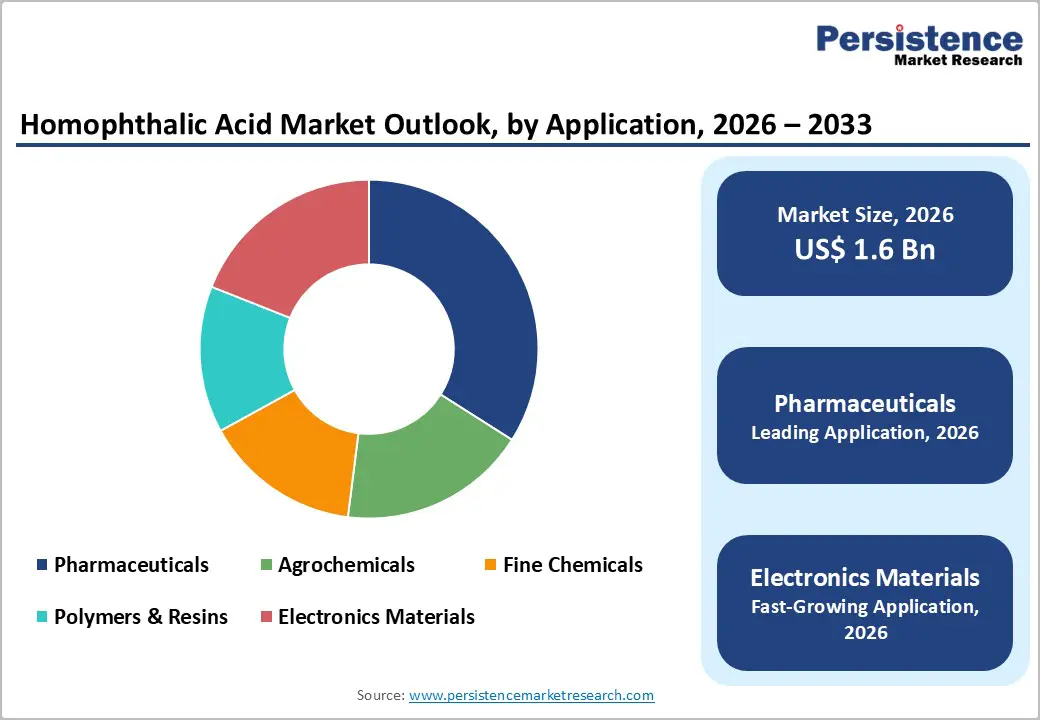
- Dominant Applications: Pharmaceuticals are set to command around 34% revenue share in 2026, while electronics are likely to grow the fastest at around 7.5% CAGR through 2033, driven by soaring demand for high-performance materials in the sector.
- Leading Product Types: High-purity grades are expected to lead with approximately 45% revenue share in 2026, while customized grades are projected to be the fastest-growing through 2033, supported by increasing demand for application-specific formulations.
- Dominant Production Methods: Chemical synthesis is anticipated to dominate the market with 52% in 2026, while bio-based synthesis is likely to register the fastest 2026-2033 growth, reflecting the industry’s shift toward sustainable and environmentally compliant production processes.
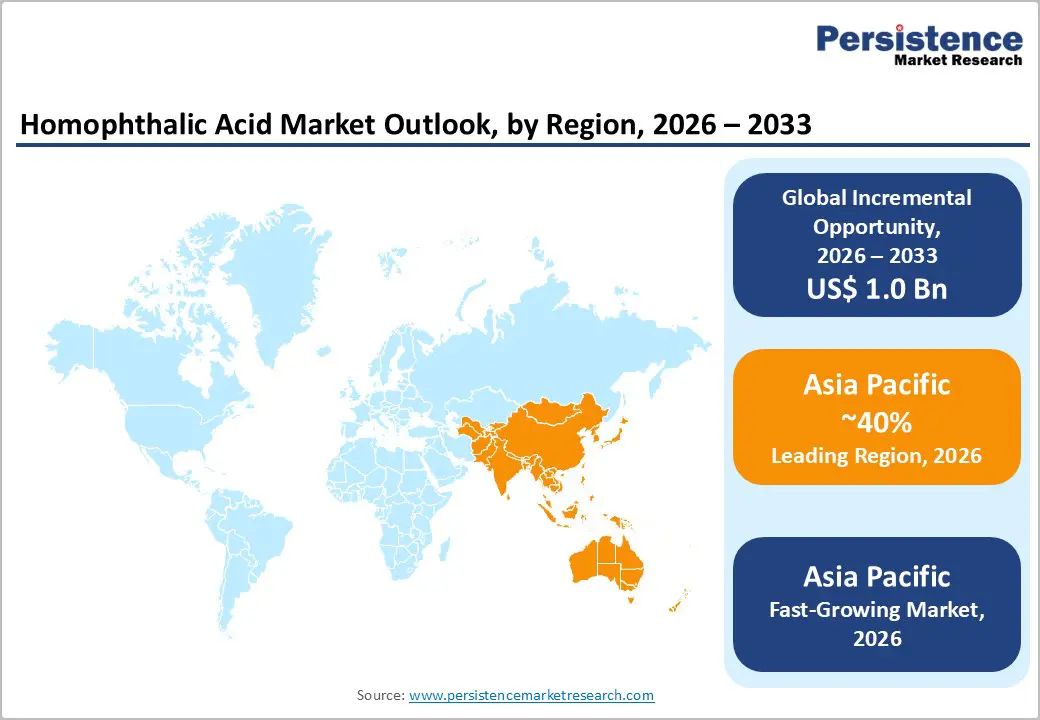
- Regional Leadership: Asia Pacific is poised to dominate with over 40% share in 2026 and maintain strong growth through 2033, led by expanding chemical manufacturing and pharmaceutical production in China and India.
- Competitive Environment: Competitive dynamics are centered on capacity expansions, strategic partnerships, and increased investment in sustainable technologies, with companies focusing on high-purity innovation and geographic expansion.
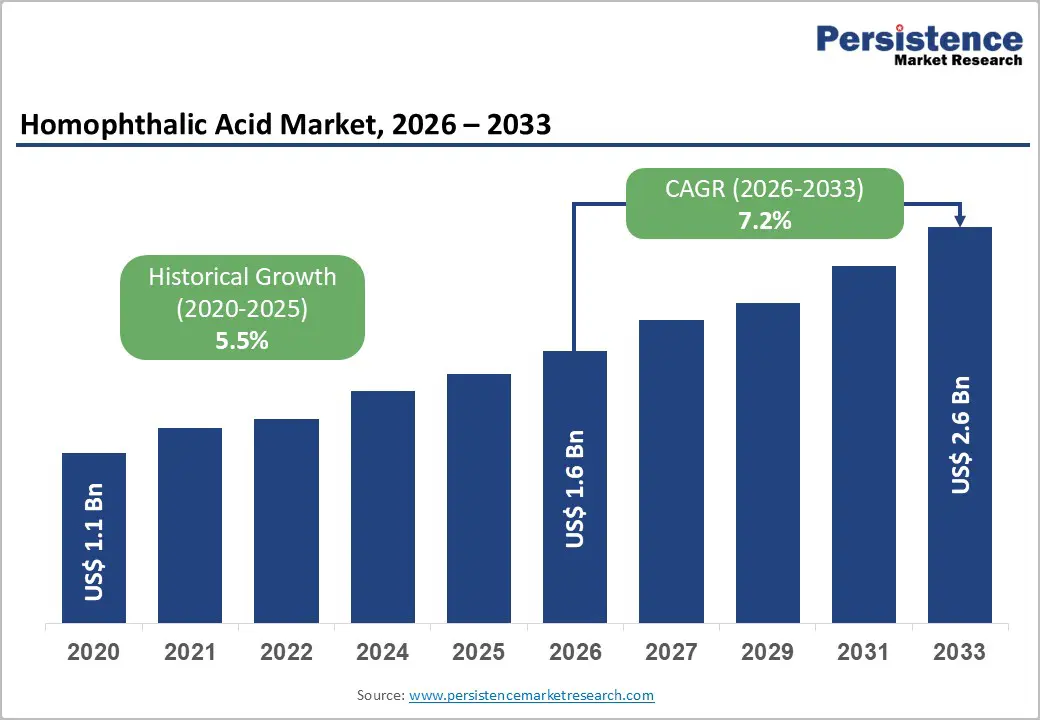
| Key Insights | Details |
|---|---|
|
Homophthalic Acid Market Size (2026E) |
US$ 1.6 Bn |
|
Market Value Forecast (2033F) |
US$ 2.6 Bn |
|
Projected Growth (CAGR 2026 to 2033) |
7.2% |
|
Historical Market Growth (CAGR 2020 to 2025) |
5.5% |
DRO Analysis
Rising Demand from Pharmaceutical Intermediates
The pharmaceutical sector remains a key driver due to the widespread use of homophthalic acid in active pharmaceutical ingredient (API) synthesis. According to the World Health Organization (WHO) and industry analyses, global pharmaceutical spending exceeded US$ 1.5 trillion in 2025, growing at 5–6% annually. Homophthalic acid is widely used in producing anti-inflammatory and cardiovascular drugs, where purity is critical. Increasing chronic disease prevalence, such as cardiovascular diseases affecting over 520 million people globally as per WHO data, drives API demand. Consequently, pharmaceutical-grade homophthalic acid consumption is increasing steadily, particularly in regulated markets such as the U.S. and the European Union (EU), strengthening long-term demand stability.
Recent industry developments further reinforce this demand trajectory. Major pharmaceutical companies significantly expanded API manufacturing capacity to strengthen supply chain resilience and reduce import dependency. For instance, large-scale investments in new API facilities and manufacturing hubs were announced across the U.S. and Europe, supported by government initiatives promoting domestic drug production. In 2026, for instance, AbbVie announced new API manufacturing facilities in the United States to enhance production capabilities for future medicines. These developments indicate a strong shift toward localized and high-quality API production, directly increasing demand for high-purity intermediates such as homophthalic acid.
Expansion of Agrochemicals and Specialty Chemicals Industry
Global agrochemical demand is rising due to food security concerns and shrinking arable land. According to the Food and Agriculture Organization (FAO), global food production must increase by 60% by 2050, prompting higher pesticide and herbicide usage. Homophthalic acid is a precursor in agrochemical synthesis, particularly in specialty herbicides. In 2025, global agrochemical market value surpassed US$ 280 billion. Countries such as India and Brazil are expanding domestic agrochemical manufacturing, supported by government incentives. This has led to increased demand for intermediates such as homophthalic acid, especially technical-grade variants, driving volume growth.
In parallel, the specialty and fine chemicals sector is witnessing strong industrial momentum, supported by technological advancements and sustainability trends. In 2025, the global chemicals industry experienced increased investments in advanced materials, coatings, and performance chemicals, particularly for electronics and automotive applications. Rapid developments in biotechnology and sustainable chemical production are further enabling new applications and process efficiencies across industrial segments. The growing adoption of high-performance materials in electric vehicles, electronics, and coatings is further strengthening demand, positioning homophthalic acid as a critical intermediate across multiple high-growth industries.
Stringent Environmental and Regulatory Compliance
Homophthalic acid production involves chemical synthesis processes that generate hazardous by-products, subject to strict environmental regulations. In 2025, the European Chemicals Agency (ECHA) tightened REACH compliance norms, increasing compliance costs by 10–15% for mid-sized manufacturers. Similarly, U.S. Environmental Protection Agency (EPA) regulations on emissions and waste disposal require continuous monitoring investments. These regulations raise operational costs and create entry barriers for smaller players, limiting supply flexibility and affecting profit margins.
Recent regulatory developments further intensify compliance pressures across the chemical industry. In 2025, the ECHA expanded its Substances of Very High Concern (SVHC) list to 250 chemicals, requiring companies to disclose and manage hazardous substances more rigorously. Under the EU’s “One Substance, One Assessment” framework introduced in late 2025, a centralized chemical data platform was established to strengthen risk evaluation and enforcement across sectors. These measures increase transparency but also require companies to upgrade compliance systems, making regulatory adherence more complex and cost-intensive, particularly for exporters targeting European markets.
Volatility in Raw Material Prices
The production of homophthalic acid relies on petrochemical derivatives, making it sensitive to crude oil price fluctuations. In 2025, crude oil prices fluctuated between US$ 70 and US$ 95 per barrel, as per data from the International Energy Agency (IEA), impacting upstream chemical costs. Feedstock price volatility directly affects production economics, leading to margin compression of 5–8% for manufacturers. Supply chain disruptions, particularly in Asia and Eastern Europe, further exacerbate cost unpredictability, making pricing strategies challenging for market participants.
Industry developments highlight the continued instability in global energy and feedstock markets. According to the International Energy Agency, oil markets experienced significant turbulence due to trade tensions and shifts in production policies, leading to sharp price movements within short periods. At the same time, evolving energy transition policies and supply adjustments have created uncertainty in long-term petrochemical feedstock availability. This volatility makes procurement planning increasingly complex, forcing manufacturers to adopt flexible sourcing and pricing strategies while still facing challenges in maintaining stable margins and long-term supply contracts.
Shift toward Bio-based Production and Sustainable Chemistry
Sustainability trends are encouraging the shift toward bio-based synthesis routes. Companies investing in green chemistry can significantly reduce carbon emissions, aligning with evolving environmental, social, and governance (ESG) mandates and environmental regulations. Bio-based homophthalic acid production offers a premium positioning opportunity and improved regulatory acceptance, especially in Europe and North America. This shift is gaining traction as industries increasingly prioritize environmentally responsible sourcing. As a result, manufacturers are exploring renewable feedstock and cleaner production pathways. These developments are strengthening the long-term viability of sustainable chemical manufacturing.
Recent policy and industry developments are accelerating this transition toward greener alternatives. The European Commission introduced a Chemicals Industry Action Plan focused on decarbonization, innovation, and sustainable production pathways across the sector. At the same time, global chemical companies are actively investing in low-carbon technologies, including renewable feedstock and electrified production processes. These efforts are aimed at meeting climate targets and aligning with stricter environmental standards. The increasing regulatory push is encouraging companies to transition toward cleaner production models. This creates a favorable ecosystem for bio-based homophthalic acid, enhancing its adoption potential across industries.
Rising Demand from Electronics and Emerging Market Expansion
The electronics sector presents strong growth potential, particularly in semiconductors and advanced coatings. Homophthalic acid derivatives are used in high-performance resins and insulating materials, which are essential for miniaturized and high-efficiency electronic components. The rapid expansion of technologies such as advanced connectivity, smart devices, and electric mobility is driving demand for these materials. As electronic devices become more compact and efficient, the need for high-performance chemical intermediates continues to rise. This trend is creating a strong and sustained demand base, positioning homophthalic acid as a critical component within advanced material applications.
Simultaneously, emerging economies are investing heavily in chemical manufacturing and electronics infrastructure. Government-led initiatives are supporting domestic production capabilities and reducing reliance on imports. For instance, India’s semiconductor and manufacturing missions are aimed at building a robust ecosystem for electronics and associated supply chains. Similar policy support is being observed across Southeast Asia, encouraging industrial expansion. These regions offer cost advantages, improving supply chain integration and supporting export-oriented production. Together, these developments are creating strong opportunities for manufacturers to expand operations and capture new growth markets.
Category-wise Insights
Application Insights
The pharmaceuticals segment is expected to lead with approximately 34% of the homophthalic acid market revenue share in 2026, driven by strong demand for API synthesis and strict regulatory emphasis on high-purity intermediates. Increasing investments in drug development and generics manufacturing, particularly in India and China, continue to support growth, alongside rising chronic disease prevalence. Regulatory frameworks in developed markets further reinforce the need for consistent quality standards. The government initiatives to strengthen domestic API supply chains and expansions in drug manufacturing have boosted demand for reliable intermediates. These trends highlight the critical role of high-purity chemical inputs. As a result, pharmaceuticals remain the most stable and high-value application segment.
The electronics materials segment is projected to be the fastest-growing, projected to expand at a CAGR of 7.5% from 2026 to 2033, driven by rising semiconductor production and demand for advanced resins. Growth in electric vehicles and consumer electronics is accelerating the adoption of specialty chemicals used in high-performance applications. Increasing miniaturization of electronic components is further driving the need for precision materials. In 2025–2026, government-backed semiconductor initiatives and new investments in chip manufacturing hubs across Asia and Europe have strengthened demand for advanced materials. These developments are increasing reliance on high-performance chemical intermediates. As a result, electronics materials are emerging as a key high-growth application segment.
Product Type Insights
High-purity (≥99%) is likely to dominate with an approximate 45% of the homophthalic acid market share, as it is essential for pharmaceutical and electronics applications where impurity levels must be minimal. Regulatory standards such as the U.S. Food and Drug Administration (FDA) and the European Medicines Agency (EMA) guidelines mandate high purity, ensuring consistent demand across regulated industries. Manufacturers are investing in advanced purification technologies to meet these stringent requirements. In 2025–2026, tighter regulatory inspections and compliance requirements have further emphasized impurity control and traceability. This has encouraged producers to upgrade quality assurance systems and production capabilities. As a result, high-purity grades remain the cornerstone of market demand.
Customized grades are anticipated as the fastest-growing segment, with a CAGR of 7.2%, driven by increasing demand for tailored chemical properties in specialty and high-performance applications. Industries such as electronics and advanced coatings require precise formulations to meet evolving performance needs. This trend is encouraging manufacturers to offer flexible and application-specific solutions. In 2025–2026, rising custom manufacturing agreements and the expansion of contract production capabilities have supported this shift. Companies are increasingly collaborating to develop specialized formulations for niche applications. As a result, customized grades are emerging as a key growth driver in the market.
Regional Insights
North America Homophthalic Acid Market Trends
North America holds a significant position in the global market for homophthalic acid, led by the United States. The regional market benefits from a well-established pharmaceutical and specialty chemicals industry, supported by strong research and development capabilities. High demand for pharmaceutical intermediates continues to drive consumption, particularly for high-purity grades. The presence of advanced manufacturing infrastructure and a skilled workforce further strengthens regional competitiveness. Growing healthcare demand and innovation in drug development support sustained market growth. As a result, North America remains a key value-driven market.
Recent developments further reinforce regional strength, with the U.S. Department of Energy (DOE) in 2025 announcing expanded funding for industrial decarbonization projects, including chemical manufacturing facilities. In 2026, multiple U.S.-based chemical producers also announced modernization of specialty chemical plants to improve efficiency and reduce emissions, as reported by leading industry news channels. These initiatives are accelerating the adoption of cleaner production technologies and advanced materials. Increased federal support for domestic manufacturing is also playing a key role in enhancing supply chain resilience. Such developments are strengthening the region’s competitive positioning. This continues to support long-term demand for high-value chemical intermediates.
Europe Homophthalic Acid Market Trends
Europe represents a key regional market, supported by a strong chemical manufacturing base and regulatory harmonization under REACH. Countries such as Germany, the U.K., France, and Spain play a vital role in driving regional demand. Germany leads in specialty chemicals, while the U.K. and France maintain strong pharmaceutical production capabilities. The region benefits from a highly developed industrial ecosystem and skilled labor force. Consistent demand for high-performance materials supports steady market expansion. Europe remains a major hub for high-quality and compliant chemical manufacturing.
In 2025, the European Commission advanced its Net-Zero Industry initiatives, encouraging investment in sustainable chemical production and reducing dependency on imported raw materials. Additionally, several European chemical clusters announced expansion plans in 2026 to support advanced material manufacturing and green chemistry adoption. These developments are promoting innovation and strengthening domestic production capabilities. Increased collaboration between research institutions and industry players is also accelerating technological advancements. The focus on sustainability is reshaping production strategies across the region. This is enhancing Europe’s position as a leader in environmentally compliant chemical manufacturing.
Asia Pacific Homophthalic Acid Market Trends
Asia Pacific is expected to dominate with over 40% of the homophthalic acid market value in 2026, and is also projected to be the fastest-growing market through 2033, driven by rapid industrialization and expanding end-use industries. China, India, Japan, and ASEAN are at the forefront, in terms of contributing to regional market growth. China leads in large-scale chemical production, while India is emerging as a major pharmaceutical manufacturing hub. The region benefits from cost-effective production, abundant raw materials, and strong domestic demand. Increasing industrial output and export-oriented manufacturing further strengthen market expansion. These advantages position Asia Pacific as the global production center.
Supporting this growth, in 2025, China announced new investments in its national chemical industrial parks to upgrade specialty chemical production capabilities, as covered by major international news outlets. In 2026, India also expanded its industrial corridor projects to boost chemical and pharmaceutical manufacturing infrastructure. Southeast Asian nations are similarly attracting foreign direct investment for specialty chemical production facilities. These developments are enhancing regional supply chain integration and export competitiveness. Government-backed industrial expansion continues to play a crucial role in scaling production capacity. As a result, Asia Pacific remains both the largest and fastest-growing regional market.
Competitive Landscape
The global homophthalic acid market structure is moderately fragmented, with leading chemical manufacturers such as LANXESS, BASF, and Merck KGaA collectively accounting for a significant share of the market. These established players leverage their strong chemical synthesis capabilities, integrated supply chains, and long-standing relationships with pharmaceutical and specialty chemical companies. They continue to invest in process optimization, high-purity production technologies, and sustainable manufacturing practices to maintain a competitive edge. Their focus on quality compliance and consistent product performance further strengthens their position in high-value application segments.
Regional and mid-sized manufacturers, particularly in Asia Pacific, are competing through cost advantages and flexible production capacities. Companies in China and India are expanding their presence by catering to bulk demand and export markets. Entry barriers such as stringent regulatory standards, environmental compliance, and the need for advanced purification technologies limit new entrants. However, increasing demand for customized and bio-based variants is opening opportunities for niche players. The market is expected to witness gradual consolidation, with larger firms exploring strategic collaborations and capacity expansions to strengthen their global footprint.
Key Industry Developments
- In February 2026, BASF advanced its “Winning Ways” strategy by commissioning the steam cracker at its Zhanjiang Verbund site in China, marking a major milestone in integrated chemical production. The facility enhances regional supply capabilities and supports high-value intermediates production using energy-efficient operations.
- In October 2025, Merck & Co. completed the acquisition of Verona Pharma to strengthen its respiratory treatment portfolio with innovative drug offerings. The deal supports demand for specialized pharmaceutical manufacturing and advanced chemical intermediates used in complex drug formulations.
- In April 2025, Merck KGaA acquired SpringWorks Therapeutics to expand its oncology pipeline and specialty pharma presence. This strategic move enhances its focus on high-value drug development, increasing the need for high-purity chemical intermediates in pharmaceutical production.
Companies Covered in Homophthalic Acid Market
- Lanxess AG
- Tokyo Chemical Industry Co., Ltd.
- Merck KGaA
- Alfa Aesar
- TCI Chemicals
- Santa Cruz Biotechnology
- Central Drug House
- Sisco Research Laboratories
- Oakwood Chemical
- Chem-Impex International
- Acros Organics
- Anhui Jinhe Industrial Co., Ltd.
- Jiangsu Zhongneng Chemical Technology
Frequently Asked Questions
The global homophthalic acid market is estimated to reach US$ 1.6 billion in 2026.
Rising demand for pharmaceutical intermediates, increasing specialty chemical applications, and expanding electronics materials usage are key growth drivers.
The market is poised to witness a CAGR of 7.2% from 2026 to 2033.
Adoption of bio-based production methods and growing demand in high-performance electronics and emerging markets present major opportunities.
LANXESS, BASF SE, Merck KGaA, Tokyo Chemical Industry, and Thermo Fisher Scientific are some of the key players in the market.


