




- Sporting Goods & Equipment
- Grill and Barbecue Equipment Market
Grill and Barbecue Equipment Market Size, Share, and Growth Forecast, 2026 - 2033
Grill and Barbecue Equipment Market by Product Type (Gas Grills, Charcoal Grills, Electric Grills, Pellet Grills, Smokers, Others), Application (Residential, Commercial, Others), Distribution Channel (Online Retail, Supermarkets/Hypermarkets, Specialty Stores, Multi-brand Stores, Direct Sales, Convenience Stores, Others), and Regional Analysis for 2026 - 2033

Grill and Barbecue Equipment Market Share and Trends Analysis
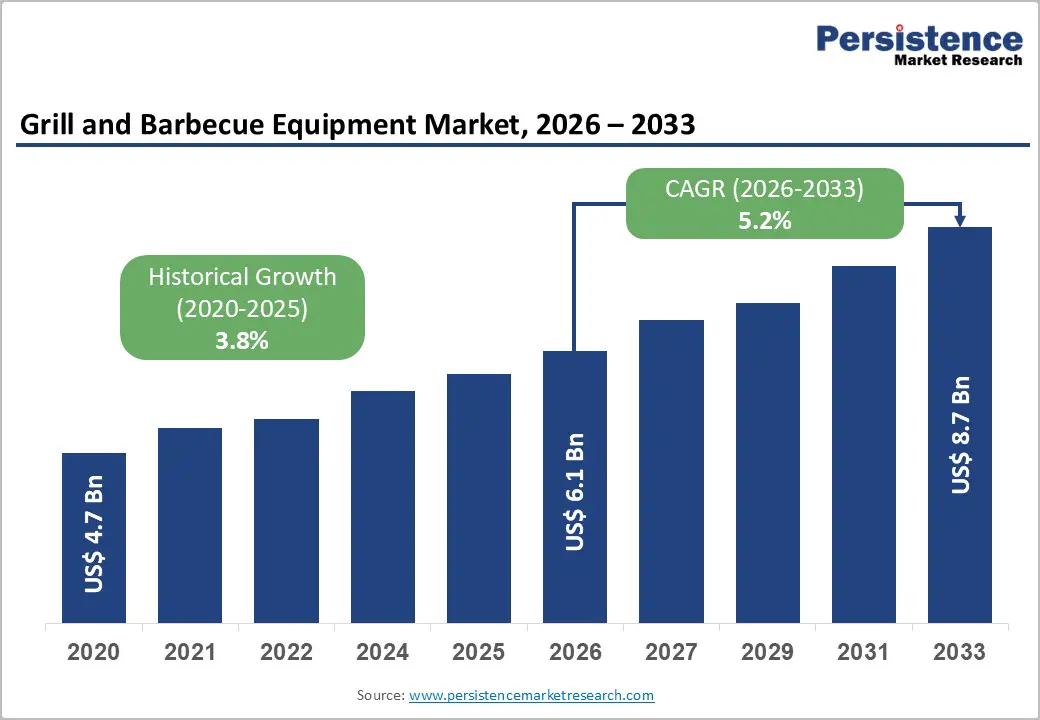
The global grill and barbecue equipment market size is likely to be valued at US$ 6.1 billion in 2026, and is projected to reach US$ 8.7 billion by 2033, growing at a CAGR of 5.2% during the forecast period 2026−2033. Market growth is primarily driven by a shift toward outdoor cooking and experiential dining. Rising urban disposable income enables higher spending on leisure-oriented home appliances, which increases demand for premium grilling systems.
The expansion of residential infrastructure, including outdoor spaces, directly contributes to equipment adoption. Cultural inclination toward social gatherings strengthens demand for backyard cooking solutions. Technological integration in grilling systems enhances efficiency, temperature control, and safety, thereby improving user confidence and expanding adoption among non-expert consumers. Smart connectivity and automation features enable remote monitoring, increasing convenience and supporting consistent cooking outcomes.
Key Industry Highlights
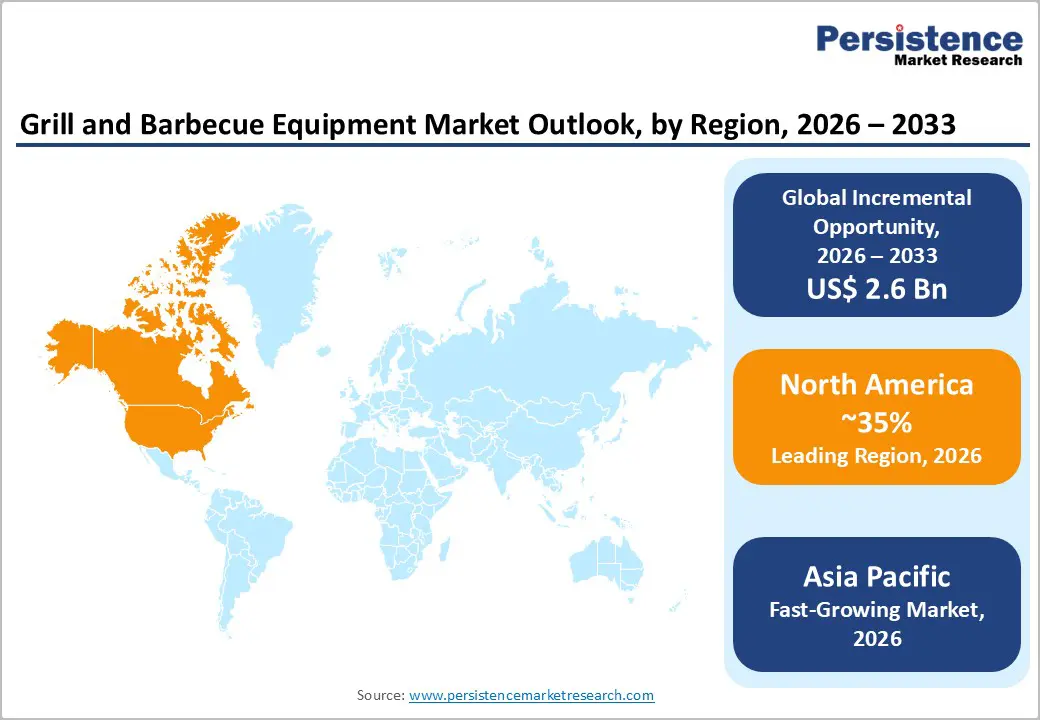
- Dominant Region: North America is expected to dominate with an estimated 35% market share in 2026, driven by grilling culture and innovation.
- Fastest-growing Regional Market: Asia Pacific is expected to be the fastest-growing market between 2026 and 2033, fueled by rising income, and compact grills.
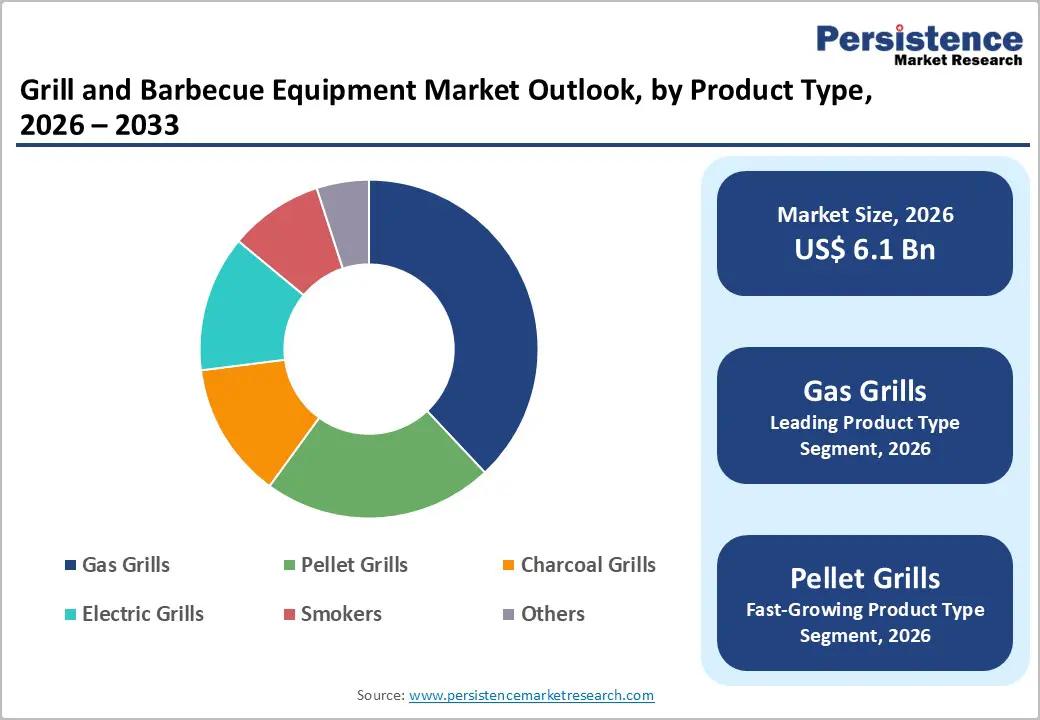
- Leading Product Type: Gas grills are expected to capture 38% market revenue share in 2026, driven by convenience, precise control, and broad retail availability.
- Fastest-growing Product Type: Pellet grills are projected to be the fastest-growing segment in 2026-2033, fueled by flavor consistency and automated control.
| Key Insights | Details |
|---|---|
|
Grill and Barbecue Equipment Market Size (2026E) |
US$ 6.1 Bn |
|
Market Value Forecast (2033F) |
US$ 8.7 Bn |
|
Projected Growth (CAGR 2026 to 2033) |
5.2% |
|
Historical Market Growth (CAGR 2020 to 2025) |
3.8% |

Market Factors - Growth, Barriers, and Opportunity Analysis
Rising Popularity of Outdoor Cooking to Drive Demand
Consumer behavior trends indicate a structural shift toward experiential dining and social engagement in open-air environments. Outdoor cooking aligns with lifestyle preferences centered on leisure, wellness, and shared experiences, thereby increasing the frequency of grill use in residential settings. Households treat outdoor spaces as extensions of indoor kitchens, supporting demand for multifunctional equipment. Public investment in parks and recreation infrastructure supports participation in such activities. Data from the U.S. Bureau of Economic Analysis indicates outdoor recreation generated about $1.2 trillion in economic output in 2025, reflecting strong engagement in outdoor cooking-related activities.
Demand expansion is reinforced by consumption patterns focused on home-based entertainment and cost efficiency. Outdoor cooking enables control over food quality, portion size, and preparation methods, aligning with health-focused preferences. Growth in suburban housing and access to private outdoor areas support the installation of grills and barbecue systems. Product innovation in portable and compact formats improves accessibility across travel and recreational use. Integration of outdoor cooking into hospitality, tourism, and event-based services supports commercial adoption, creating steady equipment utilization cycles and encouraging repeat purchases across residential and professional environments.
Smart and Advanced Grill Technologies to Attract New-Age Consumers
Smart-enabled grilling solutions align with evolving consumer expectations centered on precision, control, and seamless digital interaction. Integration of sensors, Wi-Fi, and mobile applications enables real-time temperature monitoring, automated cooking cycles, and remote operation, improving consistency and reducing manual effort. This trend reflects broader connected home adoption. According to the International Telecommunication Union (ITU), global Internet usage reached about 67% of the population in 2025, supporting the expansion of connected appliances. Data-driven cooking insights, preset programs, and adaptive heat control strengthen product differentiation and elevate user experience across residential and commercial environments.
Consumer preference trends indicate rising demand for convenience-oriented and time-efficient food preparation solutions. Advanced features such as automated ignition, precision heat zones, and app-based alerts improve operational efficiency and reduce skill dependency. Integration with voice assistants and smart home platforms enhances usability within digital lifestyles. Energy optimization functions and controlled fuel usage align with sustainability objectives, influencing purchasing behavior. Premiumization trends support adoption, as advanced technology reflects performance and quality standards. Commercial operators gain benefits through standardized output, streamlined workflows, and reduced training requirements, strengthening value perception and encouraging transition toward technologically enhanced cooking equipment.
Seasonal Demand to Affect Sales Stability
Demand patterns for grill and barbecue equipment closely align with weather cycles and outdoor activity preferences, resulting in uneven sales distribution throughout the year. Peak purchasing occurs during spring and summer, when favorable temperatures encourage outdoor cooking, social gatherings, and recreational events. Retailers experience concentrated revenue inflows during these months, followed by sharp declines in many regions during fall and winter. Inventory planning becomes complex under such conditions, as overstocking during low-demand periods increases holding costs, while understocking during peak periods results in missed revenue opportunities. Manufacturers and distributors face challenges in maintaining steady production schedules, leading to inefficiencies in supply chain utilization and workforce management.
Consumer behavior further reinforces this pattern, with purchasing decisions closely tied to seasonal lifestyle habits rather than continuous usage needs. In colder climates, outdoor cooking activities are reduced significantly, limiting equipment usage and delaying replacement or upgrade cycles. Promotional strategies and discounting are necessary during off-peak periods to stimulate demand, but they can impact profit margins. Commercial buyers, including restaurants and catering services, also adjust procurement based on seasonal customer traffic, reducing bulk purchases during slower periods. Such fluctuations create volatility in revenue streams, complicating financial forecasting and long-term investment planning across the value chain.
Alternative Appliances to Impact Demand
The widespread availability of modern kitchen appliances, such as electric ovens, induction cooktops, air fryers, and multi-cookers, shifts consumer preference toward indoor cooking solutions that deliver speed, precision, and ease of use. Urban households prioritize space efficiency and multifunctional devices, reducing the appeal of bulky outdoor grills that require dedicated setup and storage. Electric and induction appliances offer rapid heating and consistent temperature control aligned with time-sensitive routines. Food preparation integrates seamlessly into compact kitchens without reliance on outdoor space or favorable weather. Strong retail visibility and promotion of multifunctional appliances further influence consumer inclination toward versatile, space-saving cooking solutions.
Cost considerations and maintenance requirements reinforce this shift, as many alternative appliances require a lower upfront investment and simpler operation. Grills and barbecue equipment require sourcing fuel, cleaning grates, ash disposal, and periodic upkeep, creating a perceived inconvenience compared to plug-and-use appliances. Safety concerns linked to open flames, smoke generation, and ventilation constraints influence purchasing decisions, particularly in urban apartments. Residential regulations restrict open-flame cooking in many housing environments, limiting its use. Technological advancements in alternative appliances, including programmable settings and automated functions, enhance user control and reduce manual effort, positioning these solutions as practical substitutes for everyday meal preparation.
Development of Portable and Compact Grills to Fuel Adoption
Compact and portable grill formats align with evolving mobility patterns and space constraints across urban households. Limited balcony and terrace areas increase preference for space-efficient cooking solutions that support outdoor experiences without permanent installation. Portability enables use across varied settings such as campsites, beaches, and temporary gatherings, strengthening versatility and frequency of usage. Outdoor recreation trends support demand for mobile cooking equipment suited for flexible environments. Lightweight structures, foldable designs, and quick setup features improve convenience, reduce operational effort, and support wider adoption across residential and recreational users.
Design innovation and product engineering advancements strengthen this opportunity by integrating multifunctional features and improving efficiency. Manufacturers focus on compact fuel systems, consistent heat distribution, and durable materials to ensure performance alignment with larger units. The expansion of travel culture, including road trips and short-duration outdoor events, increases reliance on equipment suited to flexible deployment without infrastructure dependency. Retail transformation through digital platforms improves access to compact models with transparent specifications and convenient delivery. Consumer preference trends indicate strong alignment with products that offer portability, storage efficiency, and ease of handling, supporting sustained adoption across diverse usage environments without reliance on fixed outdoor setups.
Integration of Smart Technologies to Enhance Product Value
Smart-enabled cooking equipment delivers value through automation and precise control. Remote operation via mobile applications enables easy control of temperature and cooking time. Built-in sensors improve accuracy and ensure consistent cooking results. Real-time monitoring reduces energy waste and supports safety standards. Digital interfaces simplify user interaction and improve convenience. Programmable settings enable repeatable cooking outcomes across different use cases. These features align with changing consumer preferences for efficient and modern cooking solutions. Demand rises in both residential and commercial settings due to reliability and performance benefits.
Connected ecosystems improve product differentiation and usability. Compatibility with IoT (Internet of Things) platforms enables integration with other smart appliances. This creates a seamless and efficient kitchen environment. Data analytics provides insights into cooking behavior and usage patterns. Predictive maintenance reduces downtime and improves product lifespan. Energy optimization supports sustainability goals and cost efficiency. Commercial users gain from centralized monitoring and standardized processes. Continuous innovation in artificial intelligence and cloud connectivity strengthens premium product positioning and drives higher adoption.
Category-wise Analysis
Product Type Insights
Gas grills are expected to capture around 38% of the grill and barbecue equipment market share in 2026, reflecting widespread consumer preference for convenience and efficiency. Gas grills offer rapid ignition, precise temperature control, and reduced preparation time, which enhances usability for both residential and commercial applications. Propane and natural gas infrastructure availability support consistent operation. Manufacturers focus on durability and advanced features, including multi-burner systems and integrated thermometers, which strengthen adoption. Retail availability across multiple price ranges improves accessibility.
Pellet grills are expected to be the fastest-growing segment during the 2026-2033 forecast period, propelled by demand for flavor consistency and automated cooking control. Pellet grills use compressed wood pellets, which provide uniform heat distribution and enhanced flavor. The integration of digital controllers enables precise temperature control, improving cooking outcomes. Consumer interest in authentic barbecue experiences drives adoption. Manufacturers invest in innovation to enhance energy efficiency and connectivity features.
Application Insights
Residential extracts are poised to dominate, with a forecasted market share of over 60% in 2026, driven by rising consumer investment in home-based leisure activities. Rising preference for outdoor cooking and social gatherings supports demand for residential grilling equipment. Product availability across diverse price segments enables widespread adoption. Cultural acceptance of grilling as a lifestyle activity strengthens market penetration. Integration of compact and portable designs enhances usability in urban environments. Digital commerce platforms facilitate product discovery and purchase, which improves accessibility.
Commercial is expected to be the fastest-growing segment from 2026 to 2033, driven by the expansion of foodservice establishments specializing in grilled cuisine. Growth in the hospitality and tourism sectors increases demand for high-capacity equipment. Restaurants and catering services prioritize efficiency and consistency, which drives the adoption of advanced grilling systems. Regulatory compliance requirements influence equipment selection, promoting durable and energy-efficient models. Investment in kitchen automation enhances productivity and reduces labor dependency. Expansion of franchise-based restaurant chains further supports demand growth.
Regional Insights
North America Grill and Barbecue Equipment Market Trends
North America is expected to lead with an estimated 35% of the grill and barbecue equipment market share in 2026, supported by strong outdoor cooking culture across the United States and Canada. High household penetration of grills drives consistent replacement demand. Consumers show a preference for premium and multi-functional equipment. Organized retail networks improve product accessibility and visibility. Frequent social gatherings and seasonal events sustain product usage. High disposable income supports spending on advanced cooking solutions. Continuous product innovation by manufacturers strengthens competitive positioning and maintains steady demand across residential and commercial users.
Demand strength is reinforced by a well-established foodservice sector across the United States, Canada, and Mexico. Restaurants and catering services use grilling equipment to standardize cooking processes. Commercial operators prefer high-performance and energy-efficient systems. Digital adoption supports the integration of smart and connected cooking solutions. Strong supply chains ensure stable product availability and reduced lead times. Consumer interest in outdoor kitchen setups increases average selling prices.
Europe Grill and Barbecue Equipment Market Trends
Europe demonstrates steady demand, supported by a strong culture of outdoor leisure and seasonal cooking. Countries such as Germany, the United Kingdom, and France show consistent adoption across residential households. High awareness of product quality and safety standards influences purchasing decisions. Consumers prefer durable materials and energy-efficient designs. Electric and hybrid grills are gaining traction due to urban living constraints and environmental considerations. Premium product positioning remains strong due to the willingness to invest in long-lasting equipment. Retail distribution includes specialty stores and large home improvement chains, ensuring wide product availability and consistent consumer engagement across diverse consumer segments.
Southern countries such as Italy and Spain reflect demand driven by tourism and outdoor dining experiences. Hospitality operators integrate grilling equipment to enhance menu diversity and customer experience. Northern countries such as Sweden and the Netherlands show a preference for compact and weather-resistant equipment. Sustainability regulations influence product development and material selection. Manufacturers focus on eco-friendly fuels and low-emission technologies. E-commerce platforms expand reach and improve product comparison for consumers. Innovation in design and multifunctional features supports replacement demand.
Asia Pacific Grill and Barbecue Equipment Market Trends
Asia Pacific is forecasted to be the fastest-growing market for grill and barbecue equipment between 2026 and 2033, stimulated by rapid urban expansion and shifting consumer lifestyles. Rising middle-income households are increasing their spending on leisure cooking products. Urban housing projects support demand for compact and electric grills. Western-style food trends influence dining habits and cooking preferences. China is experiencing strong growth driven by expanding urban consumption and greater retail access. India reflects rising adoption driven by young consumers and social cooking trends. Growth in the tourism and hospitality sectors supports demand across commercial kitchens and outdoor dining formats.
Japan demonstrates steady demand supported by premium and space-efficient appliances. South Korea shows increasing interest in technologically advanced and indoor-compatible grills. Southeast Asian countries such as Thailand and Indonesia contribute by expanding foodservice sectors and commercializing street food. Digital retail channels improve product reach and consumer awareness. Local manufacturers introduce cost-effective and region-specific designs. Rising interest in home-based social gatherings increases product usage frequency. Commercial operators invest in standardized cooking equipment to improve efficiency. Infrastructure development and retail expansion continue to support strong volume growth across multiple country-level markets.
Competitive Landscape
The global grill and barbecue equipment market is moderately fragmented, with leading participants accounting for nearly half of total revenue while regional brands remain active. Weber Inc. and Traeger Inc. focus on innovation and premium products. Napoleon Products and Char-Broil LLC leverage strong retail networks. Broil King and Landmann strengthen competition through diverse offerings.
Competitive dynamics vary across price tiers and product categories. Kamado Joe differentiates through premium ceramic technology. Key players invest in product development and durability improvements. Distribution across online and offline channels improves visibility. Regional manufacturers compete through pricing and localized designs. Brand recognition and after-sales service influence purchasing decisions. Continuous innovation and partnerships support competitive positioning and steady revenue generation across segments.
Key Industry Developments
- In January 2026, Weber expanded its smart grilling portfolio by introducing connected grills and accessories that integrate with the WEBER CONNECT platform to create a unified backyard cooking ecosystem.
- In October 2025, Progresso introduced a limited-edition BBQ smoke-scented Pitmaster deodorant as part of a promotional Pit Kit paired with its new BBQ-style soups, designed to replicate the smell of grilling without actual cooking.
- In May 2025, Costco launched its own Kirkland-branded six-burner stainless steel gas grill featuring electronic ignition, LED knobs, and substantial cooking capacity at around $899.99.
Companies Covered in Grill and Barbecue Equipment Market
- Weber Inc.
- Traeger Inc.
- Napoleon Products
- Char-Broil LLC
- Broil King
- Landmann
- Kamado Joe
- Big Green Egg
- Coleman Company
- Bull Outdoor Products
- Fire Magic
- Dyna-Glo
Frequently Asked Questions
The global grill and barbecue equipment market is projected to reach US$ 6.1 billion in 2026.
Rising outdoor cooking trends, increasing disposable income, and demand for convenient, smart, and premium grilling solutions are driving the market.
The market is poised to witness a CAGR of 5.2% from 2026 to 2033.
Integration of smart technologies, expansion into emerging markets, development of eco-friendly products, portable grill innovations, and growth of e-commerce channels create key market opportunities.
Some of the key market players include Weber, Traeger, Napoleon Products, Char-Broil LLC, Broil King, Landmann, and Kamado Joe.


