


- Executive Summary
- Global EMG Biosensors Market Snapshot, 2025 and 2033
- Market Opportunity Assessment, 2025 - 2033, US$ Mn
- Key Market Trends
- Future Market Projections
- Premium Market Insights
- Industry Developments and Key Market Events
- PMR Analysis and Recommendations
- Market Overview
- Market Scope and Definition
- Market Dynamics
- Drivers
- Restraints
- Opportunity
- Key Trends
- Macro-economic Factors
- Global Sectoral Outlook
- Global GDP Growth Outlook
- COVID-19 Impact Analysis
- Forecast Factors - Relevance and Impact
- Value Added Insights
- Tool Adoption Analysis
- Regulatory Landscape
- Value Chain Analysis
- PESTLE Analysis
- Porter’s Five Force Analysis
- Price Analysis, 2025A
- Key Highlights
- Key Factors Impacting Deployment Costs
- Pricing Analysis, By Application
- Global EMG Biosensors Market Outlook
- Key Highlights
- Market Volume (Units) Projections
- Market Size (US$ Mn) and Y-o-Y Growth
- Absolute $ Opportunity
- Market Size (US$ Mn) and Volume (Units) Analysis and Forecast
- Historical Market Size (US$ Mn) Analysis, 2025-2025
- Market Size (US$ Mn) Analysis and Forecast, 2025 - 2033
- Global EMG Biosensors Market Outlook: Application
- Introduction / Key Findings
- Historical Market Size (US$ Mn) and Volume (Units) Analysis, By Application, 2025 - 2025
- Market Size (US$ Mn) and Volume (Units) Analysis and Forecast, By Application, 2025 - 2033
- Medical
- Human-Machine Interface (HMI)
- Sports & Fitness
- Consumer & Wellness
- Industrial
- Market Attractiveness Analysis: Application
- Global EMG Biosensors Market Outlook: Product Type
- Introduction / Key Findings
- Historical Market Size (US$ Mn) Analysis, By Product Type, 2025 - 2025
- Market Size (US$ Mn) Analysis and Forecast, By Product Type, 2025 - 2033
- Standalone Sensors
- Wearable Devices
- Implantable Systems
- Integrated Modules
- Sensor Arrays
- Market Attractiveness Analysis: Product Type
- Global EMG Biosensors Market Outlook: Sensor Type
- Introduction / Key Findings
- Historical Market Size (US$ Mn) Analysis, By Sensor Type, 2025 - 2025
- Market Size (US$ Mn) Analysis and Forecast, By Sensor Type, 2025 - 2033
- Surface EMG
- Intramuscular EMG
- Capacitive EMG
- High-Density EMG
- Market Attractiveness Analysis: Sensor Type
- Key Highlights
- Global EMG Biosensors Market Outlook: Region
- Key Highlights
- Historical Market Size (US$ Mn) and Volume (Units) Analysis, By Region, 2025 - 2025
- Market Size (US$ Mn) and Volume (Units) Analysis and Forecast, By Region, 2025 - 2033
- North America
- Europe
- East Asia
- South Asia and Oceania
- Latin America
- Middle East & Africa
- Market Attractiveness Analysis: Region
- North America EMG Biosensors Market Outlook
- Key Highlights
- Historical Market Size (US$ Mn) Analysis, By Market, 2025 - 2025
- By Country
- By Application
- By Product Type
- By Sensor Type
- Market Size (US$ Mn) Analysis and Forecast, By Country, 2025 - 2033
- U.S.
- Canada
- Market Size (US$ Mn) and Volume (Units) Analysis and Forecast, By Application, 2025 - 2033
- Medical
- Human-Machine Interface (HMI)
- Sports & Fitness
- Consumer & Wellness
- Industrial
- Market Size (US$ Mn) Analysis and Forecast, By Product Type, 2025 - 2033
- Standalone Sensors
- Wearable Devices
- Implantable Systems
- Integrated Modules
- Sensor Arrays
- Market Size (US$ Mn) Analysis and Forecast, By Sensor Type, 2025-2033
- Surface EMG
- Intramuscular EMG
- Capacitive EMG
- High-Density EMG
- Market Attractiveness Analysis
- Europe EMG Biosensors Market Outlook
- Key Highlights
- Historical Market Size (US$ Mn) Analysis, By Market, 2025 - 2025
- By Country
- By Application
- By Product Type
- Sensor Type
- Market Size (US$ Mn) Analysis and Forecast, By Country, 2025 - 2033
- Germany
- France
- U.K.
- Italy
- Spain
- Russia
- Türkiye
- Rest of Europe
- Market Size (US$ Mn) and Volume (Units) Analysis and Forecast, By Application, 2025 - 2033
- Medical
- Human-Machine Interface (HMI)
- Sports & Fitness
- Consumer & Wellness
- Industrial
- Market Size (US$ Mn) Analysis and Forecast, By Product Type, 2025 - 2033
- Standalone Sensors
- Wearable Devices
- Implantable Systems
- Integrated Modules
- Sensor Arrays
- Market Size (US$ Mn) Analysis and Forecast, By Sensor Type, 2025-2033
- Surface EMG
- Intramuscular EMG
- Capacitive EMG
- High-Density EMG
- Market Attractiveness Analysis
- East Asia EMG Biosensors Market Outlook
- Key Highlights
- Historical Market Size (US$ Mn) Analysis, By Market, 2025 - 2025
- By Country
- By Application
- By Product Type
- By Sensor Type
- Market Size (US$ Mn) Analysis and Forecast, By Country, 2025 - 2033
- China
- Japan
- South Korea
- Market Size (US$ Mn) and Volume (Units) Analysis and Forecast, By Application, 2025 - 2033
- Medical
- Human-Machine Interface (HMI)
- Sports & Fitness
- Consumer & Wellness
- Industrial
- Market Size (US$ Mn) Analysis and Forecast, By Product Type, 2025 - 2033
- Standalone Sensors
- Wearable Devices
- Implantable Systems
- Integrated Modules
- Sensor Arrays
- Market Size (US$ Mn) Analysis and Forecast, By Sensor Type, 2025-2033
- Surface EMG
- Intramuscular EMG
- Capacitive EMG
- High-Density EMG
- Market Attractiveness Analysis
- South Asia & Oceania EMG Biosensors Market Outlook
- Key Highlights
- Historical Market Size (US$ Mn) Analysis, By Market, 2025 - 2025
- By Country
- By Application
- By Product Type
- By Sensor Type
- Market Size (US$ Mn) Analysis and Forecast, By Country, 2025 - 2033
- India
- Southeast Asia
- ANZ
- Rest of South Asia & Oceania
- Market Size (US$ Mn) and Volume (Units) Analysis and Forecast, By Application, 2025 - 2033
- Medical
- Human-Machine Interface (HMI)
- Sports & Fitness
- Consumer & Wellness
- Industrial
- Market Size (US$ Mn) Analysis and Forecast, By Product Type, 2025 - 2033
- Standalone Sensors
- Wearable Devices
- Implantable Systems
- Integrated Modules
- Sensor Arrays
- Market Size (US$ Mn) Analysis and Forecast, By Sensor Type, 2025-2033
- Surface EMG
- Intramuscular EMG
- Capacitive EMG
- High-Density EMG
- Market Attractiveness Analysis
- Latin America EMG Biosensors Market Outlook
- Key Highlights
- Historical Market Size (US$ Mn) Analysis, By Market, 2025 - 2025
- By Country
- By Application
- By Product Type
- By Sensor Type
- Market Size (US$ Mn) Analysis and Forecast, By Country, 2025 - 2033
- Brazil
- Mexico
- Rest of Latin America
- Market Size (US$ Mn) and Volume (Units) Analysis and Forecast, By Application, 2025 - 2033
- Medical
- Human-Machine Interface (HMI)
- Sports & Fitness
- Consumer & Wellness
- Industrial
- Market Size (US$ Mn) Analysis and Forecast, By Product Type, 2025 - 2033
- Standalone Sensors
- Wearable Devices
- Implantable Systems
- Integrated Modules
- Sensor Arrays
- Market Size (US$ Mn) Analysis and Forecast, By Sensor Type, 2025-2033
- Surface EMG
- Intramuscular EMG
- Capacitive EMG
- High-Density EMG
- Market Attractiveness Analysis
- Middle East & Africa EMG Biosensors Market Outlook
- Key Highlights
- Historical Market Size (US$ Mn) Analysis, By Market, 2025 - 2025
- By Country
- By Application
- By Product Type
- By Sensor Type
- Market Size (US$ Mn) Analysis and Forecast, By Country, 2025 - 2033
- GCC Countries
- Egypt
- South Africa
- Northern Africa
- Rest of Middle East & Africa
- Market Size (US$ Mn) and Volume (Units) Analysis and Forecast, By Application, 2025 - 2033
- Medical
- Human-Machine Interface (HMI)
- Sports & Fitness
- Consumer & Wellness
- Industrial
- Market Size (US$ Mn) Analysis and Forecast, By Product Type, 2025 - 2033
- Standalone Sensors
- Wearable Devices
- Implantable Systems
- Integrated Modules
- Sensor Arrays
- Market Size (US$ Mn) Analysis and Forecast, By Sensor Type, 2025-2033
- Surface EMG
- Intramuscular EMG
- Capacitive EMG
- High-Density EMG
- Market Attractiveness Analysis
- Competition Landscape
- Market Share Analysis, 2025
- Market Structure
- Competition Intensity Mapping By Market
- Competition Dashboard
- Company Profiles (Details - Overview, Financials, Strategy, Recent Developments)
- Delsys Incorporated
- Overview
- Segments and Deployments
- Key Financials
- Market Developments
- Market Strategy
- Biometrics Ltd.
- Compumedics NeuroScan
- Noraxon USA
- OpenBCI
- iMotions
- Butler Technologies
- EB Neuro S.p.A.
- Thought Technology Ltd.
- Neurosoft
- Nihon Kohden
- Cadwell Laboratories
- Delsys Incorporated
- Appendix
- Research Methodology
- Research Assumptions
- Acronyms and Abbreviations


- Medical Devices
- EMG Biosensors Market
EMG Biosensors Market Size, Share, and Growth Forecast, 2026 - 2033
EMG Biosensors Market by Application (Medical, Human-Machine Interface (HMI), Sports & Fitness, Consumer & Wellness, Industrial), Product Type (Standalone Sensors, Wearable Devices, Implantable Systems, Integrated Modules, Sensor Arrays), Sensor Type (Surface EMG, Intramuscular EMG, Capacitive EMG, High-Density EMG), and Regional Analysis for 2026 - 2033
Key Industry Highlights
- Dominant Applications: Medical diagnostics are set to command around 42% revenue share in 2026, while human-machine interface (HMI) applications are likely to grow the fastest through 2033, driven by robotics, prosthetics, and assistive technology adoption.
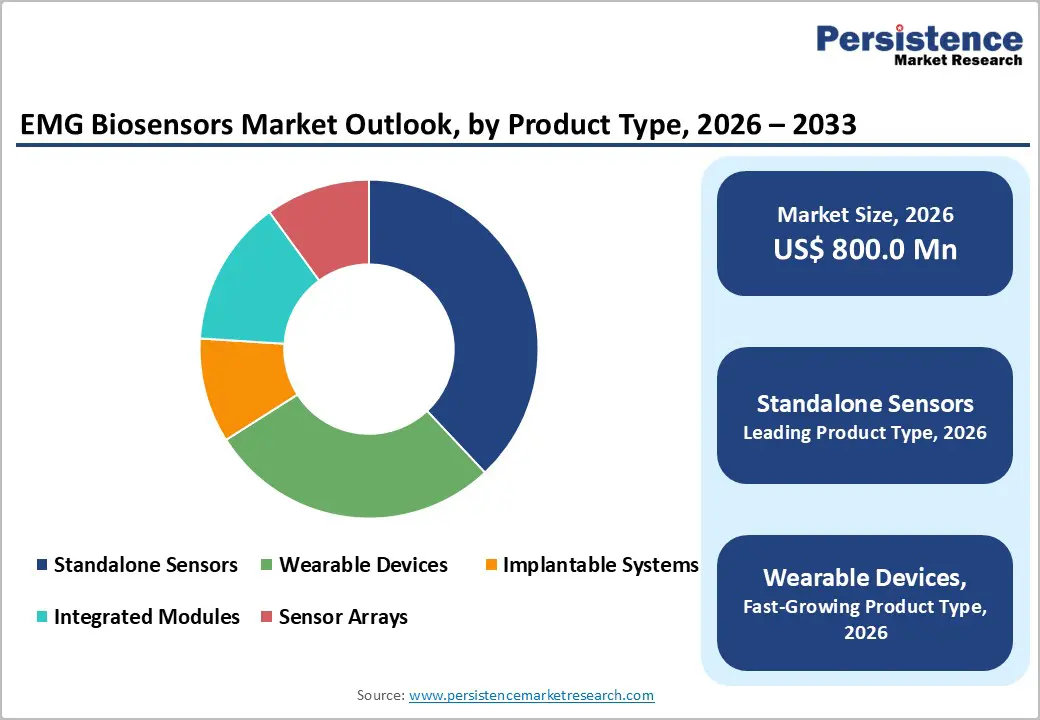
- Leading Product Types: Standalone sensors are expected to lead with approximately 38% share in 2026, while wearable devices are projected to be the fastest-growing at 9.8% CAGR during 2026–2033, reflecting rising demand for non-invasive real-time monitoring.
- Dominant Sensor Types: Surface EMG sensors are expected to hold the largest revenue share of around 40% in 2026, while high-density EMG systems are likely to grow the fastest through 2033, driven by research adoption and advanced neuromuscular diagnostics.
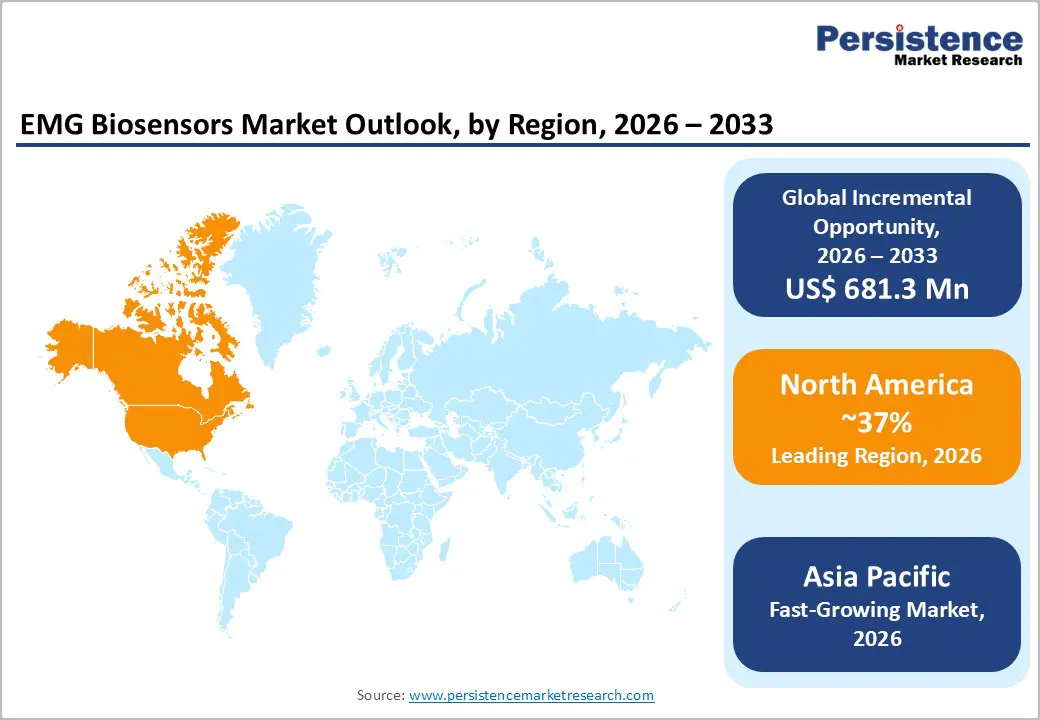
- Regional Leadership: North America is poised to capture around 37% market share in 2026, while Asia Pacific is likely to register the fastest growth at 11% CAGR through 2033, supported by healthcare expansion and digital health adoption.
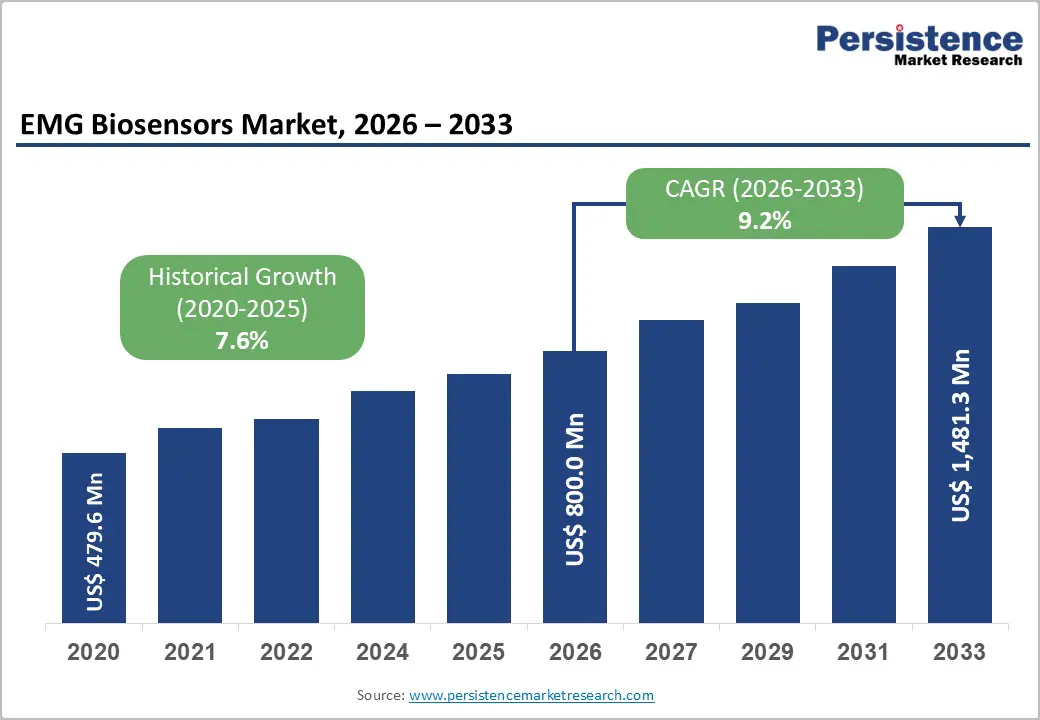
| Key Insights | Details |
|---|---|
|
EMG Biosensors Market Size (2026E) |
US$ 800.0 Mn |
|
Market Value Forecast (2033F) |
US$ 1,481.3 Mn |
|
Projected Growth (CAGR 2026 to 2033) |
9.2% |
|
Historical Market Growth (CAGR 2020 to 2025) |
7.6% |
DRO Analysis
Rising Prevalence of Neuromuscular Disorders and High Demand for Objective Diagnostics
The global incidence of neuromuscular disorders such as Parkinson’s disease, muscular dystrophy, and peripheral neuropathies continues to climb due to ageing populations and lifestyle shifts. Quantitative EMG remains a cornerstone diagnostic tool, enabling clinicians to capture and analyse muscle electrical activity with precision. Hospitals and rehabilitation centres increasingly integrate advanced EMG biosensors to improve early detection and monitor treatment effectiveness. The regulatory attention toward sensor-based digital health technologies has increased, with the U.S. Food and Drug Administration (FDA) maintaining updated authorisation lists that now include non-invasive wearable monitoring platforms cleared for clinical use, reflecting growing acceptance of physiological monitoring technology in medical settings.
EMG biosensor adoption is also reinforced by policy support and reimbursement frameworks in key healthcare markets, improving access and lowering barriers for hospitals and clinics. With continuous data collection, these systems offer clinicians objective, longitudinal muscle activity insights, aiding chronic disease management and rehabilitation planning. As neuromuscular conditions rise, demand for reliable, high-fidelity EMG diagnostics is expected to strengthen consistently. Integration with interoperable healthcare records further enhances clinical decision-making, supporting robust revenue growth throughout the forecast period.
Technological Innovations and Adoption of Wearable EMG Solutions
Technological innovation in miniaturised, wireless EMG biosensors has significantly expanded their use beyond traditional hospital environments into outpatient, home, and consumer contexts. Wearable and integrated modules now support real-time monitoring and wireless data transmission, enabling remote interpretation that benefits rehabilitation, fitness tracking, and wellness applications. These advancements in Bluetooth connectivity, cloud-based analytics, and low-power electronics facilitate seamless data collection and interpretation for both clinicians and end users. Simultaneously, machine learning integration improves signal pattern recognition and reduces noise, enhancing clinical and non-clinical usability.
Industry development in digital health regulation underscores this trend. The U.S. FDA issued updated guidance clarifying oversight for wearable and wellness devices in early 2026, allowing certain non-invasive sensor-based products to enter the market more efficiently under the general wellness category, provided they do not make specific medical claims. This regulatory clarity supports accelerated innovation and market entry for new EMG wearables, strengthening adoption across human-machine interface, consumer wellness, and sports science segments. The combination of improved device capabilities and more predictable regulatory frameworks is widening the addressable market while enhancing usability and user engagement.
High Cost of Advanced EMG Biosensing Systems
Advanced EMG systems, particularly high-density and implantable configurations, remain costly due to extensive research and development, sophisticated manufacturing processes, and regulatory compliance requirements. The high upfront investment required for these systems limits adoption, especially in smaller hospitals, clinics, and emerging markets. Budget constraints in developing regions often prevent acquisition and slow market penetration. Ongoing maintenance, calibration, and specialized servicing further add to total ownership costs. Without sufficient reimbursement frameworks, smaller institutions may defer or avoid investment in advanced systems altogether.
In addition to intrinsic device costs, broader medtech economic trends are increasing pressure on manufacturers and healthcare providers. Industry outlook reports highlight persistent supply chain disruptions and rising input costs, forcing device makers to reassess production costs and timelines, which can be passed on to buyers. Regulatory complexity around AI and sensor-based technologies also contributes to design and documentation expenses, inflating total development budgets. These economic and structural cost pressures continue to constrain EMG biosensor expansion, particularly across price-sensitive segments.
Regulatory Approval and Operator Expertise Requirements
Medical-grade EMG biosensors must navigate stringent regulatory pathways such as FDA clearance in the U.S. and CE marking in Europe, which can delay product launches and increase compliance costs. Regulatory scrutiny ensures device safety and effectiveness, but detailed clinical validation, documentation, and risk management processes add time and resource burdens for developers. In 2025, the U.S. FDA’s evolving digital health guidance for AI and sensor-based devices, while aimed at clarity, has underscored the complexity of regulatory expectations, prompting companies to invest more in compliance planning.
Beyond regulatory frameworks, the effective operation of EMG biosensors requires trained clinicians and technicians capable of interpreting complex signal data accurately. A shortage of skilled professionals, particularly in smaller clinics and resource-limited settings, further constrains adoption. Training gaps and talent deficits can delay integration of EMG technologies into routine diagnostics and rehabilitation workflows, limiting utilization outside major healthcare centres. These combined regulatory and human resource challenges serve as structural barriers that temper broader market growth.
Expansion into Consumer Health and Wellness Applications
Consumer interest in wearable EMG devices for fitness, posture monitoring, and stress management is expanding adoption beyond traditional clinical environments. Telehealth platforms and personal health trackers provide real-time insights, enabling users to integrate monitoring into daily routines. In 2025, the U.S. Centers for Medicare & Medicaid Services (CMS) announced a US$ 50 billion Rural Health Transformation Program, aimed at modernizing health IT infrastructure and supporting remote patient monitoring, including wearable devices. This initiative highlights government support for at-home health technologies, creating new consumer markets. By leveraging connectivity and telehealth, EMG wearables can offer preventive health insights and real-time feedback to a broader population.
Policy updates further enhance this trend, such as the extension of Medicare telehealth flexibilities through 2027, which removes geographic restrictions and improves access to home-based monitoring solutions. These actions encourage long-term use of wearable devices, supporting adoption in fitness, wellness, and preventive healthcare sectors. Integration with mobile apps and cloud analytics enhances engagement, adherence, and personalization. Consequently, consumer health and wellness applications represent a substantial and growing market opportunity for EMG biosensors, supported by both demand and regulatory backing.
Emerging Markets and Technological Convergence with Robotics & Prosthetics
Rapid healthcare infrastructure development in Asia Pacific and Latin America is expanding EMG biosensor adoption potential. Governments are investing in diagnostic technologies to address aging populations and rising chronic disease prevalence. For instance, India’s Regional Open Digital Health Summit 2025 promoted AI-enabled digital health ecosystems, interoperable platforms, and sustainable financing models across South-East Asia, with participation from Bangladesh, Sri Lanka, Thailand, Nepal, and the Maldives, collaborating on scalable digital public health infrastructure for universal coverage. Expanding budgets and regional collaborations provide a favorable environment for introducing innovative biosensor solutions.
In parallel, technological convergence with robotics, prosthetics, and human-machine interface devices is creating high-value specialized applications. Integration with AI and robotics enhances prosthetic control, rehabilitation outcomes, and human-machine interactions. Healthcare and technology events in 2025–2026 highlighted these developments as key growth areas, emphasizing wearable EMG devices in rehabilitation robotics. This convergence positions EMG biosensors as strategic tools in emerging assistive technology markets, offering premium unit value and long-term revenue potential.
Category-wise Analysis
Application Insights
Medical applications are expected to dominate by commanding approximately 42% of the EMG biosensors market revenue share in 2026. Their widespread adoption is driven by use in diagnostics for neuromuscular disorders, surgical planning, and rehabilitation monitoring across hospitals and clinics. Clinicians rely on EMG biosensors for precise muscle activity assessment, enabling early diagnosis and tailored treatment plans. Hospitals benefit from improved patient outcomes, while outpatient and rehabilitation centers leverage these devices for continuous monitoring. The combination of accuracy, reliability, and clinical trust has historically established medical applications as the largest revenue contributor. As aging populations and chronic conditions increase globally, the segment’s stronghold is expected to continue.
HMI applications are anticipated as the fastest-growing category, projected to expand at a 10.2% CAGR through 2033, driven by robotics, prosthetics, and assistive technology adoption. Increased investment in neurotechnology research and advanced rehabilitation devices supports this growth. HMI applications use EMG biosensors for intuitive prosthetic control, exoskeletons, and interactive rehabilitation systems. The segment is gaining traction across research labs, hospitals, and consumer robotics, as real-time data interpretation and precision control improve usability and patient outcomes. Expanding funding for assistive technologies and the rise of connected robotics platforms further accelerate adoption.
Product Type Insights
Standalone sensors, including surface and intramuscular electrodes, are projected to hold an estimated 38% of the EMG biosensors market share in 2026. Their popularity is due to foundational use in clinical diagnostics, research environments, and modular setups where flexibility and customization are critical. These sensors provide high-accuracy muscle activity monitoring, enabling physicians and researchers to analyze specific muscle groups effectively. Their established reliability and adaptability have made them the backbone of EMG-based diagnostics and rehabilitation workflows. Hospitals and labs prefer modular systems for multi-patient applications and integration with different diagnostic platforms.
Wearable devices are likely to be the fastest-growing product type, projected to grow at a 9.8% CAGR through 2033, driven by convenience, miniaturization, and integration with smartphones and cloud analytics. Continuous muscle activity monitoring for athletes and consumers supports performance optimization, recovery tracking, and wellness insights. Comfort, portability, and non-invasiveness further encourage adoption. As connected health and fitness ecosystems expand, wearable EMG devices are becoming integral to telehealth, home rehabilitation, and personalized fitness programs. Enhanced battery life, wireless connectivity, and advanced sensor technology accelerate market penetration.
Regional Insights
North America EMG Biosensors Market Trends
North America is expected to account for approximately 37% of the EMG biosensors market value in 2026 due to advanced healthcare infrastructure and high clinical adoption. The United States leads with widespread deployment of sensor-based diagnostics and remote monitoring solutions in neuromuscular care and rehabilitation programs. In 2025, the U.S. Department of Health and Human Services (HHS) launched a public campaign encouraging wearable health technologies, aimed at continuous health feedback, supporting adoption of sensor platforms including muscle-activity monitoring. This initiative highlights government support for at-home health technologies, creating new consumer markets. By leveraging connectivity and telehealth, EMG wearables can provide preventive health insights and real-time feedback to a broad population.
Regulatory developments in early 2026 clarified pathways for sensor-based digital health technologies. The FDA’s Digital Health Center of Excellence now maintains updated guidance on devices incorporating sensor technologies, including wearables with real-world monitoring capabilities, enhancing transparency for developers and healthcare providers. Investments in telehealth, AI-assisted diagnostics, and integration of EMG biosensors into digital health ecosystems expand applications beyond clinics into home and outpatient settings. This regulatory support and consumer engagement strengthen North America’s leadership, encouraging innovation in high-density and wearable EMG technologies.
Europe EMG Biosensors Market Trends
Europe holds a significant presence in the global market for EMG biosensors, with Germany, the U.K., France, and Spain as key contributors. Healthcare systems across these nations integrate advanced diagnostics and rehabilitation technologies due to aging populations and chronic disease prevalence. A key development in 2025 was the entry into force of the European Health Data Space (EHDS), designed to improve interoperability and secure exchange of electronic health data across member states. This enhances access to patient information and supports the adoption of connected diagnostic technologies. European clinics and research centers actively employ EMG technologies for diagnostics, rehabilitation, and surgical planning.
In late 2025, the European Commission (EC) also proposed simplification of the Medical Devices Regulation (MDR) and In Vitro Diagnostic Regulation (IVDR) to streamline conformity assessments while maintaining patient safety. This will improve predictability for manufacturers and accelerate access to innovative devices across the EU. European hospitals and outpatient clinics increasingly integrate EMG devices with electronic health records for outcome tracking. Adoption of wearable and home-based solutions, AI-assisted signal processing, and digital health platforms supports incremental revenue growth. Cross-institution collaborations and government health initiatives enhance regional competitiveness and strengthen the ecosystem for EMG technology innovation.
Asia Pacific EMG Biosensors Market Trends
Asia Pacific is projected to be the fastest-growing regional market for EMG biosensors, projected to expand at around 11% CAGR through 2033, led by China, Japan, and India. Rapid healthcare expenditure growth, demographic shifts, and rising chronic conditions drive demand for advanced diagnostic adoption. Governments are actively promoting digital health agendas; for example, the Asia-Pacific Economic Cooperation (APEC) health forum in 2025 emphasized innovative technologies, including AI and digital monitoring, to strengthen health systems amid demographic change.
Manufacturers are scaling production in the region to leverage lower costs and proximity to emerging markets, while government incentives support domestic medtech innovation and partnerships with global technology leaders. Investments in healthcare infrastructure and telemedicine expand access to advanced diagnostics, including sensor-enabled monitoring devices. The Asia Pacific medical device sector, including robotics and connected diagnostic systems, grew markedly in 2025 as Japan, China, and South Korea increased public and private spending to improve clinical capabilities and workforce training. ASEAN countries also show rising awareness of digital therapeutics and neuromuscular health, further enhancing EMG biosensor adoption potential.
Competitive Landscape
The global EMG biosensors market structure is moderately consolidated, with leading players leveraging extensive clinical networks, diverse product portfolios, and deep regulatory expertise to maintain market leadership. Companies focus on R&D investments in wearable systems, high-density and implantable sensors, and AI-driven diagnostic platforms. Collaboration with hospitals, rehabilitation centers, and research institutions strengthens adoption of both clinical and consumer-focused solutions. Surface EMG and integrated modules continue to be key revenue drivers, while innovations in wireless connectivity and cloud-based data analytics enhance product value and usability.
Regional and niche competitors are targeting specialized applications, including advanced prosthetics, rehabilitation robotics, and sports performance monitoring. Clinical validation requirements and regulatory compliance remain barriers for new entrants, but digital transformation enables software-centric firms to participate through platform integration and cloud-based solutions. Strategic collaborations with AI and machine learning technology providers are driving product differentiation. Market expansion is expected through selective partnerships, technology integration, and regional penetration, reinforcing both clinical and consumer adoption globally.
Key Industry Developments
- In January 2026, Boston Scientific announced a US$ 14.5 billion acquisition of Penumbra, strengthening its portfolio in medical devices and signaling increased consolidation in the broader medtech sector. This move highlights growing strategic interest in integrated diagnostic and therapeutic platforms, which could indirectly influence biosensor technology adoption.
- In October 2025, Empatica completed the acquisition of PKG Health to expand its capabilities in neurological monitoring and digital biomarker analytics. This consolidation reflects the rising importance of wearable health technologies and advanced biosensing solutions, supporting innovation in EMG-enabled monitoring and rehabilitation devices.
- In August 2025, researchers from the Shenzhen Institute of Advanced Technology, Fudan University, and Delft University of Technology developed stretchable, multifunctional EMG biosensors using a hybrid microstructure that combines wavy and microcrack designs, enabling stable performance under high strain and repeated use. The sensors simultaneously monitor sweat pH, electrolytes, and muscle activity in real time, advancing wearable health tech for continuous, non-invasive monitoring.
Companies Covered in EMG Biosensors Market
- Delsys Incorporated
- Biometrics Ltd.
- Compumedics NeuroScan
- Noraxon USA
- OpenBCI
- iMotions
- Butler Technologies
- EB Neuro S.p.A.
- Thought Technology Ltd.
- Neurosoft
- Nihon Kohden
- Cadwell Laboratories
Frequently Asked Questions
The global EMG biosensors market is projected to reach US$ 800.0 million in 2026.
Rising prevalence of neuromuscular disorders, growing demand for wearable health solutions, and integration with digital healthcare platforms are driving the market.
The market is poised to witness a CAGR of 9.2% from 2026 to 2033.
Expansion into consumer health, emerging markets, and integration with robotics and prosthetics represent major growth opportunities.
Leading players include Delsys Inc., Ottobock Healthcare GmbH, Noraxon USA, Biometrics Ltd., and Thought Technology Ltd.


