


- Executive Summary
- Global Duck Boots Market Snapshot, 2026 and 2033
- Market Opportunity Assessment, 2026 – 2033, US$ Bn
- Key Market Trends
- Future Market Projections
- Premium Market Insights
- Industry Developments and Key Market Events
- PMR Analysis and Recommendations
- Market Overview
- Market Scope and Definition
- Market Dynamics
- Drivers
- Restraints
- Opportunity
- Challenges
- Key Trends
- COVID-19 Impact Analysis
- Forecast Factors – Relevance and Impact
- Value Added Insights
- Value Chain Analysis
- Key Market Players
- Regulatory Landscape
- PESTLE Analysis
- Porter’s Five Force Analysis
- Consumer Behavior Analysis
- Price Trend Analysis, 2020-2025
- Key Factors Impacting Product Prices
- Pricing Analysis, By Product Type
- Regional Prices and Product Preferences
- Global Duck Boots Market Outlook
- Market Size (US$ Bn) Analysis and Forecast
- Historical Market Size (US$ Bn) Analysis, 2020-2025
- Market Size (US$ Bn) Analysis and Forecast, 2026–2033
- Global Duck Boots Market Outlook: Product Type
- Historical Market Size (US$ Bn) Analysis, By Product Type, 2020-2025
- Market Size (US$ Bn) Analysis and Forecast, By Product Type, 2026–2033
- Insulated Duck Boots
- Waterproof Duck Boots
- Fashion Duck Boots
- Thermal Lined Duck Boots
- Market Attractiveness Analysis: Product Type
- Global Duck Boots Market Outlook: Material
- Historical Market Size (US$ Bn) Analysis, By Material, 2020-2025
- Market Size (US$ Bn) Analysis and Forecast, By Material, 2026–2033
- Rubber
- Leather
- Textile
- Combination Materials
- Market Attractiveness Analysis: Material
- Global Duck Boots Market Outlook: End-user
- Historical Market Size (US$ Bn) Analysis, By End-user, 2020-2025
- Market Size (US$ Bn) Analysis and Forecast, By End-user, 2026–2033
- Men
- Women
- Kids
- Market Attractiveness Analysis: End-user
- Market Size (US$ Bn) Analysis and Forecast
- Global Duck Boots Market Outlook: Region
- Historical Market Size (US$ Bn) Analysis, By Region, 2020-2025
- Market Size (US$ Bn) Analysis and Forecast, By Region, 2026–2033
- North America
- Latin America
- Europe
- East Asia
- South Asia and Oceania
- Middle East & Africa
- Market Attractiveness Analysis: Region
- North America Duck Boots Market Outlook
- Historical Market Size (US$ Bn) Analysis, By Market, 2020-2025
- By Country
- By Product Type
- By Material
- By End-user
- Market Size (US$ Bn) Analysis and Forecast, By Country, 2026–2033
- U.S.
- Canada
- Market Size (US$ Bn) Analysis and Forecast, By Product Type, 2026–2033
- Insulated Duck Boots
- Waterproof Duck Boots
- Fashion Duck Boots
- Thermal Lined Duck Boots
- Market Size (US$ Bn) Analysis and Forecast, By Material, 2026–2033
- Rubber
- Leather
- Textile
- Combination Materials
- Market Size (US$ Bn) Analysis and Forecast, By End-user, 2026–2033
- Men
- Women
- Kids
- Market Attractiveness Analysis
- Historical Market Size (US$ Bn) Analysis, By Market, 2020-2025
- Europe Duck Boots Market Outlook
- Historical Market Size (US$ Bn) Analysis, By Market, 2020-2025
- By Country
- By Product Type
- By Material
- By End-user
- Market Size (US$ Bn) Analysis and Forecast, By Country, 2026–2033
- Germany
- France
- U.K.
- Italy
- Spain
- Russia
- Rest of Europe
- Market Size (US$ Bn) Analysis and Forecast, By Product Type, 2026–2033
- Insulated Duck Boots
- Waterproof Duck Boots
- Fashion Duck Boots
- Thermal Lined Duck Boots
- Market Size (US$ Bn) Analysis and Forecast, By Material, 2026–2033
- Rubber
- Leather
- Textile
- Combination Materials
- Market Size (US$ Bn) Analysis and Forecast, By End-user, 2026–2033
- Men
- Women
- Kids
- Market Attractiveness Analysis
- Historical Market Size (US$ Bn) Analysis, By Market, 2020-2025
- East Asia Duck Boots Market Outlook
- Historical Market Size (US$ Bn) Analysis, By Market, 2020-2025
- By Country
- By Product Type
- By Material
- By End-user
- Market Size (US$ Bn) Analysis and Forecast, By Country, 2026–2033
- China
- Japan
- South Korea
- Market Size (US$ Bn) Analysis and Forecast, By Product Type, 2026–2033
- Insulated Duck Boots
- Waterproof Duck Boots
- Fashion Duck Boots
- Thermal Lined Duck Boots
- Market Size (US$ Bn) Analysis and Forecast, By Material, 2026–2033
- Rubber
- Leather
- Textile
- Combination Materials
- Market Size (US$ Bn) Analysis and Forecast, By End-user, 2026–2033
- Men
- Women
- Kids
- Market Attractiveness Analysis
- Historical Market Size (US$ Bn) Analysis, By Market, 2020-2025
- South Asia & Oceania Duck Boots Market Outlook
- Historical Market Size (US$ Bn) Analysis, By Market, 2020-2025
- By Country
- By Product Type
- By Material
- By End-user
- Market Size (US$ Bn) Analysis and Forecast, By Country, 2026–2033
- India
- Indonesia
- Thailand
- Singapore
- ANZ
- Rest of South Asia & Oceania
- Market Size (US$ Bn) Analysis and Forecast, By Product Type, 2026–2033
- Insulated Duck Boots
- Waterproof Duck Boots
- Fashion Duck Boots
- Thermal Lined Duck Boots
- Market Size (US$ Bn) Analysis and Forecast, By Material, 2026–2033
- Rubber
- Leather
- Textile
- Combination Materials
- Market Size (US$ Bn) Analysis and Forecast, By End-user, 2026–2033
- Men
- Women
- Kids
- Market Attractiveness Analysis
- Historical Market Size (US$ Bn) Analysis, By Market, 2020-2025
- Latin America Duck Boots Market Outlook
- Historical Market Size (US$ Bn) Analysis, By Market, 2020-2025
- By Country
- By Product Type
- By Material
- By End-user
- Market Size (US$ Bn) Analysis and Forecast, By Country, 2026–2033
- Brazil
- Mexico
- Rest of Latin America
- Market Size (US$ Bn) Analysis and Forecast, By Product Type, 2026–2033
- Insulated Duck Boots
- Waterproof Duck Boots
- Fashion Duck Boots
- Thermal Lined Duck Boots
- Market Size (US$ Bn) Analysis and Forecast, By Material, 2026–2033
- Rubber
- Leather
- Textile
- Combination Materials
- Market Size (US$ Bn) Analysis and Forecast, By End-user, 2026–2033
- Men
- Women
- Kids
- Market Attractiveness Analysis
- Historical Market Size (US$ Bn) Analysis, By Market, 2020-2025
- Middle East & Africa Duck Boots Market Outlook
- Historical Market Size (US$ Bn) Analysis, By Market, 2020-2025
- By Country
- By Product Type
- By Material
- By End-user
- Market Size (US$ Bn) Analysis and Forecast, By Country, 2026–2033
- GCC Countries
- Egypt
- South Africa
- Northern Africa
- Rest of Middle East & Africa
- Market Size (US$ Bn) Analysis and Forecast, By Product Type, 2026–2033
- Insulated Duck Boots
- Waterproof Duck Boots
- Fashion Duck Boots
- Thermal Lined Duck Boots
- Market Size (US$ Bn) Analysis and Forecast, By Material, 2026–2033
- Rubber
- Leather
- Textile
- Combination Materials
- Market Size (US$ Bn) Analysis and Forecast, By End-user, 2026–2033
- Men
- Women
- Kids
- Market Attractiveness Analysis
- Historical Market Size (US$ Bn) Analysis, By Market, 2020-2025
- Competition Landscape
- Market Share Analysis, 2025
- Market Structure
- Competition Intensity Mapping By Market
- Competition Dashboard
- Company Profiles (Details – Overview, Financials, Strategy, Recent Developments)
- Rockport
- Overview
- Segments and Product Type
- Key Financials
- Market Developments
- Market Strategy
- Milwaukee Boots
- Frye
- Clarks
- Unmarked
- Hush Puppies
- Huckberry
- Thursday Boot
- Beckett Simonon
- Taylor Stitch
- Tecovas
- Rockport
- Appendix
- Research Methodology
- Research Assumptions
- Acronyms and Abbreviations


- Clothing, Footwear, & Accessories
- Duck Boots Market
Duck Boots Market Size, Share, and Growth Forecast, 2026 - 2033
Duck boots market by Product Type (Insulated Duck Boots, Waterproof Duck Boots, Fashion Duck Boots, Thermal Lined Duck Boots), Material (Rubber, Leather, Textile, Combination Materials), End-user (Men, Women, Kids), and Regional Analysis for 2026 – 2033
Duck Boots Market Size and Trends Analysis
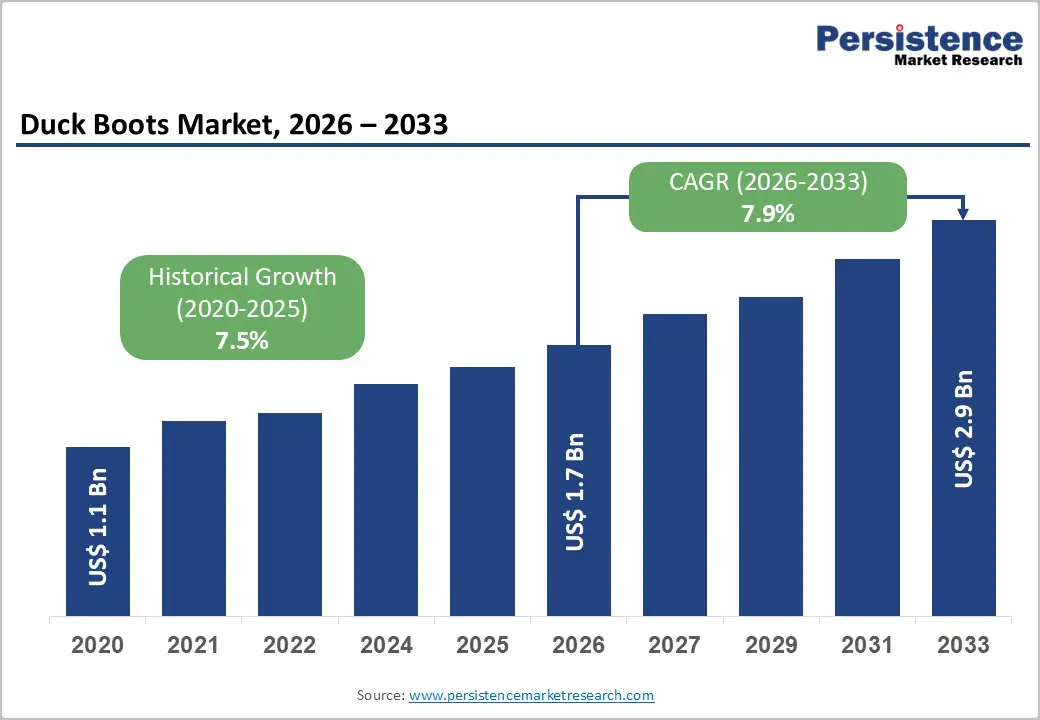
The global duck boots market size is likely to be valued at US$1.7 billion in 2026, and is expected to reach US$2.9 billion by 2033, growing at a CAGR of 7.9% during the forecast period from 2026 to 2033, driven by the increasing prevalence of outdoor lifestyle trends, rising demand for versatile all-weather footwear, and growing consumer preference for durable, stylish duck boots in casual and adventure settings.
Growing demand for waterproof and insulated duck boots, especially in leather and combination materials for men and women, is accelerating adoption across retail and e-commerce channels. Advances in breathable membranes, lightweight rubber outsoles, and sustainable leather alternatives are further boosting uptake by offering better comfort and eco-credentials. Increasing recognition of duck boots as critical for wet-weather protection, urban-to-trail versatility, and timeless fashion in emerging outdoor and lifestyle markets remains a major driver of market growth.
Key Industry Highlights:
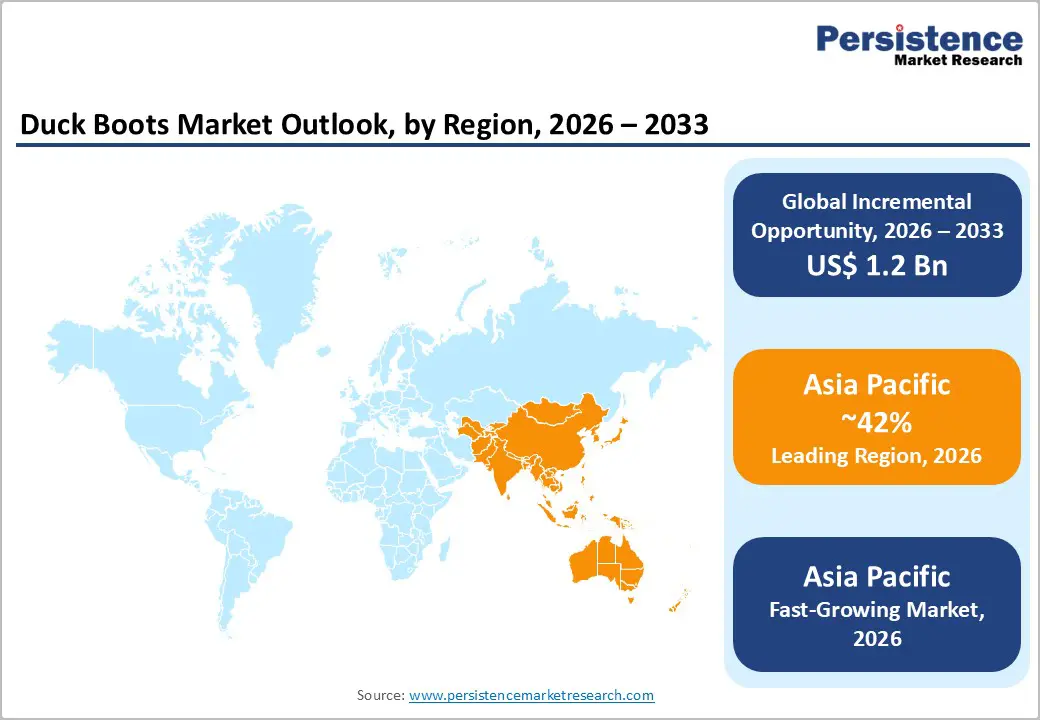
- Leading Region: Asia Pacific, anticipated to account for a 42% market share in 2026, driven by rising outdoor lifestyle awareness, increasing government initiatives, and expanding application programs across the region.
- Fastest-growing Region: Asia Pacific, fueled by rising middle-class outdoor participation, expanding urban fashion trends, and growing e-commerce penetration in China and India.
- Dominant Product Type: Waterproof duck boots, to hold approximately 45% of the market share, as they remain the core functional offering.
- Leading Material: Leather, contributing nearly 52% of the market revenue, due to premium durability and style appeal.
- Leading End-user: Men, accounting for over 42% of the market revenue, due to the highest volume of outdoor and casual purchases.
| Key Insights | Details |
|---|---|
| Duck Boots Market Size (2026E) | US$ 1.7 Bn |
| Market Value Forecast (2033F) | US$ 2.9 Bn |
| Projected Growth (CAGR 2026 to 2033) | 7.9% |
| Historical Market Growth (CAGR 2020 to 2025) | 7.5% |
Market Factors – Growth, Barriers, and Opportunity Analysis
Growth Analysis – Rising Outdoor Lifestyle and All-Weather Footwear Demand
Increasing engagement in outdoor recreation and all-weather activities clearly influences footwear choices, such as duck boots, as more people seek durable, weather-adapted footwear for varied environments. According to U.S. government data, participation in outdoor recreation continues to grow. In 2023, the outdoor recreation participant base reached a record 175.8 million Americans, representing 57.3% of the population aged 6 and older, and this was a 4.1% increase over the previous year. This broader participation encompasses hiking, biking, camping, and trail running, activities that often involve uneven terrain and wet or variable weather conditions, highlighting the need for resilient, protective footwear. The National Park Service reported a record 331.9 million recreation visits to national parks in 2024, continuing a long-term upward trend in outdoor engagement as people pursue nature-based activities across seasons.
These participation trends reflect lifestyle choices that combine fitness, wellness, and leisure in outdoor settings, driving consumers toward footwear that performs reliably in rain, mud, and cold. Duck boots, with their waterproof construction and rugged soles, align with these preferences by offering both protection and comfort. As more individuals spend time outdoors regularly for weekend hikes, park visits, or seasonal excursions, the demand for all-weather shoes that can transition from wet trails to urban streets has grown. The sustained increase in visits to natural recreation areas illustrates how outdoor activity patterns support the uptake of specialized footwear designed for durability and adaptability across weather conditions.
Growing Fashion-Forward and Gender-Neutral Adoption
Fashion trends in recent years have shifted toward versatility and self-expression, and duck boots are benefiting from that shift as consumers embrace footwear that does not adhere to traditional gender codes. Younger generations, especially Gen Z, are driving the popularity of gender-neutral and unisex fashion, choosing clothing and shoes that they feel represent personal identity rather than conform to traditional “male” or “female” categories. Surveys of online fashion behavior show spikes in interest for gender-neutral fashion terms, with search activity for “gender neutral fashion” peaking in late-2025, indicating growing curiosity and adoption of styles that appeal broadly across gender identities. Streetwear and athleisure trends, which are inherently adaptable and often unisex, continue to dominate wardrobes, with relaxed silhouettes and neutral palettes that pair well with functional footwear such as duck boots.
Outdoor-inspired functional pieces are now fashion statements in urban contexts, blending practicality with contemporary styling. This crossover has encouraged designers to offer duck boots in bolder colors, sleeker silhouettes, and design elements that can be styled with a wide array of outfits, from casual jeans to more fashion-forward ensembles. Since duck boots are not overtly ‘masculine’ or ‘feminine’ in design, do they align naturally with either gender-neutral fashion movement that values inclusivity, comfort, and versatility.
Barrier Analysis – High Price Point of Premium Duck Boots
Consumers often compare the prices of duck boots with other footwear at the point of purchase, and higher relative costs can deter purchases, particularly among budget-conscious buyers. According to U.S. government data on consumer prices, the Consumer Price Index (CPI) for footwear reached around 146.93 by July 2025, indicating that footwear prices have risen steadily over time and are well above base-period levels. When typical footwear prices are elevated, premium duck boots, which often include leather, waterproof membranes, and robust outsoles, can sit at the top end of the price spectrum compared with casual shoes or athletic sneakers, making them less accessible for large segments of the population. This can be especially impactful for first-time buyers and younger consumers, who might prioritize lower-priced options, reducing broader market uptake.
According to the U.S. Bureau of Labor Statistics, footwear prices were about 5.96% higher in 2023 than in 2019, reflecting a modest but persistent upward trend in consumer prices. When retail prices for footwear are generally rising, higher-end products such as duck boots can appear comparatively expensive, particularly when household budgets are tight or wages are stagnant. Even with functional benefits, price sensitivity limits market growth, especially in regions where consumers prioritize cost over specialized features.
Seasonal Demand and Inventory Risks
Seasonal demand patterns significantly constrain the duck boots market because these products are most useful in wet, cold, or snowy conditions, leading to concentrated buying during specific months of the year. In many regions, sales peak in late autumn and winter when rainfall and snowfall are highest, while demand drops sharply in spring and summer when lighter, breathable footwear is preferred for comfort. This creates uneven revenue streams for retailers and manufacturers, who must predict and stock the right quantities ahead of peak seasons. Misjudging demand can lead to either overstock, tying up capital in unsold inventory, or understock, missing sales opportunities when demand surges. Both situations increase operational risk and cut into profitability, especially for smaller brands without robust forecasting infrastructure.
Inventory risks are also heightened by the long lead times required for production and distribution of duck boots, which often involve specialized materials such as treated leather and waterproof rubber. If production planning is based on inaccurate seasonal forecasts, excess inventory of winter-oriented stock may remain unsold into warmer months, forcing markdowns and eroding margins. Retailers may then be reluctant to commit to large orders before the season, slowing overall market growth. In regions without pronounced wet or cold seasons, demand can be scattered and unpredictable, further complicating supply planning and weakening incentives for maintaining large inventories year-round.
Opportunity Analysis – Innovation in Sustainable and Lightweight Duck Boots
Sustainable and lightweight duck boots represent a significant growth opportunity as footwear moves toward environmentally responsible design and materials. Government sustainability criteria for footwear emphasize robust yet lightweight constructs that reduce resource use, such as energy, water, and excess materials during production, to lower environmental impact across the footwear lifecycle while ensuring durability and performance. The Netherlands’ sustainable design requirements for footwear advocate lightweight design without compromising durability and optimizing material efficiency, pointing to a future where duck boots could be engineered to meet both performance and environmental benchmarks.
Consumers and regulators are increasingly concerned about footwear’s environmental footprint, prompting interest in alternatives that reduce waste and emissions. With billions of pairs produced annually, as many as 23.4 billion pairs of shoes made and 22 billion discarded in 2023, the need for circular, sustainable products is clear, and improved materials that cut waste and permit longer life cycles are key. Sustainable designs that incorporate recycled rubber, bio-based components, or reduced weight can lessen disposal rates and energy use, appealing to eco-aware buyers and aligning with emerging regulatory expectations for product stewardship. Investing in sustainable, lightweight duck boots can differentiate products in a crowded market and attract buyers who prefer environmentally friendlier footwear that maintains comfort, durability, and weather protection.
Developments in Asia Pacific and Women’s Outdoor Segment
The Asia Pacific region has witnessed broad expansion in outdoor participation, supporting footwear categories such as duck boots. Large economies in the region have high engagement in physical activities; for example, participation rates in recreational physical activity exceed 70% in countries such as Australia, Japan, and South Korea, indicating a strong cultural affinity for active lifestyles that often intersect with outdoor environments such as trails, parks, and coastal areas. Governments across the Asia Pacific are also encouraging nature-based tourism and outdoor infrastructure development, which have helped domestic travel and adventure circuits grow, strengthening public inclination toward outdoor gear and functional footwear.
Women’s involvement in tourism and outdoor sectors in Asia and the Pacific is substantial and rising, reflecting broader social shifts toward gender parity in leisure and travel participation. Reports indicate women make up slightly over half of the tourism workforce in many parts of the region, underscoring their strong presence in a key industry connected to outdoor movement and activities. Rising urbanization and increased disposable incomes among female consumers further encourage investment in practical outdoor apparel and footwear suitable for both active pursuits and everyday urban use. As more women engage with outdoor recreation, demand for products that combine performance, comfort, and style, such as versatile duck boots, is expanding, opening opportunities for brands that tailor offerings to this dynamic and growing segment with diverse climate and lifestyle needs.
Category-wise Analysis
Product Type Insights
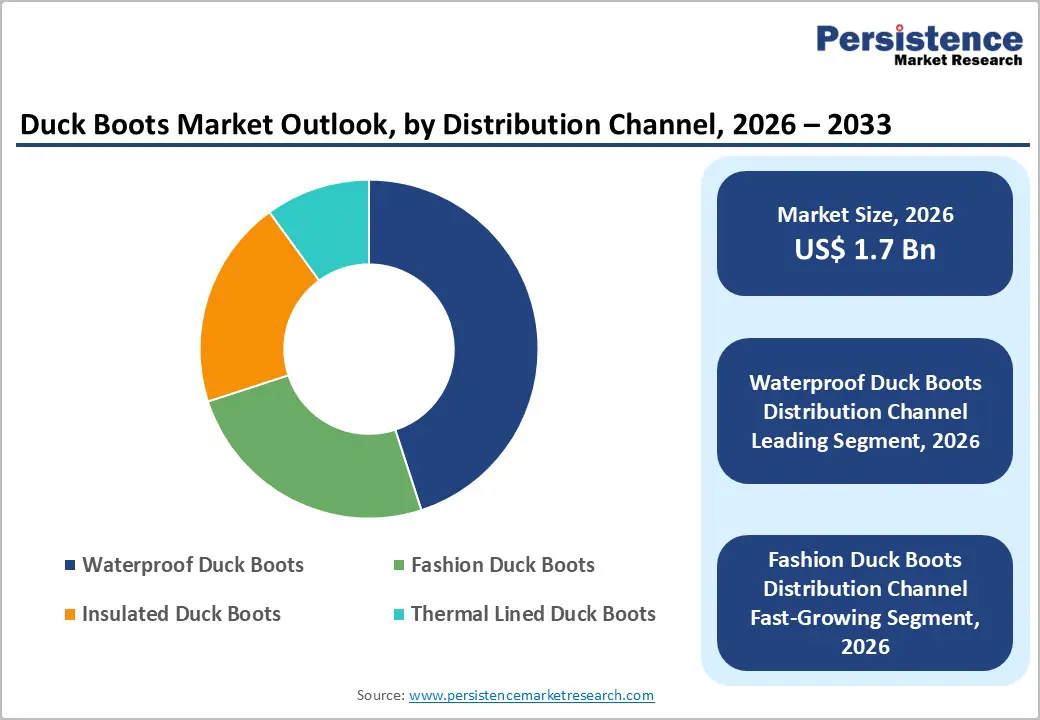
Waterproof duck boots are anticipated to dominate the market, accounting for approximately 45% of the market share in 2026. Their dominance is driven by their practical functionality and year-round usability. Designed with sealed seams, rubber soles, and treated leather, they protect against rain, snow, and wet terrains, making them ideal for outdoor activities and unpredictable weather conditions. Urban consumers also favor them for commuting and casual wear during rainy seasons, combining style with utility. The convenience of staying dry without sacrificing comfort or durability drives preference for waterproof designs over traditional leather or textile options. The LL Bean Women's Bean Boot, by L.L.Bean, features a rubber lower and leather upper to keep feet dry in rain, mud, and snow. Suitable for outdoor activities and everyday wear, it has been a flagship waterproof duck boot since 1912, known for durability and reliable weather protection.
Fashion duck boots represent the fastest-growing product type, propelled by gaining popularity as consumers seek footwear that blends style with functionality. Unlike traditional utility-focused duck boots, these designs feature sleeker silhouettes, bold colors, and modern materials that appeal to urban and younger demographics. They can be paired with casual or semi-formal outfits, making them versatile for both city streets and light outdoor activities. The combination of aesthetic appeal, comfort, and practicality drives rapid adoption, especially among women and fashion-conscious buyers. Sperry Syren Gulf Duck Boot by Sperry blends waterproof performance with a sleek, urban-friendly design that works with casual outfits as well as outdoor wear. Sperry’s duck boots are widely picked in fashion guides for their comfortable fit, modern silhouette, and versatile looks, making them popular beyond purely rugged outdoor use.
Material Insights
The leather segment is expected to dominate the market, contributing nearly 52% of revenue in 2026, fueled by its durability, premium feel, and ability to withstand harsh weather conditions. Leather provides natural water resistance, breathability, and flexibility, making it suitable for extended wear in wet or cold environments. Consumers value leather duck boots for their long lifespan and classic aesthetic, which pairs well with both outdoor and urban outfits. The material’s combination of strength, comfort, and style drives higher willingness to pay, supporting robust sales. UGG Men's Emmett Duck Leather Cold Weather Boots, featuring leather uppers and a durable waterproof design, appeal to consumers who want both premium materials and weather protection. Another is the Men’s Avenue Duck Boot from Sperry, known for its leather-accented, weather-resistant build that bridges functional outdoor use with everyday wear.
Combination materials are the fastest-growing, offering a balance of durability, comfort, and lightweight performance. These materials allow designers to create boots that are water-resistant yet breathable, rugged yet flexible, and stylish yet practical. Consumers seeking versatile footwear for both urban environments and outdoor activities prefer combination-material boots for their adaptability across weather conditions and daily use. Sperry Men's Saltwater Wool Duck Boot, which blends leather, rubber, and textile elements in its design to deliver waterproof performance along with comfort and versatility suitable for both urban and outdoor settings.
Regional Insights
North America Duck Boots Market Trends
North America is supported by the region’s strong outdoor culture, high disposable income, and high public awareness of all-weather footwear benefits. Distribution systems in the U.S. and Canada provide extensive support for duck boots programs, ensuring wide accessibility across waterproof, leather, and men's populations. Increasing demand for stylish, convenient, and easy-to-wear forms is further accelerating adoption, as these formats improve comfort and reduce barriers associated with seasonal footwear.
Innovation in duck boots technology, including stable combination materials, improved thermal lining delivery, and targeted women’s enhancement, is attracting significant investment from both public and private sectors. Government initiatives and outdoor campaigns continue to promote use against wet-weather risks, fashion concerns, and emerging lifestyle threats, creating sustained market demand. The growing focus on fashion grades and specialty uses, particularly for men and others, is expanding the target applications for duck boots.
Europe Duck Boots Market Trends
Europe is increasing awareness of all-weather footwear benefits, strong regulatory systems, and government-led sustainable fashion programs. Countries such as the U.K., Germany, France, and Italy have well-established retail and outdoor frameworks that support routine duck boots use and encourage the adoption of innovative material delivery methods, including combination and sustainable leather. These high-quality formulations are particularly appealing for men's populations, regulation-conscious retailers, and fashion users, improving comfort and coverage rates.
Technological advancements in duck boot development, such as enhanced waterproof membranes, application-targeted delivery, and improved women’s grades, are further boosting market potential. European authorities are increasingly supporting research and trials for boots against both routine and specialized needs, strengthening market confidence. The growing emphasis on convenient, durable options is aligned with the region’s focus on preventive weather protection and lifestyle wellness. Public awareness campaigns and promotion drives are expanding reach in both retail and online segments, while brands are investing in sustainable materials and novel variants to increase efficacy.
Asia Pacific Duck Boots Market Trends
Asia Pacific is projected to dominate and be the fastest-growing market, capturing for 42% revenue in 2026, driven by rising outdoor lifestyle awareness, increasing government initiatives, and expanding application programs across the region. Countries such as China, India, Japan, and South Korea are actively promoting duck boots campaigns to address urban fashion and emerging adventure needs. Duck boots are particularly attractive in these regions due to their cost-effective administration, ease of adoption, and suitability for large-scale men and women drives in both urban and semi-urban populations.
Technological advancements are enabling the development of stable, effective, and easy-to-wear duck boots that can withstand challenging weather conditions and minimize discomfort. These innovations are critical for reaching domestic retailers and improving overall footwear coverage. Growing demand for waterproof, leather, and men's applications is contributing to market expansion. Public-private partnerships, increased consumer spending, and rising investment in duck boot research and production capacity are further accelerating growth. The convenience of boots delivery, combined with improved protection and reduced risk of wet feet, positions it as a preferred choice.
Competitive Landscape
The global duck boots market is shaped by competition between long-established heritage brands and emerging direct-to-consumer players. In North America, companies such as Frye and Clarks leverage strong brand recognition, extensive distribution networks, and premium positioning, supported by innovations in waterproofing and leather construction. In the Asia Pacific region, local manufacturers focus on region-specific designs to improve accessibility and appeal. Enhanced waterproof performance increases reliability in wet conditions, reduces discomfort, and broadens lifestyle integration. Strategic partnerships, collaborations, and acquisitions enable knowledge sharing, portfolio expansion, and faster product launches. Combination-material designs reduce weight, improving comfort and encouraging urban adoption, driving overall market growth.
Key Industry Developments:
- In January 2026, the Anaheim Ducks announced the return of their award-winning partnership with Anaheim-born brand Vans, highlighted by a custom shoe designed by Hockey Hall of Famer and Stanley Cup champion Teemu Selanne. The third Ducks x Vans collaboration introduced two limited-edition sneaker styles, released exclusively at Honda Center on Sunday, Feb. 1, when Anaheim faced the Vegas Golden Knights at 6:30 p.m., with the event presented by Chick-fil-A.
Companies Covered in Duck Boots Market
- Rockport
- Milwaukee Boots
- Frye
- Clarks
- Unmarked
- Hush Puppies
- Huckberry
- Thursday Boot
- Beckett Simonon
- Taylor Stitch
- Tecovas
Frequently Asked Questions
The global duck boots market is projected to reach US$1.7 billion in 2026.
Rising outdoor lifestyle and all-weather footwear demand are key drivers.
The duck boots market is poised to witness a CAGR of 7.9% from 2026 to 2033.
Sustainable and lightweight duck boots and expansion in Asia Pacific and women’s outdoor segment are key opportunities.
Frye, Clarks, Thursday Boot, Tecovas, and Rockport are the key players.


