




- Medical Devices
- Digital Denture Market
Digital Denture Market Size, Share, and Growth Forecast, 2026 – 2033
Digital Denture Market by Denture Type (Complete Dentures, Partial Dentures, Others), Material (Resins, Plastics), Application (Definitive Dentures, Immediate Dentures (Transitional), Others), and Regional Analysis for 2026 – 2033

Digital Denture Market Size and Trends Analysis
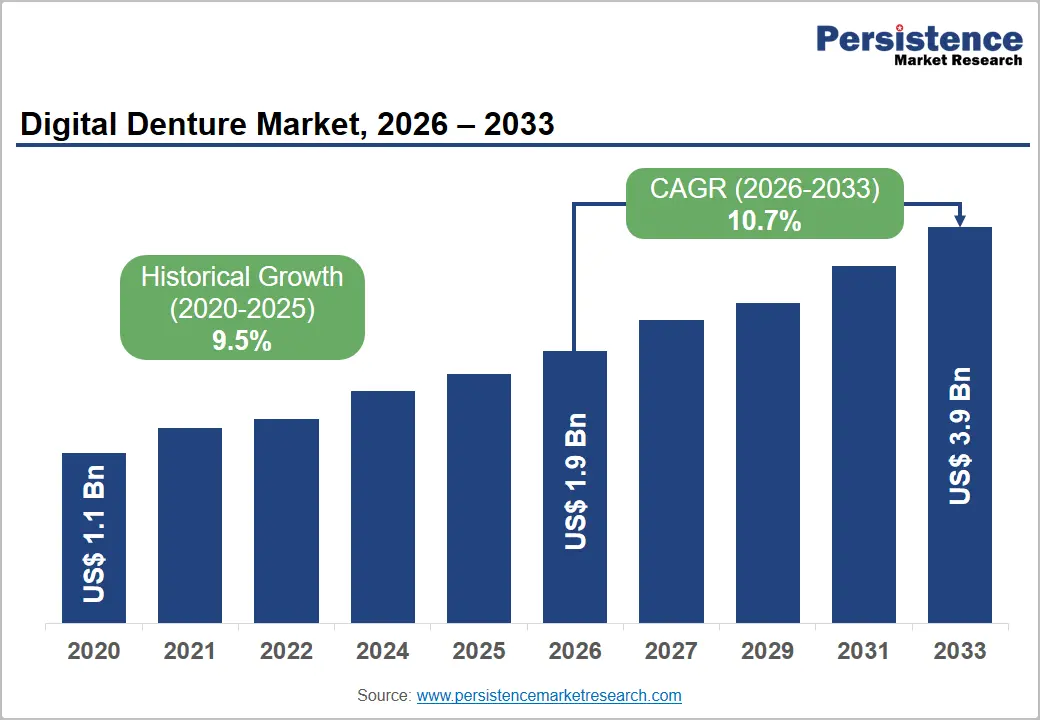
The global digital denture market size is likely to be valued at US$1.9 billion in 2026 and is expected to reach US$3.9 billion by 2033, growing at a CAGR of 10.7% during the forecast period from 2026 to 2033, driven by the increasing burden of tooth loss and the rapid adoption of digital dentistry technologies.
According to the World Health Organization (WHO), oral diseases affected nearly 3.7 billion people globally in 2025, while complete tooth loss impacts approximately 350 million people worldwide. The WHO also estimates that around 23% of individuals aged 60 years and older experience complete tooth loss, creating significant demand for denture solutions. The growing integration of CAD/CAM systems, intraoral scanning, and 3D printing is enabling faster, more accurate, and highly customized denture fabrication, supporting the transition toward fully digital dental workflows across clinics and laboratories.
Key Industry Highlights:
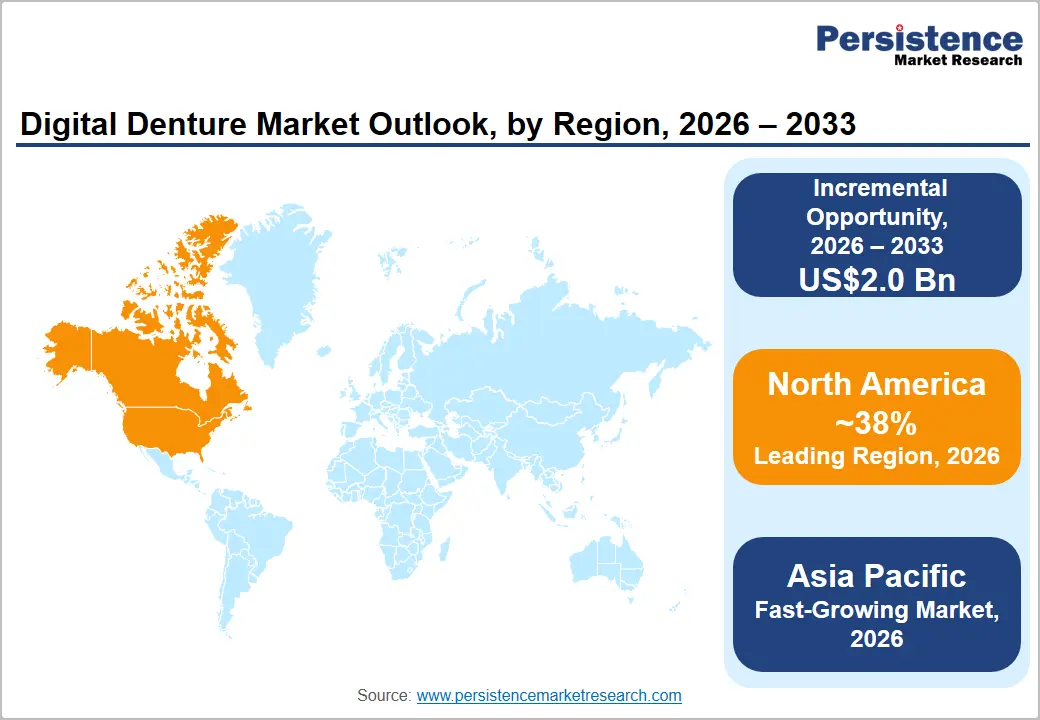
- Leading Region: North America is anticipated to be the leading region, accounting for a market share of 38% in 2026, driven by advanced digital dentistry adoption, strong regulatory support, and widespread integration of CAD/CAM and 3D printing technologies.
- Fastest-growing Region: Asia Pacific is likely to be the fastest-growing region, supported by expanding digital dental infrastructure, growing geriatric populations, and increasing adoption of advanced denture manufacturing technologies.
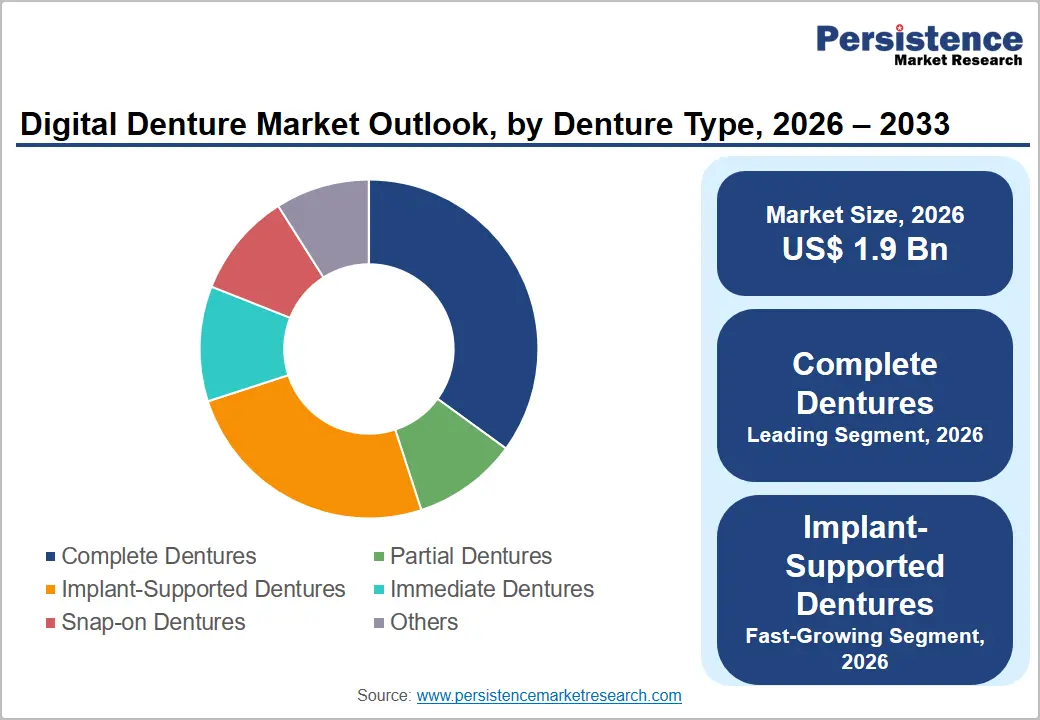
- Leading Denture Type: Complete dentures are expected to lead the denture type segment in 2026, accounting for 52% of revenue, driven by the high prevalence of edentulism and increasing demand for full-arch tooth replacement solutions.
- Leading Material Type: Resins are anticipated to be the leading material type, accounting for over 55% of the revenue share in 2026, supported by their superior aesthetics, biocompatibility, and compatibility with digital manufacturing technologies.
- Key Opportunity: The growing convergence of AI-driven design, CAD/CAM systems, 3D printing, and tele-dentistry is creating significant opportunities for scalable, highly customized, and efficient digital denture production worldwide.
DRO Analysis
Driver - Rising Geriatric Population and Prevalence of Tooth Loss
Older adults frequently require complete or partial dentures to restore chewing ability, speech, and facial aesthetics. As life expectancy increases across developed and developing countries, the number of individuals seeking long-term dental prosthetic solutions continues to rise. Digital dentures offer improved fit, comfort, and accuracy compared to conventional alternatives, making them increasingly attractive to both patients and clinicians.
This demographic shift is creating sustained demand for advanced denture manufacturing technologies worldwide. The prevalence of tooth loss caused by periodontal disease, dental caries, trauma, and age-related oral deterioration supports market expansion. Digital denture workflows enable faster production, fewer clinical visits, and more predictable outcomes, addressing the needs of growing patient volumes.
Dental clinics and laboratories are increasingly adopting CAD/CAM systems, intraoral scanners, and 3D printing technologies to efficiently manage rising demand. Elderly patients are becoming more aware of modern restorative options that provide enhanced aesthetics and functionality. The combination of increasing edentulous populations and technological advancements continues to strengthen growth prospects.
Restraint - High Initial Capital Investment and Skills Gap
Implementing digital denture workflows requires substantial expenditure on intraoral scanners, CAD/CAM software, milling systems, 3D printers, and related infrastructure. Small and medium-sized dental clinics and laboratories often face budget constraints that limit technology adoption. In addition to equipment costs, organizations must invest in maintenance, software updates, validation procedures, and workflow integration.
A shortage of trained professionals capable of operating advanced digital systems restricts market growth. Effective use of digital denture technologies requires expertise in scanning, computer-aided design, additive manufacturing, and digital treatment planning. Many dental practitioners and laboratory technicians continue to rely on conventional methods and may require extensive training before adopting digital workflows. The learning curve associated with new technologies can reduce operational efficiency during implementation phases.
Opportunity - Technological Convergence with AI and Tele-Dentistry
AI-powered software can automate denture design processes, improve treatment planning accuracy, and optimize prosthetic customization based on patient-specific anatomical data. These capabilities reduce manual intervention, shorten production timelines, and enhance consistency across dental laboratories. AI also supports predictive analysis and workflow efficiency, helping clinicians deliver improved patient outcomes.
As dental providers increasingly seek scalable and cost-effective solutions, the incorporation of intelligent technologies into digital denture manufacturing is accelerating adoption and creating new avenues for innovation across the industry. Tele-dentistry is expanding access to dental care and creating additional opportunities for digital denture providers.
Remote consultations, digital impression sharing, and virtual treatment planning enable dentists and laboratories to collaborate efficiently across geographic boundaries. Patients in underserved or rural locations can access specialized prosthetic services without frequent in-person visits. When combined with cloud-based platforms and digital manufacturing technologies, tele-dentistry supports faster case management and streamlined workflows.
Category-wise Analysis
Denture Type Insights
Complete dentures are expected to lead, accounting for 52% of revenue in 2026, due to the growing prevalence of complete tooth loss among elderly populations and the increasing demand for full-arch restorative solutions. These dentures remain the preferred choice for patients who have lost all teeth in either the upper or lower jaw, offering functional and aesthetic rehabilitation. For example, Ivoclar’s digital denture workflow enables dental laboratories to manufacture highly customized complete dentures with improved precision and reduced chairside appointments.
Implant-supported dentures are likely to represent the fastest-growing segment, supported by increasing patient preference for stable, comfortable, and long-lasting restorative solutions. Unlike conventional removable dentures, implant-supported options provide enhanced retention and chewing efficiency by anchoring the prosthesis to dental implants. For instance, Straumann Group offers integrated digital implant and prosthetic solutions that support the development of implant-supported dentures.
Material Type Insights
Resins are projected to lead the market, capturing around 55% of the revenue share in 2026, supported by their excellent aesthetics, biocompatibility, durability, and compatibility with modern digital manufacturing technologies. These materials are widely utilized in CAD/CAM milling and 3D printing applications because they enable highly precise denture fabrication while maintaining favorable mechanical properties. A notable example is Formlabs, which offers specialized dental resins for digital denture fabrication, enabling highly accurate production and supporting laboratories in streamlining modern digital workflows.
Plastics are likely to be the fastest-growing application due to increasing efforts to develop cost-effective and lightweight denture solutions. Advances in polymer engineering have improved the performance characteristics of dental plastics, making them more suitable for digital manufacturing applications. For example, several digital dental laboratories utilize advanced polymer-based denture materials within CAD/CAM workflows to deliver customized prosthetic solutions while maintaining production efficiency and affordability.
Application Insights
Definitive dentures are projected to lead the market, accounting for 40% of revenue in 2026, driven by their widespread use as a long-term restorative solution for patients with partial or complete tooth loss. Designed for durability, functionality, comfort, and aesthetics, these dentures remain a preferred treatment option. For example, Dentsply Sirona offers digital denture solutions that help clinicians and laboratories produce definitive dentures with greater accuracy, consistency, and long-term clinical outcomes.
Repairs, relines, and remakes performed through digital workflows are expected to be the fastest-growing segment, driven by the rising adoption of digital data management and advanced manufacturing technologies. Digital denture files can be securely stored and retrieved for future adjustments, repairs, relines, or remakes, reducing the need to repeat time-consuming clinical and laboratory procedures. For example, 3Shape provides a digital dental ecosystem that enables the storage and transfer of denture design files, helping laboratories efficiently manage repairs, relines, and remakes through streamlined digital workflows.
Regional Insights
North America Digital Denture Market Trends
North America is expected to lead the market in 2026, accounting for 38% of global revenue, driven by the widespread adoption of digital dentistry technologies, well-established healthcare infrastructure, and significant investments in CAD/CAM and additive manufacturing solutions. For instance, Dentsply Sirona continues to expand its digital dentistry ecosystem through advanced CAD/CAM technologies and integrated digital workflows that enhance the efficiency and precision of denture fabrication.
U.S. Digital Denture Market Trends
The U.S. is projected to dominate the North America market, accounting for approximately 80% of regional revenue in 2026. Growth is supported by the widespread adoption of CAD/CAM technologies across dental clinics and laboratories, along with increasing investments in chairside dentistry that are accelerating the implementation of digital workflows. Dental Service Organizations (DSOs) are expanding the use of standardized digital treatment protocols, while the growing adoption of 3D printing technologies is enhancing the efficiency, accuracy, and scalability of denture production.
Canada Digital Denture Market Trends
Canada is likely to be a significant market for digital dentures, holding approximately 20% of the market share in 2026. Dental laboratories are increasingly investing in digital manufacturing systems to improve productivity. Growing awareness of digital restorative dentistry is supporting demand among patients and clinicians. The country is witnessing increased utilization of intraoral scanners and CAD software. Academic institutions are promoting digital dentistry education and research.
Europe Digital Denture Market Trends
Europe is likely to be a significant market for digital dentures owing to strong dental laboratory networks, favorable healthcare systems, and widespread acceptance of digital dentistry solutions. For example, Ivoclar has expanded its portfolio of digital prosthetic solutions, helping laboratories and clinicians across Europe enhance denture design accuracy, streamline workflows, and improve the overall production efficiency.
U.K. Digital Denture Market Trends
The U.K. is expected to be a significant market for digital dentures, accounting for approximately 20% of the Europe market share in 2026. Growth is driven by increasing investments by dental laboratories in advanced scanning and manufacturing technologies, rising awareness of digital restorative solutions, and the expanding adoption of 3D printing for denture production. The integration of digital treatment planning platforms is becoming more widespread, while educational institutions are increasingly incorporating digital dentistry training into their curricula, supporting the development of a skilled workforce.
Germany Digital Denture Market Trends
Germany is expected to dominate the Europe digital denture market, accounting for approximately 35% of regional revenue in 2026, supported by its highly advanced dental technology industry and extensive network of modern dental laboratories. The country maintains strong adoption of CAD/CAM systems among clinicians and dental technicians, while domestic manufacturers continue to invest in digital manufacturing innovations. The growing use of automated production technologies is also enhancing workflow efficiency, precision, and scalability across denture fabrication processes.
Asia Pacific Digital Denture Market Trends
The Asia Pacific region is likely to be the fastest-growing region, driven by its expanding healthcare infrastructure, increasing oral health awareness, and rapid adoption of digital dental technologies. For instance, Formlabs has strengthened its presence in Asia Pacific through expanded access to dental 3D printing solutions, helping laboratories improve efficiency and produce highly customized digital dentures with greater precision.
China Digital Denture Market Trends
China is projected to lead the regional digital denture market, accounting for approximately 30% of market revenue in 2026. Growth is driven by the rapid modernization of dental healthcare infrastructure, increasing investments by dental laboratories in digital manufacturing technologies, and rising awareness of advanced restorative dentistry solutions. The expansion of domestic dental technology production is improving accessibility and affordability, while the adoption of CAD/CAM systems continues to grow across dental clinics and laboratories, supporting greater efficiency and precision in denture fabrication.
India Digital Denture Market Trends
India is expected to emerge as a significant market for digital dentures, accounting for approximately 22% of regional revenue in 2026. Growth is driven by expanding access to dental care, increasing awareness of advanced prosthetic solutions, and rising adoption of digital impression systems and CAD/CAM technologies across dental clinics. Investments in private dental healthcare are supporting market expansion, while the growing use of 3D printing in dental laboratories is enhancing production capabilities. Dental education institutions are also increasingly promoting training in digital dentistry workflows, and the rising demand for aesthetic and functional restorations is accelerating technology adoption.
Competitive Landscape
The global digital denture market exhibits a moderately fragmented structure, driven by the presence of established dental technology providers, CAD/CAM solution developers, dental material manufacturers, and emerging digital dentistry companies. Market growth is being fueled by increasing adoption of digital workflows, advancements in 3D printing technologies, and growing demand for customized dental prosthetics.
With key leaders, including Dentsply Sirona, Ivoclar, Straumann Group, Formlabs, Carbon Inc., 3Shape, Kulzer GmbH, Amann Girrbach AG, VITA Zahnfabrik, and Roland DG (DGSHAPE), the market continues to witness strong technological competition. These players compete through product innovation, expansion of digital dentistry ecosystems, advanced CAD/CAM software development, high-performance denture materials, and integrated scanning-to-manufacturing solutions.
Key Industry Developments:
- In February 2026, Roland DGA launched the Elevate Denture Solution, a comprehensive digital denture production workflow designed to help dental laboratories streamline manufacturing, improve accuracy, and enhance efficiency through advanced digital design and fabrication technologies.
- In February 2026, HeyGears launched its One-Piece Denture Solution at LMT LAB DAY Chicago, introducing a dual-material DLP 3D printing technology that seamlessly fuses denture base and tooth materials in a single printing process, enhancing fit, aesthetics, structural reliability, and manufacturing efficiency for digital dentures.
Companies Covered in Digital Denture Market
- Dentsply Sirona
- Ivoclar Vivadent AG
- 3M Oral Care
- Kulzer GmbH (Mitsui Chemicals Group)
- Straumann Group
- Amann Girrbach AG
- VITA Zahnfabrik H. Rauter GmbH & Co. KG
- Zirkonzahn GmbH
- Roland DG Corporation (DGSHAPE)
- SHOFU Dental Corporation
- Planmeca Oy
- Whip Mix Corporation
- Carbon Inc.
- EnvisionTEC GmbH (Desktop Health)
- Formlabs Inc.
- 3Shape A/S
Frequently Asked Questions
The global digital denture market is projected to reach US$1.9 billion in 2026.
The digital denture market is driven by the rising geriatric population, increasing prevalence of tooth loss, and growing adoption of CAD/CAM and 3D printing technologies in dental prosthetics.
The digital denture market is expected to grow at a CAGR of 10.7% from 2026 to 2033.
Key opportunities lie in the integration of AI, tele-dentistry, and advanced digital manufacturing technologies to deliver faster, highly customized, and more efficient denture solutions.
Dentsply Sirona, Ivoclar Vivadent AG, 3M Oral Care, Kulzer GmbH, and Straumann Group are the leading players.


