




- Specialty & Fine Chemicals
- Cetyl Trimethyl Ammonium Chloride Market
Cetyl Trimethyl Ammonium Chloride Market Size, Share, and Growth Forecast 2026 - 2033
Cetyl Trimethyl Ammonium Chloride Market by Form (Liquid CTAC, Powder / Solid CTAC), by Concentration (CTAC 30%, CTAC 50%, CTAC 70%, Others), by Function (Surfactant, Emulsifier, Conditioning Agent, Antistatic Agent, Disinfectant / Antiseptic), by Application (Personal Care, Home Care & Cleaning Chemicals, Textile Processing (Antistatic agents), Industrial Applications, Pharmaceuticals, Others), by Regional Analysis, 2026 - 2033

Cetyl Trimethyl Ammonium Chloride Market Size and Trend Analysis
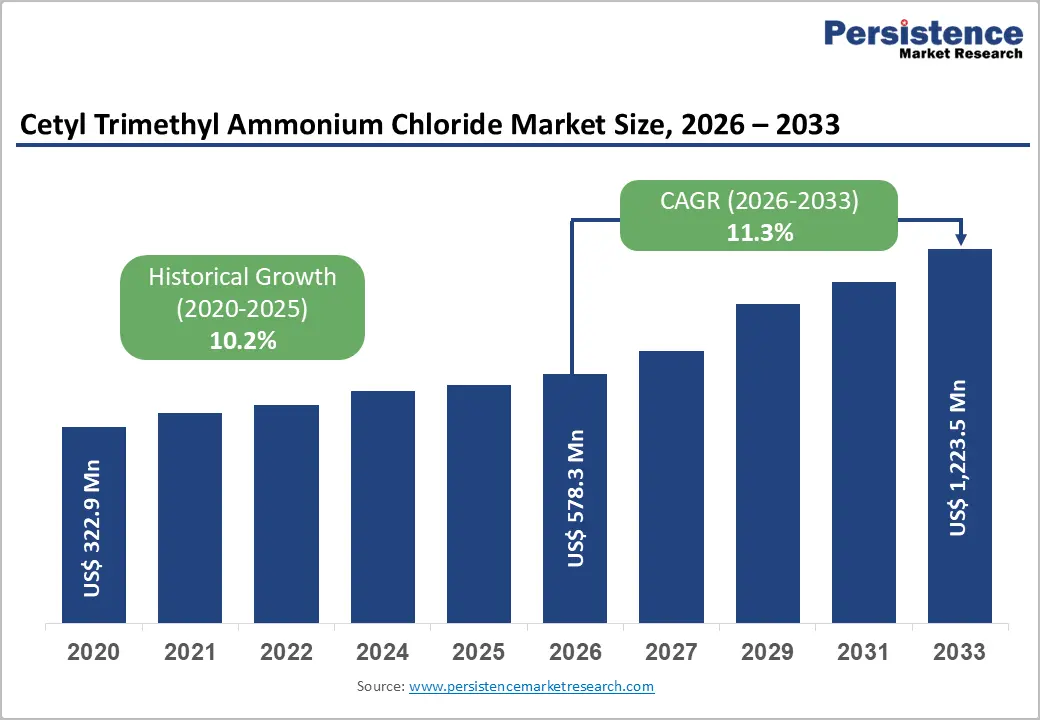
The global Cetyl Trimethyl Ammonium Chloride Market size is expected to be valued at US$ 578.3 million in 2026 and projected to reach US$ 892.8 million by 2033, growing at a CAGR of 6.4% between 2026 and 2033.
The expansion of the cetyl trimethyl ammonium chloride (CTAC) market is driven primarily by rising demand from personal care formulations, home care & cleaning chemicals, and industries such as textiles and pharmaceuticals. The growing consumer focus on hygiene and conditioning efficacy in hair and skin care products is encouraging formulators to adopt CTAC as a versatile cationic surfactant, conditioning agent, and emulsifier.
Key Industry Highlights:
- Leading Region: Asia Pacific leads the CTAC market with approximately 38% share in 2025, driven by strong personal care demand, textile production, and industrial cleaning activities.
- Fastest Growing Region: North America is the fastest-growing region, supported by rising demand for disinfectants, premium personal care formulations, and advanced industrial cleaning applications.
- Leading Form Category: Liquid CTAC dominates the market with about 65% share in 2025, preferred for its ease of handling, rapid solubility, and compatibility with large-scale formulation systems.
- Leading Concentration Category: CTAC 50% leads with roughly 55% share in 2025, offering an optimal balance of active content, stability, and formulation efficiency across multiple end-use industries.
- Key Market Opportunity: Growth in bio-based and sustainable CTAC formulations aligned with clean beauty trends and circular-economy initiatives is creating strong, long-term premiumization opportunities.
| Key Insights | Details |
|---|---|
|
Cetyl Trimethyl Ammonium Chloride Size (2026E) |
US$ 578.3 million |
|
Market Value Forecast (2033F) |
US$ 892.8 million |
|
Projected Growth CAGR (2026–2033) |
6.4% |
|
Historical Market Growth (2020–2025) |
5.1% |

Market Dynamics
Driver - Rising Penetration in Personal Care and Hygiene Formulations
The growing personal care and hygiene sector is a major driver for the cetyl trimethyl ammonium chloride market, particularly in shampoos, conditioners, and leave-on hair care products. CTAC acts as a conditioning and antistatic agent, improving hair softness, manageability, and detangling performance. Rising consumer preference for premium grooming products and increasing awareness of hair health are strengthening demand across global markets.
At the same time, hygiene awareness, driven by global public health initiatives, supports the significant use of CTAC in disinfectant and antiseptic formulations. Its compatibility with surfactant systems and broad antimicrobial effectiveness make it suitable for healthcare, household, and institutional cleaning products, further reinforcing its adoption in modern hygiene-focused formulations.
Expansion Across Industrial, Textile, and Pharmaceutical Uses
CTAC demand is expanding beyond cosmetics into textiles, industrial cleaning, and pharmaceutical applications. In textile processing, it is widely used as an antistatic agent for synthetic fibers, supporting smoother manufacturing and improved fabric quality. Growing synthetic fiber production, especially in the Asia Pacific, continues to strengthen its industrial relevance across yarn and fabric finishing operations.
In industrial and pharmaceutical sectors, CTAC is used in cleaning agents, emulsifiers, and disinfectant formulations. It supports compliance with stringent hygiene protocols in manufacturing and healthcare environments. Its role in GMP-compliant pharmaceutical cleaning and medical device maintenance further enhances its importance as a multifunctional quaternary ammonium compound across regulated end-use industries.
Restraint - Environmental Regulations Limiting Quaternary Ammonium Use
The cetyl trimethyl ammonium chloride market faces restraints due to increasing environmental and regulatory scrutiny on quaternary ammonium compounds. Regulatory bodies in North America and Europe are tightening restrictions due to concerns over persistence, aquatic toxicity, and ecological impact. This has resulted in stricter discharge norms and formulation limitations, particularly in household and industrial cleaning applications where environmental exposure is high.
In addition, regulatory frameworks are encouraging the development of biodegradable or lower-toxicity alternatives, prompting manufacturers to reformulate products or reduce CTAC concentrations. Compliance requirements increase operational costs and can limit market expansion in environmentally sensitive regions. These constraints also affect export potential, as global markets increasingly favor eco-friendly surfactant systems and sustainable chemical formulations.
Raw Material Price Volatility and Supply Chain Pressure
The CTAC market is also constrained by volatility in raw material prices, particularly those of fatty alcohols derived from palm oil and petrochemical sources. Fluctuations in global commodity prices, influenced by climatic disruptions and agricultural yield variability, directly impact production costs. This creates uncertainty in pricing structures and reduces margin stability for manufacturers across the value chain.
Additionally, geopolitical tensions and logistical disruptions in key sourcing regions can affect the steady supply of intermediates required for CTAC production. Such instability leads to production delays and occasional substitution with alternative surfactants. For cost-sensitive end-use industries like textiles and home care, these price fluctuations can limit adoption unless CTAC offers significant performance advantages over competing ingredients.
Opportunities - Growth of Bio-Based and Sustainable CTAC Formulations
A major opportunity in the cetyl trimethyl ammonium chloride market is the rising shift toward bio-based and biodegradable surfactant systems. Increasing environmental awareness and global sustainability initiatives are encouraging manufacturers to develop eco-friendly CTAC alternatives derived from renewable sources such as plant-based fatty alcohols. This aligns with broader green chemistry trends and low-carbon manufacturing goals across developed regions.
Consumer preference for clean-label and environmentally responsible personal care products is also accelerating the adoption of sustainable formulations. Many end users in North America and Europe are willing to pay premium prices for biodegradable ingredients, pushing companies to innovate. This transition enables CTAC producers to strengthen their position in premium personal care and eco-friendly industrial cleaning segments while meeting evolving regulatory expectations.
Expansion into Water Treatment and Disinfection Applications
The growing need for safe water and effective sanitation presents a significant opportunity for CTAC in water treatment and disinfection applications. Increasing investments in municipal water infrastructure and wastewater treatment systems, particularly in developing economies, are driving demand for efficient antimicrobial and surface-active chemicals that can enhance purification processes.
CTAC-based formulations can be used in disinfection, flocculation, and membrane treatment systems due to their compatibility with cationic compounds. Large-scale public health initiatives aimed at improving access to clean water are further supporting adoption. This expanding application base allows CTAC manufacturers to diversify beyond traditional markets such as personal care and textiles into high-growth environmental and public utility sectors.
Category-wise Analysis
Form Category Insights
Liquid CTAC is the leading segment, accounting for approximately 65% of the global market share in 2025. This dominance is driven by its superior handling characteristics, rapid solubility, and seamless compatibility with cosmetic and industrial formulation systems. Liquid CTAC is widely integrated into shampoos, conditioners, and fabric softeners due to its ease of blending in high-water-phase systems and suitability for large-scale automated production processes.
The powder and solid CTAC segment is witnessing faster adoption across specialized industrial applications. Its advantages in transportation efficiency, longer shelf stability, and controlled dosing make it increasingly attractive for niche formulations and export-oriented supply chains. Growth is also supported by expanding use in regions where storage conditions favor solid chemical forms for safer and more cost-efficient logistics.
Concentration Category Insights
CTAC 50% leads with around 55% share in 2025. This grade is widely preferred for its optimal balance of active content, viscosity, and ease of handling. It is extensively used in personal care formulations such as conditioners and shampoos, as well as in industrial cleaning applications where standardized performance and stability are required.
Higher concentration grades such as CTAC 70% are emerging as the fastest growing segment. Their adoption is increasing in industrial and institutional applications where stronger active content, reduced transportation volume, and enhanced formulation efficiency are critical. These grades are gaining traction in advanced cleaning systems and customized chemical blends used in manufacturing and specialty processing industries.
Function Category Insights
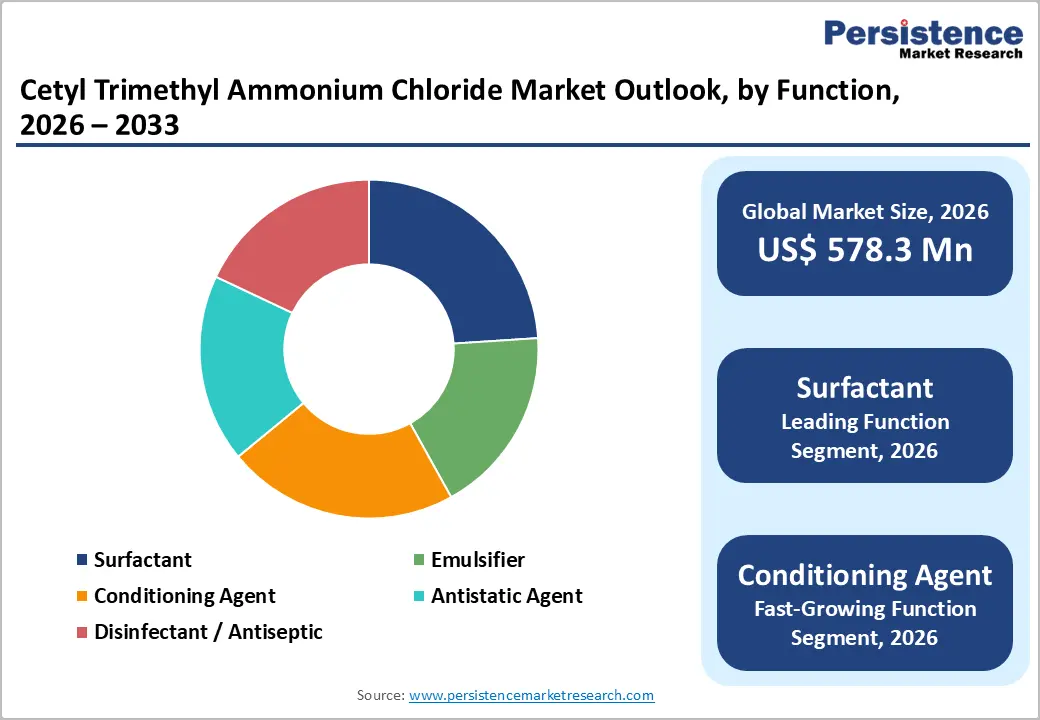
Surfactants are the leading segment, accounting for approximately 45% of the global CTAC market in 2025. This dominance is attributed to CTAC’s strong cationic nature, which enables effective surface adsorption on hair, skin, textiles, and metal substrates. Its ability to reduce surface tension and enhance conditioning performance makes it a core ingredient in formulation development across multiple industries.
At the same time, the conditioning agent segment is emerging as the fastest-growing function category. Rising demand for premium personal care products and advanced hair care formulations is driving increased use of CTAC for softness, detangling, and anti-frizz performance. Manufacturers are increasingly leveraging their conditioning efficiency in high-end cosmetic and specialty care products.
Application Category Insights
Personal care dominates with approximately 40% share in 2025. This is primarily driven by strong demand for shampoos, conditioners, and leave-on hair care products where CTAC enhances manageability, smoothness, and antistatic performance. Increasing consumer focus on grooming and premium cosmetic formulations continues to reinforce this segment’s leadership.
In contrast, home care and cleaning chemicals represent the fastest-growing application segment. Rising awareness of hygiene, increasing demand for surface disinfectants, and expansion of household cleaning product usage are driving adoption. CTAC’s antimicrobial properties and compatibility with multi-surfactant systems make it highly suitable for modern cleaning and sanitation formulations across residential and institutional environments.
Regional Insights
North America Cetyl Trimethyl Ammonium Chloride Market Trends and Insights
North America is a significant and mature market for cetyl trimethyl ammonium chloride, led primarily by the United States, driven by a well-established personal care, household cleaning, and specialty chemical industry. The region benefits from strong regulatory frameworks under the FDA and TSCA, which support the use of CTAC in approved cosmetic and antiseptic formulations while ensuring high safety and purity standards. This encourages manufacturers to develop advanced, high-performance grades for premium applications.
At the same time, North America is witnessing growing demand for disinfectant wipes, ready-to-use cleaning solutions, and institutional hygiene products. CTAC is increasingly used in healthcare-grade disinfectants and commercial cleaning systems due to its antimicrobial efficiency and formulation stability. The region holds approximately 32% share of the global market, supported by a strong consumer focus on hygiene and continuous product innovation.
Europe Cetyl Trimethyl Ammonium Chloride Market Trends and Insights
Europe represents a mature but innovation-driven market forcetyl trimethyl ammonium chloride, with strong demand across personal care, home care, and industrial cleaning applications in countries such as Germany, France, the United Kingdom, Spain, and Italy. The regulatory environment under REACH and guidance from the European Chemicals Agency have encouraged the use of higher-purity CTAC grades and optimized formulation practices to reduce environmental impact and improve safety compliance.
In parallel, Europe is experiencing steady growth in the premium hair care and professional cosmetic segments, driven by consumer demand for specialized products such as frizz-control and color-protection formulations. The region also benefits from strong demand for industrial cleaning and textile processing. Europe is projected to grow at a CAGR of approximately 5.6%, supported by sustainability-led innovation and advanced chemical manufacturing infrastructure.
Asia Pacific Cetyl Trimethyl Ammonium Chloride Market Trends and Insights
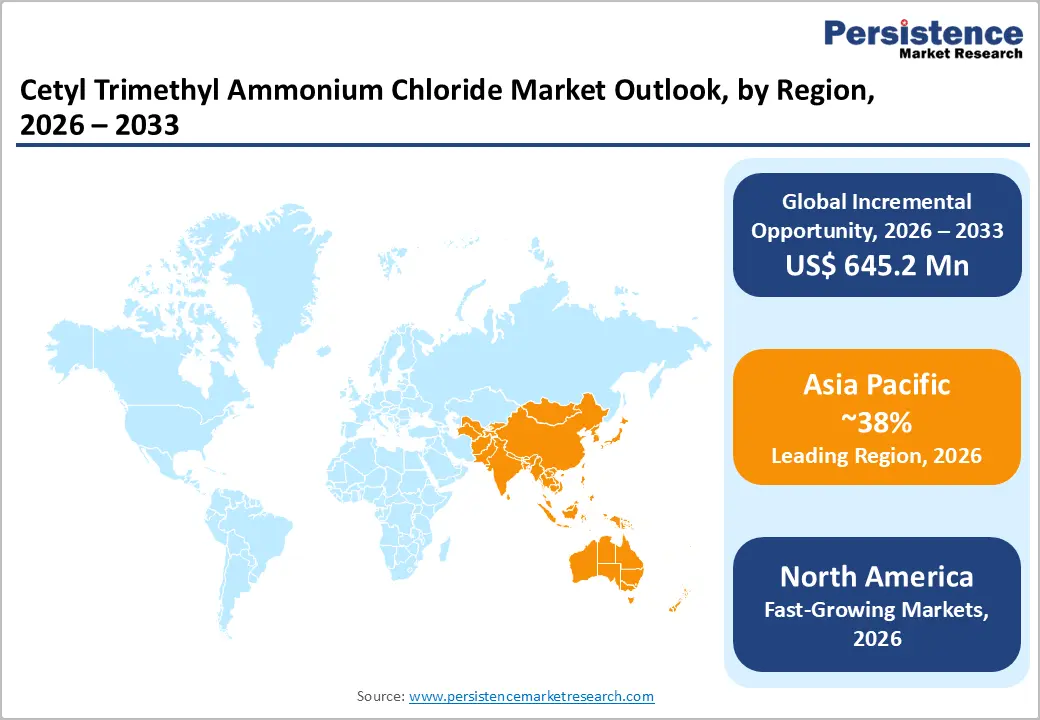
Asia Pacific dominates the global cetyl trimethyl ammonium chloride market with approximately 38% share in 2025, making it the largest regional consumer. Growth is driven by expanding personal care consumption, large-scale textile production, and rapid industrialization across China, India, Japan, and Southeast Asia. The region also benefits from strong manufacturing infrastructure and continuous investment in surfactant production capacity.
At the same time, the Asia Pacific is the fastest-growing region due to rising disposable income, urbanization, and increasing adoption of premium hair care and hygiene products. China leads in mass-market conditioners and industrial applications, while India is witnessing strong growth in branded personal care products. ASEAN countries are emerging as export hubs for chemical manufacturing, further strengthening regional CTAC demand across both domestic and global supply chains.
Competitive Landscape
The cetyl trimethyl ammonium chloride market is moderately consolidated, with a mix of large multinational chemical manufacturers and mid-sized regional suppliers. Leading players are focusing on integrated value chains, advanced synthesis capabilities, and high-purity CTAC grades to meet growing demand across personal care, pharmaceutical, and industrial cleaning applications.
At the same time, regional and specialty manufacturers are strengthening their positions through cost-efficient production and customized formulations aligned with local regulations. Competition is increasingly shaped by innovation in sustainable and low-toxicity variants, along with strategic collaborations, contract manufacturing, and co-development partnerships with downstream formulators and brand owners.
Key Developments:
- In June 2025, Kao Corporation launched a bio based CTAC 50% concentrate for European personal care brands. The formulation meets EU biodegradability and REACH sustainability requirements, targeting shampoos and conditioners while delivering high conditioning performance with reduced environmental impact.
- In March 2024, Evonik Industries expanded CTAC production capacity in the United States by approximately 20% to meet rising demand for healthcare and food-processing hygiene applications. The expansion focuses on high-purity, low-chloride grades for sensitive disinfectant and cleaning formulations.
- In November 2023, Croda International introduced a CTAC-based powder formulation for pharmaceutical and antiseptic applications. It received regulatory acceptance under FDA-aligned standards for use in gels and creams, offering high efficacy, low irritancy, and enhanced preservation performance.
Companies Covered in Cetyl Trimethyl Ammonium Chloride Market
- Kao Corporation
- BASF SE
- Evonik Industries AG
- Clariant AG
- Stepan Company
- Lonza Group Ltd.
- Croda International Plc
- KLK OLEO
- Merck KGaA
- SACHEM Inc.
- Galaxy Surfactants Ltd.
- Solvay S.A.
- Nouryon
- Global Amines Company Pte Ltd
- Feixiang Group
Frequently Asked Questions
The global CTAC market is projected to reach US$ 578.3 billion in 2026, driven by rising demand from personal care, home care, and industrial cleaning sectors.
Growing use in personal care and hygiene products, especially conditioners, disinfectants, and textile antistatic applications, is the primary demand driver.
Asia Pacific leads the market with approximately 38% share in 2025, supported by strong manufacturing, textile production, and personal care consumption.
The key opportunity lies in developing bio-based and sustainable CTAC formulations aligned with green chemistry and clean label trends.
Key players include Kao Corporation, Evonik Industries, Croda International, Lonza Group, Stepan Company, and Clariant AG.


