




- Specialty & Fine Chemicals
- CDU Heat Exchanger Antifoulants Market
CDU Heat Exchanger Antifoulants Market Size, Share, and Growth Forecast, 2026 - 2033
CDU Heat Exchanger Antifoulants Market by Product Type (Dispersants, Corrosion Inhibitors, Metal Coordinators, Polymerization Inhibitors), End-Use (Oil Refineries, Petrochemical Plants, Chemical Processing Facilities, Power Generation Plants), Material (Polymeric, Metallic, Composite), and Regional Analysis for 2026-2033

CDU Heat Exchanger Antifoulants Market Share and Trends Analysis
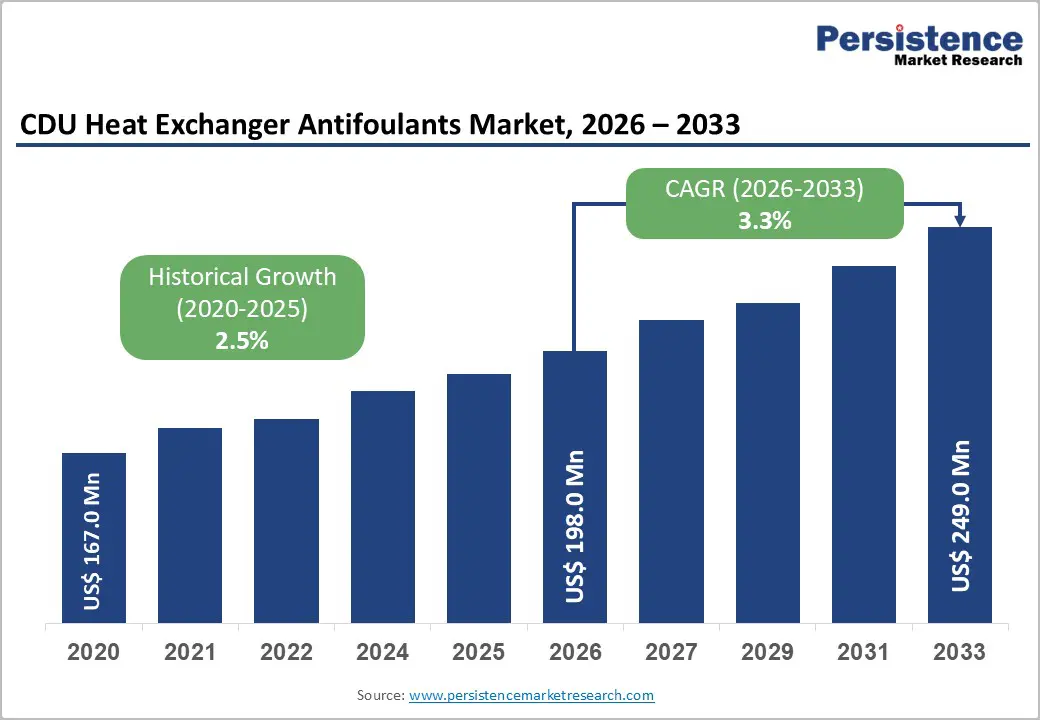
The global CDU heat exchanger antifoulants market size is likely to be valued at US$ 198.0 million in 2026, and is projected to reach US$ 249.0 million by 2033, growing at a CAGR of 3.3% during the forecast period 2026−2033. Sustained growth is driven by rising global refinery throughput, tightening environmental regulations mandating energy-efficient operations, and the accelerating shift toward heavier, more fouling-prone crude slates.
Technological advancements in multifunctional antifoulant chemistries combining dispersants, polymerization inhibitors, and corrosion suppressants are enabling refiners to extend heat exchanger run-lengths and reduce unplanned downtime. Emerging economies in Asia Pacific and the Middle East are accelerating capacity expansion, creating incremental demand for advanced antifoulant solutions.
Key Industry Highlights
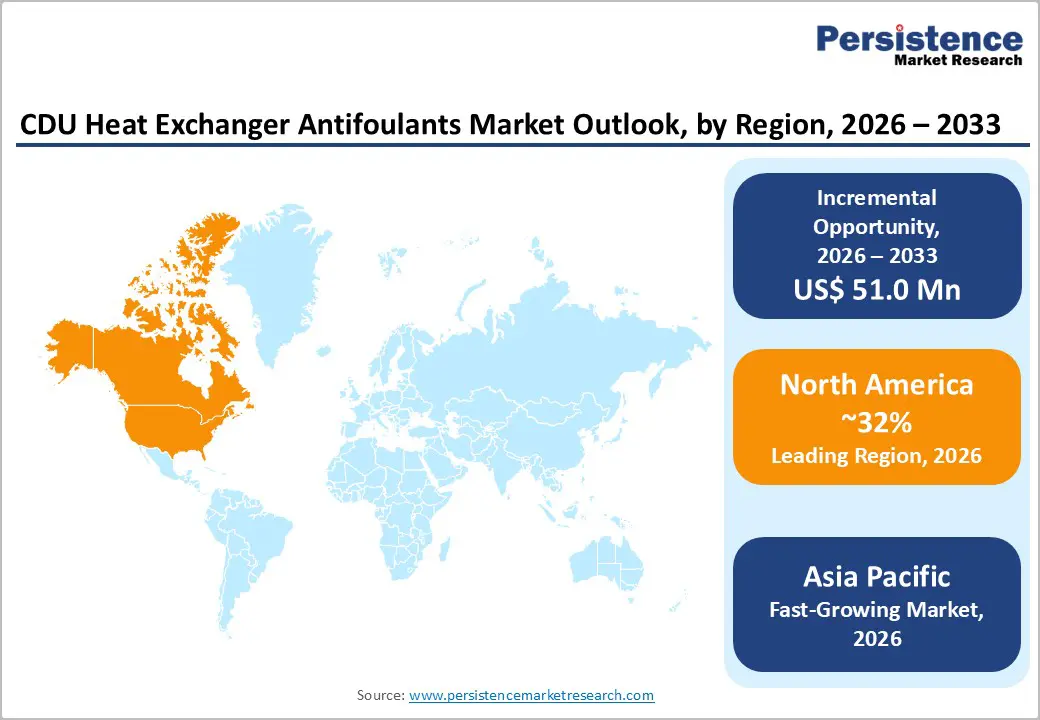
- Dominant Region: North America is hold roughly 32% of the market share in 2026, supported by established industries and stringent regulatory standards.
- Fastest-growing Market: The Asia Pacific market is slated to be the fastest-growing through 2033, powered by a robust teapot refinery sector and state-owned enterprise initiatives.
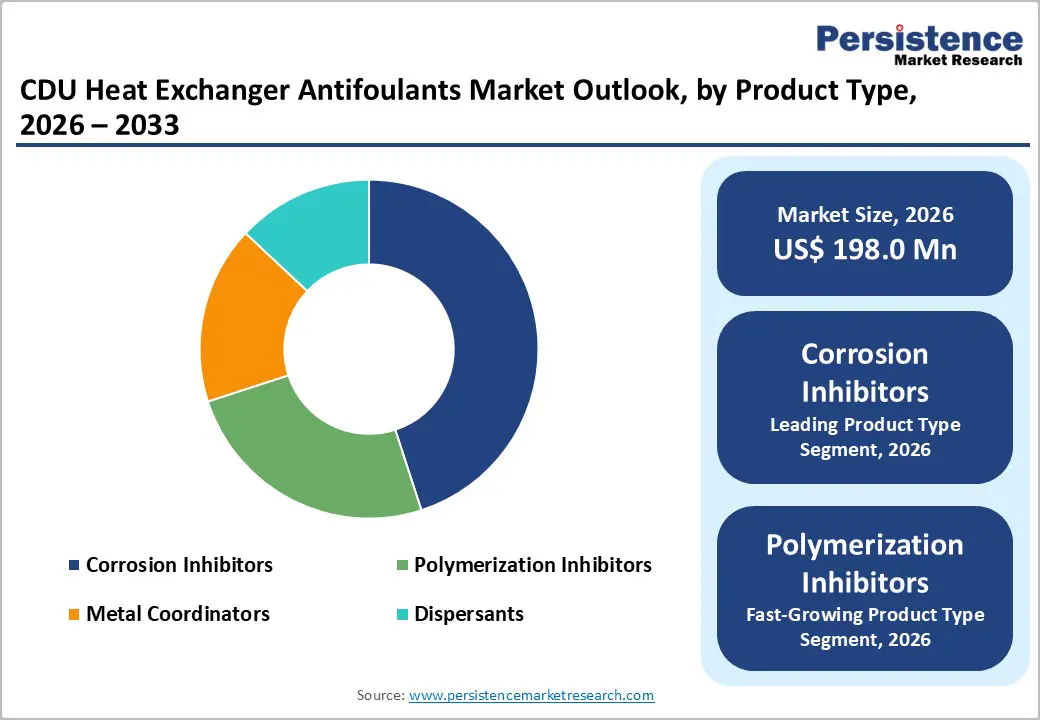
- Leading & Fastest-growing Product Type: Corrosion inhibitors are poised to dominate by commanding approximately 36.5% of the revenue share in 2026, while polymerization inhibitors are likely to be the fastest-growing through 2033.
- Leading & Fastest-growing End-Use: Oil refineries are set to command around 45% revenue share in 2026, with petrochemical plants expected to grow the fastest over the 2026-2033 forecast period.
| Key Insights | Details |
|---|---|
| CDU Heat Exchanger Antifoulants Market Size (2026E) | US$ 198.0 Mn |
| Market Value Forecast (2033F) | US$ 249.0 Mn |
| Projected Growth (CAGR 2026 to 2033) | 3.3% |
| Historical Market Growth (CAGR 2020 to 2025) | 2.5% |
Market Factors – Growth, Barriers, and Opportunity Analysis
Expanding Global Refinery Throughput and CDU Operations
Global crude distillation capacity is expanding steadily, particularly across Asia Pacific and Gulf Cooperation Council (GCC) countries, as refiners invest in new greenfield projects to meet rising fuel demand. Data from the International Energy Agency (IEA) indicates sustained additions in refining capacity across China, India, and other high growth regions. Each crude distillation unit (CDU) requires antifoulant dosing from commissioning to maintain heat transfer efficiency and protect critical equipment. Operators are applying these chemical treatments to manage fouling risks and ensure stable refinery performance.
Refining throughput is increasing as new capacity becomes operational, which is raising maintenance intensity and chemical consumption. Operators are adjusting antifoulant dosing rates and heat exchanger cleaning schedules to manage higher processing loads. This trend is creating consistent baseline demand for CDU antifoulants across global refining networks. Suppliers are securing long term contracts by offering customized formulations aligned with varying crude characteristics. Service models are also evolving to include predictive monitoring and performance optimization, which supports operational reliability and reduces unplanned downtime.
Regulatory Pressure for Energy Efficiency and Emissions Reduction
Regulatory frameworks are requiring refiners to improve thermal efficiency in CDU preheat trains. The United States Environmental Protection Agency (EPA) Clean Air Act and the European Union (EU) Industrial Emissions Directive (IED) are setting strict emission limits that drive operational changes. Refineries are adopting efficiency focused strategies to reduce energy consumption and limit waste generation. Antifoulants are playing a critical role by preventing deposit formation in heat exchangers, which helps maintain heat transfer performance and reduces the need for frequent mechanical cleaning.
Refineries are also extending operational run lengths and lowering energy intensity through optimized antifoulant dosing programs. This approach is supporting reduced greenhouse gas emissions while improving process stability. Policy measures such as the European Commission Fit for 55 initiative are increasing carbon cost exposure, which is encouraging investment in fouling mitigation solutions. Chemical treatment programs are offering a cost effective alternative to capital intensive equipment upgrades. Suppliers are developing advanced formulations aligned with environmental targets, while operators are integrating these solutions into long term efficiency and sustainability strategies.
Volatile Raw Material Costs and Supply Chain Fragility
CDU antifoulants depend on petrochemical intermediates such as maleic anhydride, polyisobutylene (PIB), and amine derivatives, all derived from crude oil and natural gas feedstock. Price volatility in energy markets is directly affecting input costs and influencing antifoulant pricing across supply chains. Manufacturers are closely monitoring commodity trends to manage cost fluctuations, while refineries are limiting bulk procurement during periods of uncertainty. Smaller producers without backward integration are facing greater margin pressure as raw material costs shift rapidly.
Large suppliers are securing feedstock stability through integrated operations or long term supply agreements, while independent firms are transferring higher costs to end users. Refineries are prioritizing predictable pricing structures to maintain maintenance planning and operational budgets. In response, manufacturers are developing cost efficient formulations and exploring alternative synthesis pathways to reduce exposure to raw material volatility. Strategic sourcing, diversification, and risk management practices are becoming essential to ensure supply continuity and maintain competitiveness in the specialty chemicals market.
Stringent Environmental and Toxicological Regulatory Barriers
Regulatory scrutiny is increasing for legacy antifoulant chemistries, driven by frameworks such as the European Union Registration, Evaluation, Authorization and Restriction of Chemicals (EU REACH) and the United States Toxic Substances Control Act (TSCA). These regulations require extensive testing, documentation, and disclosure to ensure environmental and human safety. Manufacturers are investing in research and development (R&D) to validate existing formulations and meet evolving compliance standards. Approval processes are becoming more complex, which is slowing product updates and increasing time to market for new chemical solutions.
Producers are reformulating products to align with stricter environmental requirements, which is raising development costs across the industry. Large companies are allocating resources for regulatory testing and certification, while smaller firms are facing greater financial and operational constraints. Innovation cycles are extending as companies prioritize compliant chemistries over experimental alternatives. Refineries are relying on proven solutions to minimize operational risk, which is reinforcing the position of established suppliers. Industry participants are also exploring bio based formulations and collaborative testing models to reduce compliance costs and support sustainable product development.
Digital Integration and Smart Dosing Systems
Industrial Internet of Things (IIoT) technologies are integrating with advanced process control (APC) systems and real time fouling monitoring to reshape antifoulant deployment strategies. Suppliers are shifting from product based models to comprehensive fouling management solutions that combine chemicals with digital oversight. Sensor networks are tracking parameters such as pressure drop, heat transfer efficiency, and surface temperature, while centralized platforms are enabling operators to make data driven decisions. Refineries are using these systems to adjust antifoulant dosing in real time, which improves process stability and equipment performance.
Digital integration is enabling dynamic dosing that optimizes chemical usage and reduces operational waste. Automated response systems are improving reliability by preventing deposit formation before performance declines. Suppliers are offering performance based service contracts that provide ongoing monitoring and technical support, which strengthens long term customer relationships. Refineries are adopting these integrated solutions to meet efficiency targets and reduce maintenance disruptions through predictive alerts. This shift is driving a transition toward outcome based revenue models, where providers deliver bundled solutions that combine hardware, software, and domain expertise.
Bio-Based and Green Antifoulant Chemistry Development
Sustainability mandates and environmental, social, and governance (ESG) commitments are pushing integrated oil companies (IOCs) to adopt environmentally responsible antifoulant solutions. Refineries are seeking alternatives that reduce ecological impact while maintaining operational efficiency. Manufacturers are developing bio derived formulations using approaches such as plant based dispersants and enzymatic agents to control fouling. These innovations are aligning with corporate sustainability targets and enabling operators to lower environmental footprints without compromising performance.
Suppliers are expanding portfolios of bio based antifoulants to meet demand from sustainability focused buyers and support evolving regulatory expectations. Early adopters are leveraging these solutions to strengthen ESG positioning and secure long term supplier partnerships. Research initiatives, including efforts linked to the American Chemical Society Green Chemistry Institute, are advancing the viability of bio polymers for refinery applications. Manufacturers are collaborating with academic and industry partners to improve formulation stability and effectiveness. Providers are also offering performance backed solutions to build confidence among end users and accelerate adoption across refining operations.
Category-wise Analysis
Product Type Insights
Corrosion inhibitors are positioned to dominate the product type segment and account for about 36.5% of the CDU heat exchanger antifoulants market revenue share in 2026. Refineries rely on these chemicals to protect metal surfaces from degradation caused by corrosive compounds present in crude oil, especially during initial distillation stages. Operators are applying corrosion inhibitors in preheat trains to preserve equipment integrity, reduce metal loss, and maintain stable heat transfer performance. Their proven ability to extend operating cycles and lower maintenance expenditure is reinforcing consistent adoption across refining assets. As crude quality becomes more variable, these solutions are remaining essential for managing corrosion risks and sustaining long term asset reliability.
Polymerization inhibitors are projected to be the fastest-growing segment during the 2026-2033 forecast period, driven by the increasing use of unstable and chemically reactive crude feedstock. These inhibitors are preventing the formation of polymer deposits in heat exchange systems, which helps maintain process efficiency and reduces fouling related disruptions. Advanced formulations are dispersing reactive intermediates more effectively, allowing refineries to operate under more demanding conditions without compromising throughput. Suppliers are developing customized chemistries tailored to specific crude compositions, particularly in regions processing high aromatic and complex feedstock streams. This targeted approach is strengthening performance outcomes and supporting broader adoption of polymerization control strategies across modern refining operations.
End-Use Insights
Oil refineries are anticipated to lead with about 45% of the CDU heat exchanger antifoulants market share in 2026. These facilities process large volumes of crude oil through CDUs, where fouling directly affects heat transfer efficiency and operational stability. Operators are applying antifoulants in preheat trains to maintain equipment performance, reduce deposit formation, and extend run lengths between maintenance cycles. Demand remains concentrated in this segment because refining operations depend on uninterrupted throughput and precise thermal management. Processing heavier and more complex crude slates is increasing fouling risks, which is reinforcing the need for effective chemical treatment programs. As a result, refineries are representing the majority of antifoulant consumption and are shaping product development priorities for suppliers.
Petrochemical plants are set to emerge as the fastest-growing application segment through 2033, driven by capacity expansion and feedstock diversification. These facilities are processing intermediate streams that exhibit fouling behavior similar to crude fractions, which is creating demand for antifoulant solutions adapted to petrochemical operations. Operators are integrating these treatments into heat exchange systems to maintain process efficiency and prevent performance degradation. Growth is accelerating across regions such as Asia Pacific and the Middle East, where new petrochemical complexes are coming online to meet global demand for polymers and specialty chemicals. Suppliers are developing advanced formulations tailored to aromatic rich and reactive streams, which is improving compatibility and performance in downstream processes. This convergence between refining and petrochemical operations is strengthening long term demand for antifoulants across integrated production ecosystems.
Regional Insights
North America CDU Heat Exchanger Antifoulants Market Trends
North America is expected to claim about 32% of the CDU heat exchanger antifoulants market value in 2026, supported by its large and complex refining base. The United States is leading this position as a major global refining hub that processes varied crude slates such as heavy and opportunity grades. These conditions are increasing fouling risks and are driving consistent demand for effective chemical treatment programs. Regulatory frameworks from the United States EPA and mandates such as the Renewable Fuel Standard (RFS) are encouraging refiners to improve energy efficiency and reduce emissions. Operators are investing in antifoulant solutions to maintain heat transfer performance and support compliance objectives.
The regional market is benefiting from a mature ecosystem that integrates innovation, operational expertise, and advanced service models. Leading suppliers are establishing R&D centers near key refining clusters to support customized solution development. Canada is contributing through oil sands processing, which presents complex fouling challenges and strengthens demand for specialized chemistries. Refineries are adopting digital monitoring tools to track fouling behavior in real time and optimize dosing strategies. Suppliers are positioning themselves as solution partners by offering performance based services and predictive maintenance support. This approach is strengthening long term collaborations and enabling refineries to manage complex feedstock with greater efficiency and reliability.
Europe CDU Heat Exchanger Antifoulants Market Trends
Europe represents the second largest regional market for crude distillation unit heat exchanger antifoulants, supported by its advanced and diversified refining infrastructure. Countries such as Germany, the United Kingdom, France, the Netherlands, and Spain operate complex refineries that process crude from multiple sources, including the North Sea, the Middle East, and Africa. This feedstock diversity is increasing fouling risks and is requiring targeted chemical treatment strategies. Regulatory frameworks such as the EU IED and climate initiatives under the Fit for 55 program are pushing refiners to improve thermal efficiency and reduce emissions. As a result, operators are deploying antifoulant programs to maintain heat transfer performance and meet compliance requirements.
Shifts in crude sourcing patterns are further increasing operational complexity across European refineries. Companies are adapting to varied feedstock characteristics by adopting customized antifoulant formulations that address specific fouling mechanisms. The region is also emphasizing sustainable chemical usage, with suppliers developing low toxicity solutions that comply with REACH standards. Refineries are integrating advanced monitoring systems to improve dosing precision and enhance process control. Suppliers that combine environmental compliance with technical performance are securing strong market positions, as operators prioritize solutions that align regulatory obligations with operational efficiency.
Asia Pacific CDU Heat Exchanger Antifoulants Market Trends
Asia Pacific is projected to be the fastest-growing market for CDU heat exchanger antifoulants from 2026 to 2033, driven by rapid refining capacity expansion and energy security priorities. China is leading growth through independent refineries and state backed projects, while India is advancing capacity through initiatives guided by the Petroleum Planning and Analysis Cell (PPAC). Japan and South Korea maintain technologically advanced refining systems that rely on efficient fouling control for stable operations. Governments across the region are supporting refinery modernization to strengthen domestic fuel production, which is encouraging early integration of antifoulant programs within new facilities. Emerging markets such as Vietnam, Indonesia, and Thailand are also expanding refining infrastructure, which is creating new demand for specialized chemical solutions.
New refinery developments are requiring tailored antifoulant strategies from the commissioning stage to ensure consistent performance. Suppliers are establishing regional blending and distribution networks to reduce logistics costs and improve delivery timelines. This localized approach is attracting specialty chemical providers seeking long term market presence. Refiners are selecting partners that offer customized formulations aligned with specific crude profiles and operational conditions. Adoption of digital monitoring tools is also improving dosing precision and process control across facilities. Early supplier involvement is enabling long term service agreements, which is strengthening market penetration as refining capacity scales across the region.
Competitive Landscape
The global CDU heat exchanger antifoulants market structure is moderately consolidated, with leading companies such as Baker Hughes, Nalco Water, Suez Water Technologies, Dorf Ketal, and Clariant accounting for about 60% of total market revenue. These firms maintain strong positions through extensive product portfolios, advanced formulation capabilities, and established relationships with refinery operators. Regional specialty chemical providers and niche formulators are competing by offering application specific expertise and tailored solutions that address complex fouling challenges. Differentiation is increasingly based on proprietary chemistries combined with technical service support that aligns with refinery performance requirements.
Suppliers are strengthening competitiveness by integrating digital monitoring tools with antifoulant programs to deliver measurable performance outcomes. Refineries are prioritizing partners that provide real time data insights and performance guarantees, which support operational reliability and cost control. This shift is encouraging long term service contracts and repeat engagements across refining networks. Companies are focusing on customized chemical solutions designed for specific crude profiles and operating conditions, which improves treatment effectiveness. Market leadership is increasingly defined by the ability to combine chemical innovation with data driven optimization and field level support.
Key Industry Developments
In February 2025, Alfa Laval acquired NRG Marine, a leading provider of ultrasonic anti-fouling solutions for marine, oil and gas, and industrial applications, to strengthen its portfolio in ultrasonic anti-fouling technology and expand sustainable marine solutions. The move supports innovation in biofouling prevention while enhancing energy efficiency and operational performance.
Companies Covered in CDU Heat Exchanger Antifoulants Market
- Baker Hughes Company
- Ecolab Inc.
- Suez Water Technologies & Solutions
- Dorf Ketal Chemicals
- Clariant AG
- Nouryon
- BASF SE
- SI Group, Inc.
- Halliburton
- Solenis LLC
- Innospec Inc.
- Evonik Industries AG
- Kemira Oyj
- Calumet Specialty Products Partners
- Kurita Water Industries Ltd.
Frequently Asked Questions
The global CDU heat exchanger antifoulants market is projected to reach US$ 198.0 million in 2026.
The market is driven by expanding global refining capacity and increased processing of heavy crude, both of which are elevating fouling risks and requiring effective chemical protection solutions.
The market is poised to witness a CAGR of 3.3% from 2026 to 2033.
Major opportunities are emerging in digital monitoring systems that support precision dosing and enable suppliers to offer performance-based service contracts.
Baker Hughes, Nalco Water, Suez Water Technologies, Dorf Ketal, and Clariant are some of the key players in the market.


