




- Specialty & Fine Chemicals
- Bitumen Modifier Market
Bitumen Modifier Market Size, Share, and Growth Forecast, 2026 – 2033
Bitumen Modifier Market by Modifier Type (Styrene-Butadiene-Styrene, Atactic Polypropylene, Crumb Rubber, Others), Application (Hot Asphalt, Cold Asphalt, Others), End-user (Road Construction, Others), and Regional Analysis for 2026 – 2033

Bitumen Modifier Market Size and Trends Analysis
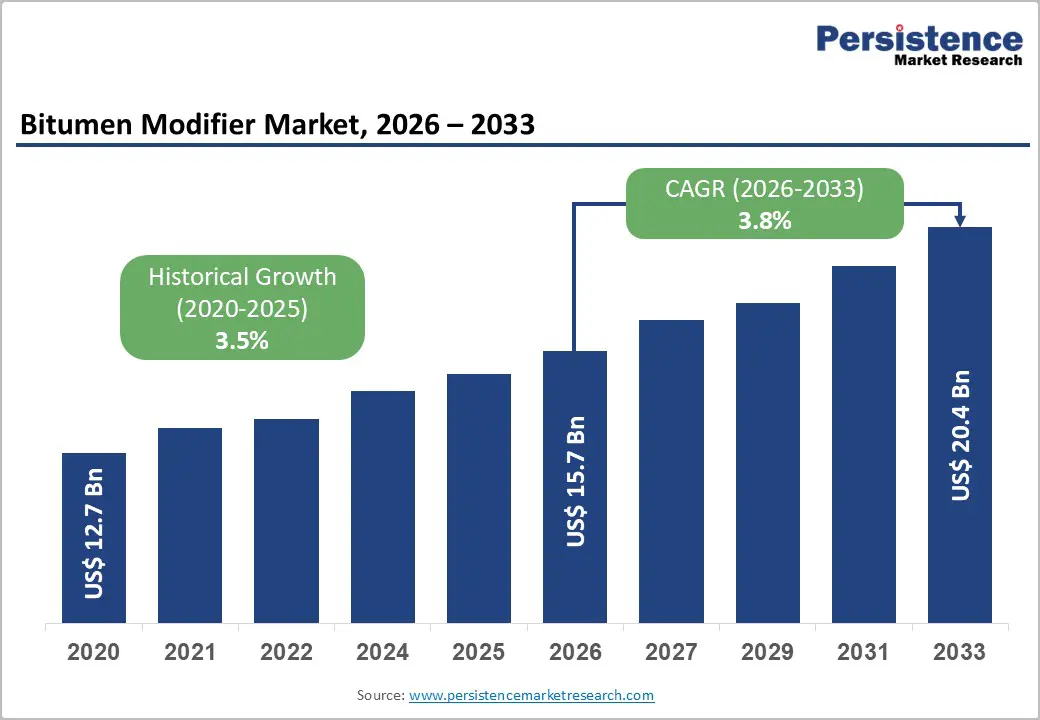
The global bitumen modifier market size is likely to be valued at US$15.7 billion in 2026 and is expected to reach US$20.4 billion by 2033, growing at a CAGR of 3.8% during the forecast period from 2026 to 2033, driven by its critical role in enhancing the performance characteristics of conventional bitumen across multiple applications. This expansion is primarily driven by increasing investments in transportation infrastructure, particularly in road construction, where modified bitumen is widely used to improve resistance to rutting, cracking, and extreme temperature variations.
Rapid urbanization and industrialization in emerging economies are accelerating demand, as governments continue to prioritize highway development, smart city projects, and urban mobility improvements. The building and construction sector is contributing significantly to market growth through the rising adoption of modified bitumen in roofing, waterproofing membranes, and insulation systems, owing to its superior durability, flexibility, and weather resistance. Technological advancements in polymer science, including the growing use of elastomers and plastomers, are enhancing the functional properties of bitumen modifiers, enabling better performance in both hot and cold climatic conditions.
Key Industry Highlights:
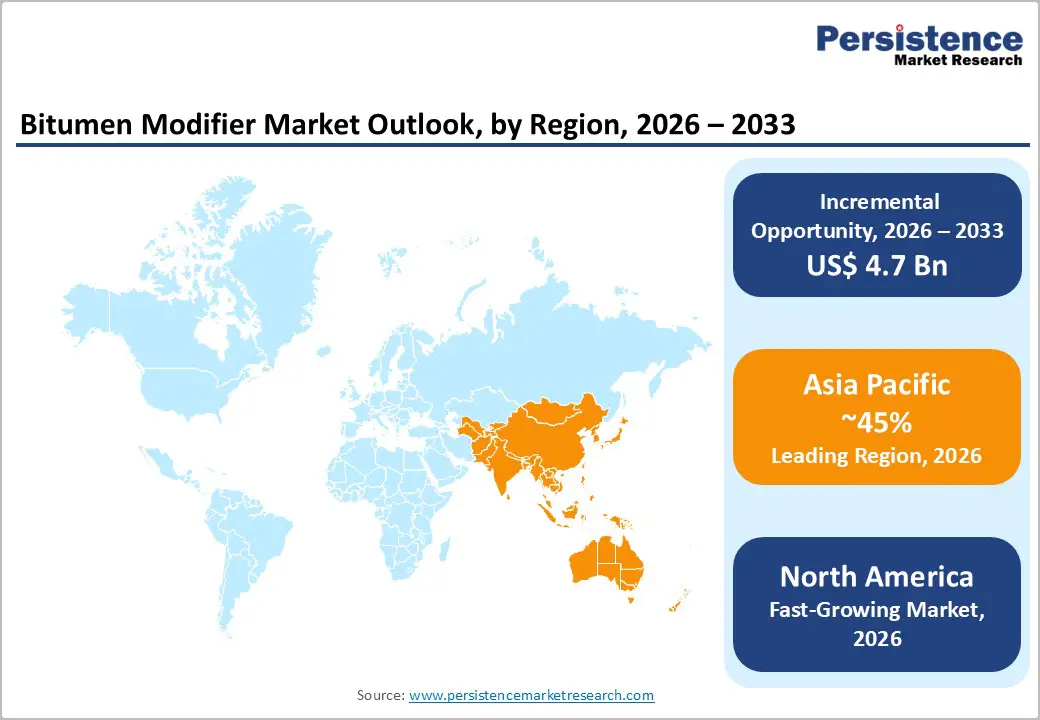
- Leading Region: Asia Pacific is anticipated to be the leading region, accounting for a market share of 45% in 2026, driven by rapid infrastructure development, expanding road networks, and increasing urbanization across major economies such as China and India.
- Fastest-growing Region: North America is likely to be the fastest-growing region, supported by ongoing infrastructure rehabilitation, strong adoption of polymer-modified asphalt, and stringent performance standards in the U.S. construction sector.
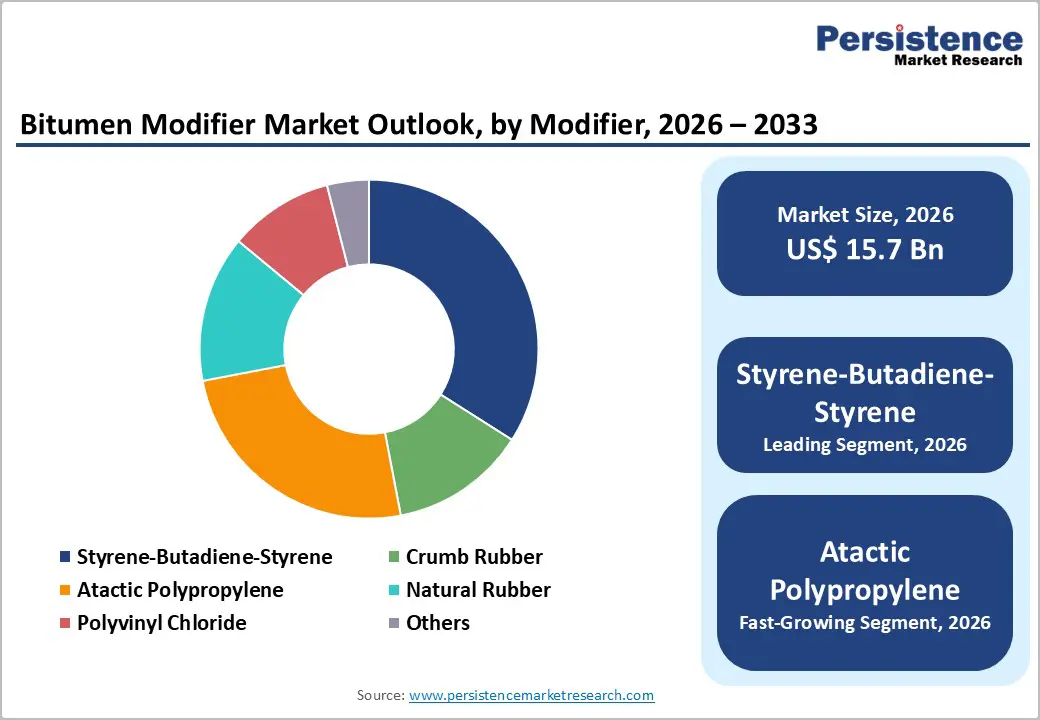
- Leading Modifier Type: Styrene-butadiene-styrene (SBS) is projected to represent the leading modifier type in 2026, accounting for 40% of the revenue share, driven by its superior elasticity and performance across diverse climatic conditions.
- Leading Application: Hot asphalt is anticipated to be the leading application, accounting for over 60% of the revenue share in 2026, supported by its extensive use in road construction and heavy-load durability.
| Key Insights | Details |
|---|---|
| Bitumen Modifier Market Size (2026E) | US$15.7 Bn |
| Market Value Forecast (2033F) | US$20.4 Bn |
| Projected Growth (CAGR 2026 to 2033) | 3.8% |
| Historical Market Growth (CAGR 2020 to 2025) | 3.5% |
Market Factors – Growth, Barriers, and Opportunity Analysis
Growth Analysis- Infrastructure Development and Road Construction Investments
Large-scale investments in transportation infrastructure are significantly increasing the demand for modified bitumen across highways, expressways, and urban road networks. Governments in emerging economies are prioritizing connectivity through national highway expansion programs, smart city initiatives, and rural road development. Modified bitumen plays a crucial role in enhancing pavement durability, reducing maintenance frequency, and improving resistance to heavy traffic loads and harsh weather conditions.
In developed regions, aging infrastructure and rehabilitation projects are supporting demand for advanced bitumen modifiers. Road authorities are increasingly focusing on performance-based specifications, encouraging the use of materials that improve fatigue resistance and minimize rutting. Public-private partnerships and long-term infrastructure funding programs are ensuring consistent project pipelines. The integration of modified asphalt in airport runways, bridges, and industrial corridors strengthens market growth.
Technological Advancements in Modifier Formulations
Continuous innovation in polymer and chemical technologies is enhancing the performance characteristics of bitumen modifiers. Advanced formulations using elastomers, plastomers, and hybrid polymers are improving elasticity, adhesion, and temperature stability, enabling better performance in both hot and cold climates. These innovations are helping to extend pavement life, reduce cracking, and improve resistance to deformation under heavy loads. The development of nanotechnology-based modifiers and specialty additives is optimizing the structural integrity of asphalt mixtures, supporting high-performance infrastructure applications across diverse environmental conditions.
Research and development efforts are focusing on improving compatibility between bitumen and modifiers to ensure uniform blending and consistent quality. Manufacturers are introducing tailor-made solutions designed for specific applications such as roofing membranes, waterproofing systems, and cold-mix asphalt. The growing adoption of warm mix asphalt technologies is also encouraging the use of advanced modifiers that reduce energy consumption and emissions during production. As sustainability becomes a key focus, innovations in bio-based and recyclable modifier materials are gaining traction, positioning technological advancement as a critical factor in market evolution.
Barrier Analysis - Technical Performance Limitations in Extreme Conditions
Despite significant advancements, bitumen modifiers can face performance challenges under extreme environmental conditions. In regions with very high temperatures, certain modifiers soften excessively, leading to rutting and deformation in road surfaces. Conversely, in extremely cold climates, reduced flexibility can result in cracking and brittleness, impacting pavement longevity. These limitations create challenges for infrastructure developers who require materials capable of maintaining consistent performance across a wide temperature range, especially in regions with fluctuating climatic conditions and heavy traffic stress.
Variations in raw material quality and improper blending processes can negatively impact the effectiveness of modified bitumen. Inconsistent formulation or inadequate quality control may lead to premature failures, increasing maintenance costs, and reducing trust among end users. The lack of standardized testing methods across regions also complicates performance evaluation. Manufacturers are under pressure to develop more robust and adaptable formulations that can withstand extreme conditions while maintaining durability and structural integrity in demanding applications.
Fragmented Standards and Conformity Assessment
The bitumen modifier market is affected by the lack of uniform standards and regulatory frameworks across different regions. Variations in specifications, testing procedures, and certification requirements create complexities for manufacturers and suppliers operating in multiple markets. This fragmentation can lead to inconsistencies in product quality and performance, making it difficult for end users to compare and select appropriate materials. The absence of harmonized standards increases compliance costs and slows down the adoption of advanced modifier technologies.
In many developing regions, limited regulatory oversight and inconsistent enforcement exacerbate these challenges. Contractors may rely on conventional materials due to uncertainty surrounding the performance of modified bitumen products. This situation restricts market growth and discourages innovation. To address these issues, industry stakeholders are increasingly advocating for standardized guidelines and improved conformity assessment mechanisms. Establishing clear and consistent regulations can enhance product reliability, promote fair competition, and accelerate the adoption of high-performance bitumen modifiers across markets.
Opportunity Analysis - Technological Convergence in Roofing and Cold-Applied Systems
The convergence of advanced material technologies in roofing and cold-applied systems is creating new growth opportunities for bitumen modifiers. Innovations in self-adhering membranes and cold-applied bituminous products are reducing the need for heat-based installation methods, improving safety and efficiency. These systems are gaining popularity in residential and commercial construction due to their ease of application and reduced labor requirements. Bitumen modifiers play a critical role in enhancing adhesion, flexibility, and weather resistance in these advanced roofing solutions.
The integration of multifunctional materials is enabling the development of roofing systems that offer waterproofing, insulation, and energy efficiency in a single solution. The growing demand for green buildings and sustainable construction practices is supporting the adoption of modified bitumen in roofing applications. Cold-applied technologies also align with environmental regulations by minimizing emissions during installation. As construction practices evolve, the increasing preference for safer, faster, and more efficient application methods is driving continued innovation and demand in this segment.
Sustainable and Recycled-Based Modifier Solutions
Sustainability is becoming a key focus area in the bitumen modifier market, driving the development of eco-friendly and recycled-based solutions. The use of materials such as crumb rubber from recycled tires and bio-based polymers is helping to reduce environmental impact while enhancing performance characteristics. These sustainable modifiers contribute to waste reduction and support circular economy initiatives, making them increasingly attractive to governments and infrastructure developers seeking environmentally responsible solutions.
Regulatory pressures to reduce carbon emissions and improve resource efficiency are encouraging the adoption of greener alternatives in road construction and roofing. Manufacturers are investing in research to develop low-emission and energy-efficient modifier technologies that meet stringent environmental standards. The growing emphasis on lifecycle assessment and sustainable procurement is accelerating this trend. As awareness of environmental issues continues to rise, sustainable bitumen modifiers are expected to play a crucial role in shaping the future of the market.
Category-wise Analysis
Product Type Insights
Styrene-butadiene-styrene (SBS) is expected to lead the Bitumen Modifier market, accounting for approximately 40% of revenue in 2026, driven by its superior elastic recovery, flexibility, and excellent performance under varying temperature conditions. SBS-modified bitumen is widely preferred in road construction as it significantly enhances resistance to rutting, fatigue cracking, and deformation caused by heavy traffic loads. For example, its extensive use in national highway development projects across countries such as India, where high traffic corridors require durable and resilient paving materials to withstand continuous vehicular stress and changing environmental conditions.
Atactic polypropylene (APP) is likely to represent the fastest-growing segment, supported by its excellent thermal stability, UV resistance, and strong suitability for roofing and waterproofing applications. APP-modified bitumen is particularly effective in high-temperature regions, where it maintains structural stability and prevents softening under prolonged heat exposure. Its increasing adoption is closely linked to the rising demand for durable and energy-efficient roofing systems in both residential and commercial construction sectors. For example, its widespread application in roofing membranes across Middle Eastern countries, where extreme heat conditions require materials that can deliver consistent performance, reflect solar radiation, and ensure long-term waterproofing and insulation efficiency in modern building structures.
Application Insights
Hot asphalt is projected to lead the market, capturing around 60% of the revenue share in 2026, supported by its extensive use in road construction and infrastructure development projects. This method involves mixing bitumen modifiers at high temperatures to produce asphalt with enhanced strength, durability, and load-bearing capacity. It is widely used for highways, expressways, and urban roads where heavy traffic volumes demand materials capable of withstanding continuous stress and environmental wear. For example, its large-scale utilization in highway expansion and rehabilitation projects in the United States, where high-performance asphalt mixtures are essential to support heavy vehicular traffic and ensure long-lasting road infrastructure.
Self-adhering is likely to be the fastest-growing application, driven by increasing demand for safer, faster, and more efficient installation methods in roofing and waterproofing systems. These solutions eliminate the need for heat or open flames, reducing safety risks and making them highly suitable for urban construction environments and labor-sensitive markets. Increasing awareness of worker safety and regulatory restrictions on torch-applied systems is accelerating demand. For example, the growing use of self-adhering roofing membranes in North America, where contractors prefer these systems to enhance installation speed, reduce labor costs, and comply with strict safety standards in building construction projects.
Regional Insights
North America Bitumen Modifier Market Trends
North America is likely to be the fastest-growing region, driven by continuous infrastructure modernization and the increasing adoption of high-performance asphalt technologies. The region, led by the United States, is witnessing rising demand for polymer-modified bitumen in highway rehabilitation, airport runways, and urban road networks. Advanced polymer blends such as SBS and EVA are being increasingly utilized to enhance durability, flexibility, and resistance to temperature fluctuations, reducing maintenance frequency and lifecycle costs.
The shift toward self-adhering and cold-applied systems reflects increasing emphasis on safety, labor efficiency, and regulatory compliance, particularly in urban construction environments. Manufacturers are also focusing on smart and high-performance roofing solutions that offer enhanced durability, moisture resistance, and long-term reliability. For example, GAF has developed advanced modified bitumen roofing systems with integrated monitoring capabilities to improve maintenance and performance tracking in large commercial structures. The integration of sustainable materials and energy-efficient roofing designs is gaining importance due to green building standards and ESG goals.
Europe Bitumen Modifier Market Trends
Europe is likely to be a significant market for bitumen modifiers in 2026, due to strong regulatory frameworks, sustainability initiatives, and continuous infrastructure modernization across major economies such as Germany, France, and the United Kingdom. The region places significant emphasis on high-performance road materials to improve durability and reduce lifecycle maintenance costs, leading to increased adoption of polymer-modified bitumen in highways, airports, and urban transport systems. Advanced technologies such as SBS, EVA, and crumb rubber are widely used to enhance elasticity and resistance to extreme weather conditions. For example, Nynas has demonstrated this trend by supplying high-performance polymer-modified binders for major infrastructure projects such as the A14 highway in the UK, supporting long-lasting and low-noise road surfaces.
Another key trend in Europe is the growing focus on circular economy practices and sustainable construction methods. The adoption of reclaimed asphalt pavement and recycled materials is increasing as governments aim to reduce carbon emissions and material waste. Road networks across Europe are extensively asphalt-based, with a strong shift toward upgrading them using modified bitumen for enhanced performance and environmental compliance. Roofing and waterproofing applications are witnessing steady growth, driven by demand for energy-efficient buildings and green construction standards.
Asia Pacific Bitumen Modifier Market Trends
The Asia Pacific region is anticipated to be the leading region, accounting for a market share of 45% in 2026, driven by rapid infrastructure expansion, urbanization, and increasing adoption of high-performance construction materials across major economies such as China, India, and Southeast Asia. Governments are heavily investing in highway networks, smart cities, and logistics corridors, which are significantly boosting the demand for polymer-modified bitumen in road construction. The region is also witnessing a shift toward advanced materials that enhance durability, reduce maintenance cycles, and withstand extreme climatic conditions such as heavy rainfall and high temperatures.
Manufacturers are investing in eco-friendly formulations such as bio-based modifiers and warm mix asphalt technologies to reduce emissions and energy consumption during production. The region is also seeing increased collaboration between local players to enhance supply capabilities and technological expertise. For example, Shell has expanded its presence in Asia Pacific by promoting advanced polymer-modified bitumen solutions and supporting large-scale infrastructure projects through sustainable product innovations. Rising demand in roofing and waterproofing applications is contributing to market diversification, driven by rapid urban construction and the need for long-lasting, weather-resistant building materials.
Competitive Landscape
The global bitumen modifier market exhibits a moderately fragmented structure, driven by the presence of numerous chemical companies and regional manufacturers competing across infrastructure and construction applications. Market participants are increasingly focusing on innovation, sustainability, and performance enhancement to differentiate their offerings. Rising demand for high-performance asphalt and roofing materials has intensified competition, with companies investing heavily in research and development to improve elasticity, durability, and environmental compliance of modifiers.
With key leaders including BASF, ExxonMobil, TotalEnergies, Evonik, and Honeywell, the competitive environment remains highly dynamic and innovation-driven. These players compete through product innovation, strategic partnerships, mergers and acquisitions, and expansion of regional manufacturing capabilities to cater to local infrastructure demands. Companies are also prioritizing the development of bio-based and recycled modifiers to align with sustainability regulations and evolving customer requirements.
Key Industry Developments:
- In December 2025, IndianOil Total Pvt Ltd (ITPL) inaugurated a greenfield bitumen derivatives plant near Chennai to produce polymer-modified, crumb rubber-modified, and natural rubber-modified bitumen, strengthening the supply of high-performance materials for road and infrastructure projects across southern India.
- In April 2025, Kraton Corporation launched its CirKular+ Paving Circularity Series to enhance sustainability in road construction by enabling higher reuse of reclaimed asphalt in surface layers while improving performance and processability.
- In February 2025, the Central Road Research Institute (CRRI), in collaboration with Ooms India, launched Rejubit, India’s first indigenously developed rejuvenating agent designed to recycle old bitumen roads, enabling the reuse of aged pavement materials while reducing reliance on new raw materials and supporting sustainable road infrastructure development.
Companies Covered in Bitumen Modifier Market
- Sika
- Carlisle Companies
- Bauder
- Icopal
- Nynas
- Kibok
- GAF
- Mackay Consolidated
- BASF
Frequently Asked Questions
The global bitumen modifier market is projected to reach US$15.7 billion in 2026.
Rising infrastructure development and increasing demand for durable, high-performance roads and roofing materials drive the bitumen modifier market.
The bitumen modifier market is expected to grow at a CAGR of 3.8% from 2026 to 2033.
Growing adoption of sustainable, recycled, and high-performance polymer-modified bitumen solutions in infrastructure and roofing applications presents key market opportunities.
Sika, Carlisle Companies, Bauder, Icopal, Nynas, Kibok, and Mackay Consolidated are the leading players.


