




- Healthcare Services
- Back Support Pillow Market
Back Support Pillow Market Size, Share, and Growth Forecast, 2026 - 2033
Back Support Pillow Market by Product Type (Basic Support Pillows, Others), Material (Memory Foam, Micro-fiber, Water-filled, Gel-filled), Indication (Chronic Spine and Back Pain, Spondylitis, Others), and Regional Analysis for 2026 – 2033

Back Support Pillow Market Size and Trends Analysis
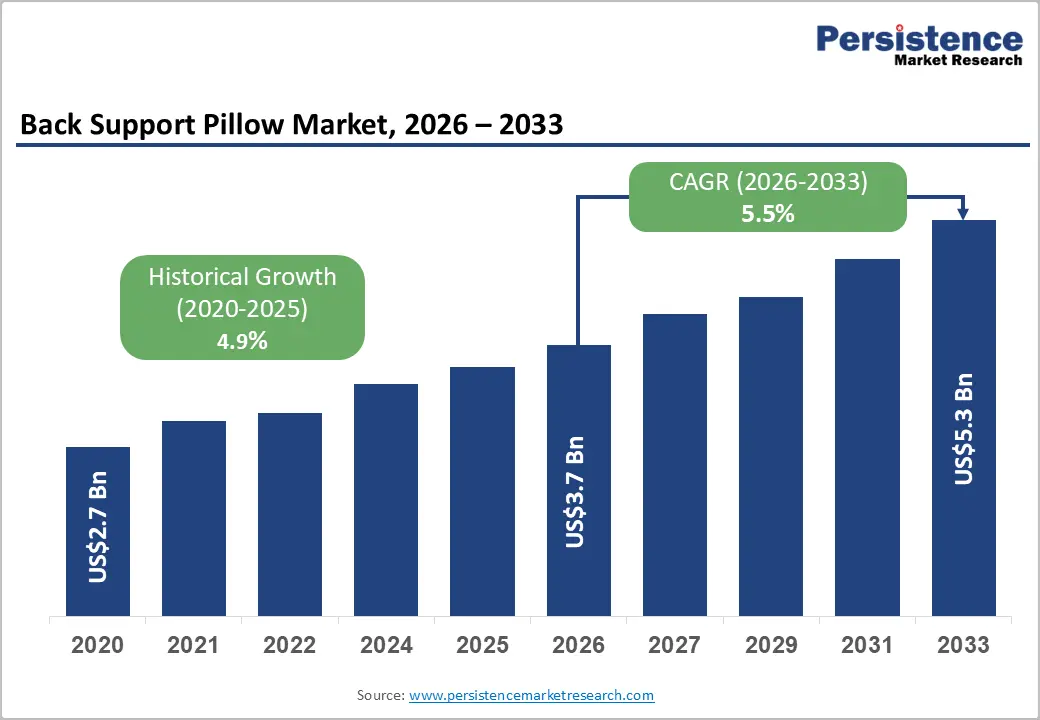
The global back support pillow market size is likely to be valued at US$3.7 billion in 2026, and is expected to reach US$5.3 billion by 2033, growing at a CAGR of 5.5% during the forecast period from 2026 to 2033, driven by the escalating global burden of spinal and musculoskeletal disorders, the lasting structural shift toward remote and hybrid work arrangements that intensify sedentary sitting time and postural stress, and growing consumer investment in ergonomic wellness and preventive spinal health management across home, office, and travel use environments.
Key Industry Highlights:
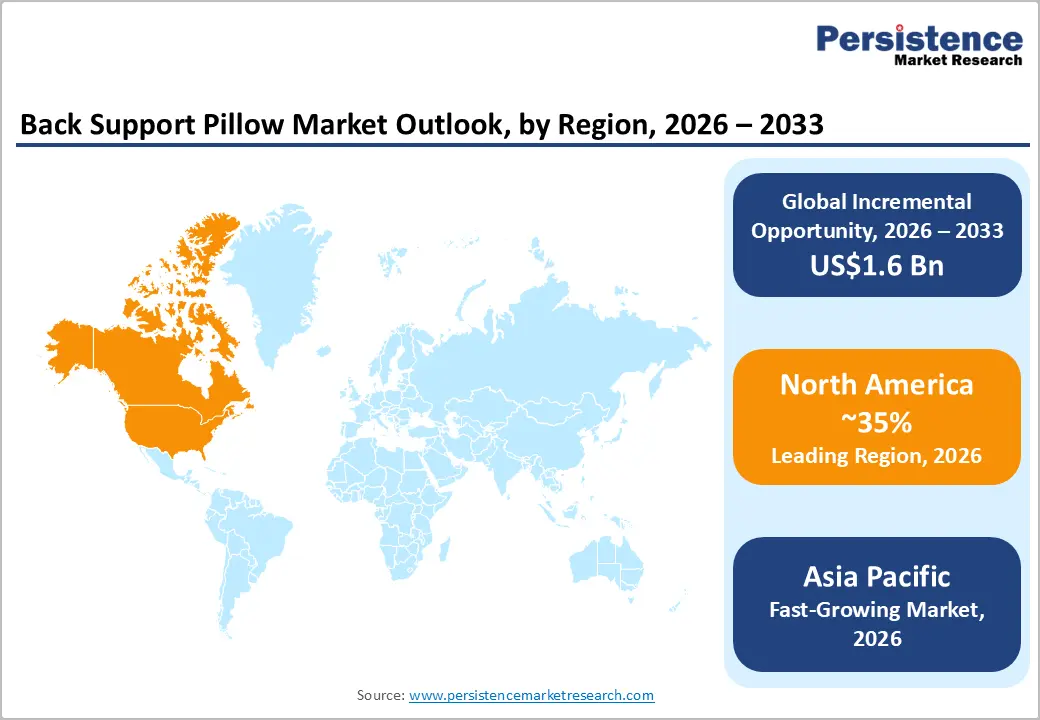
- Dominant Region: North America is expected to dominate with approximately 35% revenue share in 2026, driven by the high prevalence of chronic back pain among the working-age population, the established remote work culture accelerating ergonomic home office investment, and the strong e-commerce and direct-to-consumer product distribution infrastructure.
- Fastest-growing Region: Asia Pacific is projected to be the fastest-growing regional market, fueled by rising awareness of ergonomic health, rapidly expanding e-commerce channels, growing middle-class spending on wellness products in China, India, and Southeast Asia, and increasing back pain prevalence in urban sedentary working populations.
- Leading Product Type: Lumbar support pillows are expected to dominate with approximately 42% share in 2026, reflecting their targeted clinical and ergonomic application as the primary back support solution for office seating, vehicle use, and chronic lower back pain management across the largest global consumer and clinical user populations.
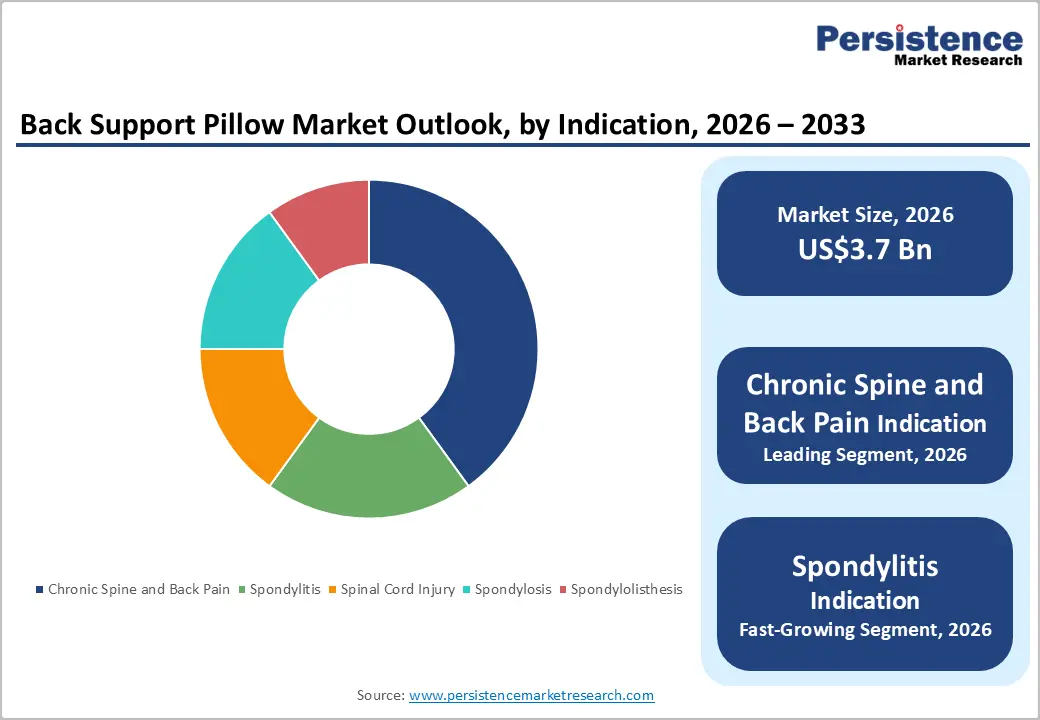
- Leading Indication: Chronic spine and back pain commands approximately 48% of market revenue in 2026, as the most prevalent and commercially significant indication driving medically motivated back support pillow purchasing across global healthcare and consumer wellness markets.
DRO Analysis
Driver - Remote Work Normalization and Ergonomic Home Office Investment
The structural transformation of work patterns accelerated by the COVID-19 pandemic establishing remote and hybrid work as permanent features of the professional working landscape across knowledge-economy sectors has created a durable and expanding consumer demand base for ergonomic home office products, including back support pillows, with tens of millions of workers globally investing in home workstation ergonomic improvements to address the musculoskeletal health consequences of extended home-based sitting in non-ergonomic consumer furniture environments.
The ergonomic wellness product category, encompassing standing desks, ergonomic chairs, monitor stands, keyboard supports, and back support pillows, has experienced sustained above-market growth driven by remote worker ergonomic investment, corporate wellness program purchasing for home office equipment provision, and the growing mainstream consumer awareness of ergonomic health as a personal wellness priority.
Restraint - Market Fragmentation and Consumer Awareness of Product Efficacy Differences
The back support pillow market's low barriers to entry have attracted an enormous number of manufacturers and brands, particularly through e-commerce platforms offering direct-to-consumer access, creating a highly fragmented competitive landscape characterized by significant product quality variation, inconsistent ergonomic design standards, and consumer difficulty differentiating clinically effective back support pillow products from commodity alternatives.
The proliferation of low-cost, poorly designed back support pillows that fail to deliver meaningful postural support or spinal pain relief creates consumer skepticism about product category efficacy, undermining willingness to pay premium prices for quality products and contributing to high product return rates that challenge brand economics for established back support pillow manufacturers. Consumer purchase decisions are often driven by price sensitivity rather than clinical evidence of postural support efficacy, creating downward price pressure on product categories that could otherwise command premium positioning based on demonstrable spinal health outcomes.
Opportunity - Healthcare Provider Partnership and Physiotherapy-Endorsed Product Channels
The development of structured physiotherapy and orthopedic specialist product endorsement and recommendation programs enabling leading back support pillow brands to secure clinical validation, physiotherapist recommendation, and hospital rehabilitation department procurement positioning represents a significant market differentiation opportunity that creates premium pricing justification and consumer trust advantages over commodity competitors. Healthcare professional recommendations remain the highest-influence purchase driver for medically motivated back support pillow buyers, creating strong commercial returns for manufacturers investing in clinical evidence generation, physiotherapy association partnerships, and healthcare provider education programs demonstrating the postural support and spinal pain relief outcomes of evidence-based product designs.
India and Southeast Asia represent particularly high-growth opportunity markets for physiotherapy-endorsed and clinical-channel back support pillow distribution, as expanding private hospital and physiotherapy clinic infrastructure creates growing institutional procurement demand alongside the large and growing consumer wellness market served through pharmacy and e-commerce channels.
Category-wise Analysis
Product Type Insights
Lumbar support pillows are expected to dominate the market by product type, commanding approximately 42% of global revenue in 2026. Their market leadership reflects the lumbar support pillow's status as the most clinically prescribed and broadly adopted back support product format, addressing the most prevalent musculoskeletal complaint, lower back pain, through targeted lumbar spinal curvature maintenance in seated and reclined positions.
Wedge pillows represent the fastest-growing product type in the back support pillow market, driven by their expanding multi-functional application across seated lumbar elevation, sleeping position support, acid reflux and GERD management, post-surgical leg and body positioning, and pregnancy support, broadening the wedge pillow's addressable consumer base well beyond traditional back pain management into the large sleep health, pregnancy wellness, and post-operative recovery markets.
Material Type Insights
Memory foam is estimated to dominate the material segment, capturing approximately 55% of the back support pillow market revenue in 2026, propelled by its visco-elastic properties that conform to body shape and lumbar curvature, providing superior pressure relief compared to conventional fills. It retains its shape over long-term use, offers temperature-responsive comfort, and supports premium positioning with higher margins for manufacturers.
Gel-filled pillows represent the fastest-growing material type, driven by growing consumer demand for back support pillows combining pressure-adaptive support with active cooling properties that address the heat retention limitation of conventional memory foam products. Gel-infused and gel-layer back support pillows use phase change gels, silica beads, or hybrid gel-foam to improve airflow, reduce heat buildup, and enhance pressure distribution, making them especially suitable for warm climates and long office use, where memory foam can feel too warm.
Indication Insights
The chronic spine and back pain segment is projected to dominate, commanding approximately 48% of global market revenue in 2026. Its dominant position reflects the enormous and growing global prevalence of chronic lower back pain as the world's leading cause of disability, affecting an estimated 619 million people globally, according to the Global Burden of Disease study and the consequent large-scale consumer and clinical demand for affordable, accessible, non-pharmacological back pain management solutions, including lumbar support pillows as first-line conservative self-management interventions.
Spondylitis represents the fastest-growing indication segment, fueled by rising diagnosis rates for ankylosing spondylitis and cervical spondylitis among working-age and younger adult populations, growing rheumatologist and physiotherapist recommendations of specialized back support pillows as conservative symptom management adjuncts, and increasing patient awareness of ergonomic spinal support's role in managing spondylitis-related postural complications and pain.
Regional Insights
North America Back Support Pillow Market Trends
North America is projected to dominate, holding approximately 35% of the total revenue in 2026, representing the largest regional market globally. The region's leadership reflects the high prevalence of chronic back pain among the U.S. and Canadian working-age population, the well-established consumer culture of ergonomic wellness investment, the large remote and hybrid working population generating ongoing ergonomic home office product demand, and the sophisticated e-commerce and direct-to-consumer retail infrastructure that supports premium back support pillow brand reach across diverse geographic and demographic consumer segments.
U.S. Back Support Pillow Market Insights
The U.S. is the largest market, driven by high chronic low back pain prevalence, widespread remote and hybrid work, and a mature e-commerce ecosystem. Leading brands such as Coop Home Goods, Xtreme Comforts, and Core Products International Inc. leverage strong D2C and Amazon strategies to meet growing demand for ergonomic support products.
Canada Back Support Pillow Market Insights
Canada’s market follows U.S. trends, supported by growing ergonomic awareness, remote work adoption, and strong demand for premium memory foam products. Physiotherapy and occupational therapy associations also recommend lumbar support as part of back pain management, reinforcing healthcare-driven demand and premium adoption.
Europe Back Support Pillow Market Trends
Europe represents the second-largest regional back support pillow market, accounting for approximately 26% of the global revenue in 2026, supported by well-established physiotherapy and occupational medicine cultures emphasizing ergonomic workplace health, national occupational safety frameworks mandating ergonomic risk assessment for office workers, and the growing consumer wellness market adopting premium ergonomic sleep and sitting support products across Western European markets.
Germany Back Support Pillow Market Trends
Germany is Europe’s leading market, driven by strong workplace ergonomics regulations (ArbStättV), a large workforce exposed to prolonged sitting, and a well-developed healthcare system where physiotherapists and orthopedic specialists commonly recommend lumbar support products for back pain management.
U.K. Back Support Pillow Market Trends
The U.K. market is growing rapidly due to widespread remote work, NHS and private physiotherapy recommendations for lumbar support in back pain management, and a strong e-commerce ecosystem that enables direct-to-consumer brands to reach health-conscious consumers efficiently.
Asia Pacific Back Support Pillow Market Trends
Asia Pacific is likely to be the fastest-growing regional market, driven by rapidly rising consumer awareness of ergonomic health across urban working populations in China, India, and Southeast Asia, the explosive growth of e-commerce channels enabling back support pillow brand reach across diverse market segments, expanding middle-class consumer spending on wellness products, and rising back pain prevalence driven by increasingly sedentary urban lifestyles.
China Back Support Pillow Market Trends
China dominates in the Asia Pacific region and is one of the fastest-growing globally, driven by a large urban white-collar workforce with rising sitting-related back pain, strong e-commerce platforms like Tmall, JD.com, and Pinduoduo enabling wide product access, and increasing consumer spending on health and wellness as incomes grow in major cities.
India Back Support Pillow Market Trends
India represents the highest-growth potential in the Asia Pacific back support pillow market, driven by the country's enormous and predominantly young urban working population experiencing escalating rates of chronic back pain from sedentary office work and extended screen time, the rapid expansion of India's e-commerce infrastructure through Flipkart, Amazon India, and Meesho, enabling nationwide product distribution, and the growing domestic wellness brand ecosystem.
Competitive Landscape
The global back support pillow market is characterized by a highly fragmented competitive landscape spanning established ergonomic and wellness product brands with multi-channel distribution capabilities, direct-to-consumer e-commerce specialists with strong digital marketing and Amazon platform expertise, clinical orthopedic product manufacturers serving physiotherapy and medical supply channels, and a large ecosystem of regional and domestic brands, particularly in India and China, addressing local market price sensitivity and consumer preference requirements.
Coop Home Goods and Xtreme Comforts are among the leading U.S. direct-to-consumer memory foam pillow brands, supported by a strong presence on Amazon and market positioning, driven by high consumer review ratings within the premium back support and sleep wellness segments. Meanwhile, Core Products International Inc. leverages its clinical orthopedic manufacturing expertise to strengthen its position in the back support pillow market through a therapeutic product portfolio recommended across both consumer and healthcare professional channels.
Key Industry Developments:
- In October 2025, Derila launched its Ergo Pillow as an ergonomic memory foam solution designed to support spinal alignment, reduce discomfort, and promote uninterrupted sleep. The company highlighted the product’s purpose, design, and scientific rationale, positioning it within the growing sleep wellness trend.
Companies Covered in Back Support Pillow Market
- Coop Home Goods
- Xtreme Comforts
- Alex Orthopedic Inc.
- My Pillow Inc.
- C cushion Labs
- The white willow
- Sleepsia
- Core Products International Inc.
- Samsonite
- SBS Biotech
- Qutool
- JSB Wellness
- Wakefit Innovations
- My Frido
Frequently Asked Questions
The global back support pillow market is projected to reach US$3.7 billion in 2026.
The COVID-19 pandemic permanently established remote and hybrid work, driving sustained global demand for ergonomic home office products like back support pillows as millions of workers upgraded home setups to reduce sitting-related musculoskeletal strain.
The back support pillow market is poised to witness a CAGR of 5.5% from 2026 to 2033.
Structured physiotherapy and orthopedic endorsements provide key market differentiation for back support pillow brands, driving clinical validation, higher consumer trust, premium pricing, and strong sales by making healthcare professional recommendations the most influential purchase factor.
Key players include Coop Home Goods, Xtreme Comforts, Alex Orthopedic Inc., My Pillow Inc., C Cushion Labs, The White Willow, and Sleepsia.


