




- Hardware & Software IT Services
- Awards Management Software Market
Awards Management Software Market Size, Trends, Share, and Growth Forecast 2026 - 2033
Awards Management Software Market by Components (Solution, Services, Implementation & Integration, Consulting & Training, and Support & Maintenance), Function (Entry Management, Judging Management, Reporting & Analytics, Application Tracking, and Others), Platform (Web, Mobile, IOS, Android, and Windows), End-user, and Regional Analysis 2026 - 2033

Awards Management Software Market Size and Share Analysis
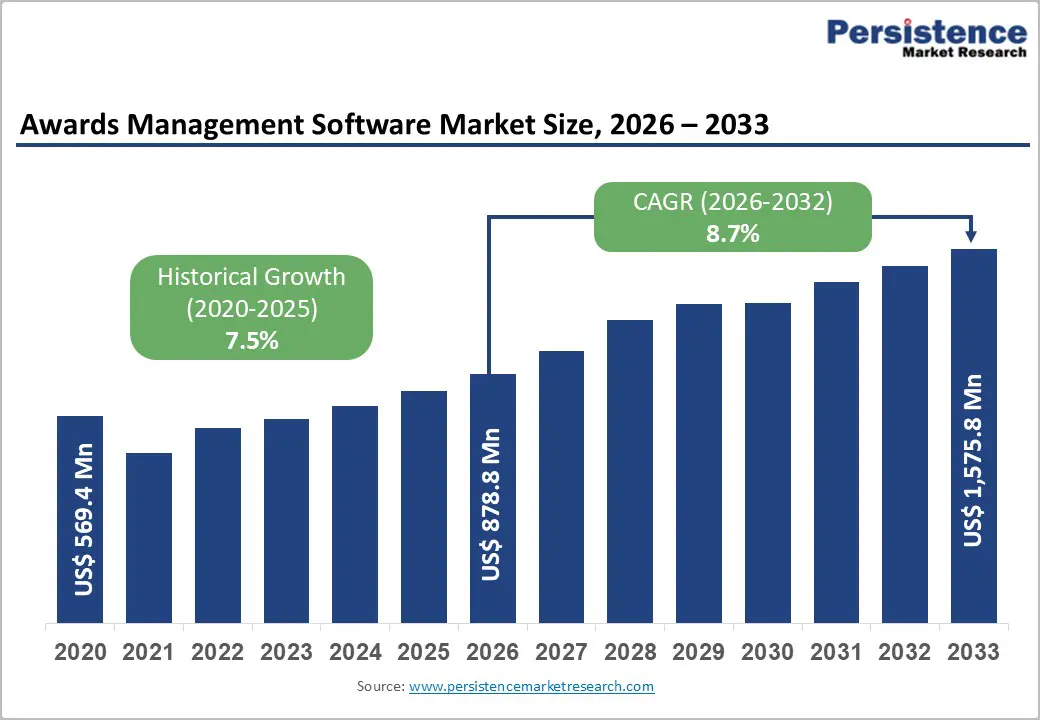
The global awards management software market size is likely to be valued at US$ 878.8 million in 2026 and is projected to reach US$ 1,575.8 million by 2033, growing at a CAGR of 8.7% between 2026 and 2033.
The market is experiencing substantial expansion driven by accelerating digital transformation initiatives across government agencies, educational institutions, and corporate organizations, combined with increasing demand for automation, transparency, and compliance-driven award and grant management solutions.
Key Industry Highlights:
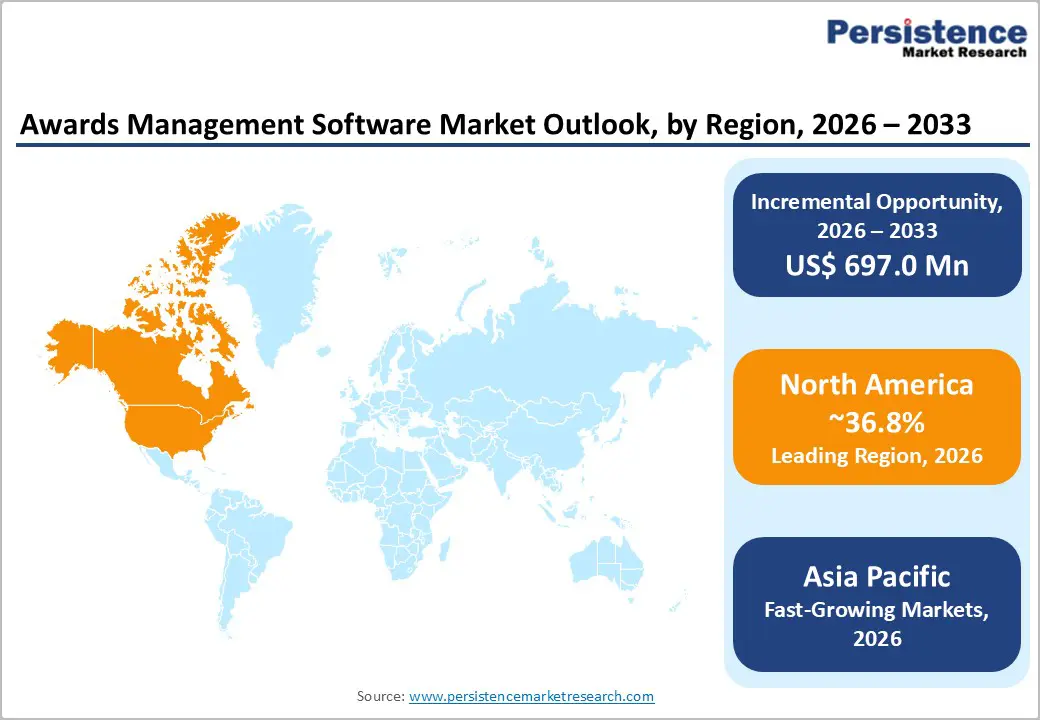
- Leading Region: North America maintains a dominant regional position, commanding 36.8% global market share through mature enterprise adoption, an established SaaS ecosystem, and the presence of leading software vendors.
- Fastest Growing Region: Asia Pacific demonstrates the fastest regional growth trajectory, expanding at 12.1% CAGR through 2033, driven by rapid digital transformation across government agencies, educational institutions, and corporate organizations in India, China, and Southeast Asia.
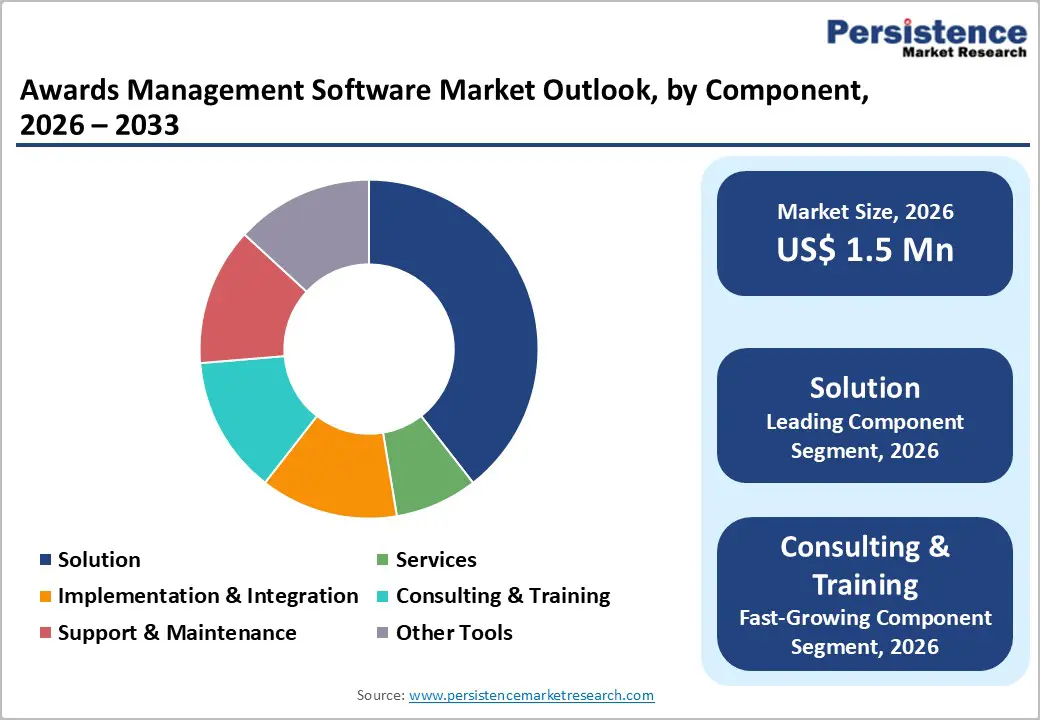
- Dominant Components: Solutions segment dominates product category, capturing 63% market share through comprehensive end-to-end award program lifecycle management capabilities, including entry management, judging workflows, reporting analytics, and compliance tracking.
- Dominant Function: Entry management within the function is among the fastest-growing segments, as rising application volumes and complex eligibility criteria push organizations to replace email and spreadsheet-based intake with automated, user-friendly online submission workflows.
- Key Market Opportunity: Integration of AI-enabled automation, analytics, and equity-focused features into awards workflows offers a major growth opportunity, enabling vendors to reduce administrative burden, improve fairness and transparency, and deliver richer impact insights to funders and program owners.
| Key Insights | Details |
|---|---|
| Awards Management Software Market Size (2026E) | US$ 878.8 Mn |
| Market Value Forecast (2033F) | US$ 1,575.8 Mn |
| Projected Growth CAGR (2026 - 2033) | 8.7% |
| Historical Market Growth (2020 - 2025) | 7.5% |
Market Dynamics
Drivers - Accelerating Digital Transformation Across Government and Public Sector Organizations
Government agencies, philanthropic organizations, and public institutions are undergoing comprehensive digital transformation initiatives, driving substantial adoption of awards management software to replace manual, paper-centric processes with automated, cloud-based solutions. According to industry research, approximately 60% of government organizations have implemented or are planning to implement integrated digital management systems, with grant and award management as a priority functional area for modernization initiatives. The U.S. Department of Transportation's SMART Grants Program announced $54 million in grant awards across 21 states in December 2024, with substantial administrative burden reduction achieved through digital submission and evaluation platforms.
Government agencies are mandating cloud-based solutions that support real-time reporting, audit trail management, and regulatory compliance documentation, creating a compelling business case for investing in awards management software. Organizations report that digital award management platforms reduce administrative processing time by 40-50%, enable remote collaboration across distributed teams, and provide real-time financial tracking supporting effective fund allocation and accountability requirements essential for public sector operations.
Expansion of Educational Scholarship Programs and Industry Award Recognition Initiatives
Educational institutions globally are expanding scholarship programs and merit-based recognition initiatives, driving significant demand for scalable award management software that enables efficient application processing, reviewer coordination, and award disbursement workflows. According to research, 87% of universities use dedicated scholarship management solutions to manage application workflows, with platform adoption accelerating, particularly among mid-size institutions seeking to expand scholarship offerings without proportional increases in administrative staffing.
Leading institutions, including major research universities, have implemented Blackbaud Award Management, Submittable, and OpenWater platforms to manage expanding scholarship portfolios, resulting in 20-30% increases in application submissions and improved diversity outcomes through enhanced applicant experience and accessibility features. Corporate organizations are simultaneously launching internal recognition programs, employee awards, and achievement recognition initiatives, driving 27% growth in corporate award platforms as companies recognize links between employee recognition and retention, engagement, and organizational culture development.
Restraints - High Implementation Complexity and Integration Challenges with Legacy Systems
Organizations face substantial implementation challenges during awards management software deployment, particularly when integrating with existing ERP, accounting, HR, and CRM systems prevalent in large enterprises and government agencies. Implementation timelines frequently extend by 6-12 months, requiring substantial consulting services, custom development, and comprehensive data migration activities, significantly inflating total project costs beyond software license fees.
Mid-market organizations struggle most with integration complexity, as legacy systems often lack modern API capabilities that enable seamless data synchronization, forcing them to choose between expensive custom development and accepting operational inefficiencies from disconnected systems. Small organizations typically lack dedicated IT staff and budget to manage complex implementation projects, creating significant adoption barriers that prevent smaller award organizations from accessing enterprise-grade platform functionality despite proven productivity benefits.
Opportunity - AI-Driven Revenue Intelligence and Predictive Sales Acceleration
The global awards management software market has a significant growth opportunity driven by the rapid digital transformation of employee recognition and incentive programs across enterprises. Organizations are increasingly shifting from manual, fragmented reward systems to centralized, cloud-based platforms that can manage nominations, approvals, reward catalogs, compliance, and analytics in a single ecosystem. This transition is strongly supported by the rise of hybrid and remote work models, which have made traditional, in-person recognition practices less effective. Award management software enables real-time, peer-to-peer recognition and standardized reward processes across geographically dispersed teams, improving employee engagement and morale.
Companies are under growing pressure to align recognition programs with measurable performance outcomes and organizational values. Advanced award management platforms address this need by integrating with HRMS, payroll, and performance management systems, enabling organizations to track participation rates, assess reward effectiveness, and measure return on investment through data-driven insights. The increasing focus on employer branding and talent retention further strengthens this opportunity, as well-structured recognition programs have been shown to reduce attrition and improve productivity. Small and mid-sized enterprises, in particular, represent an untapped segment, as SaaS-based pricing models lower adoption barriers and eliminate the need for heavy IT infrastructure. As a result, award management software vendors that offer scalable, analytics-driven, and customizable solutions are well-positioned to benefit from enterprise-wide digital recognition initiatives globally.
Integration of Artificial Intelligence and Automated Judging Capabilities for Enhanced Decision-Making
Artificial intelligence-powered award management platforms represent the fastest-growing opportunity segment, with 51% of companies prioritizing automation to reduce operational costs and 78% of executives identifying AI scaling as the top business priority. Leading platforms, including Submittable, OpenWater, and Judgify, are embedding machine learning algorithms enabling automated eligibility verification, intelligent reviewer assignment optimization, and predictive analytics identifying high-probability award recipients.
These capabilities reduce administrative overhead, minimize human error, and enable objective evaluation frameworks supporting fairer, more transparent award allocation decisions. Organizations implementing AI-enhanced award management platforms report a 35-40% reduction in administrative processing time and a 25% improvement in review quality, achieved by eliminating manual data entry errors and standardizing evaluation frameworks, creating substantial opportunities for vendors developing next-generation AI-driven award management solutions.
Category-wise Analysis
Component Insights
The Solution segment is expected to hold the dominant share, accounting for an estimated around 60% of the overall market. Across adjacent grant and awards software markets, end-users consistently prioritize feature-rich core platforms capable of handling end-to-end workflows, while selectively adding services such as implementation & integration, consulting & training, and support & maintenance. For example, industry data on grant management solutions indicate that software platforms account for well over half of the segment's revenues, driven by demand for automation, workflow configuration, and analytics capabilities among large enterprises and institutions.
Organizations managing complex, multi-cycle programs require centralized, web-based solutions that streamline applications, scoring, and reporting; services spend then follow as an add-on to tailor and optimize these deployments. This structural preference makes solutions the clear leader within the component mix.
Function Insights
Entry management emerges as the leading segment, likely capturing a market share close to 35% of function-specific revenues. Every awards, scholarship, or grant program begins with application intake, and the volume and diversity of entries have increased significantly across sectors. Platforms must support customizable forms, multi-language interfaces, file uploads, conditional logic, and accessibility standards to accommodate diverse applicant pools.
Industry solutions reports indicate that organizations view efficient entry capture and validation as the most immediate pain point, ahead of downstream analytics or reporting, because manual intake via email and spreadsheets quickly becomes unmanageable at scale. As a result, investments first concentrate on robust entry management modules that reduce administrative burden, minimize incomplete submissions, and improve applicant experience, ensuring this segment maintains a leading share within functional categories.
Platform Insights
Web-based deployment remains the dominant mode, estimated at roughly 70% share of total platform usage in many related SaaS markets. Web applications accessed through standard browsers align with organizational IT strategies focused on centralized access, single sign-on, and ease of maintenance. Large funding agencies, universities, and corporates often mandate browser-based portals that work across devices without requiring local installations, simplifying support and rollout to external applicants and volunteer judges.
While Mobile, iOS, Android, and Windows clients are increasingly important for on-the-go reviewing and notifications, heavy-duty configuration, report building, and administrative tasks still occur in web interfaces. This mirrors patterns in adjacent grant management software markets, where web-centric solutions remain the default choice for enterprise and public sector users, supporting the leading position of web platforms in awards management.
End-user Insights
By end-user, educational institutes and broader educational & research organizations stand out as one of the most prominent adopter groups, with educational institutions often representing more than 20% of demand in comparable grant and funding software categories. Universities, colleges, and research institutes administer numerous scholarships, fellowships, internal research grants, student awards, and alumni recognition programs each year. As funding sources diversify, from government agencies and philanthropic foundations to corporate sponsors, manual tracking of applications, eligibility, and reporting has become untenable.
Market evidence from grant management platforms shows that education-oriented customers adopt specialized software to manage high-volume, cyclical programs with strict compliance and documentation requirements. Given these dynamics, Educational Institutes are a key leading end-user segment in awards management software, closely followed by governments, corporations, and philanthropic organizations that run extensive recognition and grant initiatives.
Regional Insights
North America Awards Management Software Market Trends
North America maintains a dominant regional position with 36.8% global share, supported by large enterprise adoption, a mature SaaS ecosystem, and the presence of major awards management software vendors, including Submittable, OpenWater, and Award Force. The United States market dominates North America, driven by government digital transformation initiatives, including the U.S. Department of Transportation SMART Grants Program, which awards US$54 million annually; expanding university scholarship programs; and corporate investment in employee recognition initiatives that support organizational culture and retention objectives.
North American organizations are prioritizing advanced features, including AI-powered automation, real-time reporting dashboards, and compliance automation supporting GDPR, FERPA, and other regulatory requirements. Government agencies and educational institutions are leading the adoption of next-generation platforms featuring machine learning algorithms for intelligent reviewer assignment and predictive analytics identifying high-probability award recipients, with organizations reporting 25-30% improvement in award allocation efficiency and 40-50% reduction in administrative processing time through digital transformation initiatives.
Europe Awards Management Software Market Trends
Europe demonstrates robust growth with an 8.1% CAGR through 2033, driven by GDPR compliance requirements compelling organizations to adopt data privacy-preserving award management solutions, accelerating digital transformation across government sectors, and expanding education funding initiatives that support scholarship programs. Germany and the United Kingdom lead European adoption, with government digital transformation priorities establishing supportive policy frameworks encouraging cloud-based public sector software adoption.
France, Spain, and the Nordic countries are increasingly implementing award management software, with an emphasis on privacy-by-design principles, transparent evaluation processes, and accessibility requirements to support inclusive award program administration. European regulations, including GDPR, AI Act provisions, and digital accessibility directives, create distinct platform requirements that support the growth of vendors developing specialized European configurations, ensure regulatory compliance, and enable multilingual, multi-currency award program administration across diverse European markets and organizations.
Asia Pacific Awards Management Software Trends
Asia Pacific exhibits the fastest regional growth with 12.1% CAGR through 2033, driven by rapid digital transformation across government agencies, expanding educational scholarship programs, and emerging corporate recognition initiatives in rapidly developing economies. India leads regional adoption with a 92% AI adoption rate, government investment in digital infrastructure supporting cloud-based public sector services, and expanding scholarship programs within the rapidly growing higher education sector.
China demonstrates substantial market opportunity, with government digital government construction initiatives, expanding university scholarship programs, and corporate recognition platform adoption accelerating among multinational corporations establishing operations in the Chinese market. Japan and South Korea emphasize sophisticated award management capabilities supporting complex corporate recognition programs, with cultural emphasis on merit-based recognition and competitive achievement recognition driving awards management software adoption, supporting organizational culture development and employee engagement initiatives within competitive Asian markets.
Competitive Landscape
The awards management software market exhibits moderate fragmentation, with leading vendors including Submittable Holdings Inc., Blackbaud Inc., OpenWater Inc., and Award Force collectively controlling approximately 40-45% of global market share, indicating substantial competitive opportunity for specialized vendors and emerging platforms. The market structure increasingly favors vendors offering AI-native architectures, with differentiation focused on AI-powered automation, industry-specific vertical solutions, and integration depth with complementary business applications, including CRM, ERP, and financial management systems.
Market consolidation trends reflect growing vendor emphasis on strategic partnerships, integration capabilities, and API-first architectures enabling seamless connection to complementary business applications, with acquisition activity including Euna Solutions' March 2026 acquisition of AmpliFund representing strategic efforts to strengthen competitive positioning through capability expansion.
Key Market Developments:
- In June 2025, Submittable Launches AI-Powered Automated Scoring for Grant Applications Submittable Holdings Inc. released artificial intelligence-powered automated scoring capabilities enabling organizations to rapidly process high-volume grant applications through machine learning algorithms analyzing submission quality, applicant eligibility, and alignment with funding criteria, dramatically reducing administrative burden while improving decision consistency.
- In March 2025, Euna Solutions acquired AmpliFund to strengthen its grant management portfolio. Euna Solutions, a U.S.-based provider of cloud solutions for the public sector, acquired AmpliFund, a specialized grant management platform, combining AmpliFund's grant lifecycle tools with Euna's public sector SaaS capabilities to deliver comprehensive end-to-end grant administration solutions supporting government organizations modernizing award management workflows.
- In September 2024, OpenWater Expands Platform Capabilities with Enhanced Mobile Application Features. OpenWater Inc. enhanced its awards management platform with comprehensive mobile application functionality, enabling applicants and reviewers to submit applications, provide feedback, and review submissions from smartphones and tablets, supporting remote collaboration requirements and improving accessibility for distributed users worldwide.
Companies Covered in Awards Management Software Market
- AcclaimWorks Ltd.
- ALPHA
- Award Force (Creative Force Ltd)
- AwardStage
- Blackbaud, Inc.
- Currinda Pty. Ltd.
- Evalato
- IMPEXIUM
- Judgify Ltd.
- Omnipress
- Openwater.in
- reviewr
- RhythmQ Inc
- Submit.com
- Submittable
Frequently Asked Questions
The global Awards Management Software market was valued at US$ 569.4 million in 2020, reached US$ 878.8 million in 2026, and is projected to attain US$ 1,575.8 million by 2033, reflecting a historical CAGR of 7.5% and a forecast CAGR of 8.7% between 2026 and 2033.
Demand is driven by rapid digitalization of grants, scholarships, and recognition programs; rising application volumes; the need for transparency and compliance; and growing emphasis on data‑driven decision‑making and equitable evaluation.
Entry Management is the leading functional segment, as organizations prioritize robust, user‑friendly online intake to handle large volumes of applications, enforce eligibility rules, and reduce manual effort.
North America is the leading region, supported by high levels of public and philanthropic funding, advanced cloud adoption, stringent regulatory and audit requirements, and a dense ecosystem of universities, non-profits, and corporations running complex awards, grant, and recognition programs.
A major opportunity lies in integrating AI‑enabled automation and analytics to streamline eligibility checks, triage and scoring support, and bias monitoring, while also unifying grants, scholarships, CSR, and social impact initiatives on a single platform, enabling richer impact reporting and more strategic program design.
Key players include AcclaimWorks Ltd., ALPHA, Award Force (Creative Force Ltd), AwardStage, Blackbaud, Inc., Currinda Pty. Ltd., Evalato, IMPEXIUM, Judgify Ltd., Omnipress, Openwater.in, reviewr, RhythmQ Inc, Submit.com, and Submittable, along with several regional and niche competitors globally.


