




- Technology
- AI-powered Emotion Analytics Platform Market
AI-powered Emotion Analytics Platform Market Size, Share, and Growth Forecast 2026 - 2033
AI-powered Emotion Analytics Platform Market by Deployment (Cloud, On-premise), Technology (Facial Recognition, Speech and Voice Analysis), End-user (Healthcare, Automotive and Transportation), and Regional Analysis, 2026 - 2033

AI-powered Emotion Analytics Platform Market Size and Trends Analysis
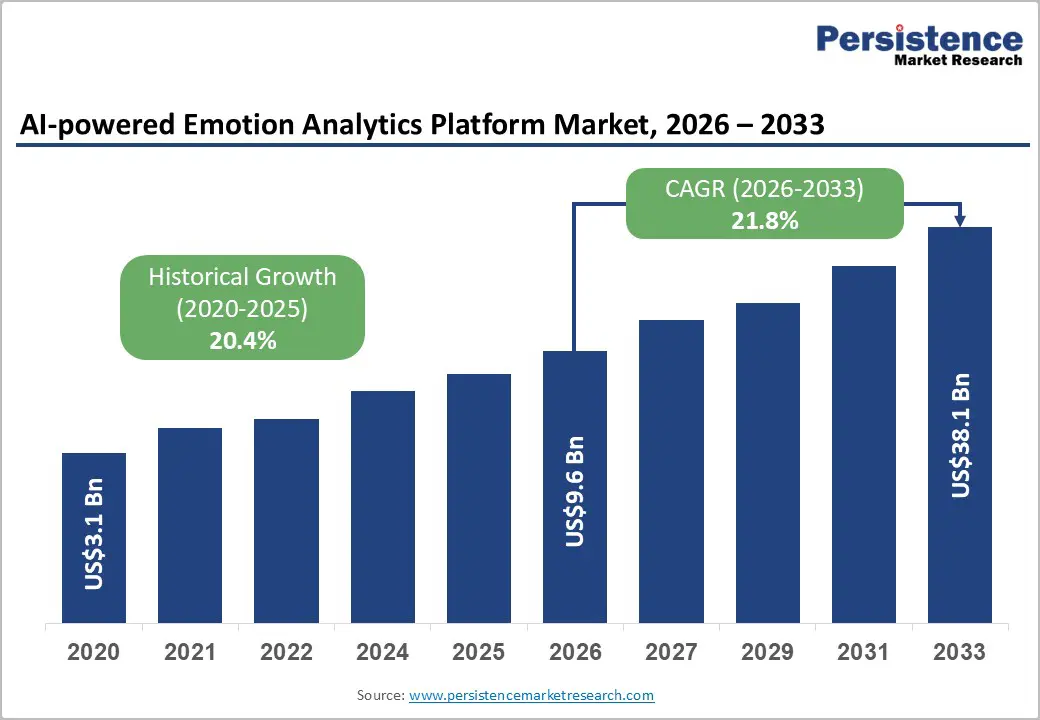
The global AI-powered emotion analytics platform market size is likely to be valued at US$9.6 billion in 2026 and is predicted to reach US$38.1 billion by 2033, growing at a CAGR of 21.8% during the forecast period from 2026 to 2033, driven by the rising use of AI in customer experience management and digital marketing.
Companies are now using emotion analytics to understand real-time user behavior across video, voice, and text interactions.
Key Industry Highlights:
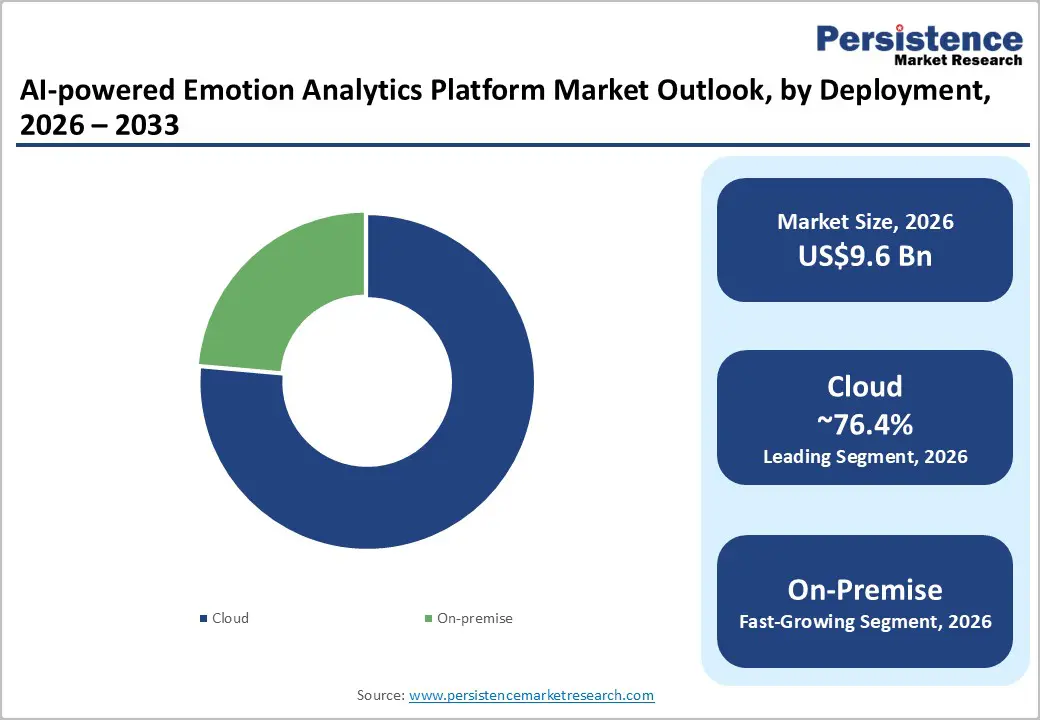
- Leading Deployment: Cloud, approximately 76.4% share in 2026, as it enables real-time emotion analysis with low infrastructure costs.
- Dominant Technology: Facial recognition, nearly 45.7% in 2026, because it allows fast and non-intrusive emotion detection through real-time analysis of facial expressions.
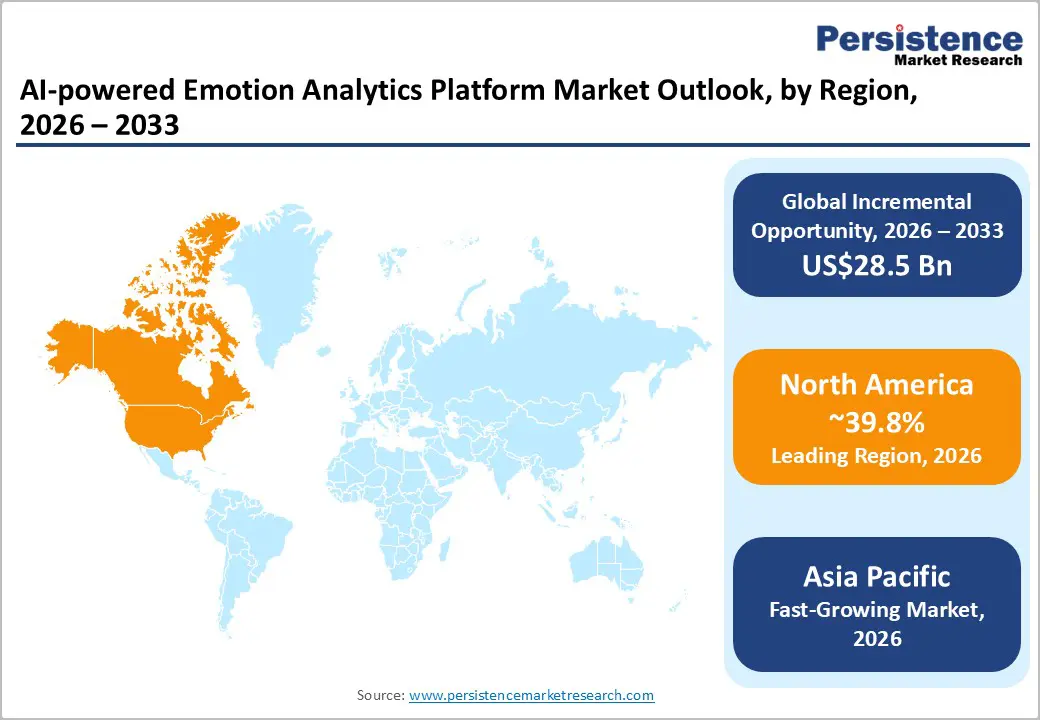
- Leading Region: North America, with about 39.8% share in 2026, owing to early adoption of AI technologies and active research support from several institutions.
- Fast-growing Region: Asia Pacific, backed by large-scale digital user data and booming call center industry.
- New Model: In May 2025, Hume AI introduced EVI 3, its third-generation speech-language model that integrates transcription, language reasoning, and speech synthesis into a single pipeline, bringing greater expressiveness and emotional understanding to voice AI.
DRO Analysis
Driver - Demand for Smart Engagement in Customer Experience and Marketing
Contact centers are shifting from post-call surveys to live emotional intelligence. Tools such as Balto and Cresta now transcribe calls in real time, flag emotional shifts, and feed agents on-screen prompts to adjust their tone, empathy, and resolution approach. This reduces escalations before they happen, not after. In e-commerce, emotion AI is replacing unreliable focus groups for ad testing.
Brands can now capture objective consumer reactions such as frustration, excitement, and confusion as they watch an ad, giving marketing teams far more honest data than self-reported responses. According to MIT Media Lab, multimodal approaches that combine voice tone, facial expressions, and text together reduce emotion misclassification by up to 30%. This is a clear advantage when every customer interaction carries retention risk.
Demand for Early Detection in Healthcare and Teletherapy
Emotion AI is filling a long-standing gap in mental health screening. A January 2025 study published in the Annals of Family Medicine evaluated Kintsugi Voice, a machine learning tool that analyzes voice biomarkers from as little as 25 seconds of free-form speech to detect signals consistent with moderate-to-severe depression, across nearly 15,000 adults in the U.S. and Canada.
This is particularly significant as the same study found that only 4% of primary care patients are currently screened for depression, despite universal screening recommendations. Companies such as Ellipsis Health have already begun implementing these capabilities in clinical settings, using vocal biomarkers extracted from patient conversations to identify potential mental health risks. In teletherapy environments, where clinicians have limited access to in-person behavioral cues, continuous analysis of voice and facial expressions can provide real-time insights into patients’ emotional states between sessions, supporting more proactive and personalized care.
Restraint - Biometric Data Collection and Security Exposure
Emotion analytics platforms depend on storing some of the most sensitive personal data that exists such as voiceprints, facial geometry, and behavioral patterns. This creates substantial legal and security exposure. Under the EU's General Data Protection Regulation (GDPR), emotion AI systems that analyze voice tone or physiological signals to infer emotional states can inadvertently reveal a person's mental health status, political opinions, or religious beliefs- all classified as special category data requiring explicit consent.
In the U.S., the risk is equally structural. In December 2024, the Department of Justice issued a final rule restricting transactions involving Americans' bulk sensitive personal data, explicitly including voiceprints, facial images, and behavioral data such as gait and keyboard usage patterns, citing national security and blackmail risks. A 2025 study found that only 12% of emotion recognition deployments could demonstrate fully compliant consent mechanisms, indicating that most platforms are operationally exposed, not just theoretically.
Opportunity - Moving Beyond Single-Signal Analysis to Multimodal Fusion
Platforms that rely on just one input, i.e., a facial expression or a text sentiment score, miss the complexity of human emotion. The next frontier is fusing multiple signal types simultaneously. A 2025 study published in Frontiers in Psychiatry demonstrated that combining EEG and ECG signals using a composite neural network model achieved 95.95% accuracy on the 'valence' dimension of emotion, far exceeding single-modality approaches.
In healthcare applications, speech emotion recognition systems now analyze voice pitch, intensity, and speech rhythm together to detect stress and mental health conditions, enabling early intervention and personalized treatment plans. For enterprise use, this is where real differentiation lies. Catching a customer who verbally says "that's fine" while their voice stress indicates otherwise may create a discrepancy that no single-channel model would flag.
Emergence of Emotion-Aware Enterprise Assistants and Chatbots
Enterprise virtual assistants are evolving from task-executors into emotionally responsive systems. Salesforce's Einstein Service Agent now detects language and sentiment in real time. For example, a life insurance company can configure it to escalate to a human agent the moment it detects sentiment tied to "loss" or "death," ensuring emotionally sensitive situations are handled appropriately. This represents a shift from scripted chatbot logic to context-aware emotional judgment.
Salesforce's Agentforce handled over one million support requests on Salesforce's own help site, demonstrating that emotionally aware AI agents can operate at enterprise scale. As these systems get trained on rich emotional signals beyond keyword detection, including vocal inflection and behavioral cues, they stand to meaningfully reduce user frustration and churn. These make emotion-awareness a measurable business outcome rather than a feature addition.
Category-wise Analysis
Deployment Insights
Cloud is predicted to lead with a share of approximately 76.4% in 2026, as cloud platforms allow companies to process video, audio, and text data instantly. This is important in use cases such as contact centers and digital advertising. For instance, Amazon Web Services provides emotion and sentiment analysis through its AI stack, which is widely used in customer service analytics. A 2024 whitepaper by National Institute of Standards and Technology highlights that cloud-based AI systems enable faster model updates and better scalability compared to local systems.
Another reason is cost flexibility. Companies avoid upfront hardware investments and pay only for usage. This has encouraged start-ups and mid-sized firms to adopt emotion AI tools faster than traditional deployments.
On-premise is estimated to be the fastest-growing segment over the forecast period, as it ensures strict data control and compliance. Various industries deal with sensitive data such as facial images, voice recordings, and behavioral signals. Healthcare, banking, and government sectors often cannot send this data to external servers. For instance, the European Commission has emphasized data sovereignty and strict AI governance under its AI regulations. This has pushed enterprises to keep emotion analytics systems in their own infrastructure. In defense and law enforcement, on-premise systems are preferred to avoid cybersecurity risks.
Technology Insights
Facial recognition is anticipated to dominate with a share of nearly 45.7% in 2026, as it delivers fast and non-intrusive emotion detection. Facial expressions are one of the most direct indicators of human emotions. AI models can analyze micro-expressions in milliseconds without requiring user input. This makes it suitable for advertising, retail, and automotive use. For example, Affectiva has analyzed over 10 million faces globally to train its emotion AI models, according to its official reports. In automotive, companies use in-cabin cameras to detect driver fatigue and distraction through facial cues.
The multimodal emotion recognition segment is expected to remain in the second position in 2026, as single-source data is often unreliable. Relying only on facial expressions or voice can lead to incorrect results. For instance, a person may smile but feel stressed, or speak calmly while being frustrated. Multimodal systems solve this by combining facial, voice, text, and physiological data. A 2024 study published on arXiv shows that combining audio and visual signals improves emotion detection accuracy significantly compared to single-mode models. Companies are already moving in this direction. Uniphore uses voice tone, speech patterns, and conversation context together in contact center analytics.
Regional Insights
North America AI-powered Emotion Analytics Platform Market Trends
North America is predicted to dominate in 2026 with a share of approximately 39.8%, owing to the early adoption and a well-established AI infrastructure. The region has a high concentration of AI companies and research institutions. Firms such as Microsoft and Amazon Web Services have already integrated emotion and sentiment analysis into enterprise tools. The National Institute of Standards and Technology has also funded evaluation programs for face and emotion recognition systems, which has improved reliability. Sectors such as advertising, gaming, and contact centers in the region actively use emotion analytics, giving it a clear lead.
U.S. AI-powered Emotion Analytics Platform Market Trends
A share of nearly 58.3% is expected to be held by the U.S. in 2026, due to high enterprise usage and continuous research & development. Large enterprises in the U.S. are using emotion AI in customer experience platforms and workforce analytics. For example, Uniphore has expanded its AI-based conversation analytics across U.S. contact centers. The National Science Foundation continues to fund AI research projects, including human-centered AI systems. The country also sees strong start-up activity, especially in mental health tech and automotive AI, which supports steady innovation.
Asia Pacific AI-powered Emotion Analytics Platform Market Trends
Asia Pacific is anticipated to be the fastest-growing region in 2026 with a share of nearly 30.6%, owing to rising digital platforms and large user bases. Countries in the region are generating massive volumes of video and voice data through social media, e-commerce, and mobile apps. This creates high demand for emotion analytics. Governments are further supporting AI adoption. For instance, India and China have national AI strategies that promote AI deployment across sectors. The ongoing expansion of call centers and digital banking in the region is another key driver.
China AI-powered Emotion Analytics Platform Market Trends
China will likely lead Asia Pacific in 2026 with a share of around 34.3%, spurred by strong government support and surveillance applications. The country’s government has heavily invested in AI under its national AI development plan. Emotion recognition is being explored in public safety and smart city projects. Companies such as Baidu are developing AI systems that include facial and voice-based emotion detection. Research papers from local universities, published in IEEE journals, show continuous improvements in facial emotion recognition accuracy, especially in large-scale datasets.
South Korea AI-powered Emotion Analytics Platform Market Trends
In 2026, South Korea is projected to account for a share of approximately 22.7%, due to advanced electronics and AI integration. The country is focusing on AI-supported consumer electronics and robotics. Samsung Electronics is actively investing in AI research, including human-machine interaction. The government’s AI strategy aims to make South Korea a global AI leader by supporting AI chips, data infrastructure, and smart services. Emotion AI is expected to surge in areas such as gaming, education tech, and healthcare monitoring.
Europe AI-powered Emotion Analytics Platform Market Trends
Europe will likely see decent growth over the forecast period with a share of nearly 16.1% in 2026, fostered by strict regulations and ethical AI focus. The region is adopting emotion analytics at a controlled pace because of data protection laws. The European Commission has introduced AI regulations that classify emotion recognition as a high-risk application in some cases. This has slowed steady deployment but increased trust and transparency. Industries such as automotive and healthcare are still adopting emotion AI with compliance-focused solutions.
Germany AI-powered Emotion Analytics Platform Market Trends
Germany will likely register a substantial share of approximately 37.2% in 2026, owing to surging automotive and industrial use cases. Domestic automakers are using emotion AI in driver monitoring systems to improve road safety. Research institutes such as Fraunhofer Society are working on human-machine interaction technologies. These systems can detect driver fatigue or stress through facial and behavioral cues. Industrial automation firms are also exploring emotion AI to improve worker safety and productivity in smart factories.
U.K. AI-powered Emotion Analytics Platform Market Trends
A share of around 18.9% is predicted to be held by the U.K. in 2026, with a focus on responsible AI deployment. The National Health Service (NHS) is exploring AI tools for mental health assessment, including voice-based emotion detection. The Alan Turing Institute is conducting research on ethical AI and bias reduction in emotion recognition systems. The country is also seeing adoption in financial services and customer support, where emotion analytics is used to improve client interactions.
Competitive Landscape
The global AI-powered emotion analytics platform market is fragmented with no single company holding a dominant position. Specialist firms such as Affectiva, Realeyes, Eyeris, Uniphore, and Entropik have built their market presence around emotion detection technologies using facial expressions, voice analysis, eye tracking, and behavioral signals. These companies focus on high-value applications, including advertising effectiveness measurement, automotive driver monitoring, customer experience management, and healthcare diagnostics.
Key technology companies such as Google Cloud, Microsoft, Amazon Web Services (AWS), and IBM are increasing competitive pressure by embedding emotion recognition and sentiment analysis capabilities into their AI platforms. Rather than selling standalone emotion analytics products, these firms utilize their cloud infrastructure, enterprise customer base, and AI networks to gain market share.
Key Industry Developments:
- In February 2026, Kintsugi announced it was shutting down its commercial operations and releasing its full technology, including AI voice biomarker models, scientific methodologies, and research, into the public domain. The open-sourcing of Kintsugi's models is predicted to fuel research and adoption across behavioral health providers globally.
- In January 2026, Google DeepMind entered a licensing agreement with Hume AI. Under the deal, Hume AI retains the right to continue supplying its emotion AI technology to other frontier AI labs, while Google integrates the talent and capabilities into its Gemini voice ecosystem.
- In January 2025, Affectiva, a Smart Eye company, announced a three-year renewal of its partnership with Kantar to continue providing emotion AI capabilities for marketing measurement and consumer insight. Affectiva's technology is used by over 90% of the world's largest advertisers to measure emotional engagement with ads and content.
Companies Covered in AI-powered Emotion Analytics Platform Market
- Affectiva
- Entropik Technologies Pvt. Ltd.
- Morphcast Inc.
- Emotibot
- Eyeris
- Realeyes
- Uniphore
- CognoviLabs
- Wayvee Analytics
- Raydiant
- Tobii
- iMotions
- Opsis Pte. Ltd.
- Others
Frequently Asked Questions
The global AI-powered emotion analytics platform market is projected to be valued at US$9.6 billion in 2026.
The AI-powered emotion analytics platform market is expected to reach US$38.1 billion by 2033.
Key market trends include the rise of multimodal emotion AI and surging focus on ethical AI.
Facial recognition is expected to be the leading technology with a share of nearly 45.7% in 2026, owing to its high accuracy in controlled environments.
The AI-powered emotion analytics platform market is expected to grow at a CAGR of 21.8% from 2026 to 2033.
Affectiva, Entropik Technologies Pvt. Ltd., and Morphcast Inc. are a few key market players.


