Home Infusion Therapy Market Size, Share, Growth, and Regional Forecast, 2026 to 2033

Home Infusion Therapy Market by Product (Infusion Pumps, Intravenous Sets, Needleless Connectors, IV Cannulas), Application (Anti-infectives/Antibiotics, Enteral Nutrition, Specialty Pharmaceuticals, Total Parenteral Nutrition (TPN), Pain Management, Chemotherapy, Hydration Therapy, Others), Sales Channel, and Regional Analysis from 2026 to 2033

ID: PMRREP2893
Calendar

December 2025

200 Pages

Author : Abhijeet Surwase

Key Industry Highlights

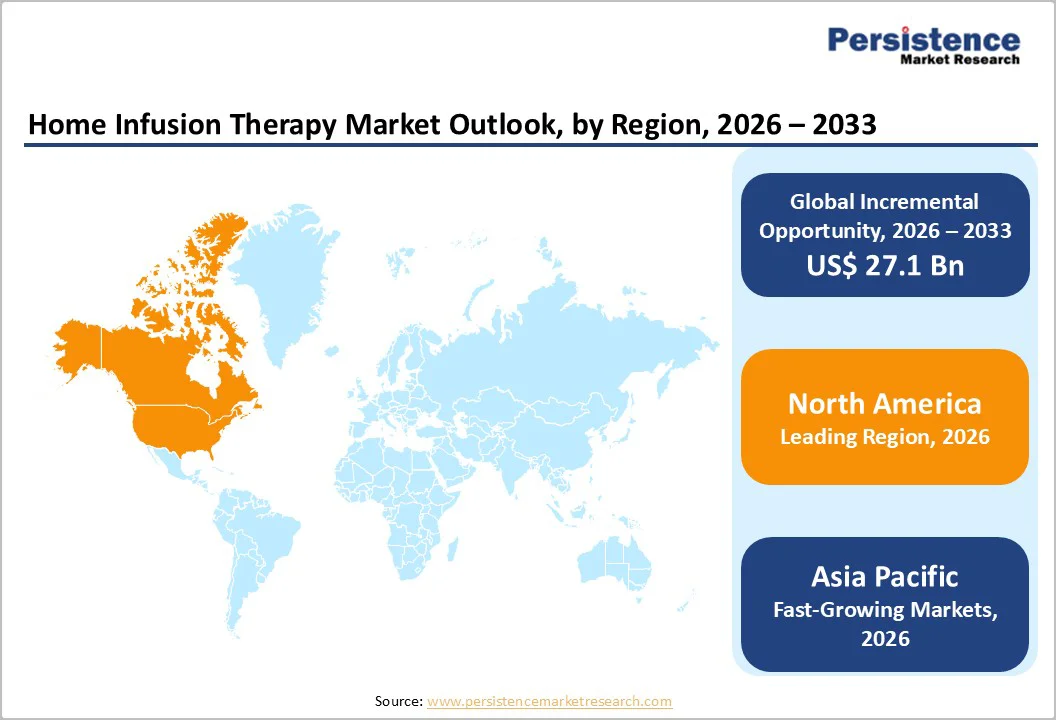
  • Leading Region: North America dominates the global market with 42.2%, driven by strong home-care adoption, advanced infusion technologies, and extensive payer support improving access to home-based therapies.
  • Fastest-Growing Region: Asia Pacific market is expected to grow rapidly with a CAGR of 10.5% in forecast period, fueled by rising chronic illnesses, rapid digital-health adoption, infusion-device launches, and expanding home-care infrastructure across major economies.
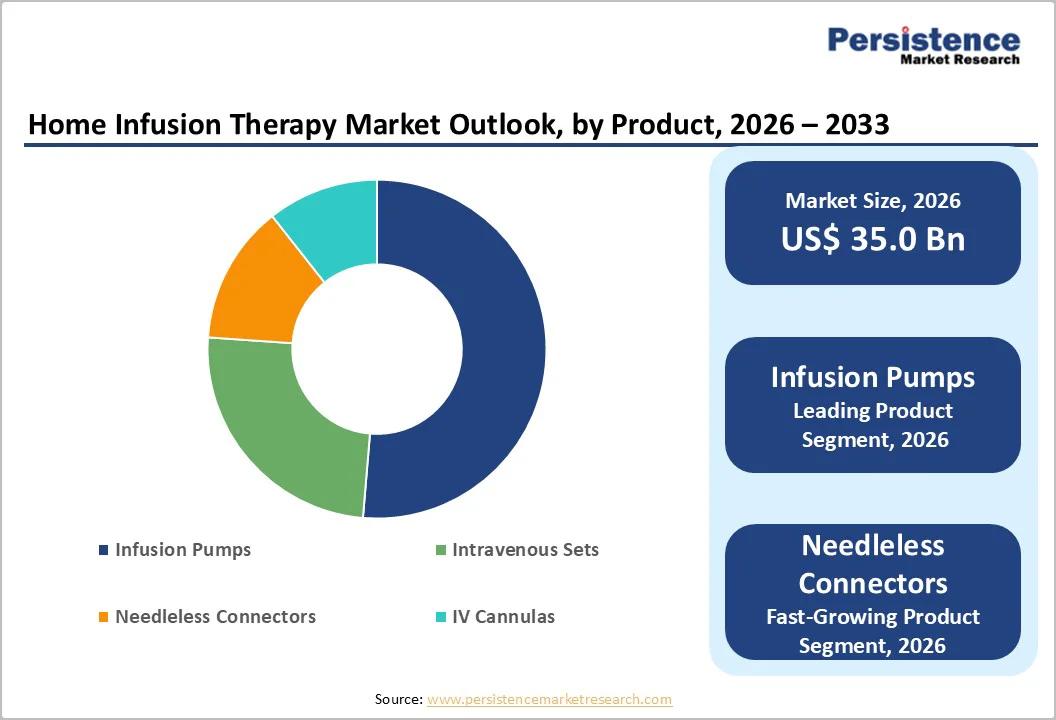
  • Leading Product: Infusion Pumps lead with 58.4% share, supported by high accuracy, safer drug delivery, smart connectivity, and increasing replacement demand for advanced pump platforms.
  • Leading Application: Anti-infectives/Antibiotics to remain dominant, driven by increasing outpatient infection management, need for long-term IV therapy, and strong shift from hospital to home-based antimicrobial care.
  • Leading Sales Channel: Institutional Sales lead with 68.8% share, due to strong procurement by hospitals, infusion centers, and home-care agencies that rely on bulk purchasing and standardized clinical protocols.
  • Collaboration among hospitals, home-care agencies, and infusion pharmacies creates streamlined IV-therapy pathways, reducing hospital load and improving therapy continuity.
  • Virtual monitoring, digital adherence tools, and remote nurse supervision improve safety and outcomes, accelerating acceptance of at-home infusion across multiple conditions.
Key Insights Details
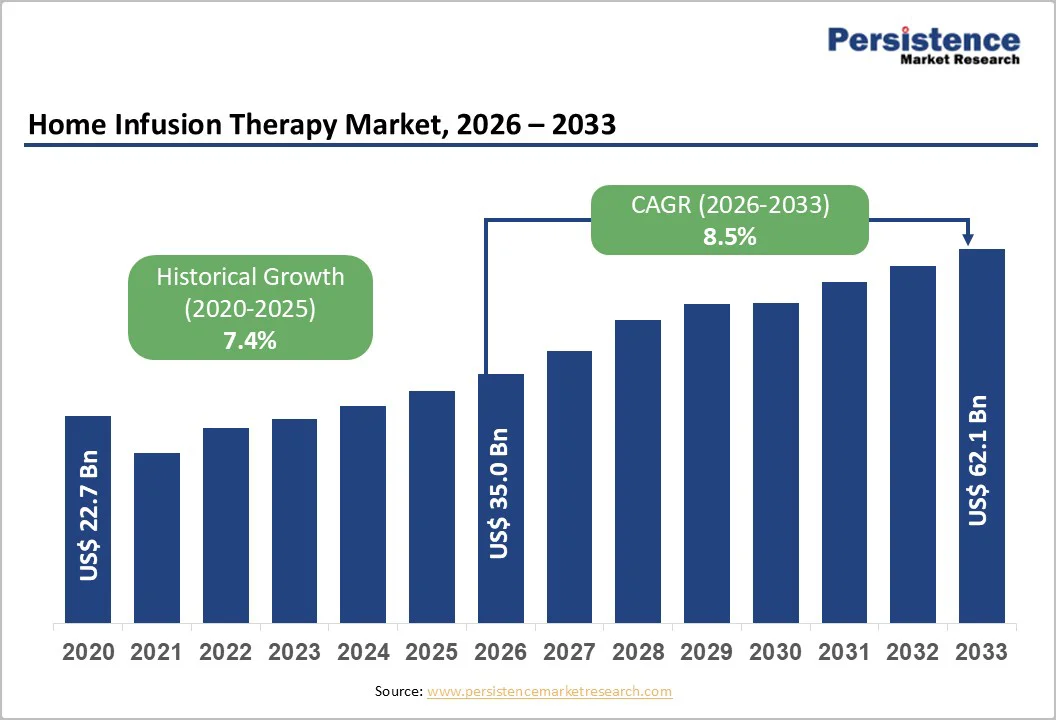
Global Home Infusion Therapy Market Size (2026E) US$ 35.0 Billion
Market Value Forecast (2033F) US$ 62.1 Billion
Projected Growth (CAGR 2026 to 2033) 8.5%
Historical Market Growth (CAGR 2020 to 2025) 7.4%

home-infusion-therapy-market-2026–2033

Market Dynamics

Driver - Rise in Clinical Needs, Home-Based Care Preference, and Advanced Infusion Technologies

The global home infusion therapy market is expanding as patients increasingly shift from conventional in-facility treatments to specialized home-based infusion services that better accommodate complex clinical needs.

Home infusion pharmacies have safely delivered IV medications for over several decades, demonstrating strong clinical outcomes for elderly, rural, disabled, and transport-challenged populations. This well-established care model aligns with rising demand for cost-effective alternatives, supported by the National Infusion Association’s findings that home infusion is significantly less expensive than hospitalization.

Market growth is further driven by the increasing prevalence of cancer, diabetes, immune disorders, cardiovascular diseases, and other chronic conditions requiring long-term infusion support. The widening application of advanced infusion devices in home settings, coupled with technological innovations-including telehealth integration and remote monitoring-enhances safety, adherence, and care continuity.

Additionally, the rising burden of hospital-acquired infections (HAIs) is accelerating the shift toward home-based therapies as a safer care environment. However, risks related to medication administration, device malfunction, user error, and complex reimbursement structures continue to challenge broader adoption.

Restraints - Workforce Shortages, Clinical Risks, High Patient Burden in Rural Regions, and Complex Reimbursement Limitations

The growth of the global home infusion therapy market is constrained by significant operational, clinical, and economic barriers that disproportionately affect underserved regions. One major challenge is the persistent shortage of trained nurses, pharmacists, and infusion-certified clinicians-particularly in rural settings-where specialized personnel are essential for safe drug preparation, aseptic handling, and real-time monitoring of infusion reactions. This workforce gap severely limits the availability and scalability of home infusion services.

Patients living in remote areas also face substantial financial and logistical burdens when accessing specialty infusion centers, including long travel distances, unreliable transportation, high fuel or vehicle-maintenance costs, hotel stays for multi-day treatments, and weather-related disruption, all of which reduce continuity of care.

Clinical risks further impede market adoption. Improper administration techniques, catheter-related complications, and device misuse remain concerns, especially in homes lacking adequate caregiver support. Additionally, variability in device reliability and the need for routine maintenance create safety and usability challenges.

Furthermore, reimbursement remains a major systemic restraint, as fragmented payer policies, limited coverage for certain infusion drugs and supplies, and administrative complexity often shift costs to patients. Together, these factors create significant barriers to equitable access and slow broader market expansion.

Opportunity - Rapid Adoption of Smart Infusion Technologies, AI Automation, EMR Connectivity, and Personalized Care Models

The global home infusion therapy market is poised for significant opportunity as advanced digital, connected, and AI-enabled technologies reshape how infusions are delivered outside traditional clinical settings.

Smart infusion pumps, remote monitoring platforms, and connectivity-driven systems are expanding the feasibility and safety of home-based care. In February 2023, Mindray’s BeneFusion i and u Series introduced high-precision delivery with drug libraries, BolusGUARD safety features, and centralized M-IoT device management-illustrating how intelligent hardware can reduce dosing errors and increase clinician oversight from a distance.

Similarly, in April 2024, Mackenzie Health deployed BD Alaris EMR Interoperability technology, enabling two-way communication between IV pumps and the EMR, automating pump programming, and reducing keystrokes by 86%, a breakthrough that can be adapted to home settings for safer, error-free infusions.

Expanding AI adoption presents another major opportunity: in March 2025, Uptiv Health partnered with Lamar Health to automate referral intake and prior authorization, significantly shortening time-to-treatment-an advantage directly relevant to infusion-dependent chronic disease patients.

Growing use of intravenous immunoglobulin (IVIG) for autoimmune and immunodeficiency disorders, along with personalized treatment plans supported by telehealth, allows home infusion providers to deliver tailored, patient-centric care models. Collectively, these innovations open strong growth pathways by improving safety, efficiency, access, and overall patient experience.

Category-wise Analysis

By Product Insights

Infusion pumps are expected to capture a 58.4% share of the global home infusion therapy market by 2026, reflecting their critical role in ensuring accurate, controlled, and safe drug delivery in home settings. Their ability to manage complex therapies, automate dosing, and minimize administration errors makes them indispensable for chronic and acute conditions treated at home.

Rising adoption of connected and smart pumps, including remote monitoring and drug library integration, further strengthens their dominance. The shift toward advanced digital home-care solutions continues to position infusion pumps as the core technology within home infusion therapy.

By Application Insights

Anti-infectives/antibiotics are projected to hold nearly 32.7% of the global home infusion therapy market in 2026, driven by the rising prevalence of chronic, post-surgical, and hospital-acquired infections requiring prolonged treatment. Home infusion provides a safer, more convenient alternative for patients needing daily or continuous antimicrobial therapy, reducing hospital stays and lowering overall treatment costs.

The growing shift toward outpatient parenteral antimicrobial therapy (OPAT) further supports category leadership. Increased physician confidence in home-based antibiotic delivery and expanding protocols for remote infection management reinforce the continued dominance of this application segment.

By Sales Channel Insights

Institutional sales are projected to account for nearly 68.8% of the global home infusion therapy market in 2026, reflecting the strong influence hospitals and care centres hold in therapy initiation, equipment procurement, and clinical decision-making. Healthcare institutions purchase pumps, consumables, and infusion sets in bulk, ensuring standardization, quality control, and compliance with safety guidelines.

Their role in prescribing home-based treatments, managing chronic-disease pathways, and coordinating with home-health agencies further strengthens this channel’s dominance. As hospitals increasingly shift suitable cases to home settings, institutional-driven demand continues to steer the market.
home-infusion-therapy-market-outlook-by-product-2026–2033.webp

Regional Insights

North America Home Infusion Therapy Market Trends

North America is projected to capture 42.2% of the global home infusion therapy market by 2026, supported by strong clinical demand, advanced infrastructure, and rapid digital transformation in infusion care. The region’s growing geriatric population and high prevalence of cancer, AIDS, diabetes, and chronic immune disorders continue to elevate the need for long-term infusion support.

Technology-enabled care models are accelerating this shift: in August 2023, WeInfuse and NeuroNet Pro partnered to streamline scheduling, documentation, and revenue-cycle workflows for neurology infusion practices, improving operational efficiency across centers.

Strategic collaborations further strengthen home-based delivery-most notably, in January 2024, Paragon Healthcare designated BrightStar Care as its premier home infusion partner, expanding access to nurse-led, patient-centric infusions, including in-home administration of Rebyota.

Innovation in infusion hardware also played a key role; in April 2024, Baxter’s Novum IQ Large Volume Pump received FDA 510(k) clearance, enhancing safety through unified interfaces and connected digital features.

Policy momentum is equally supportive: in March 2025, the reintroduction of the Preserving Patient Access to Home Infusion Act aimed to protect Medicare beneficiaries’ access to home IV therapy.

Additionally, collaborative safety initiatives-such as B. Braun joining the National Infusion Collaborative in June 2025-are strengthening national benchmarking, education, and medication stewardship. These combined forces are driving sustained market growth across North America.

Europe Home Infusion Therapy Market Trends

Europe is projected to account for 31.4% of the global home infusion therapy market by 2026, supported by strong patient preference for non-hospital procedures and a rapidly expanding geriatric population requiring frequent, long-term infusion support.

The region’s long-standing emphasis on community-based and decentralized care models continues to accelerate the adoption of home infusion services, especially for chronic conditions where continuous drug delivery improves outcomes.

Technological advancements further reinforce demand: in May 2025, Penlon introduced its new infusion system range-including the HP TCi Syringe Pump with intuitive 3.0″ touchscreen interfaces and advanced TCi models such as Eleveld-offering higher accuracy, simplified workflows, and reliable anesthesia and medication delivery across varied clinical settings.

These next-generation pumps, alongside systems such as SYS-56 and SYS-70 designed for consistent infusion control and broad rate variability, are enabling safer transitions from hospitals to home care environments.

Additionally, Europe’s strong regulatory focus on patient safety, digital health integration, and remote monitoring creates favorable conditions for home infusion expansion. As healthcare systems continue prioritizing cost-effective, high-quality care, the combination of aging demographics, rising chronic disease burden, and advanced infusion technologies is driving sustained market growth across the region.

Asia Pacific Home Infusion Therapy Market Trends

Home infusion therapy industry in Asia Pacific is rapidly expanding, projected to achieve a positive CAGR over the forecast period, driven by rising chronic disease prevalence, growing preference for home-based care, and increasing adoption of smart infusion technologies. As hospitals face capacity constraints and patients seek convenient care models, demand for safer, more accurate infusion delivery solutions has increased across the region.

This shift is also pushing providers toward digitally enabled infusion systems that can improve remote monitoring and reduce clinical errors. Terumo’s August 2025 launch of the Terufusion™ Advanced Infusion Systems directly supports this trend-offering connected syringe and volumetric pumps that enhance dosing precision, safety, and workflow efficiency, making home-based therapy easier to manage.

In another instance, strengthening of clinical standards and infusion-safety training is improving the confidence of healthcare providers in administering home infusions. This is reinforced by BD’s collaboration with the Infusion Nurses Society India to launch INSPIRE, a national program focused on elevating IV-line safety practices and nursing competencies-critical enablers for expansion of home infusion services.

On a broader scale, the rise of local medical-device manufacturing hubs also fuels growth: the Yamuna Expressway Industrial Development Authority (YEIDA) is developing a Japanese medical-device cluster near Noida Airport, in collaboration with Japanese firms (October 2025). This regional manufacturing aims to reduce equipment costs, making home-based infusion more accessible and sustainable across Asia Pacific markets.
home-infusion-therapy-market-outlook-by-region-2026-2033

Competitive Landscape

The competitive landscape of the home infusion therapy market is shaped by global med-tech leaders expanding advanced infusion devices, regional players strengthening distribution networks, and growing partnerships between device manufacturers and home-health agencies. Companies increasingly focus on smart pumps, safety-enhancing software, and remote monitoring capabilities, intensifying innovation-driven competition across mature and emerging markets.

Key Industry Developments:

  • In April 2025, McKesson launched “Specialty and Infusion for Health Systems,” a tailored suite to help hospitals establish, grow, and optimize their specialty pharmacy and infusion services. The program ranges from fully managed models to advisory services, aiming to improve patient outcomes, satisfaction, and retention within the health system’s own infrastructure.
  • In April 2025, ICU Medical received FDA 510(k) clearance for its Plum Solo single-channel and updated Plum Duo dual-channel precision IV pumps - along with LifeShield safety software - launching a new category of precision infusion devices. These pumps deliver ±3% accuracy, resist variability from bag placement or hospital conditions, and integrate with EHR via LifeShield for safer, more predictable infusions.

Companies Covered in Home Infusion Therapy Market

  • B. Braun Melsungen AG
  • Fresenius Kabi AG
  • ICU Medical, Inc.
  • Baxter
  • Terumo Corporation
  • Medtronic
  • BD
  • Convatec Group PLC
  • Nipro
  • Shenzhen Mindray Bio-Medical Electronics Co., Ltd.
  • Polymed
  • BIO-MED
  • CUBIT MEDISURGE LLP
  • ANGIPLAST PRIVATE LIMITED
  • Vygon
  • Diposafe.com
  • InfuSystem
  • EMED Technologies Corporation
  • Progressive Medical, Inc.
  • Cencora, Inc.
  • CANÈ SpA
  • RAUMEDIC AG
  • Micrel Medical Devices SA
Frequently Asked Questions

The global home infusion therapy market is projected to be valued at US$ 35.0 billion in 2026.

Growing preference for home-based care, rising chronic disease burden, and advancements in smart infusion technologies drives market growth.

The global market is poised to witness a CAGR of 8.5% between 2026 and 2033.

Expanding digital health integration, remote monitoring, and partnerships enabling wider home-care delivery present major growth opportunities.

Major players in the global home infusion therapy market include are B. Braun Melsungen AG, Fresenius Kabi AG, ICU Medical, Inc., Baxter, Terumo Corporation, Medtronic, BD, and others.

Home Infusion Therapy Market Report Scope
Report Attribute Details
Historical Data/Actuals 2020 - 2025
Forecast Period 2026 - 2033
Market Analysis Value: US$ Mn
Geographical Coverage
  • North America
  • Europe
  • East Asia
  • South Asia & Oceania
  • Latin America
  • Middle East and Africa
Segmental Coverage
  • Product
  • Application
  • Sales Channel
  • Region
Competitive Analysis
  • B. Braun Melsungen AG
  • Fresenius Kabi AG
  • ICU Medical, Inc.
  • Baxter
  • Terumo Corporation
  • Medtronic
  • BD
  • Convatec Group PLC
  • Nipro
  • Shenzhen Mindray Bio-Medical Electronics Co., Ltd.
  • Polymed
  • BIO-MED
  • CUBIT MEDISURGE LLP
  • ANGIPLAST PRIVATE LIMITED
  • Vygon
  • Diposafe.com
  • InfuSystem
  • EMED Technologies Corporation
  • Progressive Medical, Inc.
  • Cencora, Inc.
  • CANÈ SpA
  • RAUMEDIC AG
  • Micrel Medical Devices SA
Report Highlights
  • Market Forecast and Trends
  • Competitive Intelligence & Share Analysis
  • Growth Factors and Challenges
  • Strategic Growth Initiatives
  • Pricing Analysis
  • Future Opportunities and Revenue Pockets
  • Market Analysis Tools
Market Segmentation

By Product

  • Infusion Pumps
  • Intravenous Sets
  • Needleless Connectors
  • IV Cannulas

By Application

  • Anti-infectives/Antibiotics
  • Enteral Nutrition
  • Specialty Pharmaceuticals
  • Total Parenteral Nutrition (TPN)
  • Pain Management
  • Chemotherapy
  • Hydration Therapy
  • Others

By Sales Channel

  • Institutional Sales
  • Retail Sales

By Region

  • North America
  • Europe
  • East Asia
  • South Asia & Oceania
  • Latin America
  • Middle East and Africa

Related Reports

  1. Executive Summary
    1. Global Home Infusion Therapy Market Snapshot, 2026 and 2033
    2. Market Opportunity Assessment, 2026 - 2033, US$ Mn
    3. Key Market Trends
    4. Future Market Projections
    5. Premium Market Insights
    6. Industry Developments and Key Market Events
    7. PMR Analysis and Recommendations
  2. Market Overview
    1. Market Scope and Definition
    2. Market Dynamics
      1. Drivers
      2. Restraints
      3. Opportunity
      4. Key Trends
    3. Macro-Economic Factors
      1. Global Sectorial Outlook
      2. Global GDP Growth Outlook
    4. COVID-19 Impact Analysis
    5. Forecast Factors - Relevance and Impact
  3. Value Added Insights
    1. Product Adoption Analysis
    2. Regulatory Landscape
    3. Value Chain Analysis
    4. Key Deals and Mergers
    5. PESTLE Analysis
    6. Porter’s Five Force Analysis
  4. Price Analysis, 2025A
    1. Key Highlights
    2. Key Factors Impacting Product Prices
    3. Pricing Analysis, By Product
    4. Regional Prices and Product Preferences
  5. Global Home Infusion Therapy Market Outlook:
    1. Key Highlights
      1. Market Volume (Units) Projections
      2. Market Size (US$ Mn) and Y-o-Y Growth
      3. Absolute $ Opportunity
    2. Market Size (US$ Mn) Analysis and Forecast
      1. Historical Market Size (US$ Mn) Analysis, 2020-2025
      2. Market Size (US$ Mn) Analysis and Forecast, 2026-2033
    3. Global Home Infusion Therapy Market Outlook: Product
      1. Introduction / Key Findings
      2. Historical Market Size (US$ Mn) and Volume (Units) Analysis, By Product, 2020-2025
      3. Market Size (US$ Mn) and Volume (Units) Analysis and Forecast, By Product, 2026-2033
        1. Infusion Pumps
        2. Intravenous Sets
        3. Needleless Connectors
        4. IV Cannulas
      4. Market Attractiveness Analysis: Product
    4. Global Home Infusion Therapy Market Outlook: Application
      1. Introduction / Key Findings
      2. Historical Market Size (US$ Mn) Analysis, By Application, 2020-2025
      3. Market Size (US$ Mn) Analysis and Forecast, By Application, 2026-2033
        1. Anti-infectives/Antibiotics
        2. Enteral Nutrition
        3. Specialty Pharmaceuticals
        4. Total Parenteral Nutrition (TPN)
        5. Pain Management
        6. Chemotherapy
        7. Hydration Therapy
        8. Others
      4. Market Attractiveness Analysis: Application
    5. Global Home Infusion Therapy Market Outlook: Sales Channel
      1. Introduction / Key Findings
      2. Historical Market Size (US$ Mn) Analysis, By Sales Channel, 2020-2025
      3. Market Size (US$ Mn) Analysis and Forecast, By Sales Channel, 2026-2033
        1. Institutional Sales
        2. Retail Sales
      4. Market Attractiveness Analysis: Sales Channel
  6. Global Home Infusion Therapy Market Outlook: Region
    1. Key Highlights
    2. Historical Market Size (US$ Mn) Analysis, By Region, 2020-2025
    3. Market Size (US$ Mn) Analysis and Forecast, By Region, 2026-2033
      1. North America
      2. Europe
      3. East Asia
      4. South Asia and Oceania
      5. Latin America
      6. Middle East & Africa
    4. Market Attractiveness Analysis: Region
  7. North America Home Infusion Therapy Market Outlook:
    1. Key Highlights
    2. Historical Market Size (US$ Mn) Analysis, By Market, 2020-2025
      1. By Country
      2. By Product
      3. By Application
      4. By Sales Channel
    3. Market Size (US$ Mn) Analysis and Forecast, By Country, 2026-2033
      1. U.S.
      2. Canada
    4. Market Size (US$ Mn) and Volume (Units) Analysis and Forecast, By Product, 2026-2033
      1. Infusion Pumps
      2. Intravenous Sets
      3. Needleless Connectors
      4. IV Cannulas
    5. Market Size (US$ Mn) Analysis and Forecast, By Application, 2026-2033
      1. Anti-infectives/Antibiotics
      2. Enteral Nutrition
      3. Specialty Pharmaceuticals
      4. Total Parenteral Nutrition (TPN)
      5. Pain Management
      6. Chemotherapy
      7. Hydration Therapy
      8. Others
    6. Market Size (US$ Mn) Analysis and Forecast, By Sales Channel, 2026-2033
      1. Institutional Sales
      2. Retail Sales
    7. Market Attractiveness Analysis
  8. Europe Home Infusion Therapy Market Outlook:
    1. Key Highlights
    2. Historical Market Size (US$ Mn) Analysis, By Market, 2020-2025
      1. By Country
      2. By Product
      3. By Application
      4. By Sales Channel
    3. Market Size (US$ Mn) Analysis and Forecast, By Country, 2026-2033
      1. Germany
      2. France
      3. U.K.
      4. Italy
      5. Spain
      6. Russia
      7. Türkiye
      8. Rest of Europe
    4. Market Size (US$ Mn) and Volume (Units) Analysis and Forecast, By Product, 2026-2033
      1. Infusion Pumps
      2. Intravenous Sets
      3. Needleless Connectors
      4. IV Cannulas
    5. Market Size (US$ Mn) Analysis and Forecast, By Application, 2026-2033
      1. Anti-infectives/Antibiotics
      2. Enteral Nutrition
      3. Specialty Pharmaceuticals
      4. Total Parenteral Nutrition (TPN)
      5. Pain Management
      6. Chemotherapy
      7. Hydration Therapy
      8. Others
    6. Market Size (US$ Mn) Analysis and Forecast, By Sales Channel, 2026-2033
      1. Institutional Sales
      2. Retail Sales
    7. Market Attractiveness Analysis
  9. East Asia Home Infusion Therapy Market Outlook:
    1. Key Highlights
    2. Historical Market Size (US$ Mn) Analysis, By Market, 2020-2025
      1. By Country
      2. By Product
      3. By Application
      4. By Sales Channel
    3. Market Size (US$ Mn) Analysis and Forecast, By Country, 2026-2033
      1. China
      2. Japan
      3. South Korea
    4. Market Size (US$ Mn) and Volume (Units) Analysis and Forecast, By Product, 2026-2033
      1. Infusion Pumps
      2. Intravenous Sets
      3. Needleless Connectors
      4. IV Cannulas
    5. Market Size (US$ Mn) Analysis and Forecast, By Application, 2026-2033
      1. Anti-infectives/Antibiotics
      2. Enteral Nutrition
      3. Specialty Pharmaceuticals
      4. Total Parenteral Nutrition (TPN)
      5. Pain Management
      6. Chemotherapy
      7. Hydration Therapy
      8. Others
    6. Market Size (US$ Mn) Analysis and Forecast, By Sales Channel, 2026-2033
      1. Institutional Sales
      2. Retail Sales
    7. Market Attractiveness Analysis
  10. South Asia & Oceania Home Infusion Therapy Market Outlook:
    1. Key Highlights
    2. Historical Market Size (US$ Mn) Analysis, By Market, 2020-2025
      1. By Country
      2. By Product
      3. By Application
      4. By Sales Channel
    3. Market Size (US$ Mn) Analysis and Forecast, By Country, 2026-2033
      1. India
      2. Southeast Asia
      3. ANZ
      4. Rest of South Asia & Oceania
    4. Market Size (US$ Mn) and Volume (Units) Analysis and Forecast, By Product, 2026-2033
      1. Infusion Pumps
      2. Intravenous Sets
      3. Needleless Connectors
      4. IV Cannulas
    5. Market Size (US$ Mn) Analysis and Forecast, By Application, 2026-2033
      1. Anti-infectives/Antibiotics
      2. Enteral Nutrition
      3. Specialty Pharmaceuticals
      4. Total Parenteral Nutrition (TPN)
      5. Pain Management
      6. Chemotherapy
      7. Hydration Therapy
      8. Others
    6. Market Size (US$ Mn) Analysis and Forecast, By Sales Channel, 2026-2033
      1. Institutional Sales
      2. Retail Sales
    7. Market Attractiveness Analysis
  11. Latin America Home Infusion Therapy Market Outlook:
    1. Key Highlights
    2. Historical Market Size (US$ Mn) Analysis, By Market, 2020-2025
      1. By Country
      2. By Product
      3. By Application
      4. By Sales Channel
    3. Market Size (US$ Mn) Analysis and Forecast, By Country, 2026-2033
      1. Brazil
      2. Mexico
      3. Rest of Latin America
    4. Market Size (US$ Mn) and Volume (Units) Analysis and Forecast, By Product, 2026-2033
      1. Infusion Pumps
      2. Intravenous Sets
      3. Needleless Connectors
      4. IV Cannulas
    5. Market Size (US$ Mn) Analysis and Forecast, By Application, 2026-2033
      1. Anti-infectives/Antibiotics
      2. Enteral Nutrition
      3. Specialty Pharmaceuticals
      4. Total Parenteral Nutrition (TPN)
      5. Pain Management
      6. Chemotherapy
      7. Hydration Therapy
      8. Others
    6. Market Size (US$ Mn) Analysis and Forecast, By Sales Channel, 2026-2033
      1. Institutional Sales
      2. Retail Sales
    7. Market Attractiveness Analysis
  12. Middle East & Africa Home Infusion Therapy Market Outlook:
    1. Key Highlights
    2. Historical Market Size (US$ Mn) Analysis, By Market, 2020-2025
      1. By Country
      2. By Product
      3. By Application
      4. By Sales Channel
    3. Market Size (US$ Mn) Analysis and Forecast, By Country, 2026-2033
      1. GCC Countries
      2. Egypt
      3. South Africa
      4. Northern Africa
      5. Rest of Middle East & Africa
    4. Market Size (US$ Mn) and Volume (Units) Analysis and Forecast, By Product, 2026-2033
      1. Infusion Pumps
      2. Intravenous Sets
      3. Needleless Connectors
      4. IV Cannulas
    5. Market Size (US$ Mn) Analysis and Forecast, By Application, 2026-2033
      1. Anti-infectives/Antibiotics
      2. Enteral Nutrition
      3. Specialty Pharmaceuticals
      4. Total Parenteral Nutrition (TPN)
      5. Pain Management
      6. Chemotherapy
      7. Hydration Therapy
      8. Others
    6. Market Size (US$ Mn) Analysis and Forecast, By Sales Channel, 2026-2033
      1. Institutional Sales
      2. Retail Sales
    7. Market Attractiveness Analysis
  13. Competition Landscape
    1. Market Share Analysis, 2025
    2. Market Structure
      1. Competition Intensity Mapping By Market
      2. Competition Dashboard
    3. Company Profiles (Details - Overview, Financials, Strategy, Recent Developments)
      1. B. Braun Melsungen AG
        1. Overview
        2. Segments and Products
        3. Key Financials
        4. Market Developments
        5. Market Strategy
      2. Fresenius Kabi AG
      3. ICU Medical, Inc.
      4. Baxter
      5. Terumo Corporation
      6. Medtronic
      7. BD
      8. Convatec Group PLC
      9. Nipro
      10. Shenzhen Mindray Bio-Medical Electronics Co., Ltd.
      11. Polymed
      12. BIO-MED
      13. CUBIT MEDISURGE LLP
      14. ANGIPLAST PRIVATE LIMITED
      15. Vygon
      16. Diposafe.com
      17. InfuSystem
      18. EMED Technologies Corporation
      19. Progressive Medical, Inc.
      20. Cencora, Inc.
      21. CANÈ SpA
      22. RAUMEDIC AG
      23. Micrel Medical Devices SA
  14. Appendix
    1. Research Methodology
    2. Research Assumptions
    3. Acronyms and Abbreviations

Research Methodology Framework for Market Research Excellence

At Persistence Market Research, we implement a comprehensive, validated, and multi-dimensional approachto market analysis that delivers actionable insights across complex market landscapes. Our methodology combines the analytical rigor of leading consulting firms with innovative research techniques, ensuring robust market assessments that guide strategic decision-making with confidence.

Core Research Philosophy

Our methodology is built on four foundational pillars:

Research Philosophy Image

At Persistence Market Research, our methodology is designed to transcend conventional market studies by combining analytical rigor, multi-source validation, and future-focused insights.

We integrate advanced research frameworks, robust data collection strategies, cutting-edge analytics, and innovative technologies to deliver a 360-degree view of complex markets.

We integrate advanced research frameworks, robust data collection strategies, cutting-edge analytics, and innovative technologies to deliver a 360-degree view of complex markets.

Each stage spanning from strategic scoping and hypothesis-building to competitive intelligence, quality validation, and actionable recommendations is engineered to provide clients with unmatched clarity, precision, and confidence in decision-making.

By embedding innovation and technology at the core, our approach ensures that insights are not only comprehensive but also predictive, empowering businesses to seize opportunities, mitigate risks, and achieve sustainable growth

Research Philosophy Image

Capturing Key Information and Events

During this phase, key research objectives focus on essential information and data points for assessing the market, including:

Research Philosophy Image

TAM-SAM-SOM Framework Implementation

We employ both top-down and bottom-up approaches to ensure accurate market sizing.

Top-Down Market SizingBottom-Up Market Sizing
Universe Definition: Total global/regional market identificationUnit Economics: Average transaction values, purchase frequencies, customer lifecycle
Segmentation Filters: Geographic, demographic, and behavioral constraintsCustomer Segmentation: Detailed buyer persona development and sizing
Market Share Analysis: Competitive landscape assessment and share allocationPenetration Analysis: Market penetration rates by segment and geography
Growth Rate Application: Historical trends and forward-looking growth assumptionsScaling Methodology: Extrapolation techniques with confidence intervals

Validation & Cross-Verification

  • Triangulation: Comparing top-down and bottom-up results for consistency
  • Sensitivity Analysis: Testing key assumptions and parameter variations
  • Peer Benchmarking: Comparison with analogous markets and industry benchmarks
  • Expert Review: External validation through industry specialist consultation

Research Philosophy Image

Forecasting & Projection Modeling

Our proprietary forecasting models incorporate multiple variables and scenarios.

Forecasting Components

  • Historical Trend Analysis: 10-year historical growth patterns and cyclical variations
  • Driver-Based Modeling: Economic indicators, demographic shifts, technology adoption
  • Scenario Planning: Base case, optimistic, and conservative projections
  • Monte Carlo Simulations: Probability-weighted outcomes and risk assessments

Model Validation

  • Back-Testing: Historical accuracy assessment over 3–5-year periods
  • Cross-Validation: Multiple modeling approaches for result comparison
  • External Benchmarking: Comparison with established market forecasts
  • Continuous Calibration: Quarterly model updates based on new data

Comprehensive Data Collection Strategy

Our secondary research phase establishes a robust knowledge base utilizing diverse, credible sources.

Secondary Data Sourcess

  • Industry Publications & Reports
  • Government & Regulatory Data
  • Financial Intelligence (filings & reports)
  • Academic Research & Digital Intelligence

Quality Assurance Protocol

  • Source credibility assessment and publication date validation
  • Data consistency checks across multiple sources
  • Bias identification and neutralization techniques
  • Information gap tracking for primary research prioritization

Research Philosophy Image

Primary Research Excellence

Our primary research methodology employs best-in-class techniques to capture unique market insights.

Quantitative Research Methods

  • Large-Scale Surveys: Statistically representative samples with 95% confidence intervals
  • Survey Methodology: Multi-channel deployment (online, telephone, in-person)
  • Question Architecture and Response Optimization

Qualitative Research Methods

  • Executive Interviews
  • Focus Groups
  • Expert Consultations

Quality Assurance & Validation Framework

Multi-Stage Validation Process

  • Source Verification and Consistency Testing
  • Outlier Detection and Bias Assessment
  • Peer Review Process and External Validation
  • Sensitivity Analysis and Confidence Intervals

Research Philosophy Image

Methodology Validation & Credibility

Our research methodology has been extensively validated through:

  • Academic Partnerships: Collaborations with top-tier business schools and research institutions
  • Client Success Stories: Documented case studies demonstrating research impact and ROI
  • Continuous Benchmarking: Performance comparison with leading global research firms

This comprehensive methodology framework positions Persistence Market Research at the forefront of market intelligence, combining the analytical sophistication of top-tier consulting firms with innovative research techniques. Our approach ensures that every market assessment delivers precise, actionable, and strategically valuable insights that drive business success in competitive market environments.

Ready to unlock your market potential? Contact our research experts to discuss how our validated methodology can transform your strategic decision-making with data-driven market intelligence.

Copyright © 2026 Persistence Market Research. All Rights Reserved

Connect With Us -